Tag: Yuri Gagarin

Moments in history

You can blame John Zande for today’s post!

John left an intriguing question as a comment to yesterday’s post.

Oh to have a time machine!

Tell me, Paul, if you did have one, a time machine, what three moments in history would you visit?

It really grabbed Jean and me and we spent quite a few minutes during the day kicking around ideas. At first, it was easy just to do a web search on epic moments in history and see if any of them related to me. But that seemed too easy. So I have picked three that do connect with my life.

  1. May 8th, 1945

I was born on November 8th, 1944. I was born in North London (Acton). It was the period of the Second World War when the V2 rockets were landing all around. Take, for example, the incident just eleven days after my birth, when on the 19th November, 1944 a V2 landed in Wandsworth causing much damage and many fatalities around Hazlehurst Road and Garratt Lane. Spend a moment reviewing who died, and their ages, in that bombing.

img7

So I was precisely six months old when the armistice was announced on May 8th, 1945. As Wikipedia describes it:

Victory in Europe Day, generally known as V-E Day, VE Day or simply V Day was the public holiday celebrated on 8 May 1945 (7 May in Commonwealth realms) to mark the formal acceptance by the Allies of World War II of Nazi Germany’s unconditional surrender of its armed forces.[1] It thus marked the end of World War II in Europe.

On 30 April, Adolf Hitler, the Nazi leader, committed suicide during the Battle of Berlin. Germany’s surrender, therefore, was authorised by his successor, Reichspräsident Karl Dönitz. The administration headed by Dönitz was known as the Flensburg Government. The act of military surrender was signed on 7 May in Reims, France and on 8 May in Berlin, Germany.

I would have loved to witness, by being in the crowd that day, the King and Queen acknowledging the end of the war in Europe.

tdih-may08-HD_still_624x352
May 8, 1945: King George VI and Queen Elizabeth, with Princess Elizabeth and Princess Margaret, are joined by Prime Minister Winston Churchill.

Nevertheless, that day in May, 1945 has been memorable for me for all of my life. Because my mother, who is still alive today, aged 96, (still living in London but spending Christmas with my sister in Cape Town, by the way), held me in her arms and said aloud: “My dear Paul, you are going to live!” I grew up with those loving words deeply rooted within me.

2. Stonehenge – too many moons ago!

For reasons that I am not entirely clear about, I have always been fascinated by the stars. From the point of view of using the stars to help me navigate strange parts of the world, both on land and at sea. I grew up regarding Polaris, the North Star, almost as a companion. Later in my life when sailing solo from Gibraltar to The Azores, a distance of just under 1,150 nautical miles, on a Tradewind 33 yacht, despite having an early GPS unit it was backup to me using a sextant to maintain (some) awareness of my position.

Tradewind 33 - Songbird of Kent. My home for five years.
Tradewind 33 – Songbird of Kent. My home for five years.

(Reminds me of a anecdote when I was crewing on a privately-owned East Coast Essex fishing smack. I was asking Bill, the owner, why he always laid his thumb on the position on the chart in response to the question, “Where are we?” Bill’s reply: “That’s as accurate as anyone can be!”)

In 1969, when I was driving across the desert plains of Australia, often with inhabited places more than a 150-mile radius away (the Simpson Desert especially coming to mind) the Southern Cross seemed to keep me grounded and remind me that I was making progress.

Back when I was living just outside Totnes in South Devon, my frequent drives up to London along the A303 took me past Stonehenge in Wiltshire.

The December solstice happens at the same instant for all of us, everywhere on Earth. This year the solstice occurs on Tuesday December 22nd at 04:49 GMT (Universal time) with the sun rising over Stonehenge in Wiltshire at 08:04.

THE EARLIEST MONUMENT

It is possible that features such as the Heel Stone and the low mound known as the North Barrow were early components of Stonehenge,[3] but the earliest known major event was the construction of a circular ditch with an inner and outer bank, built about 3000 BC. This enclosed an area about 100 metres in diameter, and had two entrances. It was an early form of henge monument.[4]

Within the bank and ditch were possibly some timber structures and set just inside the bank were 56 pits, known as the Aubrey Holes. There has been much debate about what stood in these holes: the consensus for many years has been that they held upright timber posts, but recently the idea has re-emerged that some of them may have held stones.[5]

Within and around the Aubrey Holes, and also in the ditch, people buried cremations. About 64 cremations have been found, and perhaps as many as 150 individuals were originally buried at Stonehenge, making it the largest late Neolithic cemetery in the British Isles.[6]

Taken from here.

I would have loved being present at Stonehenge when the builders finally were able to stand back and see the Sun “speak” to them at the first Solstice after that point in its construction.

It seems to me to be a most magical place yet Stonehenge offers a mathematical and rhythmic foundation to that magic.

3. First man into space – 12th April, 1961

It was, of course, Yuri Gagarin, who made the first complete orbit of Planet Earth in space.

Yuri Alekseyevich Gagarin

I would have given anything to be in his seat (and suit). For to look out and see our planet as a small object in an enormous outer space would have to change one’s perception of almost everything; for evermore.

exo-planet-earth-from-space

My wish for the New Year is that we recognise our place both in history and on our Planet Earth, and care for it as the sole, beautiful home that we have.

Now that global recognition would be a moment in history that I would want to experience before I die!

(Thanks John for inspiring me to jot down these thoughts!)
 

Man’s first orbit around Planet Earth.

A wonderful tribute to Yuri Gagarin and all his team.

When I recently wrote of it being 41 years since Swigert on board Apollo 13 transmitted “Okay, Houston, we’ve had a problem here.” I also included a closing reflection as follows,

Finally, this Post is published, not only on the 41st anniversary of that memorable Apollo Flight but the day after the 50th anniversary of Yuri Gagarin’s first flight of a human into space, the 12th April, 1961.

Coincidentally, our favourite documentary film website, Top Documentary Films, featured on April 14th the new film First Orbit.  We watched the film that night.  It was a most unusual format for a film, yet a most haunting experience.  Watching the credits, it then became clear that the film was a co-operative venture made especially for the 50th anniversary of that remarkable, historic flight.

Of course, had I previously been aware of the venture and this remarkable film then it would have been promoted on Learning from Dogs in good time before the anniversary date.  However, better late than never!

Indeed, there is a dedicated website in recognition of this First Orbit.  Here’s the background to the film,

April 12th 1961 – Yuri Gagarin is about to see what no other person has seen in the history of humanity – the Earth from space. In the next 108 minutes he’ll see more than most people do in a lifetime. What sights awaited the first cosmonaut silently gliding over the world below? What was it like to view the oceans and continents sailing by from such a height?

In a unique collaboration with the European Space Agency, and the Expedition 26/27 crew of theInternational Space Station, we have created a new film of what Gagarin first witnessed fifty years ago.

By matching the orbital path of the Space Station, as closely as possible, to that of Gagarin’s Vostok 1spaceship and filming the same vistas of the Earth through the new giant cupola window, astronaut Paolo Nespoli, and documentary film maker Christopher Riley, have captured a new digital high definition view of the Earth below, half a century after Gagarin first witnessed it.

Weaving these new views together with historic, recordings of Gagarin from the time, (subtitled in Englsih) and an original score by composer Philip Sheppard, we have created a spellbinding film to share with people around the world on this historic anniversary.

The music in the film is most beautiful, quite moving.  Here’s the background to the music from the First Orbit website,

The music in our film is all composed by Philip Sheppard and comes from his album Cloud Songs.

First Orbit’s producer Christopher Riley first worked with Philip in 2006 on the Sundance Award winning feature documentary film ‘In the Shadow of the Moon‘ and since then Philip had been working on a new suite of music inspired by spaceflight.

“We’d been working with some of these tracks on another project” says Chris, “and we suddenly realised how perfectly they could compliment ‘First Orbit’ as well. We contacted Philip to ask his permission to use them, only to find that his entire Cloud Song album was already in orbit onboard the International Space Station!”

“NASA astronaut Cady Coleman, had them on her iPod” says Philip. “Her husband Josh Simpson is a friend of mine and they’d listened to a lot of my music together before she left, so I made up a playlist for her!”

Quite by coincidence Cady had been listening to the music in ‘First Orbit’ at one end of the Space Station whilst European Space Agency astronaut Paolo Nespoli was shooting for the film at the other end, without either of them knowing the connection!

Back on Earth Chris and the film’s editor Stephen Slater took Philip’s tracks from Cloud Song and weaved them together with Paolo’s new views of the Earth to create the different moods of the film; from the first views of snowy Siberia to the darkness of night over the Pacific Ocean and the homecoming over Africa, as Gagarin starts to re-enter the atmosphere.

The result is a mesmerising combination of imagary and music which we hope convey the spectrum of emotions which no doubt went through Yuri’s mind as he gazed down upon the Earth.

Finally, here’s the film. It’s an hour and thirty-nine minutes and, as I said, an unconventional film experience.  But if any part of you either remembers the event or wonders what it was like, those 50 years ago, then find somewhere out of reach of interruptions and watch the film.

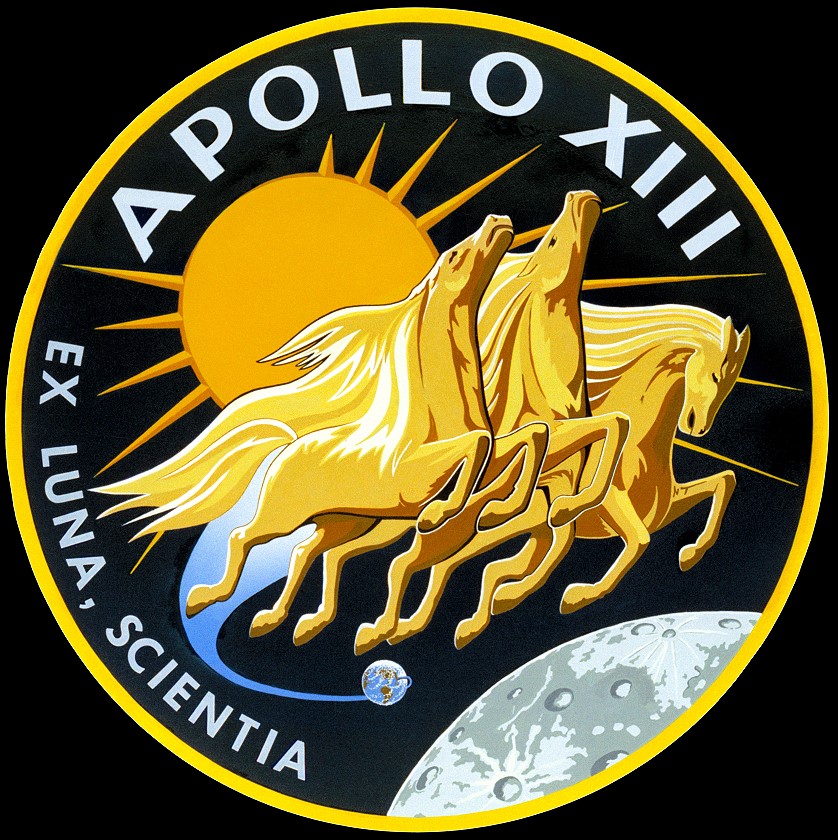
Apollo 13 – who remembers?

55:55:20 – Swigert: “Okay, Houston, we’ve had a problem here.”

Apollo 13

Probably one of the most famous phrases from the whole Apollo program, these immortal words were uttered shortly before 10.10 PM EST on April 13th, 1970.

There is so much material around that it would be pointless covering too much ground in this Post.  So why the Post today?

Because today, too, is the 13th April.  So on this day, 41 years ago, the world came together held its collective breath and prayed for a successful outcome to this scary disaster.

There are some wonderful archives around from NASA.  Here’s one that covers the chronology of events of that famous accident.

The following includes events from 2.5 minutes before the accident to about 5 minutes after. Times given are in Ground Elapsed Time (G.E.T.), that is, the time elapsed since liftoff of Apollo 13 on April 11, 1970, at 2:13 PM Eastern Standard Time (EST). 55:52:00 G.E.T. is equal to 10:05 PM EST on April 13, 1970.

Also, those who want more information, may wish to go here, here and here

And 41 years ago, this coming Sunday, i.e. April 17th 1970, with the whole world praying for their safe return, Apollo 13 splashed down near Samoa.

Four hours before landing, the crew shed the service module; Mission Control had insisted on retaining it until then because everyone feared what the cold of space might do to the unsheltered CM heat shield. Photos of the Service Module showed one whole panel missing, and wreckage hanging out, it was a sorry mess as it drifted away. Three hours later the crew left the Lunar Module Aquarius and then splashed down gently in the Pacific Ocean near Samoa. From here.

In a very real sense, Apollo 13, like a number of the other historic Apollo flights, is a wonderful reminder of something that this Planet needs right now.  A coming together of all the peoples of this beautiful planet, a unity of mankind, to remind us in these fragile and difficult times of the saying, ‘United we stand, divided we fall.’

Finally, this Post is published, not only on the 41st anniversary of that memorable Apollo Flight but the day after the 50th anniversary of Yuri Gagarin’s first flight of a human into space, the 12th April, 1961.