“Until one has loved an animal, a part of one’s soul remains unawakened.” Anatole France
This gorgeous video has been doing the rounds and came to me thanks to Suzann.
Enjoy!
Very Talented Russian Bear and His Awesome Friend
This unbelievably talented and cute Russian bear can roll over, play the trumpet, sit on a lawn chair, play the trumpet, you name it. Leave it to a random Russian guy to train such an awesome bear.
Sometimes applause seems just … oh, I don’t know …. just so inadequate!
If you, like me, was entranced by the music then thanks to a comment left by one Eugene Karry on the YouTube website, all is explained.
Eugene explained that the instrument is called the Armenian Duduk and that Armenian Duduk music is recognized by UNESCO.
It was only a quick search on the UNESCO website to find this:
The duduk, the Armenian oboe, is a single or double reed wind instrument made of the wood of the apricot tree and has a warm, soft, slightly nasal timbre. The duduk or tsiranapokh, which is also called the apricot tree pipe, belongs to the organological category of areophones, which also includes the balaban played in Azerbaijan and Iran, the duduki common in Georgia and the ney in Turkey. The soft wood is the ideal material to carve the body of the instrument. The reed, called ghamish or yegheg, is a local plant growing alongside the Arax river.
The roots of Armenian duduk music go back to the times of the Armenian king Tigran the Great (95-55 BC). The instrument is depicted in numerous Armenian manuscripts of the Middle Ages. The duduk accompanies popular Armenian traditional songs and dances of the various regions and is played at social events, such as weddings and funerals. Although there are also famous duduk soloists, among them Gevorg Dabaghyan and Vache Sharafyan, the duduk is mainly played by two musicians. One player creates the musical environment for the lead melody by playing a continual drone that is held by circular breathing, while the other player develops complex melodies and improvisations.
There are four major types of duduk, varying in length from 28 to 40 cm and in sound, ranging from one to fourth or third octaves. Therefore, the sound of the duduk can express various moods depending on the content of the piece and the playing context. The 40-cm long duduk, for example, is regarded as most appropriate for love songs, whereas the smaller one usually accompanies dances. Today, duduk craftsmen continue to create and experiment with different forms of duduks. Many Armenians consider the duduk as the instrument that most eloquently expresses warmth, joy and the history of their community.
Over recent decades, the popularity of Armenian duduk music has decreased, in particular in the rural areas where it originated. At present, most duduk players are concentrated in Yerevan. The duduk instrument is played less and less in social festivities, but more often by professionals as a staged performance. Duduk music risks losing its viability and traditional character and becoming just another facet of “high culture”.
Back to Eugene, who went on to write that Jivan Gasparyan and Gevorg Dabaghyan are famous duduk players among many others. The musical pieces played on the duduk are mostly armenian folk or spiritual tunes; many of them sad songs. Nowadays the duduk is very often played during funerals among Armenians but there are some dance songs as well.
Finally, Eugene offered these further hauntingly beautiful pieces of music.
In my last essay on love that was published on Friday, I quoted Carl Sagan, “For small creatures such as we the vastness is bearable only through love.Carl Sagan” My conclusion about love was:
… that if we don’t love our planet with all the ardour and passion of a teenager’s first romance, all those other loves in our lives will ultimately become irrelevant.
In researching for that essay, I visited Carl Sagan’s website, a rich source of information and materials for anyone interested in the far Cosmos right down to our future on this planet.
Just a little over three months ago, I wrote a post with the title of Carl Sagan with the objective of promoting his beautiful and awe-inspiring film called Pale Blue Dot.
Back to the present. On YouTube I came across this short video that seems so relevant to our need to love the only planet we have.
Carl Sagan explains the immensity of space and time in this clip is from Carl Sagan’s Cosmos episode 8, “Journeys in Space and Time.
“Those worlds in space are as countless as all the grains of sand on all the beaches of the Earth. Each of those worlds is as real as ours. In every one of them, there’s a succession of incidence, events, occurrences which influence its future. Countless worlds, numberless moments, an immensity of space and time.
And our small planet, at this moment, here we face a critical branch-point in the history. What we do with our world, right now, will propagate down through the centuries and powerfully affect the destiny of our descendants. It is well within our power to destroy our civilization, and perhaps our species as well. If we capitulate to superstition, or greed, or stupidity we can plunge our world into a darkness deeper than time between the collapse of classical civilization and the Italian Renaissance.
But we are also capable of using our compassion and our intelligence, our technology and our wealth, to make an abundant and meaningful life for every inhabitant of this planet. To enhance enormously our understanding of the Universe, and to carry us to the stars.”
Today, in the USA it is Memorial Day. The day of remembering the men and women who died while serving in the United States Armed Forces. It doesn’t seem out of order to reflect that all those courageous men and women died with a belief in the future. That belief in the future surely must embrace “… using our compassion and our intelligence, our technology and our wealth, to make an abundant and meaningful life for every inhabitant of this planet.“
“Prediction is very difficult, especially if it’s about the future.“ Niels Bohr
I love this saying from Mr. Bohr and often repeat it, albeit at times with my own twist to it. I was reminded of this uncertainty of the future from some comments to a recent post over at Lack of Environment. The particular post was called Can technology save us? and was a reflection of Martin Lack, the blog’s author, watching a recent BBC Horizon special called Tomorrow’s World. (There’s the YouTube of the broadcast at the end of this post.) Martin opened his post by saying:
I happened to stumble across a BBC TV Horizon special, entitled ‘Tomorrow’s World’ last Thursday. It begins with a fascinating review of humankind’s history of – and propensity for – invention. It also explains some truly fascinating – and inspiring – developments in the spheres of space exploration, nanotechnology, biotechnology, and power generation.
In the introduction, the programme presenter and narrator Liz Bronnin explains how, after 100’s of thousands of years of technological stagnation, the fast-moving world of technological innovation is very definitely a modern invention.
Then a little later Martin goes on to say:
After about 32 minutes, Bronnin introduces the power of the Internet to promote innovation – crowd-sourcing research funding and the concept of open-source technology – the complete abrogation of intellectual copyright… It is a fundamental challenge to globalised Capitalism; but it may well be the solution to many of our problems…
However, to me, the final third of the programme is by far the most fascinating… It looks at the challenges of finding a replacement for fossil fuels. It provides a very clear message that this is a technological challenge driven by the reality of physics – not by ideology.
But, overall, Martin lets us know his perspective with his final paragraphs:
Re-engineering nature for our benefit will, without doubt, be very very useful. However, I still think the optimism of the comment at the very end of the programme “…I never worry about the future of the human race, because I think we are totally capable of solving problems…” is very unwise. This is because anthropogenic climate disruption is a problem that is getting harder to solve the longer we fail to address it effectively.
Bronnin concludes by saying that, “it is an exciting time to be alive…” However, I remain very nervous. This is because, as Professor Peter Styles of Keele University – a strong supporter of the hydraulic fracturing industry – recently acknowledged, it will be impossible for carbon capture and storage to remove enough CO2 from the atmosphere to prevent very significant changes to our climate. This is because of the collective hypnosis that deludes most people into seeing perpetual economic growth as the solution to all our problems.
In short, I am certain that technology alone cannot save us. In order to avoid the ecological catastrophe that all but the most ideologically-prejudiced and wilfully-blind can see developing all around us… we need to modify our behaviour: This primarily means that we need to acknowledge the injustice of a “use it up and wear it out” mentality and, as individuals, all learn to use an awful lot less energy.
Climate change “sceptics” have picked a fight with history and science – primarily with the concept of Entropy – and they will lose. The only question that remains is this: Are we going to let them put us all in (what xraymike79 recently called) ‘the dustbin of failed evolutionary experiments’.
Now Jean and I also watched the Horizon special and, to be perfectly frank, found it both uplifting and inspiring. It seemed a great counter to the overwhelming volume of commentary these days along the lines of ‘The end of the world is nigh!‘ some of that coming from yours truly! That’s not to make light of the huge hurdles ahead.
But it was a couple of comments on Martin’s post from Patrice Ayme that got me thinking. Here’s the exchange that went between Patrice and Martin following on from a comment from Thomas Foster.
Considering that it is technology which has enabled us to “conquer” nature and thus the degradation of the environment which is a consequence of that it seems most unlikely to this writer that the cause will also bring about a cure. Thomas Foster
—–
The genus Homo has been technological for 5 million years. Give or take two million. Homo is the cure for life. Patrice Ayme
—-
If we Homo Sapiens have been technological for 5 million years, we have spent most of that time being very unsuccessful; and have spent the rest being far too successful. Is there no scope for just living in harmony with our environment (as opposed to being at war with it)? Martin Lack
—-
Hominids have been masters of the environment for at least three million years. By a million years ago, only Homo was left (but for places like Flores). Dozens of megafauna species got annihilated. Homo’s technology has extended to the entire Earth for at least a million years. The Earth itself was turned into a tool. A tool we are not at war with, but that we use. Patrice Ayme
—-
A utilitarian attitude to Nature is one that does not recognise its inherent value (i.e. which it would have even if we did not exist). Seeing ourselves as superior to Nature rather than as part of it has resulted in our not living in harmony with it. This is, by definition, equivalent to being at war with Nature. QED. Refer: Nature is not your enemy. Martin Lack
—-
Call it what you want, Martin. Man manipulates nature, and that nature one calls nature has not been “natural” for more than a million years. Except if one views man as part of nature! Patrice Ayme
Patrice is a very clear thinker even if, at times, pretty hard-hitting. But this exchange confirmed in my mind that clearly looking out to the future must always be hard. Most certainly in this period of mankind’s evolution predicting the future is especially difficult. Hence my contribution to Martin’s post:
Jean and I watched the Horizon special a couple of evenings ago. To be honest, I’m not entirely sure what my overall thoughts are in response to your post, Martin. What does come to mind is that old saying, “Never underestimate the power of unintended consequences.”
So it may be that we are at a particular point in time, or more likely an era, where seeing clearly into the future is challenging.
The one aspect of modern life that is a game-changer is what we are doing now. Sharing ideas and thoughts across a far-flung net. Not only as the Horizon programme illustrated but as ordinary people trying to make sense of the world.
These are incredibly uncertain times. Undoubtedly not the first in man’s long history as an historian will explain (cue to Alex!). But to all of us alive today, these are the most uncertain times we have ever experienced!
No wonder so many of us feel lost at times in today’s world.
Here’s that BBC Horizon, courtesy of YouTube.
I will close with this thought from one masterly ‘wordsmith’, William Wordsworth.
“Life is divided into three terms – that which was, which is, and which will be. Let us learn from the past to profit by the present, and from the present, to live better in the future.”
A new animated short film from Lucas Martell, the creator of Pigeon: Impossible.
Back on the 4th December, 2011 I published a post under the title of Pigeon: Impossible. Here’s some of what I wrote:
A truly remarkable example of the level of film animation being produced.
The second item that came to me from Bob D. (yesterday’s is here) has clearly done the rounds; the YouTube video has been watched nearly 7 million times! But if you haven’t seen this short film, just over 6 minutes long, then do watch it. It shows just how close to reality film animation has become! The story behind the film is from here, reproduced below.
Pigeon: Impossible is the tale of Walter, a rookie secret agent faced with a problem seldom covered in basic training: what to do when a curious pigeon gets trapped inside your multi-million dollar, government-issued nuclear briefcase.
The film took nearly 5 years to complete and is the first attempt at animation by writer/director Lucas Martell: “When the project started, it was mostly an excuse to learn 3D animation, but by the end of the project I had spent so much time reworking and polishing the story that I just wanted people to laugh.“
The end-result is a hilarious 6-minute romp through the streets of Washington D.C. as our hero fights to save himself, and the world from the chaos reigned down by a hungry pigeon. Breathtaking visuals and a sweeping soundtrack showcase the work of nearly one-hundred talented artists and musicians, and the film stands as a testament to what can be accomplished by a team of dedicated volunteers working for the love of their craft.
Personally, I think that last sentence is still an understatement. Just watch this – and be amazed.
If you haven’t seen the film then you can watch it here.
Anyway, yesterday Lucas Martell left a comment to that post, as follows:
Lucas Martell
Hi, I’m the creator of Pigeon: Impossible and am so glad you enjoyed the film! We’re trying to finish our next animated short, and would love it if you could check it out and help us spread the word.
Thanks!
It seemed a worthwhile thing to do just that. That next animated short is called The OceanMaker. Enjoy 4 minutes of it:
This is the website associated with the venture that explains more and also gives details of the way you can financially support the project, starting from as little as $10. The website is great fun! (I couldn’t resist republishing the following)
oooOOOooo
About the Film
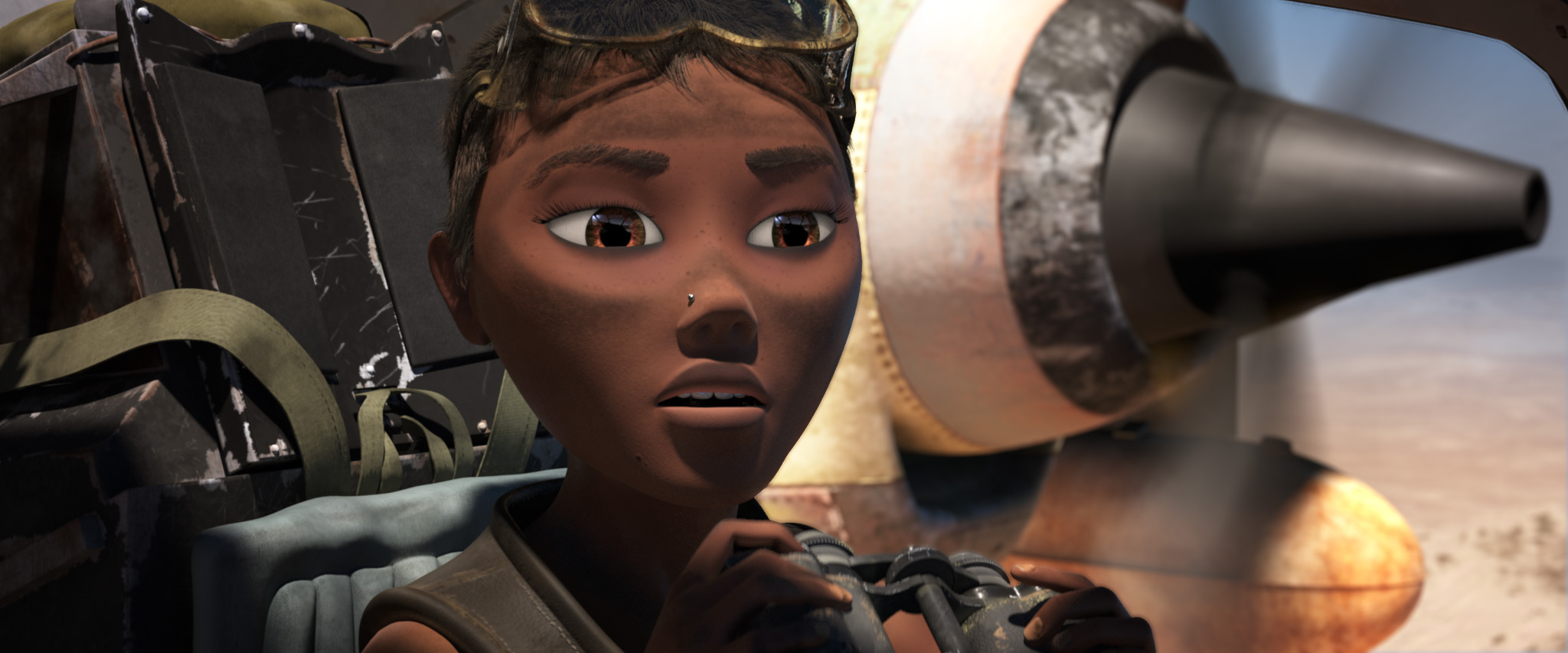
The OceanMaker is a 9-minute animated short film that takes place after Earth’s oceans have disappeared. It tells the tale of one courageous pilot who fights against vicious sky pirates for control of the last remaining source of water: the clouds.
From a visual standpoint, we’re steering away from the air pirates often found in steampunk and going straight-up “Mad Max” in the sky. The film is packed with old, beat-up planes that have been cobbled together from spare parts found in airplane graveyards.
Tonally, The OceanMaker is filled with exciting action, but the ending is emotional and powerful in a way that even feature-length films rarely achieve. The film also contains no dialogue, which means that the visuals and soundtrack need to be top notch in order to tell this story properly.
Finally, this film is unique in that it’s a complete story which stands on its own as a self-contained short film, but it’s also part of a even larger, more epic tale. Contributing to this project means a double dose of good karma, as you’re not only helping us complete the short, you’re getting us one step closer to making the feature! Our sights are set high and it’s going to be an amazing ride. We hope you’ll come along and share the adventure with us!
Goals
$10,000 – We can finish the models! – At the moment we have our hero models finished, but the story requires several other assets in order to set up the world and show how the loss of the oceans has affected life on earth. At $10,000, we’ll be able to bring on two model/texture artists to finish these assets.
$20,000 – We can finish the animation! – Animation is about 70% completed, but the remaining shots are the most challenging ones in the film. We’ll need two animators to bring these awesome shots to life!
$30,000 – We can finish the lighting! – Lighting and rendering are what make things pretty. It’s also a very technically challenging process, with each frame taking about an hour to render. At 24 frames per second, that’s just under 13,000 frames!
$40,000 – We can finish the film! – The last major step is the effects. In a word: clouds. They’re very tough to do right, and they’re pretty important for this whole story to work. Plus, these aren’t just static clouds in the background. We’re flying through them, scooping them up and making them grow!
$50,000 – Post Production! – This first stretch goal would allow us to hire a professional sound designer, as well as doing the final mix, color correction and output in a proper studio. This is crucial in order to submit the film to festivals and put it up on the big screen. If we reach this stretch goal, then all donors will also recieve a PDF copy of the script!
$60,000 – Live orchestra! – With this stretch goal, we could record Chris Reyman’s amazing score with a real live orchestra. This would be HUGE, as the film is extremely reliant on music, and the production value will increase dramatically. All donors at every level would receive a DRM-free copy of the score.
$70,000 – Expanded cast! – One thing that will make the film even better, is a second character. We already have a temporary version of that character in our animatic, but she’s very difficult to create and quite expensive for the few shots she’s in. However, that small addition would take the emotion and complexity of the story to a whole new level.
$80,000 – $100,000 The OceanMaker extended universe – As you can imagine, the OceanMaker is a really BIG story… too big to fit entirely within a short, but we’ve done an excellent job capturing the essence of it in a way that feels complete and stands on its own. However, if we hit $80,000, we can start to explore this broader story. This would be in the form of a graphic novel that delves deeper into the world both before and after the short film. The higher into this range we get, the longer this graphic novel could be and the more of the expanded story we could tell. Donors at every level would get a free digital copy of the graphic novel.
$100,000 and up – Feature!!! – OK, I realize we’re really reaching for the stars here, but you don’t do something like this without being a dreamer. If we somehow manage to reach the 100k mark, we’ll be able to start working on the feature film! It would be based in part on the content from the extended universe. The first step would be a treatment, then a script, then visual development and finally an animatic. Should we be able to complete any of these stages with money raised from this campaign, all donors will receive a digital copy of the completed work. You can take a sneak peek or remain unspoiled, but its the least we can do if your hard-earned dollars end up funding development of the feature.
oooOOOooo
So I hope you can contribute whatever you can afford.
Oh, and I should make it clear that neither Jean nor I have any financial or commercial connection with the project.
With grateful thanks to Capt. Bob who sent this to me.
Have a great Sunday, wherever you are!
A little Irish girl named Becky makes a prank phone call to have her school demolished. Becky made this call a few years ago so I’m sure her technique is even better today. Perhaps if she had offered the Top Boss a few pints in the local pub she would have pulled this off.
Last week I had to travel from Merlin in Southern Oregon up to Portland, a round-trip distance of 480 miles. The vast majority of the journey was along Highway I5, most of which is a 2-lane highway, significantly harder driving than a 3 or more laned highway.
It was the first time I had driven North along I5 since Jean and I moved to Merlin last October. What staggered me were the huge number of trucks on the highway, many of them food trucks from California and beyond. Also noticed at regular intervals were very large industrial buildings that were described as food distribution centres.
Another connection to today’s reflections is that I am about 50 pages into Barbara Kingsolver’s book Animal, Vegetable, Miracle. The book is the account of Barbara’s family spending a year deliberately eating home-grown and local food. The book’s subtitle is ‘A Year of Food Life‘ and, inevitably, the book has a website here.
So the book and the journey to Portland got me thinking about food miles and the huge transport distances of so much of what we eat today.
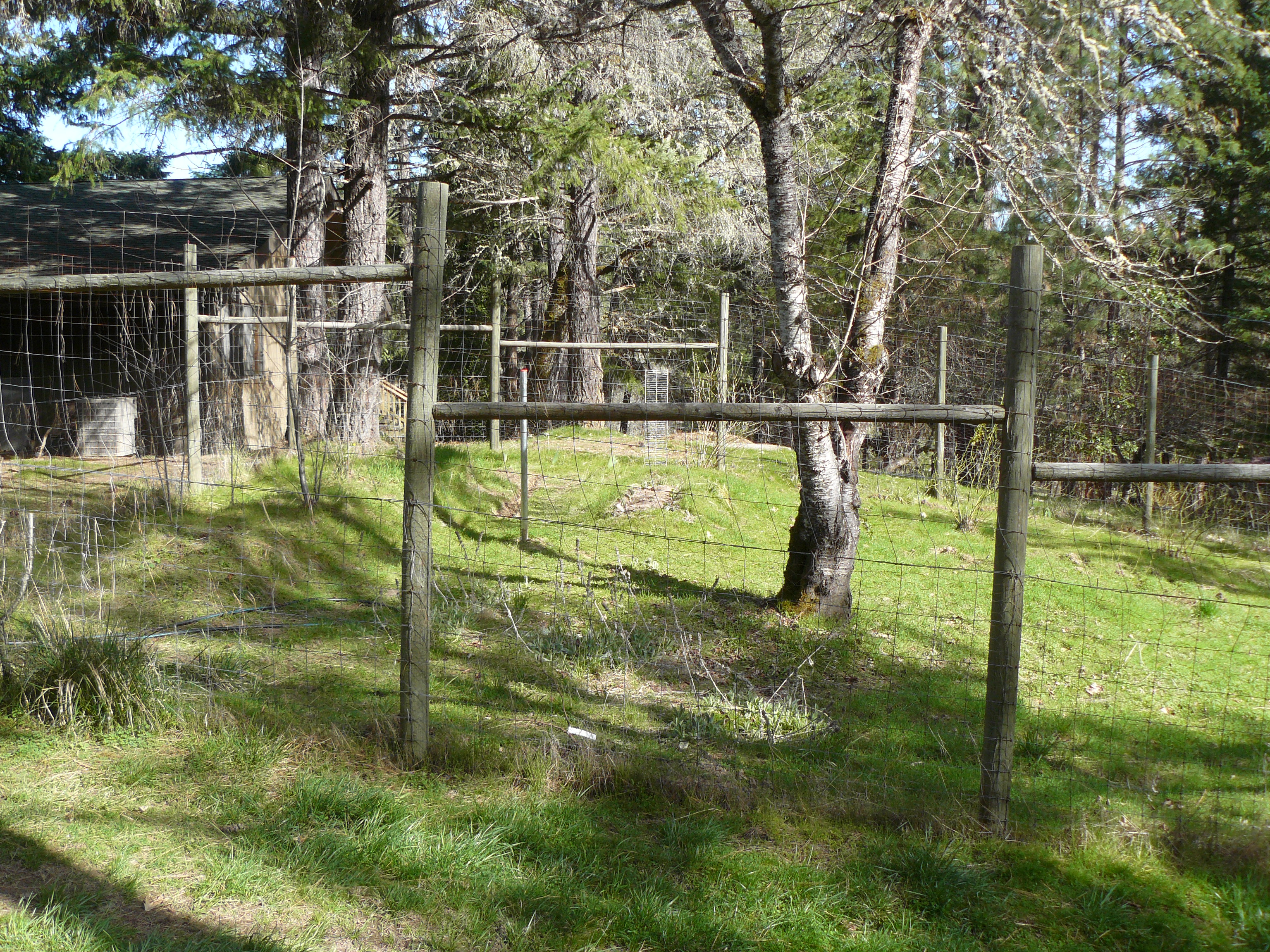
Jean and I were incredibly lucky when we bought this property last year to discover that it had a mature vegetable garden surrounded by a deer-proof fence, as the following photograph partially shows.
So even before considering the food miles we are saving from ‘grow-your-own’, we were enthusiastically planting a whole variety of vegetables. Here’s a rhubarb plant that went in last Saturday.
Anyway, I’m rather meandering along – anyone still awake!
The whole point of this long introduction is to highlight a fabulous film that we have watched over the weekend. Called Edible City: Grow The Revolution we came across it on Top Documentary Films, great source of films by the way if you don’t know it.
Luckily it is on YouTube as well.
Here’s the full film:
It’s an inspiring account of what it means for a community to take control of their food, ergo a strong recommendation to watch it in full.
If you want a taste of the film (pardon the pun!), here are two trailers.
So why don’t you join the millions of people already buying from their local Farmers’ Market. For the USA you can find your nearest market using this website and for the United Kingdom try the Local Foods website.
Not only will it give you access to much healthier food, it is a very practical way of reducing our use of energy.
Settle back for three minutes of very British humour.
The chances are that you may have seen this. According to the YouTube statistics, over 20 million already have.
I’m not sure how many of the double-meanings in this short sketch from Ronnie Corbett work around the world but, don’t worry, settle back and enjoy! Background information from the BBC website is here. And note that Orange is a provider of a mobile phone network in Britain.
How very precious, vulnerable and fragile is this precious place we call home.
Today’s consciousness perambulation is the fault of Mr. P., as I like to call him. I refer to Pendantry as he is on his blog, Wibble.
You see on Sunday he added a comment to my post Just a small, white dot! that included the beautiful and awe-inspiring film made by the late Carl Sagan called Pale Blue Dot.
Like millions of others, I came to admire Carl Sagan through watching the fabulous, the truly fabulous, television series Cosmos: A Personal Voyage.(NB. All the episodes are on YouTube, Episode One is at the end of this Post, Ed.) Here’s how WikiPedia opens their reference to Carl.
Carl Edward Sagan (November 9, 1934 – December 20, 1996) was an American astronomer, astrophysicist, cosmologist, author, science popularizer and science communicator in astronomy and natural sciences. He spent most of his career as a professor of astronomy at Cornell University where he directed the Laboratory for Planetary Studies.
He published more than 600 scientific papers and articles and was author, co-author or editor of more than 20 books. He advocated scientifically skeptical inquiry and the scientific method, pioneered exobiology and promoted the Search for Extra-Terrestrial Intelligence (SETI).
Sagan is known for his popular science books and for the award-winning 1980 television series Cosmos: A Personal Voyage, which he narrated and co-wrote. The book Cosmos was published to accompany the series. Sagan wrote the novel Contact, the basis for a 1997 film of the same name.
He died far too young and was a tragic loss to humanity. The Carl Sagan web portal is here.
That 3:30 minute video Pale Blue Dot has, likewise, been seen by millions. If you or someone you know hasn’t seen it, then you must pause now …
It’s practically impossible to watch that video and not embrace the central message from Mr. Sagan. Here’s the transcript:
Our home from 6 billion kilometres. A very tiny dot against the vastness of space.
From this distant vantage point, the Earth might not seem of any particular interest. But for us, it’s different.
Consider again that dot. That’s here. That’s home. That’s us.
On it everyone you love, everyone you know, everyone you ever heard of, every human being who ever was, lived out their lives.
The aggregate of our joy and suffering, thousands of confident religions, ideologies, and economic doctrines, every hunter and forager, every hero and coward, every creator and destroyer of civilization, every king and peasant, every young couple in love, every mother and father, hopeful child, inventor and explorer, every teacher of morals, every corrupt politician, every “superstar,” every “supreme leader,” every saint and sinner in the history of our species lived there – on a mote of dust suspended in a sunbeam.
The Earth is a very small stage in a vast cosmic arena.
Think of the rivers of blood spilled by all those generals and emperors so that in glory and triumph they could become the momentary masters of a fraction of a dot.
Think of the endless cruelties visited by the inhabitants of one corner of this pixel on the scarcely distinguishable inhabitants of some other corner. How frequent their misunderstandings, how eager they are to kill one another, how fervent their hatreds.
Our posturings, our imagined self-importance, the delusion that we have some privileged position in the universe, are challenged by this point of pale light. Our planet is a lonely speck in the great enveloping cosmic dark. In our obscurity – in all this vastness – there is no hint that help will come from elsewhere to save us from ourselves.
The Earth is the only world known, so far, to harbor life. There is nowhere else, at least in the near future, to which our species could migrate. Visit, yes. Settle, not yet. Like it or not, for the moment, the Earth is where we make our stand.
It has been said that astronomy is a humbling and character-building experience. There is perhaps no better demonstration of the folly of human conceits than this distant image of our tiny world. To me, it underscores our responsibility to deal more kindly with one another and to preserve and cherish the pale blue dot, the only home we’ve ever known.
Tomorrow, I will stay with the theme of our beautiful planet. Hope you can join me.
Now spoil yourself and watch Episode One of Cosmos.
Eugene explained that the instrument is called the Armenian Duduk and that Armenian Duduk music is recognized by UNESCO.
It was only a quick search on the UNESCO website to find this:
Back to Eugene, who went on to write that Jivan Gasparyan and Gevorg Dabaghyan are famous duduk players among many others. The musical pieces played on the duduk are mostly armenian folk or spiritual tunes; many of them sad songs. Nowadays the duduk is very often played during funerals among Armenians but there are some dance songs as well.
Finally, Eugene offered these further hauntingly beautiful pieces of music.
——-
——-
——–
oooOOOooo
Just beautiful.