I’m breaking the pattern of publishing a new post at midnight, Pacific Time, (08:00 UTC) because it seemed like fun to publish Monday’s post at the moment of the Winter Solstice; namely Sunday, December 21 at 23:03 UTC (15:03 PST).
There is no doubt in my mind that everyone is familiar with the Winter Solstice being the moment when the planet has perfect opposites, in terms of light and darkness, as the following image shows so clearly.
Day and night sides of Earth at the instant of the December 2014 solstice (2014 December 21 at 23:03 Universal Time). Note that the north polar region of Earth must endure 24 hours of night, while the south polar region gets to bask in 24 hours of daylight. Image credit: Earth and Moon Viewer
What may not be so well-known is that it occurs within about two-and-a-half hours of the new moon.
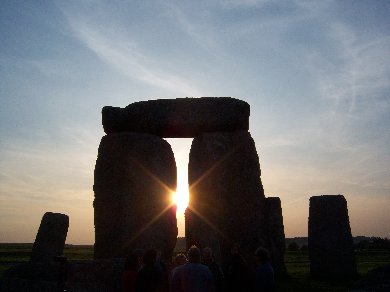
From times immemorial, early peoples on Earth knew much about the sun and the seasons, the length of daylight, and how the direction of the sunrise and sunset all shifted in a regular way throughout the year. As an Englishman, who in past times frequently drove the A303 road between London and Exeter, going past the ancient site of Stonehenge was always wonderful. Many are familiar with the sun rising during the Summer Solstice over the Heel Stone but far fewer realise that Stonehenge also marks the sun’s dawning the morning after the Winter Solstice.
The shortest day is behind us.
The English Heritage website Discover Stonehenge is brim full of facts and information so won’t ‘copy and paste’ from one to the other! Suffice to say that what we see today was completed about 3500 years ago.
However, it seems as though the ancient site is still delivering new surprises. I write this simply because just a few days ago, on the 19th December, 2014, the BBC reported:
Stonehenge dig finds 6,000-year-old encampment
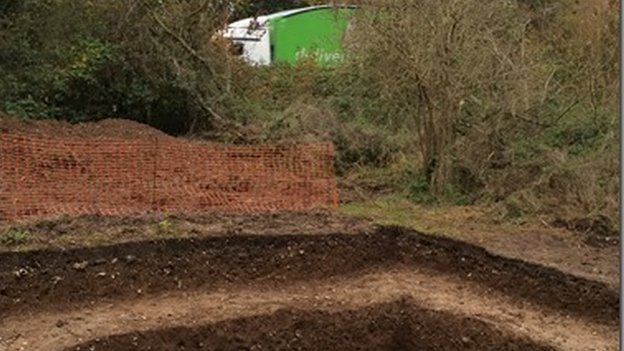
Archaeologists found the encampment during a dig at Blick Mead near Stonehenge
Archaeologists working on a site near Stonehenge say they have found an untouched 6,000-year-old encampment which “could rewrite British history”.
David Jacques, from the University of Buckingham, made the discovery at Blick Mead in October, and said the carbon dating results had just been confirmed.
But he also raised concerns about possible damage to the site over plans to build a road tunnel past Stonehenge.
The Department of Transport said it would “consult before any building”.
The Blick Mead site is about 1.5 miles (2.4km) from Stonehenge and archaeologists said “scientifically tested charcoal” dug up from the site had “revealed that it dated from around 4000 BC”.
The archaeologists found burnt flints, remains of animals and tools
David Jacques said the dig had also found “evidence of feasting” including burnt flints, tools and remains of giant cattle, known as aurochs, which were eaten by early hunter gatherers.
Mr Jacques said: “British pre-history may have to be rewritten. This is the latest dated Mesolithic encampment ever found in the UK.
“Blick Mead site connects the early hunter gatherer groups returning to Britain after the Ice Age to the Stonehenge area, all the way through to the Neolithic in the late 5th Millennium BC.
“But our only chance to find out about the earliest chapter of Britain’s history could be wrecked if the tunnel goes ahead.”
Archaeologists said the latest carbon date suggested it was continuously occupied between 7500-4000 BC
Andy Rhind-Tutt, a former mayor and current chairman of Amesbury Museum, which part-funded the dig, said the discovery could “provide what archaeologists have been searching for centuries – the answer to the story of the pre-history of Stonehenge.”
Earlier this month, the government announced funding for a 1.8-mile (2.9km) tunnel to remove congestion from the main road past Stonehenge.
A Department for Transport spokesman said: “As with any road scheme, we will consult with interested parties before any building begins on the A303.
“English Heritage and National Trust are supportive of our plans, and we will ensure sites of cultural or historical significance are safeguarded as we progress with the upgrade.”
The A303 past Stonehenge is a highly congested route.
So as the planet and the sun continue their dance to a rhythm, ancient beyond comprehension, let us reflect on the scale of the universe and our fortune to be alive this Winter Solstice, 2014.



 Learning from Dogs