I’m indebted to George Monbiot for this article, and ‘Tolly’ as a nickname for Iain Tolhurst.
Many articles from people that I follow online pass through my ‘inbox’.
But there was something special about a recent article by George Monbiot that was published in the Guardian on December 5th and I have great pleasure in republishing it here, with George’s permission.
ooOOoo
Shaking It Up
Posted on 7th December 2025
A eureka moment in the pub could help transform our understanding of the ground beneath our feet.
By George Monbiot, published in the Guardian 5th December 2025
It felt like walking up a mountain during a temperature inversion. You struggle through fog so dense you can scarcely see where you’re going. Suddenly, you break through the top of the cloud, and the world is laid out before you. It was that rare and remarkable thing: a eureka moment. For the past three years, I’d been struggling with a big and frustrating problem. In researching my book Regenesis, I’d been working closely with Iain Tolhurst (Tolly), a pioneering farmer who had pulled off something extraordinary. Almost everywhere, high-yield farming means major environmental harm, due to the amount of fertiliser, pesticides and (sometimes) irrigation water and deep ploughing required. Most farms with apparently small environmental impacts produce low yields. This, in reality, means high impacts, as more land is needed to produce a given amount of food. But Tolly has found the holy grail of agriculture: high and rising yields with minimal environmental harm.
He uses no fertiliser, no animal manure and no pesticides. His techniques, the result of decades of experiment and observation, appear to enrich the crucial relationships between crops and microbes in the soil, through which soil nutrients must pass. It seems that Tolly has, in effect, “trained” his soil bacteria to release nutrients when his crops require them (a process called mineralisation), and lock them up when his crops aren’t growing (immobilisation), ensuring they don’t leach from the soil.
So why the frustration? Well, Tolly has inspired many other growers to attempt the same techniques. Some have succeeded, with excellent results. Others have not. And no one can work out why. It’s likely to have something to do with soil properties. But what?
Not for the first time, I had stumbled into a knowledge gap so wide that humanity could fall through it. Soil is a fantastically complex biological structure, like a coral reef, built and sustained by the creatures that inhabit it. It supplies 99% of our calories. Yet we know less about it than any other identified ecosystem. It’s almost a black box.
Many brilliant scientists have devoted their lives to its study. But there are major barriers. Most soil properties cannot be seen without digging, and if you dig a hole, you damage the structures you’re trying to investigate. As a result, studying even basic properties is cumbersome, time-consuming and either very expensive or simply impossible at scale. To measure the volume of soil in a field, for example, you need to take hundreds of core samples. But as soil depths can vary greatly from one metre to the next, your figure relies on extrapolation. This makes it very hard to tell whether you’re losing soil or gaining it. Measuring bulk density (the amount of soil in a given volume, which shows how compacted it might be), or connected porosity (the tiny catacombs created by lifeforms, a crucial measure of soil health), or soil carbon – at scale – is even harder.
So farmers must guess. Partly because they cannot see exactly what the soil needs, many of their inputs – fertilisers, irrigation, deep ploughing – are wasted. Roughly two-thirds of the nitrogen fertiliser they apply, and between 50% and 80% of their phosphorus, is lost. These lost minerals cause algal blooms in rivers, dead zones at sea, costs for water users and global heating. Huge amounts of irrigation water are also wasted. Farmers sometimes “subsoil” their fields – ploughing that is deep and damaging – because they suspect compaction. The suspicion is often wrong.
Our lack of knowledge also inhibits the development of a new agriculture, which may, as Tolly has done, allow farmers to replace chemical augmentation with biological enhancement.
So when I came to write the book, I made a statement so vague that it reads like an admission of defeat: we needed to spend heavily on “an advanced science of the soil”, and use it to deliver a “greener revolution”. While we know almost nothing about the surface of our own planet, billions are spent on the Mars Rover programme, exploring the barren regolith there. What we needed, I argued, is an Earth Rover programme, mapping the world’s agricultural soils at much finer resolution.
I might as well have written “something must be done!” The necessary technologies simply did not exist. I sank into a stygian gloom.
At the same time, Tarje Nissen-Meyer, then a professor of geophysics at the University of Oxford, was grappling with a different challenge. Seismology is the study of waves passing through a solid medium. Thanks to billions from the oil and gas industry, it has become highly sophisticated. Tarje wanted to use this powerful tool for the opposite purpose – ecological improvement. Already, with colleagues, he had deployed seismology to study elephant behaviour in Kenya. Not only was it highly effective, but his team also discovered it could identify animal species walking through the savannah by their signature footfall.
By luck we were both attached, in different ways, to Wolfson College, Oxford, where we met in February 2022. I saw immediately that he was a thoughtful man – a visionary. I suggested a pint in The Magdalen Arms.
I explained my problem, and we talked about the limits of existing technologies. Was seismology being used to study soil, I asked. He’d never heard of it. “I guess it’s not a suitable technology then?” No, he told me, “soil should be a good medium for seismology. In fact, we need to filter out the soil noise when we look at the rocks.” “So if it’s noise, it could be signal?” “Definitely.”
We stared at each other. Time seemed to stall. Could this really be true?
Over the next three days, Tarje conducted a literature search. Nothing came up. I wrote to Prof Simon Jeffery, an eminent soil scientist at Harper Adams University, whose advice I’d found invaluable when researching the book. I set up a Zoom call. He would surely explain that we were barking up the wrong tree.
Simon is usually a reserved man. But when he had finished questioning Tarje, he became quite animated. “All my life I’ve wanted to ‘see’ into the soil,” he said. “Maybe now we can.” I was introduced to a brilliant operations specialist, Katie Bradford, who helped us build an organisation. We set up a non-profit called the Earth Rover Program, to develop what we call “soilsmology”; to build open-source hardware and software cheap enough to be of use to farmers everywhere; and to create, with farmers, a global, self-improving database. This, we hope, might one day incorporate every soil ecosystem: a kind of Human Genome Project for the soil.
We later found that some scientists had in fact sought to apply seismology to soil, but it had not been developed into a programme, partly because the approaches used were not easily scalable.
My role was mostly fixer, finding money and other help. We received $4m (£3m) in start-up money from the Bezos Earth Fund. This may cause some discomfort, but our experience has been entirely positive: the fund has helped us do exactly what we want. We also got a lot of pro-bono help from the law firm Hogan Lovells.
Tarje, now at the University of Exeter, and Simon began assembling their teams. They would need to develop an ultra-high-frequency variant of seismology. A big obstacle was cost. In 2022, suitable sensors cost $10,000 (£7,500) apiece. They managed to repurpose other kit: Tarje found that a geophone developed by a Slovakian experimental music outfitworked just as well, and cost only $100. Now one of our scientists, Jiayao Meng, is developing a sensor for about $10. In time, we should be able to use the accelerometers in mobile phones, reducing the cost to zero. As for generating seismic waves, we get all the signal we need by hitting a small metal plate with a welder’s hammer.
On its first deployment, our team measured the volume of a peat bog that had been studied by scientists for 50 years. After 45 minutes in the field, they produced a preliminary estimate suggesting that previous measurements were out by 20%. Instead of extrapolating the peat depth from point samples, they could see the wavy line where the peat met the subsoil. The implications for estimating carbon stocks are enormous.
We’ve also been able to measure bulk density at a very fine scale; to track soil moisture (as part of a wider team); to start building the AI and machine learning tools we need; and to see the varying impacts of different agricultural crops and treatments. Next we’ll work on measuring connected porosity, soil texture and soil carbon; scaling up to the hectare level and beyond; and on testing the use of phones as seismometers. We now have further funding, from the UBS Optimus Foundation, hubs on three continents and a big international team.
Eventually, we hope, any farmer anywhere, rich or poor, will be able to get an almost instant readout from their soil. As more people use the tools, building the global database, we hope these readouts will translate into immediate useful advice. The tools should also revolutionise soil protection: the EU has issued a soil-monitoring law, but how can it be implemented? Farmers are paid for their contributions “to improve soil health and soil resilience”, but what this means in practice is ticking a box on a subsidy form: there’s no sensible way of checking.
We’re not replacing the great work of other soil scientists but, developing our methods alongside theirs, we believe we can fill part of the massive knowledge gap. As one of the farmers we’re working with, Roddy Hall, remarks, the Earth Rover Program could “take the guesswork out of farming”. One day it might help everyone arrive at that happy point: high yields with low impacts. Seismology promises to shake things up.
George Monbiot puts his finger precisely on the point of his article: “While we know almost nothing about the surface of our own planet, billions are spent on the Mars Rover programme.“
I was born in London before the end of World War II and to a great extent my upbringing was in the times of yesterday. But the world has moved on in many, many ways. It is too easy to say that we live in very strange times.
Thus it was enlightening to come across this talk, under the TED Talks banner, quite recently. I have great pleasure in sharing it with you. Plus, Hannah’s website is here. (From which I have taken the following words!)
(P.S. The YouTube video is just over thirteen minutes long. It automatically runs into the next video so you will have to stop it yourself.)
ooOOoo
The word “sustainability” gets thrown around a lot these days. But what does it actually mean for humanity to be sustainable? Environmental data scientist Hannah Ritchie digs into the numbers behind human progress across centuries, unpacking why the conventional understanding of sustainability is misleading and showing how we can be the first generation of humans to actually achieve it.
Why you should listen
Hannah Ritchie is deputy editor and research lead at Our World in Data, an online publication making data and research on the world’s largest problems accessible and understandable for non-experts. She is a senior researcher at the University of Oxford, where she studies how environmental issues intersect with others like poverty, global health and education. She has also done extensive research into the question of how to feed everyone in the world a nutritious diet without wrecking the planet. Her work has appeared in The New York Times, The Washington Post, Vox, Wired, BBC, Al Jazeera, The Economist and New Scientist.
In 2022, Ritchie was named Scotland’s Youth Climate Champion. She is also an honorary fellow at the University of Edinburgh and Edinburgh Centre for Carbon Innovation, and a fellow at the Energy for Growth Hub, focused on ending global energy poverty. Her forthcoming book,The First Generation, makes an evidence-based case for why we have a meaningful chance to solve global environmental problems for the first time in human history.
A start to a fascinating programme on BBC Radio 4.
Yesterday morning (Oregon time) had me listening to a new series on BBC Sounds. It was Frontlines of Journalism. Here is what the Beeb had to say about it:
Released On: 27 Feb 2023
Available for over a year
In the spring of 2023, twenty years after the Americans, the British and their allies invaded to overthrow Saddam Hussein, BBC International Editor Jeremy Bowen was reporting from Iraq for the BBC. He described the invasion as ‘a catastrophe’. Taking you to some of the most difficult stories Jeremy and other journalists have covered; in this episode – why impartiality is not about trying to get perfect balance, the truth lying somewhere in the middle. Often it does not. Jeremy speaks with: journalist Rana Rahimpour who was born in Iran but left when she was 25 to work for the BBC; former BBC bureau chief Milton Nkosi, who grew up under apartheid in Soweto, South Africa; journalist and environmentalist George Monbiot, and CNN’s Chief International Anchor Christiane Amanpour.
Presenter: Jeremy Bowen Producer: Georgia Catt Assistant Producer: Sam Peach Additional research: Rob Byrne Series mixing: Jackie Margerum Series Editor: Philip Sellars.
But in wanting to present a little more to you readers, I did some research on the topic and came across this article published by the Reuters Institute at the University of Oxford. I cannot see a warning about not sharing this with you.
ooOOoo
Impartiality is still key for news audiences. Here’s how to rethink it for the digital age
Our research shows people still value the ideal of impartial news. A new report offer suggestions to adapt it to a challenging environment.
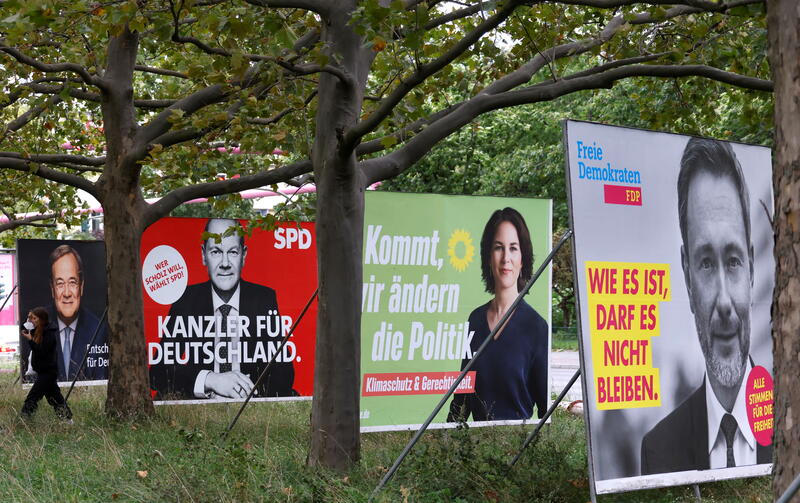
Election posters of Germany’s top candidates for chancellor. September 16, 2021. REUTERS/Fabrizio Bensch
Most people agree that news organisations and journalists should reflect all sides of an issue and not push a particular agenda – at least when asked about it in surveys. Our 2021 Digital News Report finds this to be true across countries and age groups.
However, many people feel that the media often fail to live up to this ideal. Our surveys consistently show that committed partisans believe that traditional media coverage is unfair, especially in countries where debates about politics or social justice have become deeply polarised. In recent years we’ve also seen an increase in opinion-led television formats such as Fox News/MSNBC in the United States, GB News in the UK and CNews in France, while many traditional print publications have focussed on distinctive and robust opinion as a way of standing out online.
Together with the growth of partisan websites, YouTubers and podcasters, audiences now have access to a wider range of views than ever before. Against this background, some have questioned traditional approaches to impartiality that try to represent all points of view within a single broadcast or publication. Other critics go further – arguing that impartiality has given extreme or unrepresentative views undue prominence, through its focus on balance, helping to legitimise climate change deniers and anti-vaxxers amongst others.
This all raises the question: how relevant is impartial and objective journalism to audiences today? The Reuters Institute commissioned market research company JV Consulting to carry out qualitative research in four countries – Brazil, Germany, the UK, and the US – with different news markets, traditions of public broadcasting, and systems of media regulation. They conducted a series of focus groups and in-depth interviews on our behalf in February and March 2021 with politically and ethnically diverse groups of older and younger people interested in and engaged with news (52 people in total).
These are some of the key findings of the report:
Engaged audiences in the four countries researched still care about impartiality and say it helps define news, even if some consider it an impossible ideal. They want journalists to focus on facts, objectivity and fairness, and to steer clear of opinions and bias in reporting, leaving them to decide for themselves how they feel about the news. Alongside accuracy, impartiality is a foundational value of news that underpins audiences’ trust.
People recognise the risk of giving exposure to extreme views or one side in the name of balance. However, evidence from this group of engaged users is that they are even more concerned about the suppression and silencing of viewpoints. There are particular misgivings about this in Brazil and Germany, where twentieth century history frames some people’s views.
Most participants recognise that there were some topics (e.g., science stories, natural disasters, and questions of social justice) where there were not always two or more sides to represent. Here, many felt there should be more latitude for journalists to present just one perspective or an established point of view. There are also expectations that journalists will show greater empathy and connection in their reporting than perhaps traditional interpretations of impartiality have allowed in the past.
Across countries, newer digital formats such as social media are perceived as carrying more risk of bias along with the growth of more informal and entertaining broadcast formats such as chat shows and podcasts. Impartiality is more vulnerable in these contexts, as well as when the news is emotive or controversial, because journalists’ personal views risk slipping out in the impulse to engage, although the subject and intention have a bearing on how audiences feel about this.
Younger people, who have grown up using more informal and digital sources, tend to have different expectations of impartiality, often looking for journalism that aligns with their values. But overall, their underlying attitudes and desires are remarkably similar to older people’s.
Different countries’ news traditions shape people’s experiences and expectations. Audiences in the US cannot envisage a world without partisan news outlets, but in the UK and Germany, with their public service traditions, most audiences still laud the upholding of impartiality.
Respondents also delineate between news reporting (where impartiality is expected) and opinion/commentary (where people expect that views are argued for). Importantly, many told us that they often find it difficult to distinguish between the two, especially online. Interviewees like news and they like opinion, but want them very clearly separated.
It is important to recognise that not all news organisations are committed to impartiality: indeed, some make a virtue of creating news and opinion with a clear point of view. But most will want to take note of audience desires for a range of views to be represented and to see clearer labelling of news and opinion. For news organisations that are committed to impartiality, the report highlights the increased dangers in areas where journalism is more informal or accessed in distributed environments. Public media like the BBC have already embarked on updated training and issued new guidelines on these issues. Audiences have also sent a clear signal in this report that they would like much greater transparency over why certain perspectives are included or excluded, however difficult this may be in practice.
Finally, the report notes that given the importance of social media, search and other access points, technology platforms such as Facebook, Google and Apple, will also need to develop clearer guidelines on impartiality – as their own trust levels will depend on fair implementation of policies around inclusion and exclusion, whether by algorithm or human intervention.
Now this isn’t everyone’s cup of tea but when one thinks of the enormous amount of news and information one gathers from the television, the radio, the press and a wide variety of online sources then thinking a little more about the truth of what we are being told is crucial to us making wise decisions. including voting where appropriate.
People still value the ideal of impartial news; there is no question about that!
A deeply fascinating essay from an individual at the University of Oxford.
I have long read the daily output from The Conversation. It’s a very useful way of keeping one’s brain cells functioning in some sort of fashion.
Yesterday morning I read an essay put out by Thomas Moynihan, a PhD Candidate at the University of Oxford.
It was fascinating and I am republishing it here.
Now it’s not for everyone. It is also long and it also has a number of videos to watch. And there’s not a dog mentioned!
But if you are interested in where we, as in human beings, are ‘going’, so to speak, then this is for you.
And I’m ready to admit that it may be an age thing; something that is of much interest to me because I shall be 75 in November and one naturally wonders about the end of life. Both individually and of society!
ooOOoo
The end of the world: a history of how a silent cosmos led humans to fear the worst.
It is 1950 and a group of scientists are walking to lunch against the majestic backdrop of the Rocky Mountains. They are about to have a conversation that will become scientific legend. The scientists are at the Los Alamos Ranch School, the site for the Manhattan Project, where each of the group has lately played their part in ushering in the atomic age.
They are laughing about a recent cartoon in the New Yorker offering an unlikely explanation for a slew of missing public trash cans across New York City. The cartoon had depicted “little green men” (complete with antenna and guileless smiles) having stolen the bins, assiduously unloading them from their flying saucer.
By the time the party of nuclear scientists sits down to lunch, within the mess hall of a grand log cabin, one of their number turns the conversation to matters more serious. “Where, then, is everybody?”, he asks. They all know that he is talking – sincerely – about extraterrestrials.
The question, which was posed by Enrico Fermi and is now known as Fermi’s Paradox, has chilling implications.
Bin-stealing UFOs notwithstanding, humanity still hasn’t found any evidence of intelligent activity among the stars. Not a single feat of “astro-engineering”, no visible superstructures, not one space-faring empire, not even a radio transmission. It has beenargued that the eerie silence from the sky above may well tell us something ominous about the future course of our own civilisation.
Such fears are ramping up. Last year, the astrophysicist Adam Frank implored an audience at Google that we see climate change – and the newly baptised geological age of the Anthropocene – against this cosmological backdrop. The Anthropocene refers to the effects of humanity’s energy-intensive activities upon Earth. Could it be that we do not see evidence of space-faring galactic civilisations because, due to resource exhaustion and subsequent climate collapse, none of them ever get that far? If so, why should we be any different?
A few months after Frank’s talk, in October 2018, the Intergovernmental Panel on Climate Change’s update on global warming caused a stir. It predicted a sombre future if we do not decarbonise. And in May, amid Extinction Rebellion’s protests, a new climate report upped the ante, warning: “Human life on earth may be on the way to extinction.”
Meanwhile, NASA has been publishing press releases about an asteroid set to hit New York within a month. This is, of course, a dress rehearsal: part of a “stress test” designed to simulate responses to such a catastrophe. NASA is obviously fairly worried by the prospect of such a disaster event – such simulations are costly.
Space tech Elon Musk has also been relaying his fears about artificial intelligence to YouTube audiences of tens of millions. He and others worry that the ability for AI systems to rewrite and self-improve themselves may trigger a sudden runaway process, or “intelligence explosion”, that will leave us far behind – an artificial superintelligence need not even be intentionally malicious in order to accidentally wipe us out.
In 2015, Musk donated to Oxford’s Future of Humanity Institute, headed up by transhumanist Nick Bostrom. Nestled within the university’s medieval spires, Bostrom’s institute scrutinises the long-term fate of humanity and the perils we face at a truly cosmic scale, examining the risks of things such as climate, asteroids and AI. It also looks into less well-publicised issues. Universe destroying physics experiments, gamma-ray bursts, planet-consuming nanotechnology and exploding supernovae have all come under its gaze.
So it would seem that humanity is becoming more and more concerned with portents of human extinction. As a global community, we are increasingly conversant with increasingly severe futures. Something is in the air.
But this tendency is not actually exclusive to the post-atomic age: our growing concern about extinction has a history. We have been becoming more and more worried for our future for quite some time now. My PhD research tells the story of how this began. No one has yet told this story, yet I feel it is an important one for our present moment.
I wanted to find out how current projects, such as the Future of Humanity Institute, emerge as offshoots and continuations of an ongoing project of “enlightenment” that we first set ourselves over two centuries ago. Recalling how we first came to care for our future helps reaffirm why we should continue to care today.
Extinction, 200 years ago
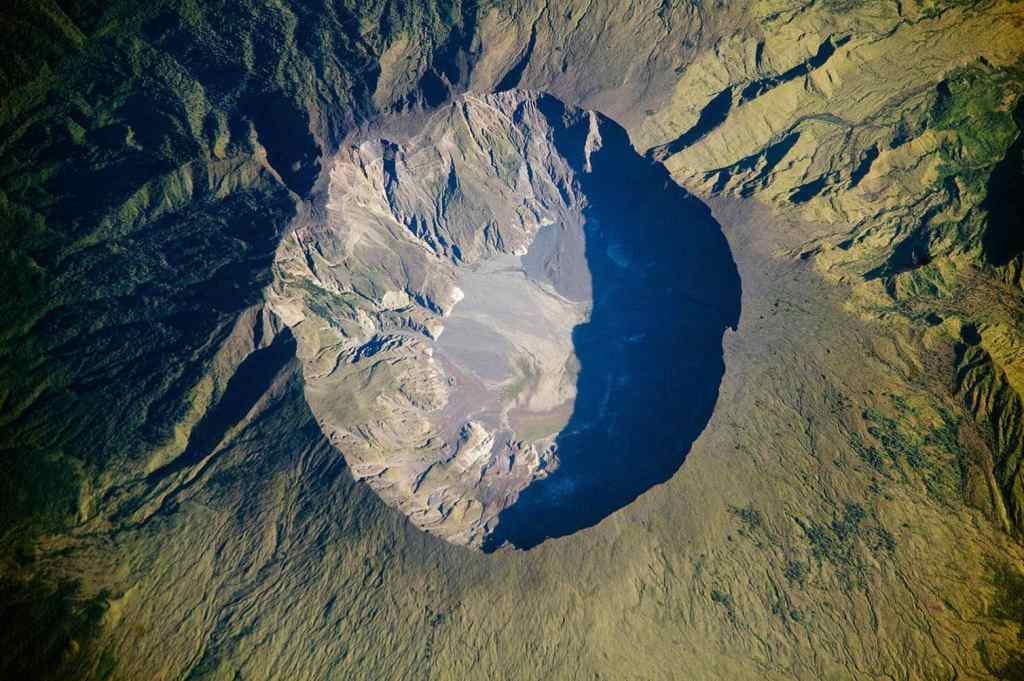
In 1816, something was also in the air. It was a 100-megaton sulfate aerosol layer. Girdling the planet, it was made up of material thrown into the stratosphere by the eruption of Mount Tambora, in Indonesia, the previous year. It was one of the biggest volcanic eruptions since civilisation emerged during the Holocene.
Mount Tambora’s crater. Wikimedia Commons/NASA
Almost blotting out the sun, Tambora’s fallout caused a global cascade of harvest collapse, mass famine, cholera outbreak and geopolitical instability. And it also provoked the first popular fictional depictions of human extinction. These came from a troupe of writers including Lord Byron, Mary Shelley and Percy Shelley.
The group had been holidaying together in Switzerland when titanic thunderstorms, caused by Tambora’s climate perturbations, trapped them inside their villa. Here they discussed humanity’s long-term prospects.
Clearly inspired by these conversations and by 1816’s hellish weather, Byron immediately set to work on a poem entitled “Darkness”. It imagines what would happen if our sun died:
I had a dream, which was not all a dream
The bright sun was extinguish’d, and the stars
Did wander darkling in the eternal space
Rayless, and pathless, and the icy earth
Swung blind and blackening in the moonless air
Detailing the ensuing sterilisation of our biosphere, it caused a stir. And almost 150 years later, against the backdrop of escalating Cold War tensions, the Bulletin for Atomic Scientists again called upon Byron’s poem to illustrate the severity of nuclear winter.
Two years later, Mary Shelley’s Frankenstein (perhaps the first book on synthetic biology) refers to the potential for the lab-born monster to outbreed and exterminate Homo sapiens as a competing species. By 1826, Mary went on to publish The Last Man. This was the first full-length novel on human extinction, depicted here at the hands of pandemic pathogen.
Boris Karloff plays Frankenstein’s monster, 1935. Wikimedia Commons
Beyond these speculative fictions, other writers and thinkers had already discussed such threats. Samuel Taylor Coleridge, in 1811, daydreamed in his private notebooks about our planet being “scorched by a close comet and still rolling on – cities men-less, channels riverless, five mile deep”. In 1798, Mary Shelley’s father, the political thinker William Godwin, queried whether our species would “continue forever”?
While just a few years earlier, Immanuel Kant had pessimistically proclaimed that global peace may be achieved “only in the vast graveyard of the human race”. He would, soon after, worry about a descendent offshoot of humanity becoming more intelligent and pushing us aside.
Earlier still, in 1754, philosopher David Hume had declared that “man, equally with every animal and vegetable, will partake” in extinction. Godwin noted that “some of the profoundest enquirers” had lately become concerned with “the extinction of our species”.
In 1816, against the backdrop of Tambora’s glowering skies, a newspaper article drew attention to this growing murmur. It listed numerous extinction threats. From global refrigeration to rising oceans to planetary conflagration, it spotlighted the new scientific concern for human extinction. The “probability of such a disaster is daily increasing”, the article glibly noted. Not without chagrin, it closed by stating: “Here, then, is a very rational end of the world!”
So if people first started worrying about human extinction in the 18th century, where was the notion beforehand? There is enough apocalypse in scripture to last until judgement day, surely. But extinction has nothing to do with apocalypse. The two ideas are utterly different, even contradictory.
For a start, apocalyptic prophecies are designed to reveal the ultimate moral meaning of things. It’s in the name: apocalypse means revelation. Extinction, by direct contrast, reveals precisely nothing and this is because it instead predicts the end of meaning and morality itself – if there are no humans, there is nothing humanly meaningful left.
And this is precisely why extinction matters. Judgement day allows us to feel comfortable knowing that, in the end, the universe is ultimately in tune with what we call “justice”. Nothing was ever truly at stake. On the other hand, extinction alerts us to the fact that everything we hold dear has always been in jeopardy. In other words, everything is at stake.
Extinction was not much discussed before 1700 due to a background assumption, widespread prior to the Enlightenment, that it is the nature of the cosmos to be as full as moral value and worth as is possible. This, in turn, led people to assume that all other planets are populated with “living and thinking beings” exactly like us.
Although it only became a truly widely accepted fact after Copernicus and Kepler in the 16th and 17th centuries, the idea of plural worlds certainly dates back to antiquity, with intellectuals from Epicurus to Nicholas of Cusa proposing them to be inhabited with lifeforms similar to our own. And, in a cosmos that is infinitely populated with humanoid beings, such beings – and their values – can never fully go extinct.
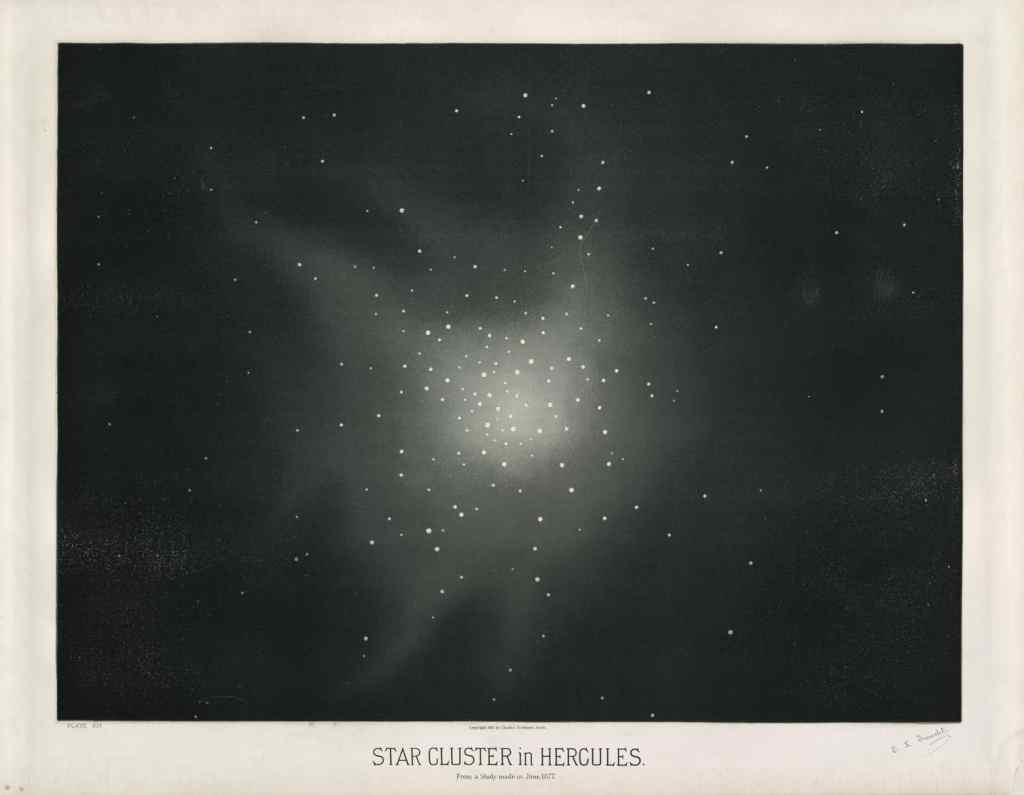
Star cluster Messier 13 in Hercules, 1877. Wikimedia Commons
In the 1660s, Galileo confidently declared that an entirely uninhabited or unpopulated world is “naturally impossible” on account of it being “morally unjustifiable”. Gottfried Leibniz later pronounced that there simply cannot be anything entirely “fallow, sterile, or dead in the universe”.
Along the same lines, the trailblazing scientist Edmond Halley (after whom the famous comet is named) reasoned in 1753 that the interior of our planet must likewise be “inhabited”. It would be “unjust” for any part of nature to be left “unoccupied” by moral beings, he argued.
Around the same time Halley provided the first theory on a “mass extinction event”. He speculated that comets had previously wiped out entire “worlds” of species. Nonetheless, he also maintained that, after each previous cataclysm “human civilisation had reliably re-emerged”. And it would do so again. Only this, he said could make such an event morally justifiable.
Later, in the 1760s, the philosopher Denis Diderot was attending a dinner party when he was asked whether humans would go extinct. He answered “yes”, but immediately qualified this by saying that after several millions of years the “biped animal who carries the name man” would inevitably re-evolve.
This is what the contemporary planetary scientist Charles Lineweaver identifies as the “Planet of the Apes Hypothesis”. This refers to the misguided presumption that “human-like intelligence” is a recurrent feature of cosmic evolution: that alien biospheres will reliably produce beings like us. This is what is behind the wrong-headed assumption that, should we be wiped out today, something like us will inevitably return tomorrow.
Back in Diderot’s time, this assumption was pretty much the only game in town. It was why one British astronomer wrote, in 1750, that the destruction of our planet would matter as little as “Birth-Days or Mortalities” do down on Earth.
This was typical thinking at the time. Within the prevailing worldview of eternally returning humanoids throughout an infinitely populated universe, there was simply no pressure or need to care for the future. Human extinction simply couldn’t matter. It was trivialised to the point of being unthinkable.
For the same reasons, the idea of the “future” was also missing. People simply didn’t care about it in the way we do now. Without the urgency of a future riddled with risk, there was no motivation to be interested in it, let alone attempt to predict and preempt it.
It was the dismantling of such dogmas, beginning in the 1700s and ramping up in the 1800s, that set the stage for the enunciation of Fermi’s Paradox in the 1900s and leads to our growing appreciation for our cosmic precariousness today.
But then we realised the skies are silent
In order to truly care about our mutable position down here, we first had to notice that the cosmic skies above us are crushingly silent. Slowly at first, though soon after gaining momentum, this realisation began to take hold around the same time that Diderot had his dinner party.
One of the first examples of a different mode of thinking I’ve found is from 1750, when the French polymath Claude-Nicholas Le Cat wrote a history of the earth. Like Halley, he posited the now familiar cycles of “ruin and renovation”. Unlike Halley, he was conspicuously unclear as to whether humans would return after the next cataclysm. A shocked reviewer picked up on this, demanding to know whether “Earth shall be re-peopled with new inhabitants”. In reply, the author facetiously asserted that our fossil remains would “gratify the curiosity of the new inhabitants of the new world, if there be any”. The cycle of eternally returning humanoids was unwinding.
In line with this, the French encyclopaedist Baron d’Holbach ridiculed the “conjecture that other planets, like our own, are inhabited by beings resembling ourselves”. He noted that precisely this dogma – and the related belief that the cosmos is inherently full of moral value – had long obstructed appreciation that the human species could permanently “disappear” from existence. By 1830, the German philosopher F W J Schelling declared it utterly naive to go on presuming “that humanoid beings are found everywhere and are the ultimate end”.
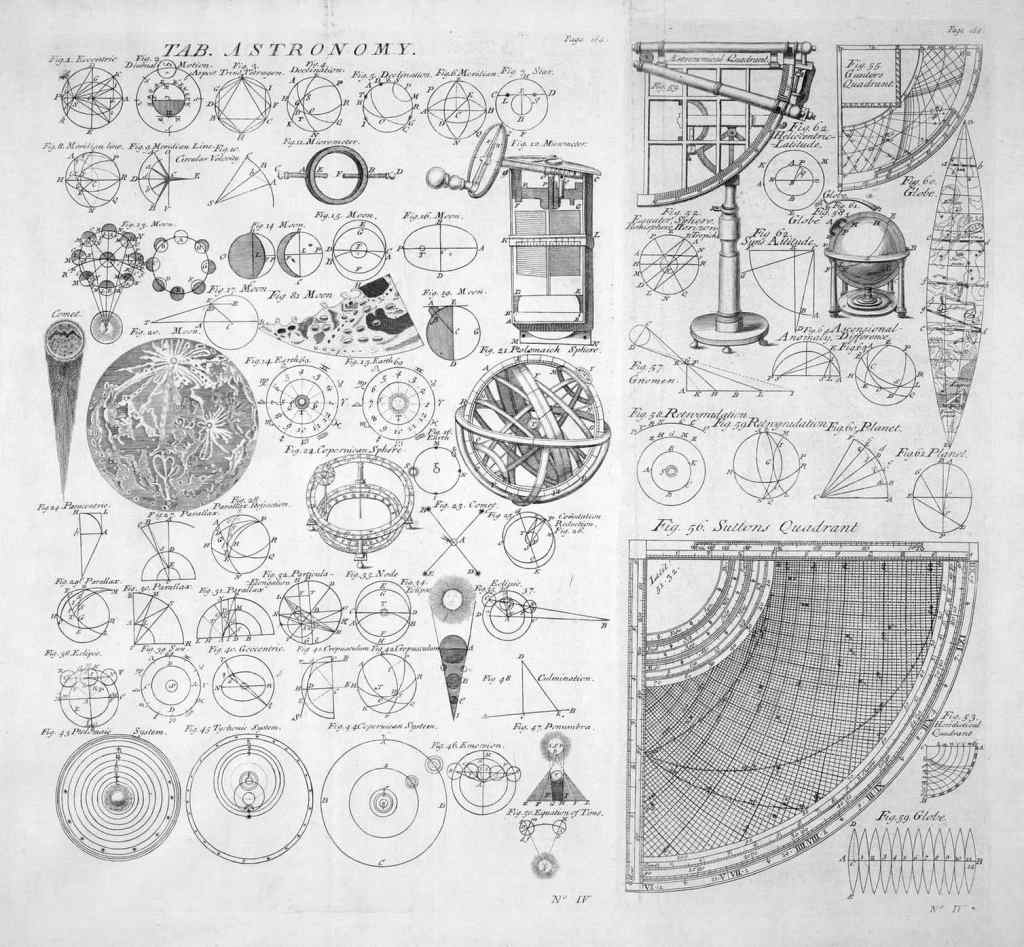
Figures illustrating articles on astronomy, from the 1728 Cyclopaedia. Wikimedia Commons
And so, where Galileo had once spurned the idea of a dead world, the German astronomer Wilhelm Olbers proposed in 1802 that the Mars-Jupiter asteroid belt in fact constitutes the ruins of a shattered planet. Troubled by this, Godwin noted that this would mean that the creator had allowed part of “his creation” to become irremediably “unoccupied”. But scientists were soon computing the precise explosive force needed to crack a planet – assigning cold numbers where moral intuitions once prevailed. Olbers calculated a precise timeframe within which to expect such an event befalling Earth. Poets began writing of “bursten worlds”.
The cosmic fragility of life was becoming undeniable. If Earth happened to drift away from the sun, one 1780s Parisian diarist imagined that interstellar coldness would “annihilate the human race, and the earth rambling in the void space, would exhibit a barren, depopulated aspect”. Soon after, the Italian pessimist Giacomo Leopardi envisioned the same scenario. He said that, shorn of the sun’s radiance, humanity would “all die in the dark, frozen like pieces of rock crystal”.
Galileo’s inorganic world was now a chilling possibility. Life, finally, had become cosmically delicate. Ironically, this appreciation came not from scouring the skies above but from probing the ground below. Early geologists, during the later 1700s, realised that Earth has its own history and that organic life has not always been part of it. Biology hasn’t even been a permanent fixture down here on Earth – why should it be one elsewhere? Coupled with growing scientific proof that many species had previously become extinct, this slowly transformed our view of the cosmological position of life as the 19th century dawned.
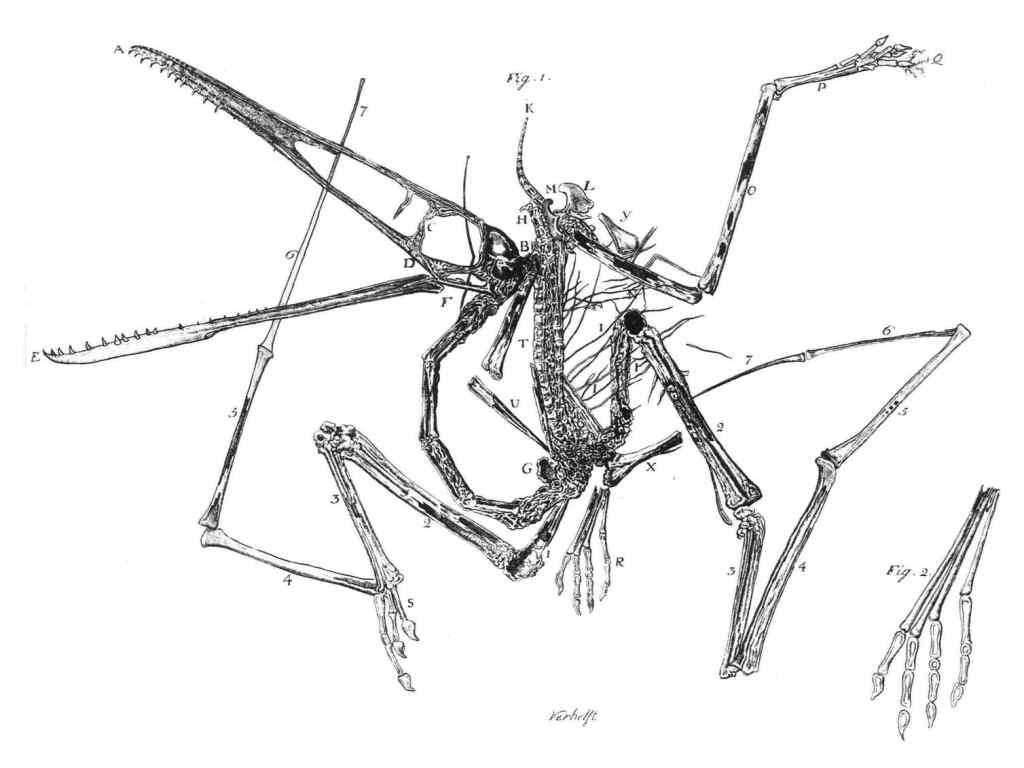
Copper engraving of a pterodactyl fossil discovered by the Italian scientist Cosimo Alessandro Collini in 1784. Wikimedia Commons
Seeing death in the stars
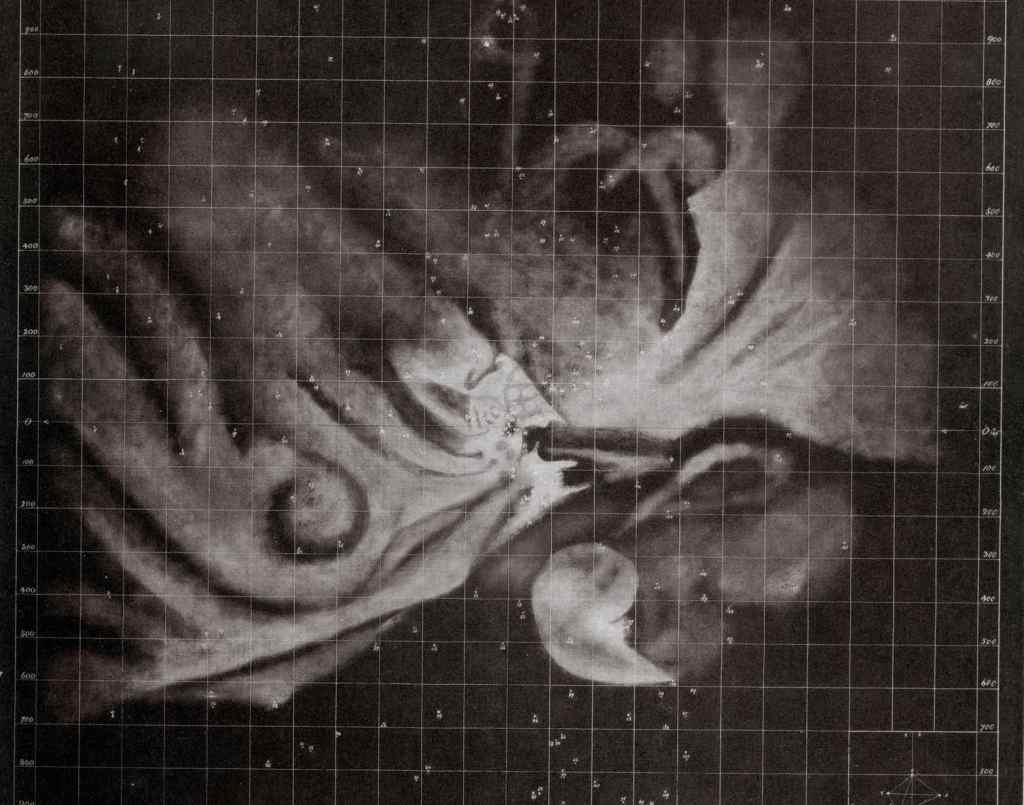
And so, where people like Diderot looked up into the cosmos in the 1750s and saw a teeming petri dish of humanoids, writers such as Thomas de Quincey were, by 1854, gazing upon the Orion nebula and reporting that they saw only a gigantic inorganic “skull” and its lightyear-long rictus grin.
The astronomer William Herschel had, already in 1814, realised that looking out into the galaxy one is looking into a “kind of chronometer”. Fermi would spell it out a century after de Quincey, but people were already intuiting the basic notion: looking out into dead space, we may just be looking into our own future.
People were becoming aware that the appearance of intelligent activity on Earth should not be taken for granted. They began to see that it is something distinct – something that stands out against the silent depths of space. Only through realising that what we consider valuable is not the cosmological baseline did we come to grasp that such values are not necessarily part of the natural world. Realising this was also realising that they are entirely our own responsibility. And this, in turn, summoned us to the modern projects of prediction, preemption and strategising. It is how we came to care about our future.
As soon as people first started discussing human extinction, possible preventative measures were suggested. Bostrom now refers to this as “macrostrategy”. However, as early as the 1720s, the French diplomat Benoît de Maillet was suggesting gigantic feats of geoengineering that could be leveraged to buffer against climate collapse. The notion of humanity as a geological force has been around ever since we started thinking about the long-term – it is only recently that scientists have accepted this and given it a name: “Anthropocene”.
Will technology save us?
It wasn’t long before authors began conjuring up highly technologically advanced futures aimed at protecting against existential threat. The eccentric Russian futurologist Vladimir Odoevskii, writing in the 1830s and 1840s, imagined humanity engineering the global climate and installing gigantic machines to “repulse” comets and other threats, for example. Yet Odoevskii was also keenly aware that with self-responsibility comes risk: the risk of abortive failure. Accordingly, he was also the very first author to propose the possibility that humanity might destroy itself with its own technology.
Acknowledgement of this plausibility, however, is not necessarily an invitation to despair. And it remains so. It simply demonstrates appreciation of the fact that, ever since we realised that the universe is not teeming with humans, we have come to appreciate that the fate of humanity lies in our hands. We may yet prove unfit for this task, but – then as now – we cannot rest assured believing that humans, or something like us, will inevitably reappear – here or elsewhere.
Beginning in the late 1700s, appreciation of this has snowballed into our ongoing tendency to be swept up by concern for the deep future. Current initiatives, such as Bostrom’s Future of Humanity Institute, can be seen as emerging from this broad and edifying historical sweep. From ongoing demands for climate justice to dreams of space colonisation, all are continuations and offshoots of a tenacious task that we first began to set for ourselves two centuries ago during the Enlightenment when we first realised that, in an otherwise silent universe, we are responsible for the entire fate of human value.
It may be solemn, but becoming concerned for humanity’s extinction is nothing other than realising one’s obligation to strive for unceasing self-betterment. Indeed, ever since the Enlightenment, we have progressively realised that we must think and act ever better because, should we not, we may never think or act again. And that seems – to me at least – like a very rational end of the world.
ooOOoo
I hope you have read it all. There’s much to engage one. And the message to me is very clear: We have to regard this race, correction: our race, as unique. As is put in the penultimate paragraph:
“Enlightenment when we first realised that, in an otherwise silent universe, we are responsible for the entire fate of human value.”
Now there’s a thought for an atheist on a Saturday morning!



 Learning from Dogs