Tag: University of Illinois at Chicago

Technology and ageing

This article hits home!

I find it is very hard to keep current on new technological developments. I am well past being young but still fascinated by science and technology.

Thus, it seemed like one that I should publish.

ooOOoo

Constant technology changes throw seniors a curve – and add to caregivers’ load
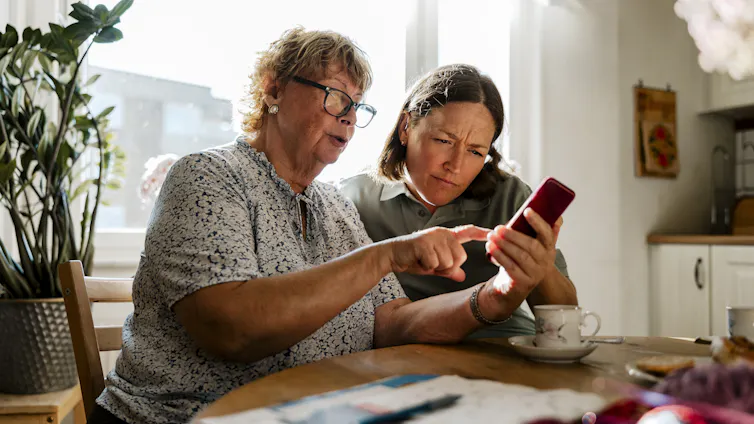
Shifting interfaces and frequent updates challenge elders and increase the burdens on people who try to help them. Maskot via Getty Images

Debaleena Chattopadhyay, University of Illinois Chicago

This past Christmas, I helped my parents choose a water filter. The latest “smart” models all came with a smartphone app that promised to monitor filter life, track water quality and automatically request service. Yet my father, age 75, and mother, 67, were quick to reject them in favor of a nondigital model.

“Every time it updates or I forget how to use it, we’ll have to call you,” my dad said.

As an only child living 8,000 miles (12,875 kilometers) away, I didn’t need convincing. My parents are aging in place and don’t need traditional caregiving – they cook, drive and manage their home just fine. Instead, I provide what I call technology caregiving: helping them with their digital activities of daily living, from online banking to booking theater tickets.

But as the tech industry shifts toward artificial intelligence agents and generative user interfaces – promising to make devices smarter than ever – I am bracing for this invisible workload to become heavier, not lighter. In addition to being a technology caregiver, I’m a computer scientist who studies human-computer interaction.

Technology caregiving

Technology caregiving is the act of helping someone use digital tools. While this isn’t entirely new – people have long helped grandparents program VCRs and connect parents’ desktop computers to the internet – the stakes have changed.

Today, digitization is ubiquitous. Helping with these tools is no longer just occasional unpaid tech support – it is a form of continuous caregiving essential for maintaining independence. For example, even the simple act of clipping coupons has gone digital – marginalizing older adults who are unable to navigate store apps to access these discounts.

People often view older adults as resistant to technology, but recent years – particularly since the COVID-19 pandemic – have shattered that myth. While gaps in internet access and device ownership remain, they are no longer major barriers to technology access.

an older woman uses a laptop computer at a table
Today’s seniors are not tech-averse, but constant updates and interface changes make using technology more difficult for them. Jose Luis Raota/Moment via Getty Images

The emerging crisis is not about access, but effective use. Many older adults are now online and willing to use these tools, but they require frequent help from family, friends or communities.

The innovation tax

The problem isn’t just that devices and apps are getting complex; it’s that they are constantly changing. Frequent software updates and shifting interfaces can be frustrating for all users, but they turn familiar tools into foreign concepts for older adults.

This unpredictability is about to accelerate. Take generative user interfaces, which designers can use to dynamically generate an interface in minutes. Pair them with AI agents, and the system can assume the designer’s role, taking independent actions based on how it perceives a user’s intent or need.

If the “Pay Bill” button is in a different place every third time you open a particular app because an AI decided to optimize the interface, you might feel perpetually incompetent if you can’t quickly locate it. While the industry calls this personalization, for an older adult it is a moving target.

This relentless pace of change – even when intended to be helpful – is directly at odds with age-related cognitive changes. And this dynamic is continuing with the new generation of seniors. They may be more eager to adopt new tools than the last, but wanting to use technology is not the same as being able to use it when the rules are constantly changing.

To navigate a brand new or shifting interface, your brain relies on fluid intelligence: the ability to reason, solve novel problems and ignore distractions on the fly. Unlike the knowledge that people accumulate over time, fluid intelligence naturally declines with age.

When an app updates or an AI optimizes a layout, it forces the user to discard their hard-won mental models and start over. For an older adult, this isn’t just a minor inconvenience; it is a taxing job for their working memory.

As an older adult participant in a study my colleagues and I conducted put it:

“I had a computer on my desk in 1980, OK, when nobody else did. So this is not a foreign language, but the changes that are made with little to no explanation and then things that you knew how to do have either changed or disappeared completely, that is the stuff that absolutely drives me, and I will tell you, every other older adult in America nuts.”

Help the helper

I believe that the way forward is to stop treating tech support as an afterthought and start designing for the technology caregiver. Digital literacy training for seniors and encouraging designing technologies for all users are important but not enough; it’s important to build tools that share the burden.

Two promising paths are emerging. First, cognitive accessibility features – like AI assistants that find buried buttons or provide real-time tech support – can offload tasks from the caregiver. Second, tools for caregivers are beginning to move beyond simply controlling device feature access to capabilities such as allowing authorized access for banking as co-users, or recording personalized instructions.

These tools will also need to be tailored: Family caregivers need different tools than community helpers like libraries and senior centers.

In the age of AI, innovation shouldn’t be a tax on the aging brain – it should help bridge the digital divide.

Debaleena Chattopadhyay, Assistant Professor of Computer Science, University of Illinois Chicago

This article is republished from The Conversation under a Creative Commons license. Read the original article.

ooOOoo

I like the idea of having a technology caregiver. I like the idea very much.

Living the long life

Two remarkable aspects of human longevity.

OK, a change to the theme of the last few days, to a topic that must cross the minds of practically every single human being at some point; what is our lifespan going to be?  Who doesn’t want to live a long and healthy life, and I don’t wish to be insensitive to those who labour under mental and physical troubles, of course.

So a recent couple of fascinating stories have given an insight into just how to live that longer and healthier life.

The first one is easy – be a woman!

Actress Michelle Ryan as the Bionic Woman was destined to live even longer!

OK, a bit of an issue if you are a man like me but did you realise, because I didn’t, that being the female of many species offers a significant advantage.  This came from a BBC item published on the 2nd August, from which I quote,

Scientists believe they have discovered a clue to why women tend to live longer than men – by studying fruit flies.

Writing in Current Biology, they focus on mutations in mitochondrial DNA – the power source of cells.

Mitochondria are inherited only from mothers, never from fathers, so there is no way to weed out mutations that damage a male’s prospects.

Then came an extraordinary fact [my italics below],

By the age of 85, there are approximately six women for every four men in the UK, and by 100 the ratio is more than two to one.

And females outlive males in many other species.

If you are of the scientific bent and/or a woman! you can read a fuller account of the research findings on the Science Daily website.  As well as that link you can also read the  Monash University press release on those research findings.

As a fella’ I think I’m moving on!

The second one is almost as easy – Fasting

Again, this news came from the BBC website, the news about the power of fasting.  In an article promoting the showing of a BBC Horizon programme, Michael Mosley wrote this,

Scientists are uncovering evidence that short periods of fasting, if properly controlled, could achieve a number of health benefits, as well as potentially helping the overweight, as Michael Mosley discovered.

I’d always thought of fasting as something unpleasant, with no obvious long term benefits. So when I was asked to make a documentary that would involve me going without food, I was not keen as I was sure I would not enjoy it.

But the Horizon editor assured me there was great new science and that I might see some dramatic improvements to my body. So, of course, I said, “yes”.

I am not strong-willed enough to diet over the long term, but I am extremely interested in the reasons why eating less might lead to increased life span, particularly as scientists think it may be possible to get the benefits without the pain.

For obvious reasons I can’t republish the full BBC article but I encourage you to read it here.  And stay with me for some more research links that are most interesting.

But I will just include this part from the BBC item,

The IGF-1 hormone (insulin-like growth factor) is one of the drivers which keep our bodies in go-go mode, with cells driven to reproduce. This is fine when you are growing, but not so good later in life.

There is now evidence suggesting that IGF-1 levels can be lowered by what you eat. Studies on calorie restrictors suggest that eating less helps, but it is not enough.

As well as cutting calories you have to cut your protein intake. Not entirely – that would be a very bad idea. It’s about sticking to recommended guidelines, something most of us fail to do.

The reason seems to be that when our bodies no longer have access to food they switch from “growth mode” to “repair mode”.

As levels of the IGF-1 hormone drop, a number of repair genes appear to get switched on according to ongoing research by Professor Valter Longo of the University of Southern California.

Intermittent fasting

One area of current research into diet is Alternate Day fasting (ADF), involving eating what you want one day, then a very restricted diet (fewer than 600 calories) the next, and most surprisingly, it does not seem to matter that much what you eat on non-fast days.

Dr Krista Varady of the University of Illinois at Chicago carried out an eight-week trial comparing two groups of overweight patients on ADF.

“If you were sticking to your fast days, then in terms of cardiovascular disease risk, it didn’t seem to matter if you were eating a high-fat or low-fat diet on your feed (non-fast) days,” she said.

Michael Mosley explains how he couldn’t manage Alternate Day Fasting and found it was just too impractical.

Instead I did an easier version, the so-called 5:2 diet. As the name implies you eat normally 5 days a week, then two days a week you eat 500 calories if you are a woman, or 600 calories, if you are a man.

The BBC Horizon programme  was screened on the 6th August but is available on the BBC iPlayer for UK viewers.  Here’s how it was promoted on the BBC website,

Michael Mosley has set himself a truly ambitious goal: he wants to live longer, stay younger and lose weight in the bargain. And he wants to make as few changes to his life as possible along the way. He discovers the powerful new science behind the ancient idea of fasting, and he thinks he’s found a way of doing it that still allows him to enjoy his food. Michael tests out the science of fasting on himself – with life-changing results.

This programme clip will also attract your attention, trust me!

and if you would prefer a more inspiring antidote then here’s another clip from the programme,

Tomorrow, I’m going to link to the scientists behind these new findings because this is very significant research that could revolutionize the future health for millions.

Finally, I’m here to tell you that Jean and I have ‘signed up’ to the 5:2 pattern and had our fast days last Thursday and Friday.  They were much easier than I expected and, frankly, will be fun to maintain.  Leave a comment if you would like details of the food and calorific values of what Jean served those two days.