Tag: United States

Just a reflection on nearly 900 posts!!

Prompted by a recent comment from a reader.

This Blog started on July 15th, 2009.  At first there were a group of authors all committed to the vision but for various reasons they all were unable to maintain the very real challenges of writing a daily article and they amended the relationship to that of occasional guest author. My fellow founding author, Jon Lavin, has just completed a very demanding Master’s Degree which, for very valid reasons, has kept his nose to a different grinding wheel for the last 3 years.  My greatest wish is that Jon can return to writing for this Blog simply because the original idea about dogs having much to teach us came from Jon.

The vision of why so many hours are spent managing and writing on Learning from Dogs is encapsulated here.  One of the ideas expressed there is, “Our children require a world that understands the importance of faith, integrity and honesty“.  This aspect has become more and more important in my mind.  Within less than a month of this Post, I will have my first grandchild (the gender is a closely guarded secret!)  When I look at some of the scenarios that could face that grandchild over the next four decades, it’s easy to feel pretty nervous. So being able to use the power of this electronically connected world to ramble on is my way to trying to do something!

This is leading me to the point of this Post.  If it wasn’t for the growing number of readers, now several hundred a day, and the graciousness of those readers to find the time to comment, I think this Blog would have rolled over and gone back to sleep in front of the fire as Pharaoh is wont to do!

The comments have been fabulous and even selecting a couple seems unfair on the rest.  But nonetheless that is what this article is going to include.

Just a few days ago, there was an article about the internet and control.  Dogkisses wrote:

I feel quite positive about technology, including the Internet, but I also wish we could keep things like public libraries and continue to learn skills such as handwriting.

My nephew, an A student in college, recently had to take a handwriting course. My sis was embarrassed ’til she arrived finding many Mothers she knew there for the same reason. Many college students didn’t know how to write.

I volunteered once at a “Center for Independent Living.” One of the main services they offered was free Internet access to people with disabilities. I have since learned how important this is for people who are either bed-ridden or as with Chronic Fatigue Syndrome, stay home much of the time. It is a connection to the world. People can have a sense of community. This is a good thing.

I also love how quickly I can learn little things, such as words and how that might take me somewhere else to learn about something different. Pretty cool.

Maybe some people who have control in certain arenas are afraid that The People who are being controlled will, via the Internet, be heard and all too clearly.

Then last Friday, another reader, Steven Law, added an insightful comment to a Guest Post written by Patrice Ayme last December 10th., the Essence of the Civilizational Crisis, a very profound piece.  This is what Steven wrote:

“To create public money, the money everybody uses (be it cash, electronic transfers, swaps, whatever) we use a private system, with proprietary money creating devices inside (say subprime, or derivatives). Civilization has never worked this way before, as the state previously was careful to stay the one and only money creator.”
What Patrice ignores here is that the State “creates” nothing. And I do not support “private” monopoly of money either.What I would like to entertain is the ability for a true free market (one in which we do not have) to explore competitive money, and yes, privately issued by competing banks. But that these banks would not operate on fractional reserve. They would largely operate their monies on a commodities basket reserve system. Not just precious metals, but multiple commodities as well.
At any rate you can learn more on this by reading F.A. Hayek’s “Good Money”pts. 1 & 2. Also I recommend spending some time at The Von Mises Institute online, great insights and education from an Austrian perspective on these matters.

I like your post, but find a few flaws in the argument. My main point here is that civilization has failed throughout history to keep the State under control and not allow state controlled money monopoly. Fiat currencies have failed miserably throughout history and are doing so again. We have some serious learning lessons coming our way…again.

Just want to expand on what I said about the State not creating anything. How can they create when the monies the receive are largely from coercion as well as monopoly? Therefore any “creation” by the State is at the expense of industry and freedom. Hence the need for a limited government.
I also recommend watching “Corporation Nation” on youtube. It’s pretty long and supports with verifiable evidence the depths our government has reached into fascism.

So there we are! Writing this Blog is a labour of love and having both readers and readers willing to comment keeps the love affair going!  Thank you all, every one of you.

Finally, Steven mentions that YouTube video Corporation Nation.  The whole series of videos is long but if you fancy starting in at the beginning, here it is.
Total, utter madness, Pt 4

Continuing the review of Lester Brown’s book World on the Edge.

Regular readers will be aware that I have been summarising each chapter of this pivotal book.  Chapters 2, 3 and 4 are part of the section that Lester Brown calls A Deteriorating Foundation.  But I am aware that wall-to-wall gloom is often too much for people to take in so I wanted to let you know that the third section, The Response: Plan B, is very much a realistic and pragmatic approach to the alternative, a planet that will let countless future generations live in harmony and sustainably.

So please take in the dire situation that we are in by reading these summaries or, better still, buy the book!

Chapter Four, Rising Temperatures, Melting Ice, and Food Security.

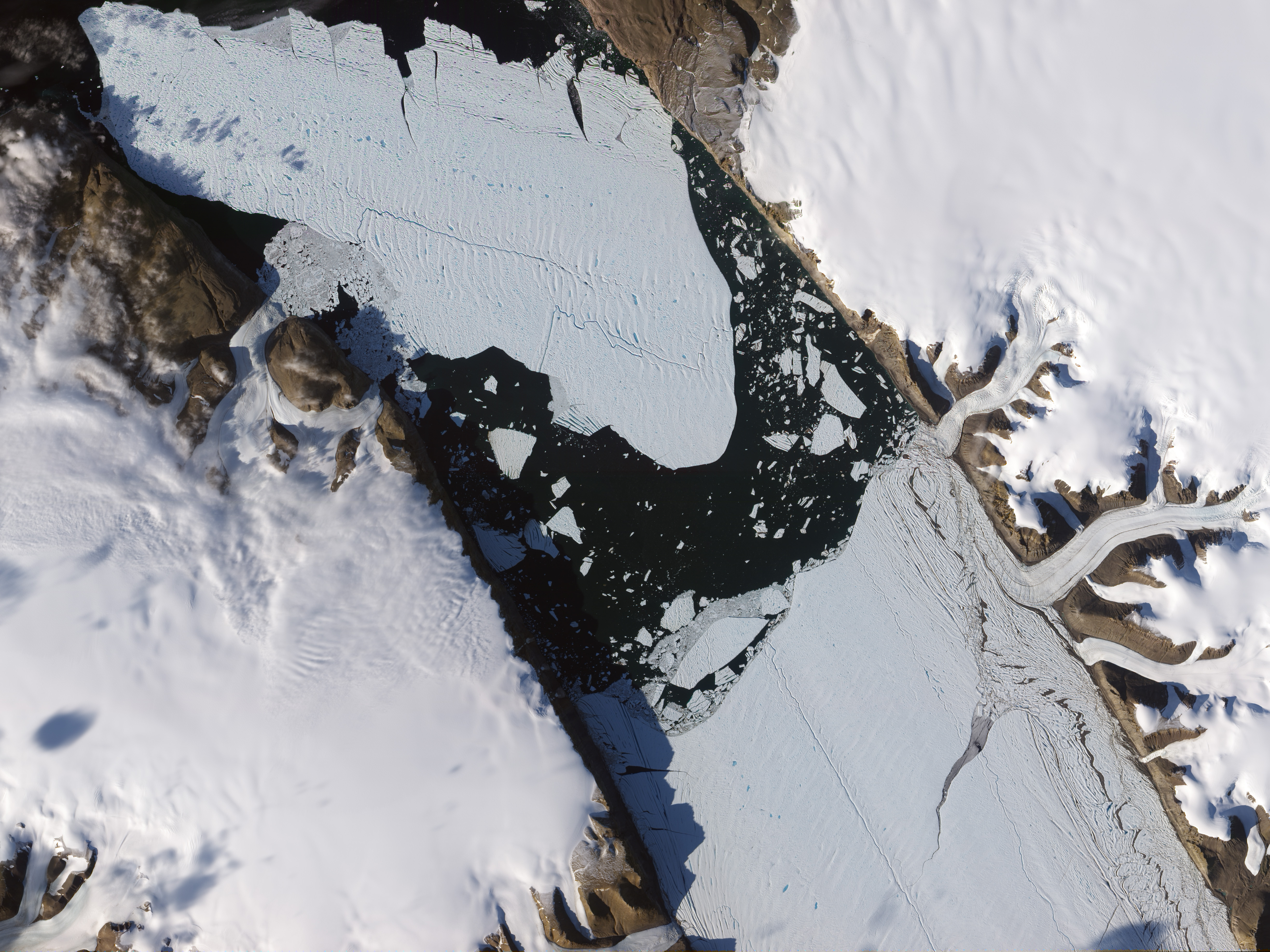
  • The Petermann Glacier calves an iceberg that covered 97 square miles on August 5th, 2010.
  • Scientists for some years have been reporting that the Greenland ice sheet was melting at an accelerating rate.
  • Richard Bates, from the University of St Andrews, part of a team monitoring Greenland ice melt, was reported as saying:

Dr Richard Bates, who is monitoring the ice alongside researchers from America, said the expedition had expected to find evidence of melting this year after “abnormally high” temperatures in the area. Climate change experts say that globally it has been the warmest six months globally since records began.

But he was “amazed to see an area of ice three times the size of Manhattan Island had broken off.

“It is not a freak event and is certainly a manifestation of warming. This year marks yet another record breaking melt year in Greenland; temperatures and melt across the entire ice sheet have exceeded those in 2007 and of historical records.”

  • A temperate rise of between 2C and 7C would cause the entire Greenland ice mass to melt – raising sea-levels world-wide by 23 feet (7 metres)!
  • In the United States last year saw record hot temperatures on the East Coast.
  • On September 27th Los Angeles recorded an all-time high of 113 degrees F, then the official thermometer broke.
  • A nearby thermometer survived to register a temperature of 119 degrees F, a record for the region.
  • Crop ecologists use a rule of thumb that for each 1-degree-Celsius rise in temperature above the optimum during the growing season, we can expect a 10-percent decline in grain yields.
  • Temperatures are rising much faster in the Arctic than elsewhere.  Winter temperatures in the Arctic, including Alaska, western Canada and eastern Russia, have climbed by 4-7 degrees F. over the last half-century.
  • This record rise in temperatures in the Arctic region could lead to changes in climate patterns that will affect the entire planet.
  • Even a 3-foot rise in sea level would sharply reduce the rice harvest in Asia. It would inundate Bangladesh, a country of 164 million people, submerge part of the Mekong Delta ( a region that produces half of Viet Nam’s rice).

That’s enough from me, simply because although this chapter in the book continues with many more frightening facts, I can’t continue to list them in this particular Post.  If the above doesn’t cause you to think and want to change, then a couple of dozen more facts aren’t going to do it either.

Just look at the photograph below and ponder on what we are leaving our children and our grand-children.  Indeed, if you are, say 50 years or younger, ponder on what the next few decades could offer for you.

We have to break our addiction with our modern way of living – or Planet Earth will do it for us.

A mother of an iceberg!

On Aug. 5, 2010, an enormous chunk of ice, roughly 97 square miles (251 square kilometers) in size, broke off the Petermann Glacier, along the northwestern coast of Greenland. The Canadian Ice Service detected the remote event within hours in near real-time data from the Moderate Resolution Imaging Spectroradiometer (MODIS) on NASA’s Aqua satellite. The Petermann Glacier lost about one-quarter of its 70-kilometer (40-mile) long floating ice shelf, said researchers who analyzed the satellite data at the University of Delaware. Taken from here.

Words fail one

Income inequality, when it becomes excessive, is very corrosive to a society.

This is clearly a complex subject because one man’s excess is another man’s just reward for building a successful business that employs his fellow citizens.

Nonetheless, I do want to touch on this sensitive area because, to my mind, they are connected with the tragic story that is the point of this article.

But first, a couple of quotes from an article by Prof. G. William Domhoff of the Sociology Department of the University of California at Santa Cruz.  It was entitled Wealth, Income, Power.

This document presents details on the wealth and income distributions in the United States, and explains how we use these two distributions as power indicators.

Some of the information may come as a surprise to many people. In fact, I know it will be a surprise and then some, because of a recent study (Norton & Ariely, 2010) showing that most Americans (high income or low income, female or male, young or old, Republican or Democrat) have no idea just how concentrated the wealth distribution actually is.

Later on, Prof. Domhoff writes:

The Wealth Distribution

In the United States, wealth is highly concentrated in a relatively few hands. As of 2007, the top 1% of households (the upper class) owned 34.6% of all privately held wealth, and the next 19% (the managerial, professional, and small business stratum) had 50.5%, which means that just 20% of the people owned a remarkable 85%, leaving only 15% of the wealth for the bottom 80% (wage and salary workers). In terms of financial wealth (total net worth minus the value of one’s home), the top 1% of households had an even greater share: 42.7%. Table 1 and Figure 1 present further details drawn from the careful work of economist Edward N. Wolff at New York University (2010).

That table and the whole article is powerful and a well-worth reading. Read it here.

Stay with me a little longer.  Here’s an extract from an article from Nicholos Kristof of the New York Times written in November last year.

Nicholas Kristof

In my reporting, I regularly travel to banana republics notorious for their inequality. In some of these plutocracies, the richest 1 percent of the population gobbles up 20 percent of the national pie.

But guess what? You no longer need to travel to distant and dangerous countries to observe such rapacious inequality. We now have it right here at home — and in the aftermath of Tuesday’s election, it may get worse.

The richest 1 percent of Americans now take home almost 24 percent of income, up from almost 9 percent in 1976. As Timothy Noah of Slate noted in an excellent series on inequality, the United States now arguably has a more unequal distribution of wealth than traditional banana republics like Nicaragua, Venezuela and Guyana.

C.E.O.’s of the largest American companies earned an average of 42 times as much as the average worker in 1980, but 531 times as much in 2001. Perhaps the most astounding statistic is this: From 1980 to 2005, more than four-fifths of the total increase in American incomes went to the richest 1 percent.

By the way, Kristof has his own blog site and added material from him about this topic and readers’ comments are here.

Now to the core of this article on Learning from Dogs which, I passionately believe, is closely tied in to the background theme already expressed here.  It’s from the blogsite Corrente and, once again, I am indebted to Naked Capitalism for having it in a recent set of links.

It concerns Jack, his family and their house.

The House that Jack’s Bank Took

Jack was a friendly man, who always had a pleasant word and a smile and handshake for everyone. The men hung with him at barbeques and discussed sports. He was strong, had a belly, and always wore a baseball cap. He was married to his high school sweetheart, Mary. He was good to his 4 kids and took care of his oldest child when he had a breakdown in his early twenties. He went to all school and family events and encouraged his children in their dreams. He took care of the family needs and finances. He was a small business owner and had invented his product, which a short while ago became outmoded. He always decorated the house with lots of Christmas decorations and candles. They are still up. He lost his house to foreclosure and the family was given 3 days to move out.

He drove into the deep woods and drank poison to make sure he was dead. I knew him. My family knew him; he lived within walking distance of one of us. At his funeral his childhood sweetheart and their children told a lot of Jack stories. The family did their best to resurrect him to our eyes. One of his kids sang and the eldest read a poem he’d written. Mary said she didn’t know what she was going to do and that she would now have to rely on those from town sitting in the packed chapel pews. There are other houses nearby that haven’t been foreclosed on but Jack’s house was nice and had a good view. The bank has now given Mary 3 weeks to move out.

It was written on the 15th February, 2011; you can read it here.  Click on the link and read some of the comments expressed – very powerful.

Wish I could think of something apt to say but I can’t.  All I can feel is great sadness and a horrible feeling in the pit of my stomach that this ‘Jack’ story is being echoed in many other places.

Food prices are up, up and up!

Interesting release from the Earth Policy Institute.

On the 3rd February I wrote a piece about the above Institute of which I had recently become aware.  That was in conjunction with the book World on the Edge that I had started reading.  Since then I have been summarising chapters on Learning from Dogs under the general heading of Total, Utter Madness.

So with food prices continuing to reach record levels around the world, with all the implications this carries for millions of families, I was interested to read the following which was emailed to me on the 15th from the EPI.

World One Poor Harvest Away From Chaos

www.earth-policy.org/plan_b_updates/2011/update91

By Lester R. Brown
Earth Policy Release
Plan B Update
February 15, 2011

Today there are three sources of growing demand for food: population growth; rising affluence and the associated jump in meat, milk, and egg consumption; and the use of grain to produce fuel for cars.

In early January, the U.N. Food and Agriculture Organization (FAO) reported that its Food Price Index had reached an all-time high in December, exceeding the previous record set during the 2007-08 price surge. Even more alarming, on February 3rd, the FAO announced that the December record had been broken in January as prices climbed an additional 3 percent.

Will this rise in food prices continue in the months ahead? In all likelihood we will see further rises that will take the world into uncharted territory in the relationship between food prices and political stability.

Everything now depends on this year’s harvest. Lowering food prices to a more comfortable level will require a bumper grain harvest, one much larger than the record harvest of 2008 that combined with the economic recession to end the 2007-08 grain price climb.

If the world has a poor harvest this year, food prices will rise to previously unimaginable levels. Food riots will multiply, political unrest will spread and governments will fall. The world is now one poor harvest away from chaos in world grain markets.

Over the longer term, expanding food production rapidly is becoming more difficult as food bubbles based on the overpumping of underground water burst, shrinking grain harvests in many countries. Meanwhile, increasing climate volatility, including more frequent, more extreme weather events, will make the expansion of production more erratic.

Some 18 countries have inflated their food production in recent decades by overpumping aquifers to irrigate their crops. Among these are China, India, and the United States, the big three grain producers.

When water-based food bubbles burst in some countries, they will dramatically reduce production. In others, they may only slow production growth. In Saudi Arabia, which was wheat self-sufficient for more than 20 years, the wheat harvest is collapsing and will likely disappear entirely within a year or so as the country’s fossil (nonreplenishable) aquifer, is depleted.

In Syria and Iraq, grain harvests are slowly shrinking as irrigation wells dry up. Yemen is a hydrological basket case, where water tables are falling throughout the country and wells are going dry. These bursting food bubbles make the Arab Middle East the first geographic region where aquifer depletion is shrinking the grain harvest.

While these Middle East declines are dramatic, the largest water-based food bubbles are in India and China. A World Bank study indicates that 175 million people in India are being fed with grain produced by overpumping. In China, overpumping is feeding 130 million people. Spreading water shortages in both of these population giants are making it more difficult to expand their food supplies.

Beyond irrigation wells going dry, farmers must contend with climate change. Crop ecologists have a rule of thumb that for each 1-degree-Celsius rise in temperature during the growing season, grain yields drop 10 percent. Thus it was no surprise that searing temperatures in western Russia last summer shrank the grain harvest by 40 percent.

On the demand side of the food equation, there are now three sources of growth. First is population growth. There will be 219,000 people at the dinner table tonight who were not there last night, many of them with empty plates. Second is rising affluence. Some three billion people are now trying to move up the food chain, consuming more grain-intensive meat, milk, and eggs. And third, massive amounts of grain are being converted into oil, i.e. ethanol, to fuel cars. Roughly 120 million tons of the 400-million-ton 2010 U.S. grain harvest are going to ethanol distilleries.

Encouragingly, President Sarkozy of France vowed to use his term as president of the G-20 in 2011 to stabilize world food prices. Thus far the talk has been about such measures as regulating export restrictions and speculation, but if the G-20 ends up treating the symptoms and not the causes of rising food prices, the effort will be of little avail.

What is needed now is a worldwide effort to raise water productivity, similar to the one launched by the international community a half century ago to raise cropland productivity. This earlier effort tripled the world grain yield per acre between 1950 and 2010.

On the climate front, the goal of cutting carbon emissions 80 percent by 2050—the widely accepted goal by governments—is not sufficient. The challenge now is to cut carbon emissions 80 percent by 2020 with a World War II-type mobilization to raise energy efficiency and to shift from fossil fuels to wind, solar, and geothermal energy.

On the demand side, we need to accelerate the shift to smaller families. There are 215 million women in the world who want to plan their families, but who lack access to family planning services. They and their families represent over a billion of the world’s poorest people. While filling the family planning gap, we need to simultaneously launch an all-out effort to eradicate poverty. Once under way, these two trends reinforce each other.

And in an increasingly hungry world, converting grain into fuel for cars is not the way to go. It is time to remove subsidies for converting grain and other crops into automotive fuel. If President Sarkozy can get the G-20 to focus on the causes of rising food prices, and not just the symptoms, then food prices can be stabilized at a more comfortable level.

Lester R. Brown is President of the Earth Policy Institute and author of 
World on the Edge: How to Prevent Environmental and Economic Collapse.

Additional data and information sources at www.earth-policy.org

Feel free to pass this information along to friends, family members, and colleagues!

*This piece was originally published through Global Viewpoint, LA Times Syndicate, on Monday, February 9, 2011.

Small update. Some few hours after writing the above piece, the BBC News Website had an item on soaring food prices.  Here’s a taste (pardon the pun!).

The World Bank says food prices are at “dangerous levels” and have pushed 44 million more people into poverty since last June.

According to the latest edition of its Food Price Watch, prices rose by 15% in the four months between October 2010 and January this year.

Food price inflation is felt disproportionately by the poor, who spend over half their income on food.

If you want to read the February Food Price Watch report published by the World Bank, then that link is here. http://www.worldbank.org/foodcrisis/food_price_watch_report_feb2011.html

People power

A lovely postscript to a recent campaign.

On the 9th February, there was a Post on Learning from Dogs about the flower industry.  Here’s a small extract.

At flower farms in Ecuador and Colombia — the countries that export the most to the U.S. — two-thirds of the workers are women. These women are routinely subjected to harassment and even rape from their male supervisors. They suffer eye infections and miscarriages from consistent contact with dangerous pesticides.

In the weeks leading up to Valentine’s Day and Mother’s Day, they’re routinely forced to work 80-hour weeks with no overtime pay. Attempts to form a union are met with opposition by police and armed forces.

Apparently some 40% of annual purchases of flowers are purchased for Valentine’s Day in the USA.  Anyway, in today’s in-box is this lovely update from Change.org

Dear Paul,

We are blown away by the incredible impact Change.org members have made around the world by starting, joining, and winning dozens of meaningful campaigns over the past few weeks. So we wanted to drop you a quick note to say thank you. And congratulations. And let’s keep fighting.

Here are a few of the top victories and successes we’ve had together:

  • Late last week, the largest florist in the world, 1-800-Flowers, responded to 54,000 Change.org members and agreed to begin selling Fair Trade flowers and insist on a strong code of conduct for all their suppliers to counteract the deplorable working conditions that thousands of female flower workers face in South America. They’ve promised to offer Fair Trade flowers in time for Mother’s Day, making 1-800-Flowers a leader in the industry. (Click here to write a thank you message on 1-800-Flowers’ Facebook wall.)

Nice one!  The website Change.org can be found here.

Total, utter madness, Pt 3.

The third chapter of Lester Brown‘s book, World on the Edge.

This pivotal book is being explore for you, dear reader, chapter by chapter.  Chapter One set the background, Chapter Two looked at Falling Water Tables and Shrinking Harvests, this next Chapter looks at the land itself.

Chapter Three, Eroding Soils and Expanding Deserts.

  • On March 20th, 2010 a huge and suffocating dust storm first affected 250 million people in Eastern China before moving on to
    No sustenance here!

    South Korea.  It was described by the Korean Meteorological Administration (KMA) as the worst dust storm on record.

  • The thin layer of topsoil that covers the earth’s land surface is typically measured in inches and is the foundation of our civilization.
  • Journalist Stephen Leahy writes in Earth Island Journal that soil erosion is “the silent global crisis.” A gradual, unobserved process that has potentially catastrophic consequences if ignored for too long.
  • Today, roughly a third of the world’s cropland is losing topsoil at an excessive rate.
  • Studies on soil erosion in the U.S. shows that for every inch of topsoil lost, wheat and corn crop yields declined by 6 percent.
  • A U.S. Embassy report entitled, “Desert Mergers and Acquisitions” describes satellite images showing two deserts in north-central China expanding and merging to form a single, larger desert overlapping Inner Mongolia and Gansu Provinces.
  • India, with scarcely 2 percent of the world’s land area, is struggling to support 17 percent of the world’s people and 18 percent of its cattle.
  • According to scientists at the Indian Space Research Organisation, 24 percent of India’s land area is slowly turning into desert.
  • As countries lose their topsoil, they eventually lose the capacity to feed themselves.
  • Countries facing this problem include Lesotho, Haiti, Mongolia, and North Korea.

As this chapter concludes, “the health of the people cannot be separated from the health of the land itself.”


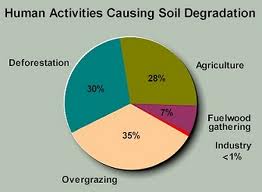
Human Activities


OK, another grim chapter covered in this series simply to underscore the grave seriousness that our beautiful planet faces if it is to continue to sustain all our peoples.  Lester Brown says that now, not tomorrow or the next day, now is the time to change direction, to stop the wholesale destruction of the very environment that we all, yes ALL OF US, depend on for our existence.  It has to be done radically and passionately.

But the book ultimately carries an extremely positive second half.  That there is a Plan B that is viable, achievable and cost-effective, and that many countries are committed to making a life-saving difference.  So while these posts carry some pretty grim messages, and will for a while, please remain hopeful and positive that you, and I, and all those around us, can make a difference once we know what to do.

Total, utter madness, Pt 2.

More on the way we are most likely treating Planet Earth.

At the start of the week the first of a shortish series of articles was published, reflecting my support of the book, World on the Edge.  Here’s what I wrote then:

I have mentioned before the Earth Policy Institute and Lester Brown’s latest book, World on the Edge.  Details of the book are here.

At the time of writing this Post (10am US Mountain Time on the 4th Feb.) I have read through to the end of Chapter 5 of the book and will have it completed soon.  It’s opening my eyes hugely!

I have decided over the next week or so to summarise each chapter, hoping that this encourages many readers of Learning from Dogs to reflect, go to the EPI website, buy the book or think about making a difference in any way that you can.

So today, I move on to the next chapter.

Chapter two, Falling Water Tables and Shrinking Harvests.

  • The term ‘fossil aquifer’ demonstrated that not all aquifers are the same.  Let me quote, “There are two sources of irrigation water: underground water and surface water.  Most underground water comes from aquifers that are regularly replenished with rainfall; these can be pumped indefinitely as long as water extraction does not exceed recharge.  But a distinct minority of aquifers are fossil aquifers – containing water put down eons ago.  Since these do not recharge, irrigation ends whenever they are pumped dry.
  • The big fossil aquifers are the Ogallala underlying the US Great Plains, the major aquifer in Saudi Arabia , and the deep aquifer under the North China Plain.
  • Saudi Arabia started drilling for water from their underground fossil aquifer when after the Arab oil-export in the 1970s, the Saudis realised that they were dependent on imported grain and set out to create self-sufficiency in grain by way of irrigation.
  • In January 2008 the Saudis announced that this huge aquifer was largely depleted!
  • From 2007 to 2010 the Saudi wheat harvest dropped from nearly 3 million tons to around 1 million tons.
  • The likelihood is that the last Saudi harvest will be around 2012.

One can’t imagine how the management of a fine and proud country such as Saudi Arabia could be so foolish!  But slightly closer to home …..

  • In most of the leading U.S. irrigation states, the amount of irrigated area has peaked and begun to decline.
  • California, historically the irrigation leader, has seen irrigated areas fall from nearly 9 million acres in 1997 to an estimated 7.5 million acres in 2010, that’s a 16% drop!  Why?
  • Aquifer depletion and diversion of water to fast-growing cities!
  • Then there’s Texas.  Their irrigated area peaked in 1978 at 7 million acres, now down to 5 million acres, a loss of 29%, as the Ogallala fossil aquifer under the Texas panhandle becomes depleted.
  • Colorado has seen its irrigated are shrink by 15%
  • Arizona’s irrigated area is shrinking.
  • Florida’s irrigated area is shrinking.

Then there’s India.  Then there’s Mexico.  And on and on.  I could quote so much more from this single chapter but – you get the message!

Here’s how the chapter ends.

Today more than half the world’s peoples live in countries with food bubbles.  The question for each of these countries is not whether the bubble will burst, but when – and how the government will cope with it. [Read that last sentence again, folks. Ed]

Will governments be able to import grain to offset production losses?  For some countries, the bursting of the bubble may well be catastrophic.  For the world as a whole, the near-simultaneous bursting of several national food bubbles, as aquifers are depleted could create unmanageable food shortages.

This situation poses an imminent threat to food security and political stability.  We have a choice to make.  We can continue with over-pumping as usual and suffer the consequences.  Or we can launch a worldwide effort to stabilise aquifers by raising water productivity – patterning the campaign on the highly successful effort to raise grainland productivity that was launched a half-century ago.

H’mmm.  Tough reading.

Amazon Drought in 2005.

The above photograph was taken from this website; here’s an extract from the accompanying article.

Food inflation is here and it’s here to stay.  We can see it getting worse every time we buy groceries. Basic food commodities like wheat, corn, soybeans, and rice have been skyrocketing since July, 2010 to record highs.  These sustained price increases are only expected to continue as food production shortfalls really begin to take their toll this year and beyond.

This summer Russia banned exports of wheat to ensure their nation’s supply, which sparked complaints of protectionism.  The U.S. agriculture community is already talking about rationing corn over ethanol mandates versus supply concerns. We’ve seen nothing yet in terms of food protectionism.

But as I wrote in the previous article, “Be worried, be concerned but don’t panic – you and I, all of us, have the collective power to sort this all out.”  Lester Brown’s book sets out some strong advice on the way forward.

To be continued, as they say.

Flowers for your Valentine

This opened my eyes; thought I would share it with you.

I know that many of the several hundred readers of Learning from Dogs are not in the USA.  But many are.  Hence me deciding, after mulling it over, to publish in full the contents of an email that came in a short while ago from the organisation Change.

Here’s that email.

Dear Paul,

Valentine’s Day, which accounts for 40% of fresh flower sales annually, is fast approaching.

Not always a sweet smell.


If you’re planning to order a bouquet from 1-800-Flowers — the world’s largest florist — you should know where most of those flowers really come from.

At flower farms in Ecuador and Colombia — the countries that export the most to the U.S. — two-thirds of the workers are women. These women are routinely subjected to harassment and even rape from their male supervisors. They suffer eye infections and miscarriages from consistent contact with dangerous pesticides.

In the weeks leading up to Valentine’s Day and Mother’s Day, they’re routinely forced to work 80-hour weeks with no overtime pay. Attempts to form a union are met with opposition by police and armed forces.

Many retailers — such as Whole Foods and Stop & Shop — have taken the important first step of offering Fair Trade flowers to consumers who want no part of these abuses. Fair Trade certified farms must adhere to strict standards for workers’ rights, which prevents the abuses described above.

1-800-Flowers is the largest florist in the world. Yet they offer no Fair Trade flowers at all.

Tell 1-800-Flowers to join other major retailers in offering Fair Trade flowers.

1-800-Flowers uses a certifying agency called Florverde, which ensures that its flower farms measure up to certain environmental standards — this is a good thing. But Florverde has almost no labor standards: A farm can be certified even if it uses forced labor.Indeed, Florverde is owned by the Association of Colombian Flower Exporters, so it has a financial incentive to keep wages low and suppress workers’ rights.

This is the week before Valentine’s Day — more people will purchase flowers during the next seven days than any other week this year. This is our best opportunity to demand a promise from 1-800-Flowers to join its competitors in offering Fair Trade flowers. So after you sign the petition, please share this email widely and post on Facebook — do everything you can to pressure 1-800-Flowers to show a little respect for the women who toil in unbearable circumstances. The women without whom they’d have no flowers to sell.

Click the link below to tell 1-800-Flowers to make a promise this Valentine’s Day to sell Fair Trade flowers:

http://www.change.org/petitions/ask-1-800-flowers-to-offer-fair-trade-flowers-that-arent-picked-by-exploited-workers?alert_id=IiStMzHsCg_LCLOlfFAhl&me=aa

Since this campaign began, the company has emailed to tell us that it will post more information on its website about the farms that supply their flowers. But this is a far cry from selling fair trade products — and we have much more to do to make sure workers are protected. This is the week to do it.

Thanks for taking action,

Patrick and the Change.org team

If you feel so minded to sign the petition, which can be done by people outside the USA, then that may be done here.

Thanks.

Earth Policy Institute

An organisation that deserves wide support.

Read it!

My copy of Lester Brown’s book World on the Edge arrived on Tuesday and already it’s opening my eyes big time.  I do recommend that you think about purchasing the book, or you may download the entire book for free – details here.

Regular visitors to Learning from Dogs will remember that there was mention in a recent Post, Group Human Insanity about Lester Brown’s new book.  I have subscribed to regular updates from the EPI and recently received the following; it’s worth reproducing in full, with the permission of the EPI.

Restoring Food Security for All
Takes Action on Many Fronts

www.earth-policy.org/book_bytes/2011/wotech12_ss5

By Lester R. Brown

Today there are three sources of growing demand for food: population growth; rising affluence and the associated jump in meat, milk, and egg consumption; and the use of grain to produce fuel for cars.

Population growth is as old as agriculture itself. But the world is now adding close to 80 million people per year. Even worse, the overwhelming majority of these people are being added in countries where cropland is scarce, soils are eroding, and irrigation wells are going dry.

Even as we are multiplying in number, some 3 billion of us are trying to move up the food chain, consuming more grain-intensive livestock products. As incomes rise, annual grain consumption per person climbs from less than 400 pounds, as in India today, to roughly 1,600 pounds, as among those living high on the food chain in the United States, where diets tend to be heavy with meat and dairy products.

When the United States attempted to reduce its oil insecurity by converting grain into ethanol, the growth in world grain demand, traditionally around 20 million tons per year, suddenly jumped to over 50 million tons in 2007. Roughly 119 million tons of the 2009 U.S. grain harvest of 416 million tons went to ethanol distilleries, an amount that exceeds the grain harvests of Canada and Australia combined. This massive ethanol distillery investment in the United States launched an epic competition between cars and people for grain.

On the supply side of the food equation, several trends are making it more difficult to expand production rapidly enough to keep up with demand. These include soil erosion, aquifer depletion, more frequent crop-shrinking heat waves, melting ice sheets, melting mountain glaciers, and the diversion of irrigation water to cities.

Farmers are also losing cropland to nonfarm uses. Cars compete with people not only for the grain supply but also for the cropland itself. The United States, for example, has paved an area for cars larger than the state of Georgia. Every five cars added to the U.S. fleet means another acre of land will be paved over—the equivalent of a football field.

The implications for China of this relationship between cars and cropland are startling. In 2009, for the first time, more cars were sold in China than in the United States. If China were to reach the U.S. ownership rate of three cars for every four people, it would have over a billion cars, more than the entire world has today. The land that would have to be paved to accommodate these cars would be two thirds the area China currently has in rice.

This pressure on cropland worldwide is running up against increased demand for soybeans, which are the key to expanding the production of meat, milk, and eggs. Adding soybean meal to livestock and poultry feed sharply boosts the efficiency with which grain is converted into animal protein. This is why world soybean use climbed from 17 million tons in 1950 to 252 million tons in 2010, a 15-fold jump.

Nowhere is the soaring demand for soybeans more evident than in China, where the crop originated. As recently as 1995, China produced 14 million tons of soybeans and consumed 14 million tons. In 2010, it still produced 14 million tons, but it consumed a staggering 64 million tons. In fact, over half of the world’s soybean exports now go to China.

Demand is climbing, but since scientists have failed to increase yields rapidly, the world gets more soybeans largely by planting more soybeans. The soybean is devouring land in the United States, Brazil, and Argentina, which together account for four fifths of world soybean production and 90 percent of exports.

Ensuring future food security was once the exclusive responsibility of the ministry of agriculture, but this is changing. The minister of agriculture alone, no matter how competent, can no longer be expected to secure food supplies. Indeed, efforts by the minister of health and family planning to lower human fertility may have a greater effect on future food security than efforts in the ministry of agriculture to raise land fertility.

Similarly, if ministries of energy cannot quickly cut carbon emissions, the world will face crop-shrinking heat waves that can massively and unpredictably reduce harvests. Saving the mountain glaciers whose ice melt irrigates much of the cropland in China and India during the dry season is the responsibility of the ministry of energy, not solely the ministry of agriculture.

If the ministries of forestry and agriculture cannot work together to restore tree cover and reduce floods and soil erosion, grain harvests will shrink not only in smaller countries like Haiti and Mongolia, as they are doing, but also in larger countries, such as Russia and Argentina—both wheat exporters.

And where water shortages restrict food output, it will be up to ministries of water resources to do everything possible to raise national water productivity. With water, as with energy, the principal potential now is in increasing efficiency, not expanding supply.

In a world where cropland is scarce and becoming more so, decisions made in ministries of transportation on whether to develop land-consuming, auto-centered transport systems or more-diversified systems that are much less land-intensive will directly affect world food security.

In the end, it is up to ministries of finance to reallocate resources in a way that recognizes the new threats to security posed by agriculture’s deteriorating natural support systems, continuing population growth, human-driven climate change, and spreading water shortages. Since many ministries of government are involved, it is the head of state who must redefine security.

At the international level, we need to address the threat posed by growing climate volatility and the associated rise in food price volatility. The tripling of wheat, rice, corn, and soybean prices between 2007 and 2008 put enormous stresses on governments and low-income consumers. This price volatility also affects producers, since price uncertainty discourages investment by farmers.

In this unstable situation, a new mechanism to stabilize world grain prices is needed—in effect, a World Food Bank (WFB). This body would establish a support price and a ceiling price for wheat, rice, and corn. The WFB would buy grain when prices fell to the support level and return it to the market when prices reached the ceiling level, thus moderating price fluctuations in a way that would benefit both consumers and producers.

One simple way to improve food security is for the United States to eliminate the fuel ethanol subsidy and abolish the mandates that are driving the conversion of grain into fuel. This would help stabilize grain prices and buy some time in which to reverse the environmental and demographic trends that are undermining our future. It would also help relax the political tensions over food security that have emerged within importing countries.

And finally, we all have a role to play as individuals. Whether we decide to bike, bus, or drive to work will affect carbon emissions, climate change, and food security. The size of the car we drive to the supermarket and its effect on climate may indirectly affect the size of the bill at the supermarket checkout counter. At the family level, we need to hold the line at two children. And if we are living high on the food chain, we can eat less grain-intensive livestock products, improving our health while helping to stabilize climate. Food security is something in which we all have a stake—and a responsibility.

#   #   #

Adapted from Chapter 5, “The Emerging Politics of Food Scarcity” and Chapter 12, “Feeding Eight Billion” in Lester R. Brown, World on the Edge: How to Prevent Environmental and Economic Collapse
(New York: W.W. Norton & Company, 2011), available online at www.earth-policy.org/books/wote

Additional data and information sources at www.earth-policy.org

Feel free to pass this information along to friends, family members, and colleagues!

Not much I can add to that!

UPDATE:  Just a few hours after completing the Post, I saw this on the BBC News website.

The global consumption of fish has hit a record high, reaching an average of 17kg per person, a UN report has shown.

Fisheries and aquaculture supplied the world with about 145m tonnes in 2009, providing about 16% of the population’s animal protein intake.

The findings published by the Food and Agriculture Organization (FAO) also stressed that the status of global fish stocks had not improved.

It said that about 32% were overexploited, depleted or recovering.

“That there has been no improvement in the status of stocks is a matter of great concern,” said Richard Grainger, one of the report’s authors and FAO senior fish expert.

Full article on the BBC is here.


Essence Of The Civilizational Crisis.

A guest Post from Patrice Ayme.

(Well I say ‘guest’ in the sense that Patrice has very kindly allowed me to publish a post he recently published on his own Blog. It’s very much appreciated. I should add that the minor changes that I have made, in my editorial role, are gently to improve the clarity of this fine piece of work, not in any way to amend meaning. Ed.)

THE PRIVATIZATION OF MONEY CREATION IS THE ENGINE OF PLUTOCRACY.

To understand the present financial and economic crisis, we need the clarity of deep philosophy.

The situation is actually simple, in its grossest outline. To create public money, the money everybody uses (be it cash, electronic transfers, swaps, whatever) we use a private system, with proprietary money creating devices inside (say subprime, or derivatives). Civilization has never worked this way before, as the state previously was careful to stay the one and only money creator.

Now society, worldwide, uses a privately-managed public-money ‘system’ creating what is known as a fractional reserve system. [Wikipedia explanation of fractional reserve system, Ed]

That puts huge power in the hands of underground private individuals we don’t even know the names of. Those cloaked powers in turn corrupt the visible political socio-economy, from below. The whole metastasis is not even described, because intellectuals would have to do so, but most are paid by institutions subservient to the present global corruption.

We saw a similar situation in the Roman empire, when the intellectual class was at its richest, but its critical ability had been corrupted.

The modern banking system is a Faustian bargain (as in a deal with the Devil) with the bankers; in exchange for the immense powers the private bankers were given with money creation, they were supposed to loan it back to society for its development.

This worked reasonably well in the Nineteenth Century. But in the Twentieth Century, bankers observed they could support fascism regimes, and get away with it (only Dr. Schacht, one of the “Lords of Finance”, sat in Nuremberg tribunal, and he was exonerated). Now bankers think they can engineer a depression, and get even richer from it: just keep the profits, and make taxpayers pay for the losses.

By Patrice Ayme

Note 1: Paul Krugman observes, with many others, that the crisis of the West needs “intellectual clarity” to be resolved, and, meanwhile we are “overmatched“. I made preceding comment in answer to Krugman’s cogent remarks. (The New York Times had the kindness to publish what I wrote within two minutes! )

Note 2: HOW THE FINANCIAL CRISIS IS TURNING CIVILIZATIONAL:

China just established another train speed record for “unmodified’ train sets (481 km/h). OK, some will claim China stole a lot of Japanese and European technology. And some French engineers have sneered that the very high speed system in China is not as high performing as it looks (France has much higher average speeds, the highest in the world). However, this is not the point. The point is that China is trying very hard to progress and improve. Meanwhile some of the colossal technological edge of the West is eroding away quickly. The result will be world war, or global plutocratic peace (as plutocracy furthers its deal with China).

How does China improve so much and so fast? Because Chinese banks, the largest in the world, operate according to the fiduciary duty, the Faustian bargain, that the fractional reserve system ought to impose, and used to impose in the West.

Top Chinese bankers know all too well that if they cheated, they may end up with a bullet in their skull. China is led by scientists and engineers who turned to politics, but know that they cannot make mistakes in their calculations. Mao made many mistakes, and dozens of millions died.

The history of China, in the 26 centuries before that, was spoiled by a well meaning, but meek philosophy, which left too small a place to deliver progress of the material, and intellectual kinds.

Civilization is not about “leaving it at that”, the way Confucius mostly had it. Civilization is also about the dream, and implementing it. Indeed, civilization cannot stand still, anymore than a biker can stand still, because resources run out always (as Rome and the Mayas found out). Thus moving on is the price of sustainability. Progress is the price of sustainability.

Note 3: It may seem a curious thing that Karl Marx did not make a strident version of the preceding critique (instead he modestly accused tangentially bankers of “monopoly” powers).

But this Marxist discretion proves the point I alluded to above, namely that bankers were better behaved in the 19C. So Marx talked about other things.

Ironically, early American presidents had perfectly well seen the danger bankers posed, and worried more about them than Marx himself! And let no one call Andrew Jackson a communist: that would be serious mistake…

In the 21st Century, by capturing the states (USA, EU), and various institutions above them (IMF, World Bank, BIS), the bankers have established a monopoly of power early American presidents rightly feared (and Jackson, wounded at 13 by an English sword, later a proud carrier of several bullets, and a general in the field, feared very little). The wise know what to fear. The mentally simple just smile, thinking only about themselves, as they can’t think much further than that.

*********************************

From the Ed.

Dear Readers, I really hope that you read Patrice’s post in full and in a quiet place where you could reflect on the meaning and underlying implications of what Patrice is saying.  Those in the UK may have been able to watch a typically fabulous BBC Television series, Ancient Worlds.  It’s still available on BBC iPlayer.

What comes out from the message of mankind over the centuries is that wonderful French expression plus ça change, plus c’est la même chose – the more that changes, the more it stays the same thing.  But where we are as we approach the New Year of 2011 A.D. is possibly at a cross-roads – and I intend to write a little more on this idea over the coming days.