Tag: Toronto Star

What is love?

How the relationship that we have with domesticated animals taught us the meaning of love.

This exploration into the most fundamental emotion of all, love, was stimulated by me just finishing Pat Shipman’s book The Animal Connection.  Sturdy followers of Learning from Dogs (what a hardy lot you are!) will recall that about 5 weeks ago I wrote a post entitled The Woof at the Door which included an essay from Pat, republished with her permission, that set out how “Dogs may have been man’s best friend for thousands of years longer than we realized“.

The following day, I wrote a further piece introducing the book and then commenced reading it myself.  Please go there and read about the praise that the book has received.

What I want to do is to take a personal journey through love.  I should add immediately that I have no specialist or professional background with regard to ‘love’ just, like millions of others, a collection of experiences that have tapped me on the shoulder these last 67 years.

I would imagine that there are almost as many ideas about the meaning of love as there are people on this planet.  Dictionary.com produces this in answer to the search on the word ‘love’.

love

[luhv]  noun, verb, loved, lov·ing.
noun

  1. a profoundly tender, passionate affection for another person.
  2. a feeling of warm personal attachment or deep affection, as for a parent, child, or friend.
  3. sexual passion or desire.
  4. a person toward whom love is felt; beloved person;sweetheart.
  5. (used in direct address as a term of endearment, affection,or the like): Would you like to see a movie, love?

But, I don’t know about you, those definitions leave something missing for me.  Here’s my take on what love is, and it’s only by having so many dogs in my life that I have found this clarity of thought.

Love is trust, love is pure openness, love is knowing that you offer yourself without any barriers.  Think how you dream of giving yourself outwardly in the total surrender of love.  Reflect on that surrender that you experience when deeply connecting, nay loving, with your dog.

Here’s how Pat Shipman expressed it in her book:

Clearly, part of the basis of our intimacy with tame or domesticated animals involves physical contact.  People who work with animals touch them.  It doesn’t matter if you are a horse breeder, a farmer raising pigs, a pet owner, a zoo keeper, or a veterinarian, we touch them, stroke them, hug them.  Many of us kiss our animals and many allow them to sleep with us.  We touch animals because this is a crucial aspect of the nonverbal communication that we have evolved over millennia.  We touch animals because it raises our oxytocin levels – and the animal’s oxytocin levels.  We touch animals because we and they enjoy it. (p.274)

Pat soon after writes,

From the first stone tool to the origin of language and the most recent living tools, our involvement with animals has directed our course.

Thus it is not beyond reason to presume that tens of thousands of years of physical and emotional closeness between humans and their animals have developed the emotion of love in us humans, so eloquently expressed in art and life.

There’s another aspect of what we may have learned from dogs.  In Alexandra Horowitz’s book Inside of a Dog, she writes of the way that dogs look at us,

Having been folded into the world of humans, dogs no longer needed some of the skills that they would to survive on their own.  As we’ll see, what dogs lack in physical skills, they make up for in people skills.

AND THEN OUR EYES MET ….

There is one final, seemingly minor difference between the two species.  This one small behavioral variation between wolves and dogs has remarkable consequences.  The difference is this: dogs look at our eyes.

Dogs make eye contact and look to us for information – about the location of food, about our emotions, about what is happening.  Wolves avoid eye contact.  In both species, eye contact can be a threat: to stare is to assert authority.  So too is it with humans.  In one of my undergraduate psychology classes, I have my students do a simple field experiment wherein they try to make and hold eye contact with everyone they pass on campus.  Both they and those on the receiving end of their stares behave remarkably consistently: everyone can’t wait to break eye contact.  It’s stressful for the students, a great number of whom suddenly claim to be shy: they report their hearts begin to race and they start sweating when simply holding someone’s gaze for a few seconds.  They concoct elaborate stories on the spot to explain why someone looked away, or held their gaze for a half second longer.  For the most part, their staring is met with deflected gazes from those they eyeball.

Then a few sentences later, Alexandra continues to write,

Dogs look, too.  Though they have inherited some aversion to staring too long at eyes, dogs seem to be predisposed to inspect our faces for information, for reassurance, for guidance.  Not only is this pleasing to us – there is a certain satisfaction in gazing deep into a dog’s eyes gazing back at you – it is also perfectly suited to getting along with humans. (pps 45-46)

No apologies for now inserting the photograph of Pharaoh that adorns the Welcome page of Learning from Dogs.  Underlines what Alexandra wrote above in spades.
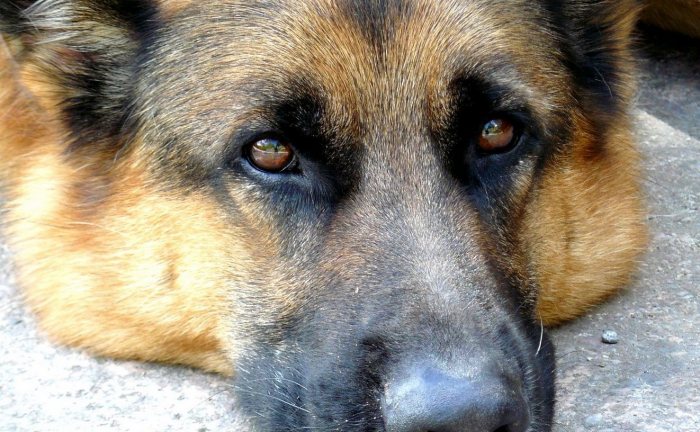
Now that is a gaze!

OK, time to start bringing this to a close.

The Toronto Star ran a great review of Pat Shipman’s book from which I will just take this snippet,

“But understanding animals and empathizing with them also triggered other changes in humanity’s evolution, Shipman said.

All those things allow people to live with people. Once people have domesticated animals, they start to live in stable groups. They have fields, crops and more permanent dwellings.”

In other words, we can see that living with animals took us from nomadic hunter-gatherers to living with other people in stable groups; the birth of farming.  It is my contention that the evolution of communities and the resulting more stable relationships elevated love leading to love becoming a higher order emotion than just associated with the ‘grunt’ of reproduction.

I started by saying that it was Pat Shipman’s book that stimulated me to wander through my own consciousness and realise that when I bury my face in the side of one of the dogs, say on the bed, it resonates with the most ancient memories in my human consciousness.  Indeed, I am of no doubt that my openness and emotional surrender to that dog enables me to be a better, as in more loving, person for Jean.

So let me close this essay by asking you to return here and read the guest post tomorrow from author Eleanore MacDonald, where Eleanore writes of the loss of their dog Djuna.  You will read the most precious and heart-rending words about love.  Thank you.
What part of the word ‘change’ are you having trouble with?

Climate change denialists and cloud cuckoo land!

Yesterday, I republished the recent Post from Martin Lack under my title of Playing with fire!  In that Post there was a reference to just one example of the very different climatic world that we all live in.  That reference was to the recent huge devastation of the apple and soft-fruit crops in Northern USA and Canada.

The website Climate Denial Crock of the Week carried the story in a clear and fine fashion.  Let me borrow some of that content,

Canada/US Great Lakes Area Fruit Growers “Wipeout” Due to Extreme Spring. Deniers: “They Need More CO2″

May 18, 2012

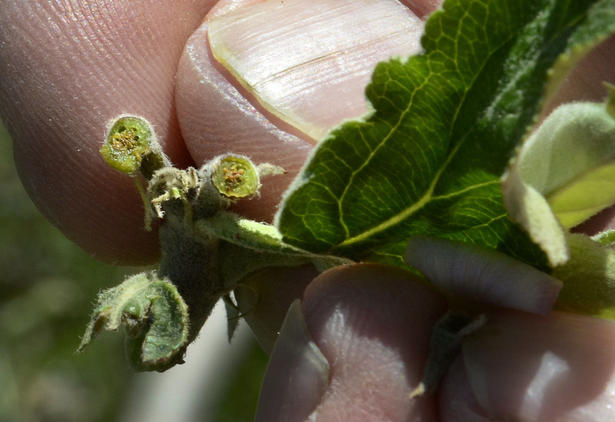
The brown centre of an apple blossom indicates a bloom that would not result in an apple being produced following this spring’s unusual weather.

Elsewhere on the blog, we are still hearing that “CO2 is good for Plants”. Meanwhile, here in the reality based community….

Windsor Star, May 5: 

A catastrophic freeze has wiped out about 80 per cent of Ontario’s apple crop and has the fruit industry looking at losses already estimated at more than $100 million.

“This is the worst disaster fruit growers have ever, ever experienced,” Harrow-area orchard owner Keith Wright said Friday. “We’ve been here for generations and I’ve never heard of this happening before.

“This is unheard of … all fruit growing areas in the Great Lakes area, in Michigan, Pennsylvania, New York State, Ontario, are all basically wiped out.”

Wright lost hundreds of thousands of dollars worth of apples and peaches Sunday morning when freezing temperatures killed the blossoms.

Warm temperatures caused fruit trees to bloom early and when temperatures plummeted Sunday morning it damaged or wiped out much of the $60-million apple crop and 20 to 30 per cent of Ontario’s $48-million tender fruit crop which includes peaches, cherries, pears, plums and nectarines.

Brian Gilroy, a Georgian Bay-area apple grower who is chairman of the Ontario Apple Growers, said the loss to fruit growers and the economy will easily be more than $100 million. On top of the lost yield or no crop at all, orchard workers and spinoff industries such as juice, packing, storage and farm supplies will be affected.

Gilroy said consumers will find locally grown apples pricey and difficult to find this fall. Some varieties of apples, such as Empire, will be very difficult to find.

Washington State has a good crop but consumers should expect apple prices to jump because all of northeastern North America was affected, he said.

The article goes on to report from the Globe and Mail and the Toronto Star.  It does not make for pretty reading!

Then in a private email, Martin referred me to this Think Progress article of May 19th,

April 2012: Earth’s 5th Warmest On Record And La Niña Officially Ends, So The Heat Is On.

By Climate Guest Blogger on May 19, 2012 at 3:09 pm

JR: It’s remarkable how warm it was globally in April considering that we were only just coming out of a double dip La Niña. If we don’t triple dip, we’ll set more temperature records soon. Indeed, NOAA models predict a good chance of an El Niño forming in the late summer, which would make it quite likely next year would be the hottest on record. As for April, you’ll note it was hot in the ‘wrong’ places again — over much of the tundra, which is a carbon time bomb

The Think Progress article then draws heavily on an extensive comment from Dr.Jeff Master’s WunderBlog that I am going republish, hopefully in the interests of helping to spread the truth about this planet of ours.

April 2012 was the globe’s 5th warmest April on record, according to the National Oceanic and Atmospheric Administration’s National Climatic Data Center (NCDC). NASA rated April 2012 as the 4th warmest April on record. April 2012 global land temperatures were the 2nd warmest on record, and the Northern Hemisphere land surface temperature was 1.74°C (3.13°F) above the 20th century average, marking the warmest April since records began in 1880. Global ocean temperatures were the 11th warmest on record, and April 2012 was the 427th consecutive month with ocean temperatures warmer than the 20th century average. The last time the ocean temperatures were below average was September 1976. The increase in global temperatures relative to average compared to March 2012 (16th warmest March on record) was due, in part, to warming waters in the Eastern Pacific, due to the La Niña event that ended in April. Global satellite-measured temperatures for the lowest 8 km of the atmosphere were 6th or 4th warmest in the 34-year record, according to Remote Sensing Systems and the University of Alabama Huntsville (UAH). April temperatures in the stratosphere were the 1st to 4th coldest on record. We expect cold temperatures there due to the greenhouse effect and to destruction of ozone due to CFC pollution. Northern Hemisphere snow cover during April was 4th smallest in the 46-year record. Wunderground’s weather historian, Christopher C. Burt, has a comprehensive post on the notable weather events of April in his April 2012 Global Weather Extremes Summary. Notably, national heat records (for warmest April temperature on record) occurred in the United States (a tie), Germany, Austria, Poland, Belarus, Lithuania, Moldova, Hungry, Croatia, Ukraine, and Slovakia as well as the cities of Moscow and Munich.

Figure 1. Departure of temperature from average for April 2012. The most notable extremes were the warmth observed across Russia, the United States, Alaska, and parts of the Middle East and eastern Europe. There were no land areas with large-scale cold conditions of note. Image credit: National Climatic Data Center (NCDC) .

La Niña officially ends

According to NOAA’s Climate Prediction Center (CPC), La Niña conditions are no longer present in the equatorial Pacific, where sea surface temperatures were approximately average as of May 13. The threshold for a La Niña is for these temperatures to be 0.5°C below average or cooler. CPC forecasts that neutral conditions will persist though the summer, with a 41% chance of an El Niño event developing in time for the August – September – October peak of hurricane season. El Niño conditions tend to decrease Atlantic hurricane activity, by increasing wind shear over the tropical Atlantic.

Figure 2. Arctic sea ice extent in 2012 (blue line) compared to the average (thick grey line.) The record low year of 2007 (dashed green line) is also shown. Arctic sea ice was near average during April, but has fallen well below average during the first half of May. Image credit: National Snow and Ice Data Center (NSIDC).

April Arctic sea ice extent near average
Arctic sea ice extent was near average in April 2012, the 17th lowest (18th greatest) extent in the 35-year satellite record, according to the National Snow and Ice Data Center (NSIDC). This was the largest April Arctic sea ice extent since 2001. However, ice in the Arctic is increasingly young, thin ice, which will make it easy for this year’s ice to melt away to near-record low levels this summer, if warmer than average weather occurs in the Arctic.

So to those that still think the jury is out on climate change, let me just repeat the title, “What part of the word change are you having trouble with?”