Tag: The Conversation,

The facts behind hurricanes

Being from London originally, I grew up not being aware of hurricanes.

Now that we are living in Oregon, hurricanes are closer, both literally and figuratively.

This article was posted for the youngsters but I’m using it as my post because of its general interest.

ooOOoo

How much rain can a hurricane make, and does the storm size matter?
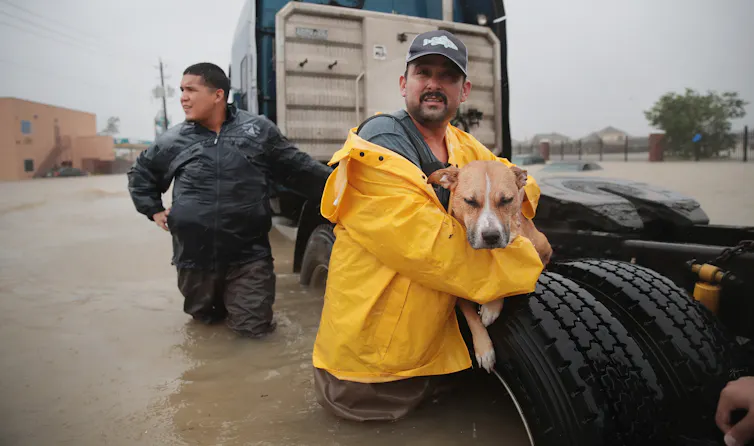
Two men stand in thigh-deep water in the rain next to a truck, one is holding a dog under his rain jacket.
Hurricane Harvey dropped several feet of rain on Texas, stranding trucks, people and their pets. Scott Olson/Getty Images

Zachary Handlos, Georgia Institute of Technology

Curious Kids is a series for children of all ages. If you have a question you’d like an expert to answer, send it to CuriousKidsUS@theconversation.com.


How much rain can a hurricane make, and how much do big versus small hurricanes make? – Naarah, age 8, Pittsburgh


Hurricanes can produce enormous amounts of rain, adding up to trillions of gallons of water. But the big risk isn’t their total amount – it’s how much rain falls on each location.

One town in Texas got over 60 inches (152 centimeters) of rain from Hurricane Harvey over five days in 2017. That means empty swimming pools there would have filled with rainwater 5 feet (1.5 meters) deep. Hurricane Lane dumped 58 inches (147 centimeters) of rain on Kahuna Falls, Hawaii, the following year.

So, what causes that much rain, and does the size of the storm matter?

I’m an atmospheric scientist who teaches college students about weather at Georgia Tech. Let’s take a look at where a hurricane’s rainfall comes from and some of the questions about hurricanes and their rainfall that scientists are still trying to answer.

First, what goes into creating a hurricane?

A few ingredients are needed for a hurricane to form: A tropical thunderstorm complex, lots of moisture in the air, winds that don’t change speed much with height, and warm sea surface waters below.

The water temperature is very important.

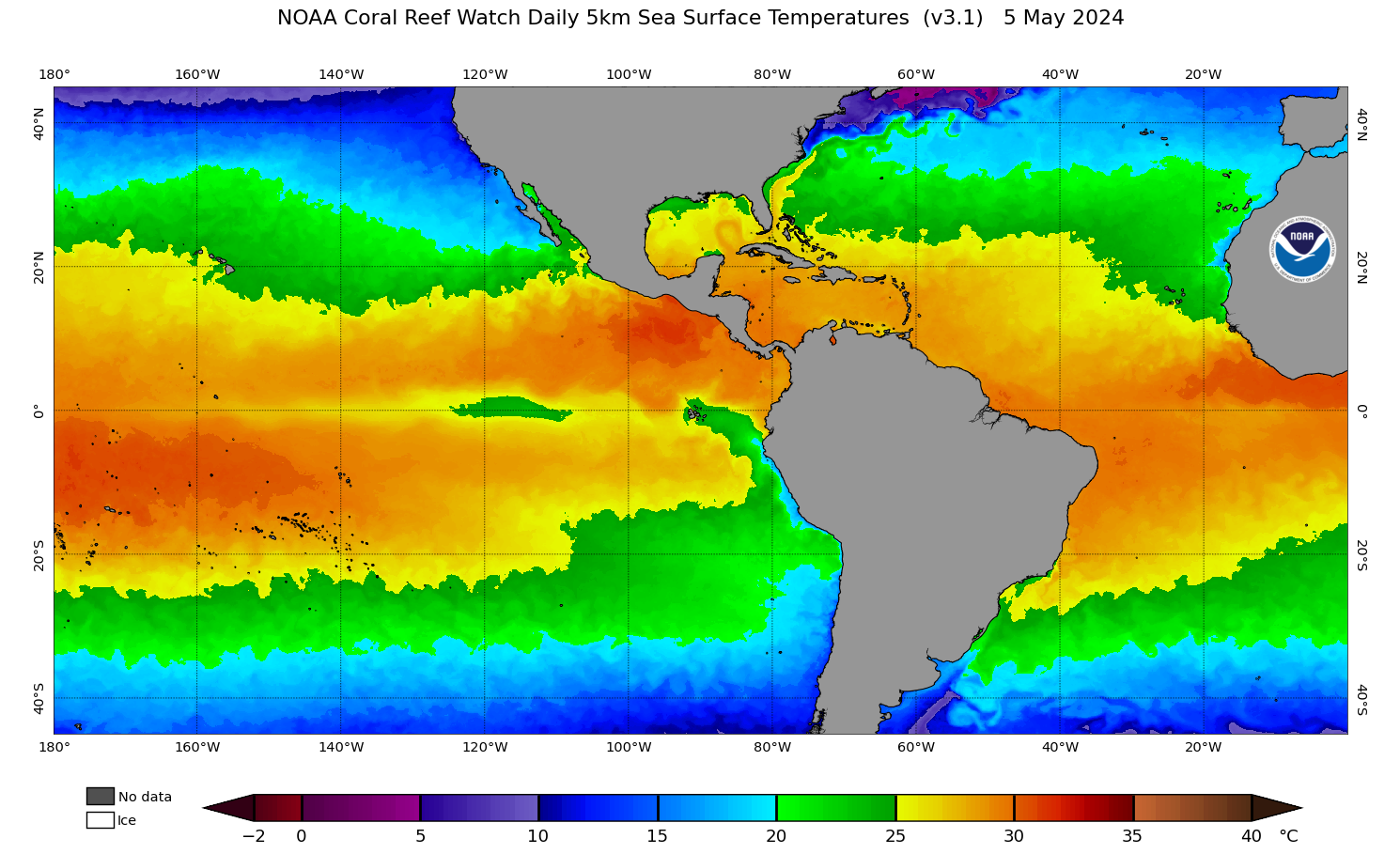
A map shows water temperatures very warm in the Gulf.
Sea surface temperatures on Oct. 6, 2026, show the very warm water in the western Gulf of Mexico, where a tropical storm grew into Hurricane Isaias the following day. Water that is over 80 degrees Fahrenheit (26.5 degrees Celsius) can fuel hurricanes. NOAA

The magic number for surface water temperature to be able to fuel a hurricane is at least 80 degrees Fahrenheit (26.5 degrees Celsius). At that temperature and above, the warm ocean water evaporates into the air, changing from liquid to vapor. As it makes that change, it provides energy to fuel the storm and also adds moisture to the atmosphere that eventually falls as rain.

Another very interesting post from The Conversation

When a hurricane moves over warm water, especially when the warm water extends many feet below the surface, the storm pulls in even more energy and moisture.

What affects hurricane size and rainfall?

This is one of the many questions about hurricanes that atmospheric scientists are working on.

The average hurricane is about 300 miles (482 kilometers) wide, but hurricanes – or typhoons, as they’re called in the western Pacific of the Northern Hemisphere – can be much bigger or smaller.

Super Typhoon Tip in 1979 grew to half the size of the lower 48 U.S. states. It had a radius of about 690 miles (1,110 kilometers), measured from the center of the storm to its outer edges, meaning it was 1,380 miles (2,222 kilometers) wide. Tropical Storm Marco’s gale-force winds in 2008, in comparison, had a radius of 11.5 miles (18.5 kilometers), meaning it was about 23 miles (37 kilometers) across – not much larger than New York City.

A map shows the difference in size between the largest tropical storm, Tip, which took up half the Lower 48 states, and Marcos, which was about the size of New York City.
How the largest tropical cyclone in recorded history and the smallest compare. It’s quite a difference! NOAA

In 2025, scientists published a study showing that hurricane size appears to be influenced by how warm the ocean water is compared to its usual temperature that time of year. So, if a hurricane moves over water that is much warmer than normal, it tends to grow in size rapidly as well as growing in strength.

A recent hurricane that was very large in size was the extremely destructive Hurricane Helene in 2024. As Helene moved over water near Florida that was much warmer than normal for late September, it picked up lots of moisture that it carried all the way to the mountains of North Carolina. Several days of rain from the storm caused catastrophic flooding there.

A satellite image of a very large Hurricane Helene hitting the Florida Gulf coast.
A satellite image shows Hurricane Helene making landfall on Sept. 26, 2024, near Perry, Fla. The storm carried a lot of water far inland, causing flooding in the North Carolina mountains. NOAA National Environmental Satellite, Data, and Information Service

But don’t count the small hurricanes out.

Just because a hurricane is small, that does not mean that it won’t have a big impact.

Hurricane Andrew in 1992 was destructive yet small. Its strongest winds extended only about 90 miles (150 km) from its center when it reached Miami and the Everglades. But that Category 5 hurricane is still known as one of the strongest hurricanes to hit the United States. It destroyed more than 25,000 homes.

A radar image showing the reach of Andrew's rain bands indicates a small storm.
Hurricane Andrew wasn’t very big when it made landfall on Elliott Key, Fla., near Miami, on Aug. 24, 1992, but it was powerful and extremely destructive. National Hurricane Center

A strong storm isn’t necessary for a lot of rain to fall. Tropical Storm Allison in 2001 is still one of the wettest tropical weather events in U.S. history. It caused over US$4 billion in damage in Texas alone, and it didn’t even develop into a hurricane!

So, what really leads to the highest rainfall totals?

Hurricanes that move slowly or nearly stop along their path usually cause the biggest rainfall problems because their rain keeps falling over the same location. The rain may be just as intense in a fast-moving hurricane, but it doesn’t stick around as long.

An example is Hurricane Harvey, which hit southeastern Texas in late August 2017. The storm dropped an estimated 27 trillion gallons of water over the state – that’s enough to fill about 40 million Olympic-size swimming pools.

When Harvey stalled over the Houston area, the storm kept drawing moisture from the warm waters of the Gulf. Over four days, it brought precipitation that totals as high as 60.58 inches (1.54 meters) of rain over Nederland, Texas. The extreme rainfall overran the town’s drainage and transformed Nederland into an island.

A map of rainfall totals over several days shows areas around Houston receiving extremely high amounts of rain.
The Houston area received extraordinarily high precipitation totals from Aug. 25 through Sept. 1, 2017, associated with Hurricane Harvey. National Weather Service, Lake Charles, La., office

If a storm moves fast, like Hurricane Michael did in 2018 when it hit the Florida Panhandle, its winds and storm surge can make a big mess, but its rainfall totals will be lower.

Michael was a Category 5 hurricane – more powerful than Harvey and Helene – but its rainfall totals for locations along its path ranged from 6 to 10 inches (15 to 25 centimeters) because it was moving so fast. That’s still a lot of rain, but not compared to Harvey or to Helene, which dumped 30 inches (76 centimeters) of rain on Busick, N.C., over a few days.

A satellite image showing the eye of the hurricane on the Florida coast.
Hurricane Michael passes over Mexico Beach, Fla., on Oct. 10, 2018. The storm moved quickly, so it brought less rainfall to each location compared to slow-moving Hurricane Harvey in Texas the previous year, but its wind and storm surge caused catastrophic damage. NOAA NESDIS

So, a hurricane can be large or small in size and still have a big impact, depending on how slowly it’s moving.

There is still a lot to learn about hurricanes. Some big questions involve what’s known as rapid intensification. That occurs when a tropical storm’s maximum wind speed increases quickly, by 30 knots (about 34.5 miles per hour or 55 kilometers per hour) or more within 24 hours.

When rapid intensification occurs, as happened with hurricanes Harvey, Michael and Helene before they hit land, the storm can surprise coastal residents and become catastrophic.

Hurricanes of all sizes can be dangerous, so accurate forecasting well before they reach land is crucial to help people prepare for their impacts. One very important area of research that today’s scientists – and future scientists – can work on is improving forecasting so coastal residents know what’s coming and have time to prepare.


Hello, curious kids! Do you have a question you’d like an expert to answer? Ask an adult to send your question to CuriousKidsUS@theconversation.com. Please tell us your name, age and the city where you live.

And since curiosity has no age limit – adults, let us know what you’re wondering, too. We won’t be able to answer every question, but we will do our best.

Zachary Handlos, Atmospheric Science Educator, Georgia Institute of Technology

This article is republished from The Conversation under a Creative Commons license. Read the original article.

ooOOoo

The changing weather is a frequent topic on all communication channels.

Here in Merlin, Southern Oregon, we have had weeks of drought, and what had been forecasted for early next week as rain showers has now been changed to cloudy conditions.

Workout information

This is an interesting report.

Exercise is good. From the following article we read that exercise is much more than an event. Read on to see where I am coming from.

ooOOoo

Your cells keep a record of every workout you’ve ever done – and those gains persist even after a break from exercise

Person lying half on a treadmill, half on the ground
Your body retains the benefits of exercise even when you need to hit pause. Williams+Hirakawa/The Image Bank via Getty Images

Diego Hernandez-Saavedra, University of Illinois Urbana-Champaign and Yi-Heng (Hank) Huang, University of Illinois Urbana-Champaign

Have you ever taken months off training – maybe due to an injury, a new baby or crushing work deadlines – and come back convinced you were starting from zero?

Research from our team has some good news: At the cellular level, you probably weren’t.

We found that muscle and liver cells store memories from every training session in ways that may help improve endurance, control blood sugar levels and even slow weight regain after inactivity.

Use it or lose it? Maybe not

For most of the past century, long before fad diets and fancy workout trends took off, exercise was considered one of the most effective lifestyle changes to lower the risk of heart disease, Type 2 diabetes, several cancers and early death for people of all ages. But people typically understood exercise as something whose beneficial effects fade away over time: You use it or lose it.

When you stop training, your maximum oxygen uptake, muscle gains and insulin sensitivity drift back to where they started, often within weeks. Physical activity guidelines are built on this fact, which is why they emphasize consistency above all else.

Consistency, however, is a luxury that roughly 3 in 4 American adults aren’t able to enjoy. People can experience injuries, illness, pregnancy or jobs that limit their time for or ability to exercise. If adaptation really resets, every time you step into the gym would be as if you’ve never been there before. But that scenario doesn’t match what coaches and returning athletes typically describe: In practice, people who have trained before can get fit again faster than those who haven’t undergone similar training.

In recent years, however, scientists have started challenging the concept of “use it or lose it.” New research hints that your cells might keep a record of your training history so all of your gains are not completely lost.

More than muscle

We are exercise physiologists who study how cells remember exercise. Our lab and others have shown that the body is able to store a form of exercise memory across different organs.

To study how this exercise memory works, our team of researchers use an ON-OFF-ON exercise training protocol in mice, which involves an initial four- to eight-week training period, followed by detraining – a period of no exercise – and a second training bout. This method allows us to examine how cells form a memory of exercise, maintain a record of exercise through detraining, and recall memories of prior training when exposed again to exercise.

Using this strategy, our team found that skeletal muscle memory accelerates muscle growth. Compared to mice with no training history, mice who retrained grew bigger muscles, and the individual muscle fibers inside those muscles grew too. Larger muscle fibers meant that the working cells were themselves getting bigger, rather than the surrounding tissue.

Microscopy image of small pink dots enclosed within several circular membranes
Individual muscle fibers (the pink dots) grow larger with exercise. Ed Reschke/Stone via Getty Images

Looking more closely at these muscle cells, we found that retrained muscle is better at matching energy production to demand – meaning, the muscles were better at drawing from energy stores when it’s needed most – and this ability persists without further exercise. This memory held even when the mice ate a high-fat diet, suggesting that prior training can still offer benefits even when diet is working against those gains.

Muscle isn’t the only body part that learns from exercise. Working muscle needs fuel, and the liver supplies it during and after training sessions.

My colleagues and I found that liver cells also store exercise memory and uses it to feed muscle more efficiently. In both mice and people who trained, stopped, then trained again, their livers released higher levels of a family of enzymes called carboxylesterases. These enzymes chop up lipids circulating in the blood, delivering fat in a form that muscle can take up and burn as it grows.

A record that outlives you

Recorded cellular memories of exercise may even be passed down to future generations.

In mice, we found that three to four weeks of maternal and paternal endurance exercise can have a lasting effect on their offspring. Compared to offspring born to sedentary parents, parental exercise granted protection against poor blood sugar levels and excess weight gain for an entire year after birth.

Researchers have hypothesized numerous ways that prenatal exercise may affect offspring. For example, maternal exercise might allow offspring to spend more time developing in the womb or lead parents to producer higher quality milk.

But there remains much to be discovered on how parents influence the health of their children and whether their lifestyle could provide a fitness advantage across generations.

Every cell remembers

Biology has traditionally granted memory to a short list of cells. Neurons store memory in the connections between them. Immune cells store memory so they can recognize pathogens faster and more strongly the next time they encounter them.

Researchers previously considered all other cells to be memoryless; a cell responds to a signal, then returns to baseline without keeping a record of that interaction. But that assumption is now coming apart.

Skin stem cells can keep a record of inflammation, allowing them to heal a new wound faster months later. Human fat cells keep a record of obesity that persists even after substantial weight loss, which may account for why you gain weight faster when switching back to a high-calorie diet – the so-called yo-yo effect.

Two people sitting inside a gym, fit bumping
While consistent exercise is still key to health, don’t stress if you need to take a break. The Good Brigade/DigitalVision via Getty Images

We propose that every cell in the body remembers exercise, regardless of how little or how much someone trains. The question is how long these records are stored and whether researchers could prolong or expand each cell’s storage capacity. Better understanding of how cells learn and remember exercise, where they store memories and how those memories are preserved could help improve exercise guidelines for those who cannot exercise for prolonged or consistent periods of time.

To be clear, none of these findings are evidence for skipping the gym; nothing in our data suggests the effects of past training can substitute for present training. But there is hope that the work you put into getting in shape isn’t completely lost over time.

Somewhere, deep in your cells, there is a record waiting to be replayed the next time you lace up your running shoes, pick up a pair of dumbbells or want to fulfill a New Year’s resolution.

Diego Hernandez-Saavedra, Assistant Professor of Applied Health Sciences, University of Illinois Urbana-Champaign and Yi-Heng (Hank) Huang, Ph.D. Candidate in Applied Health Sciences, University of Illinois Urbana-Champaign

This article is republished from The Conversation under a Creative Commons license. Read the original article.

ooOOoo

There were many aspects of this applied health science that surprised me, and I suspect will surprise others. It is another supporting reason why I go cycling three or four times a week.