This is the concluding part four of a multipart series on the factors that drive U.S. and foreign bond prices and yields.
[Part One is here, Part Two here, Part Three here Ed.]
Bond’s in a weak or faltering economy will generate a lower return to lenders than bonds in a strong economy, absent inflation or any other material changes in the purchasing power of the currency. Weak demand for goods and services means weak demand for financial capital which means low rates of return on financial capital.
The policies of the government can increase the borrowing costs of private industry. Fiscal policy that increases taxes reduces the profitability of projects and undermines the ability of companies to pay coupons and repay principal. Monetary policy that increases the money supply may lead to inflation, which also increases the cost of borrowing and reduces economic activity.
Lastly, and of the greatest concern of late, is the level of borrowing by the U.S. government. Debt levels are at record highs, with no relief in sight. The AAA rating of U.S. debt is reportedly in jeopardy (Chicago Tribune editorial).
Moody's Corporate Logo
Both existing and new lenders worry about the ability of the U.S. government to repay. Yes, the can simply roll over existing debt by raising taxes or creating money to retire old debt and replace it with new, but the interest rate required by new lenders goes up as the ability of the private economy to sustain tax revenues falls and the risk of inflation rises (Moody’s explains U.S. bond ratings).
Both factors are in play now: an anemic economy with little hope that this administration will undertake policies that support business, and a ballooning money supply and weak dollar that undermine the purchasing power of the returns to lenders. The returns to U.S. debt may still be healthy relative to those one can earn in other countries, but the spread is shrinking. The private economy remains fundamentally strong, thanks to the work ethic of the American people and the profit motive of the capitalistic system, but the policies of the U.S. government are straining those resources.
A dream that, perhaps, one day politicians will be truthful.
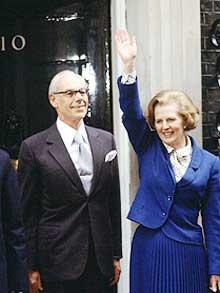
British General Elections are always fascinating occasions. On the one hand they are deadly serious. Mrs Thatcher’s win in 1979 set up the country for 18 years of Tory rule with massive changes and frequent social conflict whose effects are still felt today.
It was either a total social and economic disaster or a great leap forward into modernity depending on your point of view. Her victory of course also consigned Labour to 18 years of impotent pfaffing about in the political wilderness.
But on the other hand they always cause a great deal of hilarity to the student of human behaviour, as day after day nonsensical, fatuous, spinladen pronouncements are made by those desperate to get their hands on power.
And these pronouncements of future intentions (often delivered with the word “pledge” attached – as if that were somehow more weighty than “promise”) are often based not on reason or good planning but on how they will go down with the public!
And amazingly, they often seem to be made without any great thought about the consequences. Brown has got some stick only today because he promised (or if you like “pledged”) that there would be no VAT imposed on the Simon Cowell charity record for Haiti, yet EU rules prohibit such gestures and so the Treasury is having after all to charge VAT and is now promising to pay this back with increased aid as a workaround.
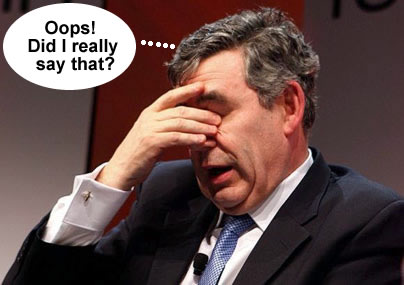
Foot in mouth - again!
The increased aid could have been given in the first place without his headline-grabbing “pledge” to make it VAT-free.
As ex Chancellor, Brown should have KNOWN that removing VAT from individual items on a whim is not allowed, but he clearly spoke without thinking, the headline-potential of declaring the record VAT-free being irresistible.
Gordon Brown has also got himself into “another fine mess” by trying out a variation of his trick of the 1994 election.
During the pre-election campaign then he solemnly pledged NOT to raise income tax. No, not he. He was not the man to steal the public’s hard-earned cash by raising income tax; that would be most unsporting.
Meanwhile the poor old honest and hopelessly-naive spinfree Lib-Dems promised to put one measly pence onto income tax to pay for more education. Naturally, in the election they got slaughtered as wild spenders. You couldn’t make it up!
As for Gordon Brown, he kept his word. Income Tax remained as untouched as the virgin snow. But he had a cunning plan; as soon as he got his hands on our money, he vastly raised National Insurance (NI) instead. It actually comes down to the same thing, but of course the SPIN was different. That was how Brown’s management of our finances began, and so it has gone ever since.
Well, it’s hard not to repeat a winning formula, as many crooks have found out to their cost. Putting up National Insurance of course (even if this time you TELL the people you’re going to do it) can be sold as much more socially responsible than simply putting up income tax. The former can be spun as essential to pay for hospitals, pensions and the like whereas the latter seems more often like Robin Hood in reverse. The silly thing is that it’s ALL MONEY TAKEN FROM OUR PAYPACKETS, so what difference does it make?
Well, to the wage-earner, none at all, but to the employer quite a lot, and this is where Brown is batting on a sticky wicket. Increasing National Insurance certainly IS a “tax on jobs”. Let’s look across the English Channel ……
They have a VERY high level of NI (French = “charges”) in France. The result is that:
Employers bend over backwards NOT to employ anyone; it is so expensive.
Productivity in France is very high (higher than in the US – fewer workers than in many other countries do the same amount of work).
Unemployment is also consistently very high.
In Denmark it is much cheaper and easier to hire and fire people than in France. Oh Dear! Horrible, nasty, capitalist, Denmark and wonderful, caring, socialist France!!
Errmmm … No, actually; unemployment in Denmark is usually around 4% (I just checked; it is TODAY despite all the economic chaos just 4.1%) and in France endemically nearer 10%.
Rocket science it ain’t. Sad for the otherwise-could-be-employed it certainly is.
Well, even the plebs are not quite as gullible as 25 years ago. The negative effects on employment are blindingly-obvious to employers but as it is such an easy thing to understand (though not apparently for the entire French government or for Mr Brown) ordinary people are beginning to understand it, too. Brown’s statement that he will raise NI isn’t doing his election campaign any good at all.
However, as it is currently business leaders in particular who are bleating about this, perhaps it will be spun as: “Don’t worry chaps – it’s just those capitalist business-chief bastards whinging again”. That’s one thing you can rely on in an election; there will be endless spinning, quoting of statistics and rubbishing of the enemy ….

 Learning from Dogs