A rather poignant moment as the last NASA Space Shuttle is programmed to launch today.
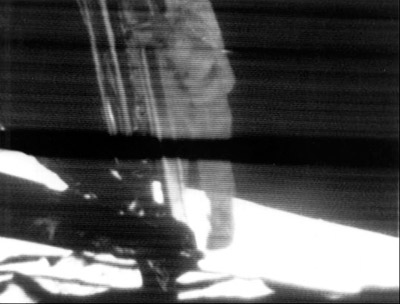
Many of my age will have been fascinated by man’s progress in exploring space, from the Russian Sputnik 1 launched into earth orbit in October, 1957 (I was 12!) through to man first putting a foot on the surface of the moon on 20th July, 1969 on the US Apollo 11 Mission.
Today, the end of an era is being played out. Today, the last Space Shuttle, Atlantis, is due to be launched. From the NASA website,
Date: July 8
Mission: STS-135
Launch Vehicle: Space Shuttle Atlantis
Launch Site: Kennedy Space Center – Launch Pad 39A
Launch Time: 11:26 a.m. EDT
Description: Space shuttle Atlantis will carry the Raffaello multipurpose logistics module to deliver supplies, logistics and spare parts to the International Space Station. Atlantis also will fly a system to investigate the potential for robotically refueling existing spacecraft and return a failed ammonia pump module.
The BBC recently had an interesting news item where all six crew members of Shuttle Discovery were interviewed after that last flight, more details including a video of the interview here.
Astronauts of shuttle Discovery describe ‘amazing’ craft
At almost 27 years old, and with more than 143 million miles on the clock, the space shuttle Discovery returned from her final mission in March.
The crew of Discovery’s final mission, Commander Steve Lindsey, astronauts Eric Boe, Stephen Bowen, Alvin Drew, Michael Barratt and Nicole Stott, spoke to Breakfast News about what it was like to fly the shuttle for the last time.
So where does it go from here?
The current edition of The Economist has a quite a lot to say about that. A leader starts with raising the question of how big the Earth is?
HOW big is the Earth? Any encyclopedia will give you an answer: its equatorial diameter is 12,756km, or, for those who prefer to think that way, 7,926 miles. Ah, but then there is the atmosphere. Should that count? Perhaps the planet’s true diameter is actually nearer 13,000km, including all its air. But even that may no longer be an adequate measure. For the Earth now reaches farther still. The vacuum surrounding it buzzes with artificial satellites, forming a sort of technosphere beyond the atmosphere. Most of these satellites circle only a few hundred kilometres above the planet’s solid surface. Many, though, form a ring like Saturn’s at a distance of 36,000km, the place at which an object takes 24 hours to orbit the Earth and thus hovers continuously over the same point of the planet.
Later, this leader speculates,
The reason for that second objective is also the reason for thinking 2011 might, in the history books of the future, be seen as the year when the space cadets’ dream finally died. It marks the end of America’s space-shuttle programme, whose last mission is planned to launch on July 8th (see article, article). The shuttle was supposed to be a reusable truck that would make the business of putting people into orbit quotidian. Instead, it has been nothing but trouble. Twice, it has killed its crew. If it had been seen as the experimental vehicle it actually is, that would not have been a particular cause for concern; test pilots are killed all the time. But the pretence was maintained that the shuttle was a workaday craft. The technical term used by NASA, “Space Transportation System”, says it all.
But the shuttle is now over. The ISS is due to be de-orbited, in the inelegant jargon of the field, in 2020. Once that happens, the game will be up. There is no appetite to return to the moon, let alone push on to Mars, El Dorado of space exploration. The technology could be there, but the passion has gone—at least in the traditional spacefaring powers, America and Russia.
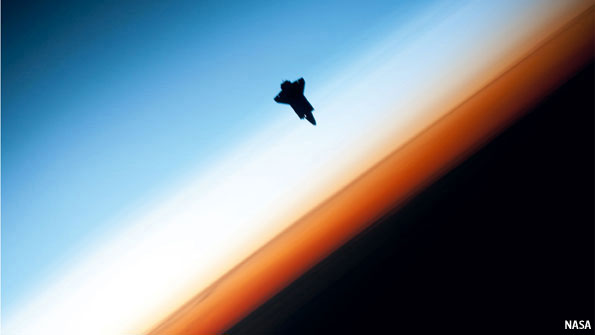
From STS-1 launched on 12 April 1981 through to today’s planned launch of STS-135, it indeed has been an era for science, for exploration and for adventure.
UPDATE 10:30 am Mountain Time

Still awe-inspiring after all these years. Live BBC feed is here. Travel safely guys!
 Learning from Dogs