Philosopher Daniel Dennett offers a kind of self-help book for deep thinkers.
Those of you that are regular followers of Learning from Dogs know that I tend to offer posts for the week-end that are light-hearted. Certainly that’s easier for me, if you pardon me from saying, and hopefully a change for you, dear reader.
Well today’s offering is not exactly heavy but it is, nonetheless, not a typical Saturday topic.
However, trust you find it engaging.
Of the many blogs and websites that I follow, I enjoy the regular mental stimulation that flows from the blog Big Think. Recently there was a piece from Daniel Dennett that tickled my interest and I wanted to share it here.
Wikipedia describes Daniel Dennett as follows:
Daniel Clement “Dan” Dennett III (born March 28, 1942) is an American philosopher, writer and cognitive scientist whose research centers on the philosophy of mind, philosophy of science and philosophy of biology, particularly as those fields relate to evolutionary biology and cognitive science.
This is the Big Think piece that caught my eye. Enjoy!
oooOOOooo
The Philosopher’s Self-Help Book (with Daniel Dennett)
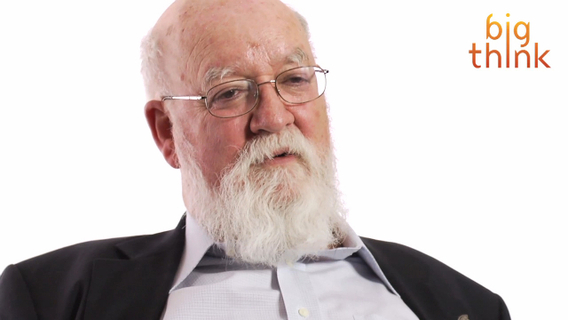
While Silicon Valley and Silicon Alley busy themselves making every aspect of our lives more efficient (except, perhaps, for the process of discovering these new technologies, learning them, and integrating them into our lives), Daniel Dennett sits up at Tufts University in Massachusetts, philosophizing. His latest book, Intuition Pumps and Other Tools for Thinking is an attempt to make transparent some of the tricks of the philosopher’s trade. In an accelerating age, it’s a self-help book designed to slow the reader down and improve our ability to think things through.
The kinds of things Mr. Dennett likes to think about include the nature of consciousness, evolution, and religious belief. But the mind-training his new book offers is applicable to any problem you want to consider thoroughly. In an age of quick fixes and corner-cutting, we’re in constant danger of bad decision making – of overreliance on what cognitive psychologist Daniel Kahneman calls “system 1”, and what most of us call intuition. This rapid decision making channel of the brain is helpful when we are in mortal danger, or pressed for a quick decision within our areas of expertise. But for most decisions, the slower, more deliberate channel (system 2) is much more reliable. What Dennett offers, then, in Intuition Pumps, is a workout for system 2 – a series of thought experiments you can apply to puzzles real and imagined to bulk up the slower, wiser parts of your consciousness.
Some of the tools Dennett offers in the book are more familiar than others. Reductio ad absurdum arguments, for example, in which we test the validity of a claim by taking it to its most outrageous illogical extreme (a: “all living things have a right to liberty.” b: “so let me get this straight – a blade of grass has a right to liberty? What does that even mean?”). But the true delights of the book are the far-out exercises Dennett and his colleagues have dreamed up in the course of their work, such as “Swampman Meets A Cow-Shark”, from Donald Davidson, which begins:
Suppose lightning strikes a dead tree in a swamp; I am standing nearby. My body is reduced to its elements, while entirely by coincidence (and out of different molecules) the tree is turned into my physical replica. My replica, The Swampman, moves exactly as I did; according to its nature it departs the swamp, encounters and seems to recognize my friends, and appears to return their greetings in English.
Walking us through Davidson’s considerations about whether and to what extent the Swampman is anything like Davidson, and related ones about a cow that gives birth to something that looks exactly like a shark (yet has cow DNA in all of its cells), Dennett teaches us a surprising lesson about the utility of wild philosophical speculation.
Cloaked in the breezy, familiar trappings of a self-help book, Intuition Pumps is in actuality a dark mirror of that genre – a field of rabbit holes designed to leave the reader with more questions than answers, and wiser for the long and indirect journey.
Watch for Daniel Dennett’s Tools For Better Thinking – a Big Think Mentor workshop coming soon.
oooOOOooo
Don’t know about you but Daniel Dennett’s book looks like one that deserves reading. If you feel the same way the book is called Intuition Pumps And Other Tools for Thinking and here’s the link to Amazon.
 Learning from Dogs