Tag: Self-compassion

More inward thoughts.

Each of us must care and love ourselves before we can love others.

(Apologies if this post rambles around a bit!)

Dr. Kristin Neff, Ph.D. is widely recognized as one of the world’s leading experts on self-compassion. Dr. Neff has a website over at Self-Compassion.org. If you go to that site you will quickly read (And while I have copied and pasted it 100% as found on that webpage, I have modified the layout to make it easier to read from a visual point-of-view.):

Definition of Self-Compassion:

Having compassion for oneself is really no different than having compassion for others. Think about what the experience of compassion feels like.

First, to have compassion for others you must notice that they are suffering. If you ignore that homeless person on the street, you can’t feel compassion for how difficult his or her experience is.

Second, compassion involves feeling moved by others’ suffering so that your heart responds to their pain (the word compassion literally means to “suffer with”). When this occurs, you feel warmth, caring, and the desire to help the suffering person in some way. Having compassion also means that you offer understanding and kindness to others when they fail or make mistakes, rather than judging them harshly.

Finally, when you feel compassion for another (rather than mere pity), it means that you realize that suffering, failure, and imperfection is part of the shared human experience. “There but for fortune go I.”

Self-compassion involves acting the same way towards yourself when you are having a difficult time, fail, or notice something you don’t like about yourself. Instead of just ignoring your pain with a “stiff upper lip” mentality, you stop to tell yourself “this is really difficult right now,” how can I comfort and care for myself in this moment?

Instead of mercilessly judging and criticizing yourself for various inadequacies or shortcomings, self-compassion means you are kind and understanding when confronted with personal failings – after all, who ever said you were supposed to be perfect?

You may try to change in ways that allow you to be more healthy and happy, but this is done because you care about yourself, not because you are worthless or unacceptable as you are. Perhaps most importantly, having compassion for yourself means that you honor and accept your humanness. Things will not always go the way you want them to. You will encounter frustrations, losses will occur, you will make mistakes, bump up against your limitations, fall short of your ideals. This is the human condition, a reality shared by all of us. The more you open your heart to this reality instead of constantly fighting against it, the more you will be able to feel compassion for yourself and all your fellow humans in the experience of life.

Let me highlight a small section from this:

….having compassion for yourself means that you honor and accept your humanness. Things will not always go the way you want them to. You will encounter frustrations, losses will occur, you will make mistakes, bump up against your limitations, fall short of your ideals. This is the human condition, a reality shared by all of us.

This is the human condition; whatever one’s gender, status in life or age!

Moving on.

There is no question that I learnt something from my cycling accident last November 22nd and my subsequent emergency admission to hospital for sub-dural bleeding on December 24th. Something that I would not otherwise have understood so clearly and so starkly.

The remarkable power of the brain to heal itself; albeit very slowly compared with some minor physical injuries.

The BBC science series Horizon broadcast earlier this year the story of ‘Richard’. The full title was My Amazing Brain: Richard’s War.

Horizon follows the story of Richard Gray and his remarkable recovery from a life-changing, catastrophic stroke. Recorded by his documentary film-maker wife Fiona over four years, this film provides a rare account of the hard work that goes into post-stroke rehabilitation.

Initially bed bound and unable to do anything, including speak, the initial outlook was bleak, yet occasionally small glimmers of hope emerged. Armed always with her camera, Fiona captures the moment Richard moves his fingers for the first time, and then over months she documents his struggle to relearn how to walk again.

The story also features poignant footage delivered in a series of flashbacks, in which we see and hear Richard at his professional best. He was a peacekeeper with the United Nations, immersed in the brutal war in Sarajevo, Bosnia. We also hear from the surgeons and clinicians who were integral to Richard’s remarkable recovery, from describing life-saving, high-risk reconstructive surgery to intensive rehabilitation programmes that push the former soldier to his limits.

As the film starts, Fiona asks ‘will Richard, my Richard still be there?’ By the end the answer is clear.

Unfortunately unless you are in the UK it is not possible to watch the programme.

But Fiona, Richard’s wife, has produced a YouTube video. It so much deserves to be watched:

http://www.youtube.com/watch?v=uLJehIZJRlY

Moving on, yet again.

I am of no doubt that most, if not all, of us at some point in our lives wonder what on earth is the point in what we are doing or where we are at the stage in our own life’s journey. Certainly has applied to me in the past.

Frequently when we are a bit lost as to where on earth we are heading it helps enormously to hang on the shirt-tails of others.

Professor Clayton Christiansen has some really fabulous shirt-tails. For now just watch his presentation given at TEDx

“It’s actually really important that you succeed at what you’re succeeding at, but that isn’t going to be the measure of your life.”

For a slightly different perspective, watch Adam Leipzig.

Being human means a journey from birth through maturity and thence to death. It is likely that the last phase generates the greatest fear for us. But let’s not dwell on that for now!

Because I want to close my introspective journey by returning to self-compassion.

Or rather for our compassion for this beautiful planet that is the one and only home we have.

Dear Carl Sagan sums it up as perfectly as one could ever ask for.

Alright folks! I’m through!

Must go and hug a dog! (Or, more accurately, a dog memory!)
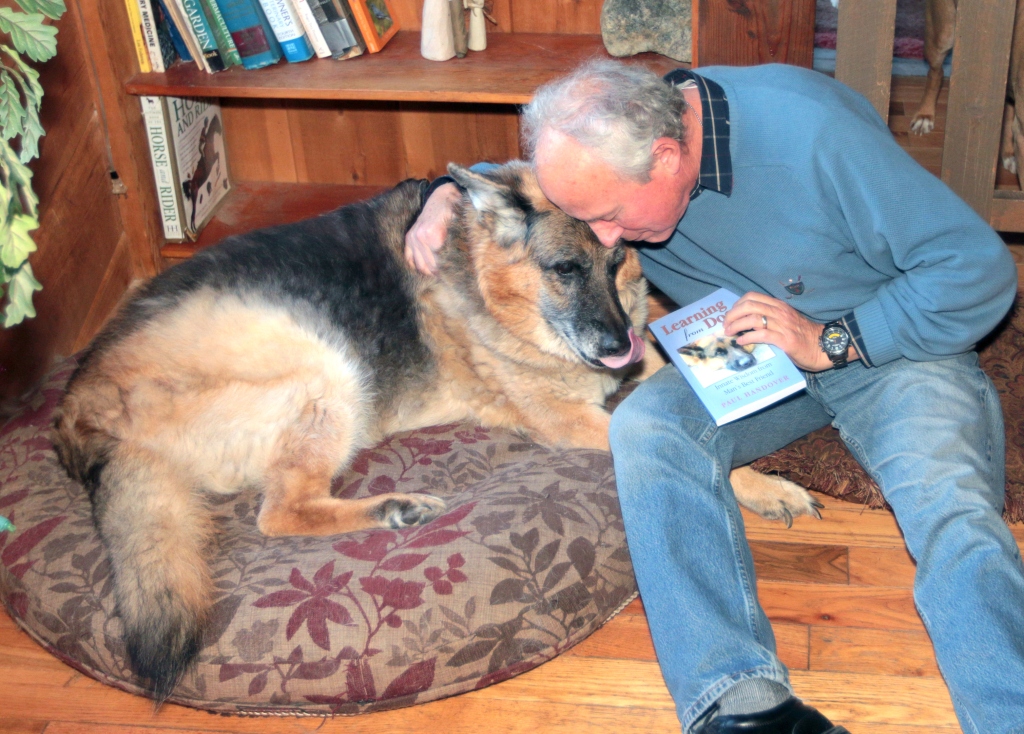
TIMOTHY BULLARD/Daily CourierPaul Handover with Pharaoh, a 12 year-old German Shepard that he uses on the cover of his new book about man’s best friend.

Tomorrow a clutch of dog recall advisories that have come in recently!

As they say a change is as good as a rest!

Once again I must say that I hold no qualifications whatsoever in the fields of psychiatry, psychology or any related disciplines. If you have found yourself to be affected to the point where you think you need proper counselling then, please, do seek help.

The book! Part Four: Compassion for self.

That one can not truly love another until you love yourself is a truism that is well-known.

If only it was that simple!

As an earlier chapter, The process of change, illustrated, albeit in a anecdotal manner, loving who one is rests fundamentally on knowing who one is and that, for a sizeable chunk of people, I don’t doubt, is a significant journey of self-awareness.

Stepping lightly over that last sentence, for this section is about change in thoughts and deeds, and focussing on the title to this specific chapter, compassion for self, leads one to pause and ask two questions: exactly what do we mean by self-compassion, and how is self-compassion different to self-esteem?

To be perfectly honest, until I started thinking about the answers to those questions, the differences between self-esteem and self-compassion had previously never occurred to me in the many (too many) years of my life. Yet another surprise that has been visited upon me as a result of writing this book!

But, of course, as soon as one thinks about it, there is a difference between self-esteem and self-compassion! Almost as though the former is an outward-looking perspective of oneself and the latter is the diametric opposite; an inward-looking perspective

Or as Kristin Neff, an associate professor in human development and culture at the University of Texas, Austin, puts it in an article published online by the The Greater Good Science Center, University of California:

Most of us are incredibly hard on ourselves when we finally admit some flaw or shortcoming: “I’m not good enough. I’m worthless.”

And of course, the goalposts for what counts as “good enough” seem always to remain out of reach. No matter how well we do, someone else always seems to be doing it better. The result of this line of thinking is sobering: Millions of people need to take pharmaceuticals every day just to cope with daily life. Insecurity, anxiety, and depression are incredibly common in our society, and much of this is due to self-judgment, to beating ourselves up when we feel we aren’t winning in the game of life.

So if self-esteem is the judgement or evaluation of oneself, self-judgment in other words, and may only be measured, by definition, through comparing oneself to others, then what is self-compassion?

An article published in February, 2011 by Tara Parker-Pope of The New York Times offers an insight that isn’t immediately obvious to one. It opens:

Do you treat yourself as well as you treat your friends and family?

That simple question is the basis for a burgeoning new area of psychological research called self-compassion — how kindly people view themselves. People who find it easy to be supportive and understanding to others, it turns out, often score surprisingly low on self-compassion tests, berating themselves for perceived failures like being overweight or not exercising.

Tara Parker-Pope then refers to Professor Kristin Neff; as follows:

But Kristin Neff, a pioneer in the field, says self-compassion is not to be confused with self-indulgence or lower standards.
I found in my research that the biggest reason people aren’t more self-compassionate is that they are afraid they’ll become self-indulgent,” said Dr. Neff, an associate professor of human development at the University of Texas at Austin. “They believe self-criticism is what keeps them in line. Most people have gotten it wrong because our culture says being hard on yourself is the way to be.

Fear of becoming self-indulgent restrains people from being more self-compassionate! I find that counter-intuitive but readily admit that it had never crossed my mind. The article then continues:

Imagine your reaction to a child struggling in school or eating too much junk food. Many parents would offer support, like tutoring or making an effort to find healthful foods the child will enjoy. But when adults find themselves in a similar situation — struggling at work, or overeating and gaining weight — many fall into a cycle of self-criticism and negativity. That leaves them feeling even less motivated to change.

Self-compassion is really conducive to motivation,” Dr. Neff said. “The reason you don’t let your children eat five big tubs of ice cream is because you care about them. With self-compassion, if you care about yourself, you do what’s healthy for you rather than what’s harmful to you.

Now that started to make sense to me. Still, if at this point in my learning journey I had been challenged to define precisely what I understood by self-compassion, I would have been bound to display some lingering uncertainties.

Therefore, how does one understand self-compassion in a clear and easily understood manner? Thank goodness for more guidance from the good Professor Neff. Back to that article published by the University of California.

As I’ve defined it, self-compassion entails three core components. First, it requires self-kindness, that we be gentle and understanding with ourselves rather than harshly critical and judgmental. Second, it requires recognition of our common humanity, feeling connected with others in the experience of life rather than feeling isolated and alienated by our suffering. Third, it requires mindfulness — that we hold our experience in balanced awareness, rather than ignoring our pain or exaggerating it. We must achieve and combine these three essential elements in order to be truly self-compassionate.

Self-kindness, recognition of our common humanity and mindfulness. Wow! What a trio of wonderful components.

I took a writing break at this point and went across to our living-room where some of our dogs were larking around. To my eyes, the group of five dogs, from old man Pharaoh, he of the front cover, down to young Oliver of less than a year old, were displaying kindness for themselves, an obvious recognition of their common doggyness and what seemed to me as mindfulness!

Then when I returned to ‘the book’, I couldn’t resist Kristin Neff’s concluding words from the above-mentioned article:

An island of calm

Taken together, this research suggests that self-compassion provides an island of calm, a refuge from the stormy seas of endless positive and negative self-judgment, so that we can finally stop asking, “Am I as good as they are? Am I good enough?” By tapping into our inner wellsprings of kindness, acknowledging the shared nature of our imperfect human condition, we can start to feel more secure, accepted, and alive.

It does take work to break the self-criticizing habits of a lifetime, but at the end of the day, you are only being asked to relax, allow life to be as it is, and open your heart to yourself. It’s easier than you might think, and it could change your life.

Relax, allow life to be as it is, and open your heart to yourself.

Those words should be framed and hung on the walls of every house in the land.

For they provide passionate reasons for changing how we think and, inevitably, how we act.

1,185 words. Copyright © 2014 Paul Handover