Trying to make sense of our place in the world – and probably failing!
Yesterday’s post, Making sense of who we are?, was built upon a recent essay from George Monbiot: A Small and Shuffling Life. It is a terrific essay, in the very best tradition of George Monbiot. I really hope you read it in yesterday’s post because today’s introspective jaunt is built on that essay. Two particular paragraphs of his essay really ‘spoke’ to me.
The opening paragraph:
Live free or die: this is the maxim of our age. But the freedoms we celebrate are particular and limited. We fetishise the freedom of business from state control; the freedom not to pay taxes; the freedom to carry guns and speak our minds and worship whom we will. But despite – in some cases because of – this respect for particular freedoms, every day the scope of our lives appears to contract.
Later:
We carry with us the psychological equipment, rich in instinct and emotion, required to navigate that world. But our survival in the modern economy requires the use of few of the mental and physical capacities we possess. Sometimes it feels like a small and shuffling life. Our humdrum, humiliating lives leave us, I believe, ecologically bored.
In that second paragraph I sense something from Mr. Monbiot that is felt by me and Jean and appears to be shared very widely. A sense that something about today’s society is broken. That the last, say fifty years, of increasing living standards, health and prosperity, albeit not universally embraced, have brought us no closer to a golden future. That, as so clearly voiced in the preceding paragraph, “… our survival in the modern economy requires the use of few of the mental and physical capacities we possess.”
My guess is that George Monbiot and Terry Hershey have never met. One might suggest that their backgrounds are as different as two people might be. Take their respective ‘About’ pages on their blogsites. Here are their closing paragraphs.
First, George:
My work is more sedentary than it used to be, so I temper it with plenty of physical activity: sea kayaking, ultimate frisbee, running and some heavy duty gardening: growing my own vegetables and much of my own fruit.
Here are some of the things I love: my family and friends, salt marshes, arguments, chalk streams, Russian literature, kayaking among dolphins, diversity of all kinds, rockpools, heritage apples, woods, fishing, swimming in the sea, gazpacho, ponds and ditches, growing vegetables, insects, pruning, forgotten corners, fossils, goldfinches, etymology, Bill Hicks, ruins, Shakespeare, landscape history, palaeoecology, Gavin and Stacey and Father Ted.
Here are some of the things I try to fight: undemocratic power, corruption, deception of the public, environmental destruction, injustice, inequality and the misallocation of resources, waste, denial, the libertarianism which grants freedom to the powerful at the expense of the powerless, undisclosed interests, complacency.
Here is what I fear: other people’s cowardice.
I still see my life as a slightly unhinged adventure whose perpetuation is something of a mystery. I have no idea where it will take me, and no ambitions other than to keep doing what I do. So far it’s been gripping.

Now, Terry:
I used to ask of myself and others: what have you accomplished? Where are your credentials? What does your job and your bank account say about who you are?
Now, my questions are different:
Are there butterflies in your garden?
What are the color of loved ones’ eyes, when they are looking at you with hope?
And when was the last time your house smelled of paper-white narcissus?
Do sunsets make you smile?
When was the last time you stood in stocking feet just to stare at the rising moon?
Have you ever seen a sunflower bloom?
Does the laughter of children do your heart good?
At what angle does the sun enter your house?Do I understand that life is full of complications, obligations and distractions? Yes. I do. My wife and I raise a teenage son. We run two businesses. So, yes, I know a bit about down-to-earth realities.
But this, too, is reality:
I love to watch the hummingbirds dance.
I love that my son likes to put on his dancing shoes.
I love to join him when we play
old-time rock and roll.
I love to stretch out on a garden bench on a
warm summer day.
I love a hot shower and drying with an expensive,
oversized cotton towel.
I love books, delight in poetry,
and find sustenance in writing.
I treasure the certainty that grace
gives us all many second chances.
I value the times I can simplify life by letting go of my need to validate my humanity through productivity.
And I love to lose track of time in a garden.I also know that sharing this with you – offering my practices for pausing, resources for doing less and living more, reflections in my blog —feeds me.
So I invite you, too, to join us — and together we’ll share, remind, and support each other, to “do less, live more.”

Yet, despite the differences in backgrounds, cultures and much more, to me there is a common openness, an honesty shared, and a passion for the truth.
All of which is a very long introduction to this week’s Sabbath Moment from Terry; republished in full.
ooOOoo
Finding sanctuary and grace
January 19, 2015
Today I am sitting in a café (and bar) in Vaison-la-Romaine, in the Provence region of France, nursing my espresso. The old men of the village (actually all of them are about my age) gather. They unload, swap stories, sip pastis, and watch petanque on TV. Some read the newspaper–with stories about Charlie Hebdo and photos of “Somme Nous Charlie“–carrying reminders of hope in our fragile and broken world.
I am glad to be here. Today. In this place. There is an air of familiarity among the men, and comfort in their ritual. I am grateful for reminders and invitations to live well into a place. Not just a physical space, but a tonic and sanctuary to the spirit. The invitation is a permission to settle down. (In the words of Jesus, “to come away and rest awhile.”) A sanctuary is a place that restores us, replenishes us, nourishes us. In this renewal, we are reminded, once again, of what really is important.
I agree that it is easy to sentimentalize. But living into the moment doesn’t smooth the edges of our life. It allows us to pay attention. I like to think that we can name the edges, to welcome and invite them into the sanctuary.
Outside a bicycle club gathers in the village center parking lot, ready for their weekend excursion. Their spirit is eager, their uniform bearing homage to their journey to the top of Mont Ventoux.
Sitting in the café, my thoughts meander, with no agenda or responsibilities to tether them. So I let them wander, a gift to embrace. But my reverie is interrupted with worry … I need a Sabbath Moment. And I don’t have a clue (I tell myself). It’s not easy on vacation. Especially without wi-fi.
I am on my annual trip to Europe with my good friend Bill McNabb to taste wine. He’s a wine writer (and pastor) in the San Francisco area. But mostly, he’s a friend. I’m his aide-de-camp and connoisseur.
We travel to wine regions and are blessed to taste beverages that we cannot afford, but offer us a glimpse of heaven.
Yes I’m biased. But then wine is not a beverage here; it is an experience. Your choice is to savor and take delight.
We visited wineries harvesting grapes from vines 100 years old. These are businesses passed down through the generations, grandfather to father to son (and now thankfully, often to daughter). A world where terroir is king, the personality of the soil. Meaning that this wine is born of a place, a very specific place. Here in the Rhone Valley, I’m honored to be in the company of crafts people. Like being with a great gardener. The men and women I met coddle their vines–they call them trees–lovingly.
Unlike Peter Mayle, I don’t have “A Year in Provence.” I only have a few days. But that’ll do… It is my first visit and I’m sure won’t be my last.
We’re in our gite–a rural rental property in France–we relish the evening light, a layer of bruised purple (pourple) above the slopes in Provence (Cotes du Rhone). Below the hills, vineyards roll through the landscape, the vines–still in winter and pruned–pose as menorah renderings in the dusk light.
Yes, this scene is a tonic. There is something about these moments that carry significance, because they are reminders, and they are sacraments. Partial, yes, but containing the full sustenance of grace.
And I think of the question a friend asks me, “What holds you?”
In other words… What sustains you, and carries you gently through your days?
Ryoken, a Zen master, lived the simplest kind of life in a little hut at the foot of a mountain. One evening a thief visited the hut, only to discover there was nothing in it to steal. Ryoken returned and caught him in the act.
“You may have come a long way to visit me,” he told the disillusioned prowler, “and you should not return empty-handed. Please take my clothes as a gift.”
The thief was bewildered. But he took the clothes and slunk away.
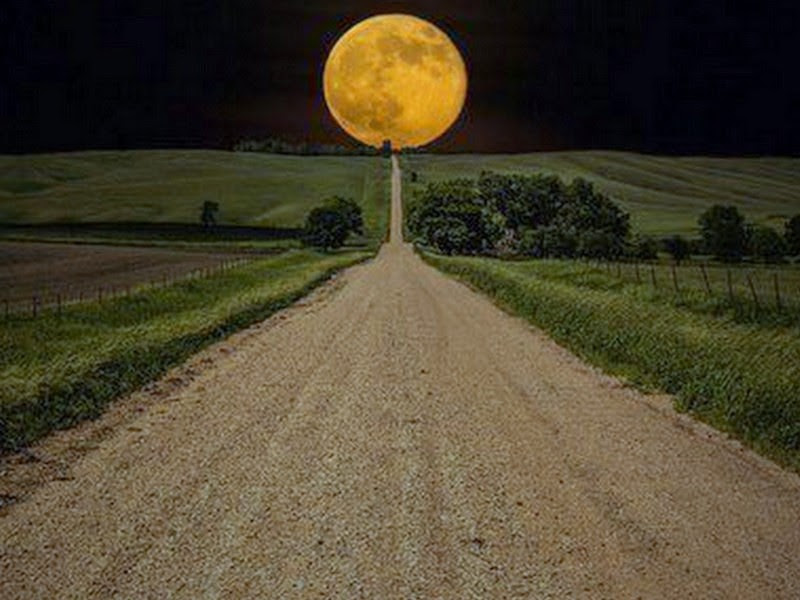
Ryoken sat naked, watching the moon, “Poor fellow,” he mused. “I wish I could have given him this beautiful moon.”
Sometimes I feel like that thief. Standing–in my own home, or in front of an audience, or in a crowd, or all alone–I am looking for something, for whatever ails me or creates a hole or emptiness; but, like that thief, not finding it. “What am I missing?” I ask myself. What am I wanting, yearning for, that I find myself in such a pell-mell-hurry or weighted down… hoping to fix it, or find it, or mend it. So I run and race and call on God, or the sky, or roll the dice with some prayer from my childhood. This will solve it, I tell myself. But the more I push, the more I ask, the more I beseech, the further I move from the center.
Here’s the deal: In my state of distraction, I cannot see that the core of my identity, the place where I stand in this moment (even at times without clarity, or stability, or faith, or answers)… I stand smack dab in the center of an awesome and illogical grace. Smack dab in the center of the sacred present.
If I do have the permission to see that place, I know that I am grounded.
I am now able to breathe in
and out,
and rest in this acceptance.
Last night, above the slopes to the south, a slivered crescent moon rests, the sky a cobalt blue canvas. It is visceral, arresting, piercing. And for whatever reason, reassuring. This snapshot is imprinted, and I know in my heart that it is in some way essential, indispensable. I accept this gift of the moon, even though I don’t yet know why.
I don’t know what to tell you to do, exactly. Only that I too, wish I could give you the gift of that crescent moon.
I know this for certain: when we do not pay tribute, we are like the thief in the Zen story–without even knowing it–and we settle for less. So much less. So it is not just a question of what hold us, but of what holds us back… from being wholehearted, true to our self, fully alive, unafraid of uncertainty, and grateful for the gift of this moment.
Lord knows we look for ways to bottle it and sell it, when I reckon we should just get out of the way.
Our gite sits squarely in a vineyard and a working farm. A perfect setting to replenish. For years I’ve been writing about sanctuary and the need for restoration. And I’m my own worst enemy. There’s not a week that goes by that a Sabbath Moment friend doesn’t remind me to follow my own advice to pause… and let my soul catch up with my body. Gladly, this week I did.
ooOOoo
My penultimate reflection to today’s post is with a short, six-minute video from Professor Dan Gilbert. The video is entitled: The psychology of your future self. I hope you see it as offering a calming perspective to two days of inner psychological ramblings!
Published on Jun 3, 2014
“Human beings are works in progress that mistakenly think they’re finished.” Dan Gilbert shares recent research on a phenomenon he calls the “end of history illusion,” where we somehow imagine that the person we are right now is the person we’ll be for the rest of time. Hint: that’s not the case.
My final reflection is the lesson that dogs teach us; that one about living in the present.

 Learning from Dogs