Tag: Russia

‘Big Oil’, please learn from dogs!

The latest announcement continues to show dogs in very good light!

Before I plunge into this Post, just an apology.  I’m trying hard to get out of what feels like a recent pattern of ‘re-publishing’ stuff rather than posting material that is primarily my own creative output.  Ironically, it’s become a little harder to achieve since starting a creating writing course last Tuesday 23rd (every Tuesday evening for 12 weeks!).  The course requires several thousand words of ‘homework’ each week.

Then I lost the plot and published two posts yesterday, when one of them should have been scheduled for today!  Thus making it almost impossible to be fully creative today!

Anyway, to today’s theme.  Which comes very close on the heels of my post on Monday about the antics of the big oil companies and ‘recovering’ oil from tar sands in Canada.

We all know that some of the most ecologically and environmentally fragile places on the planet are the polar regions.  Of the two polar regions, the more sensitive one is the North Polar region.  The Arctic ice cap is forecast to be clear of ice each Summer by 2030 assuming the huge annual run-off of fresh water doesn’t screw up the existing ocean currents before then.  (Indeed, a fascinating film about the complexity of the weather systems as a result of very long heating and cooling cycles was seen recently on YouTube – link at the end of this post.)

So continued madness over our love affair with oil is just that: madness.  Don’t get me wrong.  Jean and I drive gasoline-powered vehicles but at least we are conscious of the damage we are doing and will change just as soon as it becomes viable for us to so do.

So with all that in mind, here’s a recent announcement from Exxon first seen on the BBC News website.

US oil major Exxon Mobil has clinched an Arctic oil exploration deal withRussian state-owned oil firm Rosneft.

The venture seemingly extinguishes any remaining chance of BP reviving its own deal, which lapsed in May.The agreement was signed on Tuesday in the presence of Prime Minister Vladimir Putin, a Rosneft spokesman said.

Prime Minister Putin said that it would also allow Rosneft to develop fields in the Gulf of Mexico and Texas, according to local media reports.

“New horizons are opening up. One of the world’s leading companies, Exxon Mobil, is starting to work on Russia’s strategic shelf and deepwater continental shelf,” he said.

‘Big win

Under the agreement, the two firms will spend $3.2bn on deep-sea exploration in the East Prinovozemelsky region of the Kara Sea, as well as in the Russian Black Sea.

Exxon described these areas as “among the most promising and least explored offshore areas globally, with high potential for liquids and gas”.

The two companies will also co-operate on the development of oil fields in Western Siberia.

Exxon spokesman Alan Jeffers told the BBC: “[The Russian Arctic] is among the most promising and least explored regions for oil, that is why we are very interested.

Cynic mode on: “The Russian Arctic is among the most promising and least explored regions for oil …”  Well that’s alright then!

If one follows that link in the BBC news item, it goes to the ExxonMobil press release where one can quickly read the following key points,

  • US $3.2 billion exploration program planned for Kara Sea and Black Sea
  • Establishment of a joint Arctic Research and Design Center for Offshore Development in St. Petersburg
  • Rosneft participation in ExxonMobil projects in the U.S. and other countries with a focus on building offshore and tight oil expertise
  • Joint operations to develop Western Siberia tight oil resources
  • Companies form partnership to undertake projects in the Russian Federation and internationally

Thus this is not some small sideline – it’s potentially very big business for both partners.

So where is the Kara Sea?

Kara Sea, Russia

Here’s how the website WorldAtlas describes it,

The Kara Sea, an extension of the Arctic Ocean, is located off the coastline of Siberia in far northwestern Russia.

It’s separated from the Barents Sea (in the west) by the Kara Strait and Novaya Zemlya – and the Laptev Sea (in the east) by the Taymyr Peninsula and Severnaya Zemlya. The northern border (shown) is a mapping opinion.

It has an estimated area of 880,000 sq km (340,000 sq mi), an average depth of 128 m (420 ft) and a maximum depth of 620 m (2,034 ft).

Ice-bound for most of the year, the sea is generally navigable only during August and September.

The main ports are Dikson (Dickson) and Novyy Port, and they are heavily used during the two-month (lucrative) fishing season. They will also be distribution points when the petroleum and natural gas discovered here is brought to the surface.

Just look at that map again and see how far North of the Arctic Circle is the Kara Sea.

Dad, where's the ice gone?

Let’s go back to dogs.  When dogs were primarily wild animals, really when they were still carrying all the ‘habits’ of the Grey Wolf, from which dogs are genetically descended, they were very territorial, as indeed domestic dogs are towards their domestic area.  WikiPedia explains, ‘The core of their territory is on average 35 km2 (14 sq mi), in which they spend 50% of their time.‘  (That’s a great article on WikiPedia about the Grey Wolf, by the way.)

Anyway, the wolves, like practically all other animal species, live in harmony within their territory and only move or amend their territorial boundaries if the survival of the pack is threatened.

So when, oh when, is mankind going to learn that our territory is Planet Earth.  We have no other territory to move to.  I still remember my form teacher way back in my first English school saying to me, “There are two ways you can learn this lesson, the easy way or the hard way!”  Same applies to us all!  Let’s urgently learn this lesson from dogs and move on from oil.

Finally, that YouTube video.  Less than an hour long, it has some interesting facts about climate change over many thousands of years and a rather interesting conclusion.
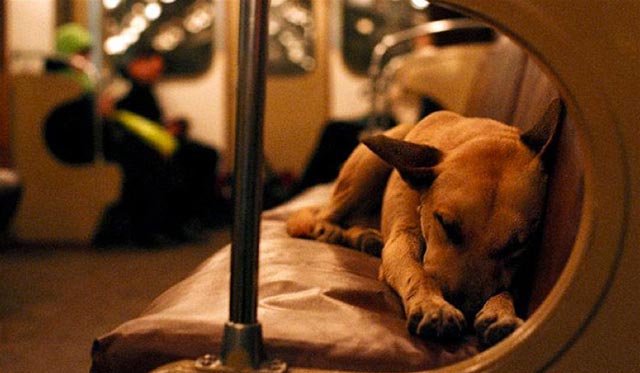
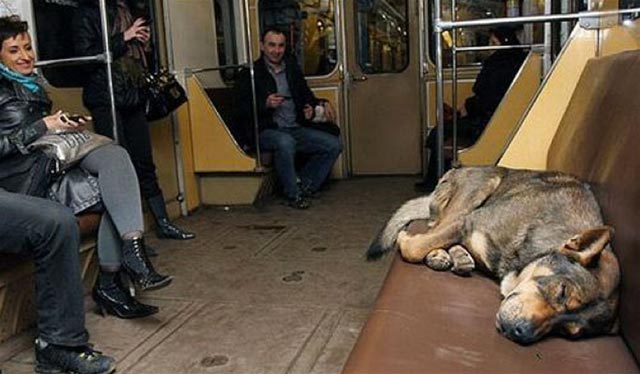
The Tenacity of Dogs, part one.

Stray dogs demonstrate remarkable skills at staying alive.

Before I start, a big word of thanks to Paul Gilding who passed this story to me.  Apart from reading Paul’s powerful book, The Great Disruption, and exchanging a couple of emails, he doesn’t know me from Adam.  But the fact that this undoubtedly busy man (his book has been a great success) not only responded to an earlier email from me and then dropped me a note to say that I might enjoy the following article, says a great deal about the integrity of the person.

The article, from the website The Dog Files, is about Moscow’s stray dogs.  I’m taking the liberty of reproducing it in full.

Each morning, like clockwork, they board the subway, off to begin their daily routine amidst the hustle and bustle of the city.

But these aren’t just any daily commuters. These are stray dogs who live in the outskirts of Moscow Russia and commute on the underground trains to and from the city centre in search of food scraps.

Then after a hard day scavenging and begging on the streets, they hop back on the train and return to the suburbs where they spend the night.

Experts studying the dogs, who usually choose the quietest carriages at the front and back of the train, say they even work together to make sure they get off at the right stop – after learning to judge the length of time they need to spend on the train.

Scientists believe this phenomenon began after the Soviet Union collapsed in the 1990s, and Russia’s new capitalists moved industrial complexes from the city centre to the suburbs.

Dr Andrei Poiarkov, of the Moscow Ecology and Evolution Institute, said: “These complexes were used by homeless dogs as shelters, so the dogs had to move together with their houses. Because the best scavenging for food is in the city centre, the dogs had to learn how to travel on the subway – to get to the centre in the morning, then back home in the evening, just like people.”

Dr Poiarkov told how the dogs like to play during their daily commute. He said: “They jump on the train seconds before the doors shut, risking their tails getting jammed. They do it for fun. And sometimes they fall asleep and get off at the wrong stop.”

The dogs have also amazingly learned to use traffic lights to cross the road safely, said Dr Poiarkov. And they use cunning tactics to obtain tasty morsels of shawarma, a kebab-like snack popular in Moscow.

With children the dogs “play cute” by putting their heads on youngsters’ knees and staring pleadingly into their eyes to win sympathy – and scraps.

Dr Poiarkov added: “Dogs are surprisingly good psychologists.”

By Elaine Furst for Dog Files

Now had this been a normal day then I would have had the time to complete this story about the tenacity of dogs.  But a failed wireless modem earlier today (Thursday) meant the loss of too many hours fighting technology.  It was all sorted just a little before 5pm.  It is now 6.15 pm and dinner is ready and, frankly, my brain is too tired to continue.

So stay with this fascinating story about stray dogs as I continue it tomorrow (Saturday, 20th.).

Global Warming? Not our problem Comrade ….

The Russians are building a load of nuclear power stations to fuel their expansion and landgrab to the North Pole to extract the 75 billion tons of oil and gas thought to be there.

This is sure to outrage not only those against carbon emissions but others who don’t like nuclear fission, thus scoring a double whammy for the Russians. Putin must be pleased.

I can’t really see the point of trying to reduce emissions on a personal level; on a macro scale countries are not taking it seriously and are still extracting oil and gas as fast as they can. I believe only a dramatic breakthrough will actually achieve anything. Why they are not putting up giant mirrors into space or if you like in slowly desertifying Southern Spain is a mystery to me.

It’s all nothing if not ironic. Global warming caused most probably by emissions is opening up the Northeast passage which makes it much easier for the Russians to send MORE oil and gas to China. A perfect vicious circle indeed …..

And if WWIII doesn’t start in the China Sea maybe it’ll be up in the frozen North as nations squabble over “their” territory.
Look on the bright side; when there is no ice left at all it will be even better; ships will be able to go direct by straight line from any country to another. Mind you, when they arrive they’ll have to deliver the oil by submarine. No doubt they’re already working on that.

What does a (I hope) fairly sane private citizen do about all this nonsense? I’d like to save the planet for my children, but I am feeling rather helpless ……

By Chris Snuggs

P.S. One way to do something is to support those organisations that are doing all they can. See:

And recognise that this is something else we can learn from dogs – not to foul one’s own bed.

P.

Horror at Smolensk

Will this air crash be a milestone in improving relationships with the Russians?

The Poles are naturally turning out to mourn their President and other leaders killed in the tragic accident at Smolensk.

Sadly, I fear that if and when the investigation turns up the truth about what happened the reaction may be more questionable. The Russians have apparently recovered the black boxes and presumably cockpit recordings, and what already seems clear from ATC Officers involved is that the pilot had categorically refused “instructions” to land at another airport, Smolensk being judged by ATC to be too dangerous.

Now others on Learning from Dogs will know far better than me, but it seems to me extraordinary that a professional, experienced pilot would refuse such advice and try to land in such appalling weather conditions.

This of course begs the question of why he did so, which is where the deceased President may come in.  An extract from the NY Times of April 12th:

Investigators examining the crash appeared to be focusing on why the pilot did not heed instructions from air traffic controllers to give up trying to land in bad weather in western Russia on Saturday morning.

Their inquiry may lead to an even more delicate question: whether the pilot had felt under pressure to land to make sure that the Polish delegation would not be late for a ceremony on Saturday in the Katyn forest, where more than 20,000 Polish officers and others were massacred by the Soviets during World War II.

Let us hope that it was mechanical failure of some kind (though early reports seem to rule this out) rather than the repetition of a previous incident where the Polish President had argued with the pilot of his plane.

This tragic event is of course surreally-ironic, as if the grisly hand of Josef Stalin had risen from the grave to cause the deaths of yet more Poles in addition to the 20,000 or so murdered in Katyn Forest on his direct orders.

As one who grew up during decades of Soviet denials of responsibility for this cruel genocide, I have been moved by the reaction of the Russians to all this, and no more so than by Putin himself. This is a man who referred to the demise of the Soviet Union as “the greatest tragedy of my life”, yet his grief and fellow-feeling for the Poles have been clear and genuine.

It was already a major breakthrough that Russia should have after all this time so clearly accepted responsiblity – and made apologies – for the Katyn massacre. That Putin and others have shown such fellow-feeling for the Polish loss gives one hope for a deeper reconciliation after the terrible schism in Europe caused by the Russian Revolution and seizure of power by Stalin, possibly the most murderous dictator in history. It was always insane that Russia should be our enemy; let us hope that by and by they will become our firm friends and allies.

By Chris Snuggs

New Dawn For Russia?

Red-letter weekend?

medvedev
Dmitry MEDVEDEV

Dimitry Medvedev, President of Russia, hitherto regarded as something of a stooge for “Czar” Vladimir Putin, recently made an extraordinary attack on those trying to rehabilitate Josef Stalin, who has strong claim to be the greatest mass-murderer and originator of human misery in history.

On the face of it, it seems extraordinary that anyone in their right mind could possibly seek to rehabilitate such a monster, but for many Russians he represents “the good old days”, when Russia was “great”, and in particular the dark days of WWII, when he is supposed to have “saved” Russia from the Nazis.

This last of course ignores  the small detail that those who saved Russia were mostly young boys in Red Army uniforms who faced down the Wehrmacht in Stalingrad and elsewhere in unimaginably-terrible conditions.

However, despite being an “international communist”, Stalin “saved” Russia by appealing to nationalist sentiments. As this great country is once more going through tough times, the Russian conservatives, headed by Putin (“the loss of the Soviet Union was the greatest tragedy of my life”) have been seeking to play upon nationalistic sentiment by rehabilitating Stalin.

Now, nationalism is the most destructive of forces (apart perhaps from those inspired by “God”), and so we have a lot to fear from the extreme Russian version. But Medvedev has pricked the bubble in an act of considerable courage, for many enemies of the  Kremlin have died for less – witness Alexander Litvinenko in London

So, hats off to Medvedev.

Is he deliberately distancing himself from Putin? We should follow these events closely. We need Russia as a friendly partner on the world stage, and not just because of her resources.

By Chris Snuggs