As in how a primate chooses to communicate with humans.
In recent times there have been a couple of posts in this place about the science of communication between dogs and humans.
What about other animals?
What about a gorilla?
If you drop across to the YouTube site and search for Koko the Talking Gorilla you will be astounded by how many videos are to be seen.
Try this one:
A very moving account from Robin Williams.
If we then want more background information on this remarkable animal, Wikipedia is there to oblige (in part):
Hanabiko “Koko” (born July 4, 1971) is a female western lowland gorilla who is known for having learned a large number of hand signs from a modified version of American Sign Language (ASL).
Her instructor and caregiver, animal psychologist Francine “Penny” Patterson, reports that Koko is able to understand more than 1,000 signs of what Patterson calls “Gorilla Sign Language” (GSL).[2] In contrast to other experiments attempting to teach sign language to non-human primates, Patterson simultaneously exposed Koko to spoken English from an early age. Reports state that Koko understands approximately 2,000 words of spoken English, in addition to the signs.[3] Koko’s life and learning process has been described by Patterson and some of her collaborators in a number of books, peer reviewed articles, and on a website.
Koko got her birthday wish this July 4th — not only did one kitten come to visit, but a whole litter. Koko fell in love with one, and the other fell in love with her. Koko has adopted these two kittens into her family, and it has energized her world.
Not only have Koko’s maternal and play instincts kicked in, but she is signing more to her caregivers and generating new content everyday that can be used by The Gorilla Foundation to create empathy for great apes. This can have significant benefits to both endangered free-living great apes and those in captive environments, by encouraging the development of 2-way communication with their caregivers (which Koko has had since she was a baby).
The Gorilla Foundation is now working on a multimedia sequel to the classic book, “Koko’s Kitten,” which has already reached millions of children worldwide, and has the power to motivate millions more to learn how to make the world a better place for all of its conscious inhabitants.
You can support The Gorilla Foundation mission of Conservation through Communication by visiting http://www.koko.org
Thank you!
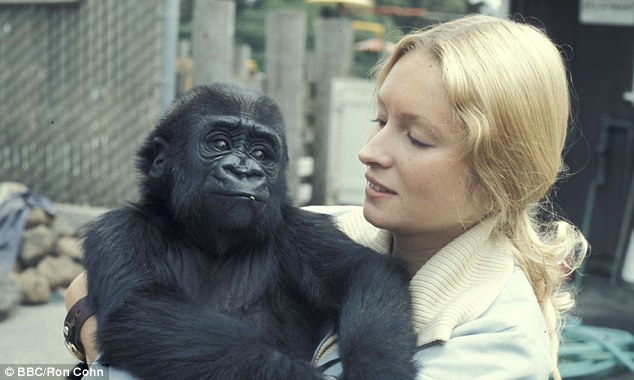
Will close with this photograph seen ‘on the web’.
Graduate student Penny Paterson with a young Koko on her back not long after they met in 1971 in San Francisco. (The Daily Mail newspaper 2nd June, 2016.)
I can’t recall how but recently I came across an online source of analysis, ideas and research that calls itself The Conversation. In their folder How we’re different, (in part) they explain:
The Conversation US launched as a pilot project in October 2014. It is an independent source of news and views from the academic and research community, delivered direct to the public.
Our team of professional editors work with university and research institute experts to unlock their knowledge for use by the wider public.
Access to independent, high quality, authenticated, explanatory journalism underpins a functioning democracy. Our aim is to promote better understanding of current affairs and complex issues. And hopefully allow for a better quality of public discourse and conversation.
We aim to help rebuild trust in journalism. All authors and editors sign up to our Editorial Charter. All contributors must abide by our Community Standards policy. We only allow authors to write on a subject on which they have proven expertise, which they must disclose alongside their article. Authors’ funding and potential conflicts of interest must also be disclosed. Failure to do so carries a risk of being banned from contributing to the site.
The Conversation launched in Australia in March 2011 and the UK in May 2013.
So with no further ado, and within the terms of The Conversation, may I share:
What does it mean to preserve nature in the Age of Humans?
Is the Earth now spinning through the “Age of Humans?” More than a few scientists think so. They’ve suggested, in fact, that we modify the name of the current geological epoch (the Holocene, which began roughly 12,000 years ago) to the “Anthropocene.” It’s a term first put into wide circulation by Nobel-Prize winning atmospheric chemist Paul Crutzen in an article published in Nature in 2002. And it’s stirring up a good deal of debate, not only among geologists.
The idea is that we needed a new planetary marker to account for the scale of human changes to the Earth: extensive land transformation, mass extinctions, control of the nitrogen cycle, large-scale water diversion, and especially change of the atmosphere through the emission of greenhouse gases. Although naming geological epochs isn’t usually a controversial act, the Anthropocene proposal is radical because it means that what had been an environmental fixture against which people acted, the geological record, is now just another expression of the human presence.
It seems to be a particularly bitter pill to swallow for nature preservationists, heirs to the American tradition led by writers, scientists and activists such as John Muir, Aldo Leopold, David Brower, Rachel Carson and Edward Abbey. That’s because some have argued the traditional focus on the goal of wilderness protection rests on a view of “pristine” nature that is simply no longer viable on a planet hurtling toward nine billion human inhabitants.
Given this situation, we felt the time was ripe to explore the impact of the Anthropocene on the idea and practice of nature preservation. Our plan was to create a salon, a kind of literary summit. But we wanted to cut to the chase: What does it mean to “save American nature” in the age of humans?
We invited a distinguished group of environmental writers – scientists, philosophers, historians, journalists, agency administrators and activists – to give it their best shot. The essays appear in the new collection, After Preservation: Saving American Nature in the Age of Humans.
Getting the chronology right, it turns out, matters less than we might think. The historian J R McNeill recounts the difficulty in fixing a clear start date for the Anthropocene. (Should it coincide with the late Pleistocene megafaunal extinctions? The rise of agriculture? The birth of the industrial era in the 19th century? The mid-20th century uptick in carbon emissions?) Wherever we peg it, McNeill argues, the future of nature preservation in America will increasingly be shaped by environmental traditions more congruent with notions of a human-driven world.
Is humanity now ‘too big for nature?’ (Photo by Mark Klett) Trails of Weekend Explorers, near Hanksville, CC BY-NC-ND
It’s a view shared by ecologist Erle Ellis. We’ve simply “outgrown” nature, Ellis argues, and so we have to become more comfortable within the “used and crowded planet” we’ve made. Andrew Revkin, author of the Dot Earth environmental blog for the New York Times, sounds a similar theme, arguing that the whole idea of “saving” a nature viewed outside the human presence is an anachronism. What we need instead, he suggests, is to focus on restoring a bipartisan politics able to cope with the challenges of living in and managing a human-driven world.
But all this talk of a more human-driven world and a species that is now “too big for nature” is dismissed by wilderness activist Dave Foreman, who spies a dark future awaiting us if we continue on the current path. Foreman condemns the vision of the “Anthropoceniacs” who he argues are promoting nothing less than the technological takeover of life on the planet. We need to remind ourselves, he writes, “that we are not gods.”
The need for humility courses throughout After Preservation. But it’s joined by an equally strong plea for pragmatism and more intelligent control. As science journalist Emma Marris writes, the desire to restrain ourselves in nature may ironically prove self-defeating if it means we can’t intervene to prevent present and future species extinctions. The biologist Harry Greene echoes this view with his manifesto to “rewild” the Anthropocene by actively introducing cheetahs, elephants, camels and lions to North America as proxies for the long-lost megafauna of the Pleistocene. It’s a rebooting of the wilderness idea – or maybe a wilderness 2.0 – for the technological age.
Regardless of how the Anthropocene debate plays out, environmental science and policy experts Norm Christensen and Jack Ward Thomas remind everyone how hard it is to implement whatever we want on the ground without unexpected consequences. Thomas, a former chief of the US Forest Service, describes how the unpredictability of ecosystems can result in cases in which the preservationist agenda becomes complicated as ecosystems change in surprising ways (for instance, when an unplanned growth in the barred owl population starts to displace the protected northern spotted owl in the Pacific Northwest).
The Anthropocene has become an environmentalist Rorshach. (Photo by Mark Klett) Computer Monitor Washed Down Stream by Flood Waters, Salt River, CC BY-NC-ND
Much of the discussion of the Anthropocene must hinge on values. But many of our authors conclude that it also needs grounding in a deeper and more nuanced understanding of history. As historians Donald Worster and Curt Meine point out, even if purist notions of the wilderness may no longer be realistic in the Anthropocene, it would be a grave mistake to jettison our environmental traditions and the commitment to protecting as much wildness as we can.
Even so, many suggest that nature conservation will have to evolve in order to reflect a more diverse constituency, an urban population not well served by the older preservationist values and images. Or, as ecologist Michelle Marvier and The Nature Conservancy’s Hazel Wong sum it up, “Move over, Grizzly Adams.”
The debate wasn’t settled at the end of After Preservation but we didn’t expect it to be. The argument has deep roots, as the writer and climate activist Bill McKibben reminds us in his coda to the book. And in one way or another, pragmatists and preservationists have been at odds since the birth of the American conservation movement in the late 19th century. The Anthropocene debate is only the most recent replaying of this enduring struggle.
What way forward? We think John McPhee probably got it about right nearly forty years ago in his memorable portrait of modern Alaska, Coming into the Country:
Only an easygoing extremist would preserve every bit of country. And extremists alone would exploit it all. Everyone else has to think the matter through – choose a point of tolerance, however much the point might tend to one side.
Our hope is that After Preservation will help us choose that point of tolerance as we puzzle through the environmental ethos of the Anthropocene. We’ve little choice: it’s going to be a challenge confronting the meaning and work of nature preservation for some time to come.


 Learning from Dogs