Tag: Politics

Update on the “British Solution”

The Credit Crisis in Britain

Following yesterday’s Post on this Blog about Goldman Sachs, here’s Britain in action.

Ministers yesterday (17th November) launched a £50 billion ($84 billion) bailout of Britain’s crippled banks – and warned there could be worse to come. State-controlled lenders Royal Bank of Scotland and Lloyds Banking Group will receive fresh injections of taxpayers’ money totalling £39 billion ($65.5 billion).

RBS – which has now received the biggest state rescue anywhere in the world – was also handed £11 billion ($18.5 billion) in tax breaks to help keep it afloat.

Source: The Daily Mail

Thanks for the Greed. Are the directors responsible still in place? Are the Great and Good who removed controls and oversaw the decade of binge-spending and easy credit still in place?
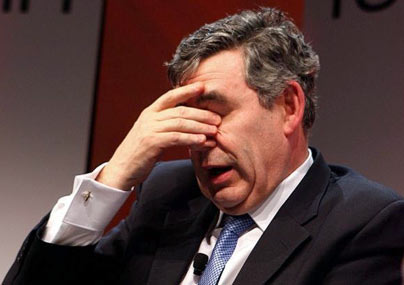
Britain's Global Giant!

Oh, I remember now. The very same person in Britain who was Chancellor throughout the 90s and is now Prime Minister is – according to John Prescott (former Labour Deputy-Leader and the person whose office sign was changed at a cost of £700 ($1,200)  when his job name was rebadged weeks before he left it anyway)  – a “Global Giant” who saved the world.

Oh, and let’s not forget, this is the same person who said that: “Britain is better placed than other countries in Europe to weather the crisis …..etc blah, blah, blah …”

The reality (which is in fairly short supply among Global Giants) is different:

Within hours of the Chancellor’s announcement, the European Commission issued a stark warning about the frayed state of Britain’s national finances, warning of an ‘extraordinary deterioration’ because of the cost of City rescues.

It estimates public debt will double as a share of the economy between 2007 and 2011, reaching 88 per cent of gross domestic product – the biggest rise of any leading EU economy.

The latest £50billion bank bailout is roughly equivalent to the annual schools budget and far exceeds the annual defence budget of £35billion. The new moves bring the total of public money lavished on Britain’s financial rescue to £1.2trillion – almost £20,000 for every man, woman and child living in the country.

… and the £ has sunk drastically against the euro ….

Still, let’s have a bit of positive spin …. the National Debt isn’t quite (yet) what is was just after WWII. A great achievement. Well done  Gordon Brown …. but you can do it …. just one more little push.

We could do with fewer spin-ridden “Global Giants” and more people with vision, courage and competence.

And rather than “saving the world” it might be nicer if Gordon Brown started with saving Britain.

By Chris Snuggs

WOMD

Mass Destruction?

No, it’s not weapons – I just wanted to get your attention; it’s “Words”. Last week two words of enormous significance crept into the news, and the first of them was the word “fair“.

This is a very interesting and potentially devastating word, but I wonder if the Minister was wise in letting it out of the box? Has he read the story of Pandora?

The word was used in connection with a report by British Schools Adjudicator Ian Craig, who had been asked by the British Labour government to look into the procedures and practice of admissions to secondary schools in Britain.

It seems that many parents, desperate to get their child into a good school, are devising ways to get round the strict allocation procedures put in place to ensure “fairness”. As has been brilliantly explained by Judith Woods in “The Telegraph” these desperate tricks include “using grandparents’ addresses on admissions forms for sought-after schools, renting homes in the catchment area, feigning marriage break-up and then reporting that one parent has moved nearer the school, and swapping houses with friends.”

According to Mr Craig – and the government – this is “cheating” and not “fair”, and the former is asking for local authorities to “use all means open to them to deter parents from cheating the admissions system. This includes removing places from the guilty and pursuing them through the courts, possibly using the Perjury Act.”

My interest here is not so much in the minutiae of the details of this current spat but the concept of “fairness” in society, which strikes me as pretty fundamentally complex.

It is of course a fairly modern concept, not one that much preoccupied Genghis Khan or even the Victorians, who were much happier with the principles outlined in this verse of the hymn “All things bright and beautiful”.

The rich man in his castle,
The poor man at his gate,
God made them, high or lowly,
And order’d their estate.

Interestingly, the concept is also one that is not often explicitly discussed by governments. I wonder if this is because the power and moneyed elite know that they might be on a sticky wicket in any discussion of “fairness”?

As ever, one cannot hope to find the answers until one has clearly posed the questions. So here goes:

Minister, as you have introduced into evidence the concept of fairness and labelled those trying to get round the school admission regulations as “cheats”, could you possibly answer these questions?

  • Is it fair that many families – desperate to provide a good education for their children – cannot afford to move to an area where there are good schools but are stuck through their limited means in an educational ghetto?
  • Is it fair that people can play the religion card and send their kids to a high-quality “faith” school outside of their catchment area, Tony Blair, former British PM, being the best recent example.
  • Is it fair that a substantial minority of parents don’t have to bother about finding a good state school at all since they can go private? (And shockingly, according once more to  Judith Woods: “the advantage of being educated at an independent school is greater in Britain than in almost any other country.”)
  • Is it fair that many of the same substantial minority own multiple dwellings while hundreds of thousands of ordinary families do not own their own home and have to pay rent to someone, a system that seems to me to be a direct descendent of the feudal system where you slaved all day in return for the right to live on some Lord’s property? (Speaking of which – much as I love the Queen – is it fair that the small Royal Family owns vast, multiple dwellings that could house thousands of homeless people?)
  • Is it fair that poor person A should die of some horrible disease or disability while person B of limited means can pay for special treatment and survive?

And of course, the ultimate question: Is it fair that I wasn’t born with the voice of Elvis Presley and the brain of Albert Einstein?

Yes indeed; the concept of “fairness” goes far. Once you introduce it as a premise, then where do you stop? And either you base your government on “fairness” or you don’t. You can’t have your cake and eat it, can you?

I look forward in coming days to hearing more from Ministers – and indeed from readers – on the concept of “fairness”. One thing is sure to me, in a world of rapidly-increasing problems and people we risk hearing the word a lot more often as we struggle to find solutions which are “fair”.  Of course, that assumes we think things should be “fair”.

Looking around, my conclusion is that we pretend to think it’s important but only if it doesn’t affect us too much personally.

Oh, the second Word of Mass Destruction? You’ll have to wait till next time …..

By Chris Snuggs

Reflecting on insider trading

Time to Reassess Insider Trading Rules?

On the face of it, prohibiting insider trading seems to be fair and reasonable.

US insider trading laws, refined over time in court on a case-by-case basis, define “trading on the basis of inside InsiderTradinginformation” as any time a person trades while aware of material nonpublic information (US Securities and Exchange Commissions Rule 10b5-1, which also creates an affirmative defense for pre-planned trades.) SEC regulation FD (“Fair Disclosure”) also requires that if a company intentionally discloses material non-public information to one person, it must simultaneously disclose that information to the public at large; in an unintentional disclosure, the company must make a public disclosure “promptly.” Lastly, the Williams Act gives the SEC regulatory authority over insider trading in takeovers and tender offers.
Read more about Insider Trading

Chickens coming home to roost?

Chickens, farming and global issues.

We keep chickens at our home in Devon, England and, thus, we have an account with a local farming supplies organisation called Mole Valley Farmers. Once a month we get a small news letter which I find fascinating. The first page always has The Chairman’s Newsletter and I love reading about the current price of grain, what’s current in the dairy world and a bit about food politics – usually very little about chickens but then I’m biased!

The Chairman quoted a British Government minister at a recent conference making a reference to the need to increase food production but then spending most of his speech talking about “rewilding” the countryside by reintroducing lynx and elk.  (The link is to a slightly tongue-in-cheek article in the Times Online.)

Quite how that would help food production was “incomprehensible” but it shows a complete lack of understanding about the serious threat to the UK, and other countries, as we now import so much of our basic food needs and many local farmers have been underpriced out of farming by the monopoly of the supermarkets. An interesting parallel with the banks  and greed in general.

With a world food shortage affecting many parts of the world it makes me wonder what is in store for us, especially our children. So far, I am unaware of anyone in UK politics making a link between pollution, food shortages, global warming and the fact that unless we wake up soon, we stand a big risk of reproducing ourselves out of existence.

By Jon Lavin

I haven’t got the energy ….

Energy contradictions underline some very strange attitudes.
h-mountainsI went for a bike ride this afternoon ….. there is a super 6km circuit that goes from our village Unterthingau along a country road, up past a farm with magnificent views over the Allgäu countryside then along to Oberthingau and back home …..  On the way there are horses and cows munching happily in fields and of course the snow-capped Alps in the background ….  The exercise and the fresh air were great, but during the ride I was struck by a couple of things. On the skyline in the direction of Kempten was – as usual – a line of a dozen wind turbines. All were – as usual – immobile, save one which was doing its best to turn languidly, and hardly succeeding.
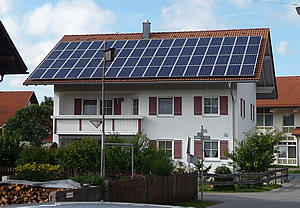

solar2
A private house in the village

Now the Germans do things properly, as we know. This area is pristine, hardly a blade of grass or a stone out of place; it is stunning.  So when it comes to energy-saving, they do it seriously (up to a point).

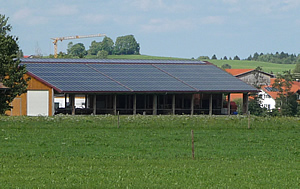
For a start, there are solar panels covering many roofs; the farmers get a subsidy for the installations and sell any surplus to the German National Grid. And then there are those windmills …. but the point is, they are usually motionless. There may be plenty of winter snow in this area, but there isn’t much wind.

solar1
Solar panels on cowshed ...

This confirmed my view that windmills in most places in Europe are never going to solve the energy shortage. They are contributing almost nothing now, and of course only produce anything at all when there’s wind. Full marks to the Germans for trying, but it’ll never be enough.

Leaf-Blower_Vacuum
leaf-blower ....

Then as I rode through Oberthingau I saw a local resident blowing leaves off his forecourt with one of those “leaf-blower” machines ….  This struck me as bizarre.

In truth, I’ve NEVER understood those things. What is the point? You blow the leaves from one place to another and later on when there is a little wind it’ll blow them straight back again. If he had been hoovering UP the leaves, fine, but blowing them from one place to another? Why not use a broom? And what have they got against leaves, anyway?

And I thought, on the one hand we are rushing around like headless chickens trying to think of ways of generating energy and on the other we are totally wasting it on ludicrous non-essentials.

As has been claimed and to my mind proven for Africa, what is needed is not giant, national and international projects (though more nuclear power-stations would help) but micro-projects for the masses, and especially a cosmic change in the mindset. You only have to look around to see examples of humungous waste of energy.  Get rid for a start of most traffic lights! Dangerous? Errrmmm, no actually … experiments have shown that when there are no lights people drive more cautiously ….  Get rid of those barriers on motorways that go up and down thousands of times every day. How many people actually drive through a toll barrier without paying? And even if they do, the operator can take their number and report them; why on earth do we need an energy-consuming barrier?

It’s individual mindsets that need to change …  Do people really have to fire up their car to drive 300 metres to the baker’s on Saturday mornings? What happened to walking?  The British “school run” is a classic example; kids are driven to school, don’t get enough exercise and so get fat, the roads are clogged up (and dangerous) and loads of CO2 is produced. Insane …..

One thing is sure, insanity will not save us ….

Lies, damn lies and Government statistics!

Do the last US 3rd Quarter GDP figures stand up to inspection?

The press recently celebrated the 3.5% annualized rise in the third quarter in reported U.S. Gross Domestic Product (GDP).  The figures were widely reported with, for example, CNNMoney, carrying the following headline and opening remarks:

Economy finally back in gear

Government says GDP grew 3.5% in third quarter, ending a year-long string of declines and coming in better than forecasts.

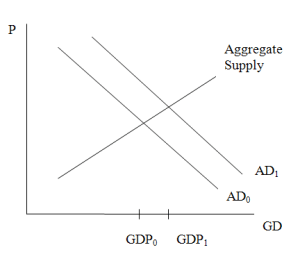
I urge caution in interpreting these figures at face value.  After all, the current GDP of the U.S. economy is simply the intersection of aggregate demand with aggregate supply.

As the figure below shows, GDP increases with increases in either the demand or supply curve, although increases in demand are accompanied by rising price levels while increases in supply push prices down and real incomes up.

graph

The quarterly figures make clear that the increase in demand was driven almost entirely by the expansion of government spending; the other three components of demand – consumption, business spending, and net exports, were either flat or falling.

Government spending is inherently short-term; it does not create wealth or enable sustainable growth.  In fact, neither consumption nor net exports create sustainable economic growth either.   Only business investment in new productive equipment (which includes business fixed investment, new residential housing and additions to inventory) has the potential to create sustainable growth in U.S. GDP, and then only when the investment leads to a permanent increase in the productivity of the business, namely a rightward (increased output per input) or downward (decreased cost) shift in the Aggregate Supply curve.

And there was little chance that the reported increase in GDP resulted from a long-term increase in the productive capacity or efficiency of the U.S. economy, as Business Investment was soundly negative in the 3rd quarter of 2009.

By Sherry Jarrell

[P.S. Karl Denninger at Market Ticker also raised big question marks about these figures. Ed.]

Britain’s National Interest ….

When is a National Interest not in the national interests?

“The Guardian”, a British newspaper, ran a story on October 30th quoting British Prime Minister Gordon Brown as gordon-brownsaying:

“If you have the chance for that to happen, it is in Britain’s national interest. But of course it may not happen, and there are other candidates as well.

This was in relation to the possible nomination of former British Premier Tony Blair as the first President of Europe as prescribed by the Lisbon Treaty, the EU’s attempt to rationalize its processes and – according to critics – take the EU forward on its seemingly-inevitable path to political union.

Now, a couple of things stuck me forcefully about this statement.

First, WHAT EXACTLY has choosing the first European President got to do with Britain’s national interest? Should we not be first of all concerned with EUROPE’S interest? Is a preoccupation with OUR national interest in the spirit of European partnership at all?

Secondly, HOW exactly could Britain’s national interest be supposed to benefit from the President being British? Would he somehow be expected to favour Britain? Perhaps swing lucrative aerospace contracts our way?

In other words, what Brown said was ridiculous, betraying a narrow, partisan view of what European cooperation is all about. Now I have many problems with the EU, but that doesn’t mean I like to see Britain taking such a parochial and frankly selfish standpoint.

I would feel no pride whatsoever just to see a Brit as President, nor would I expect or indeed wish any particular aspect of British national interest to be furthered just because the EU President was British.

On the contrary, I believe Britain’s image has immensely suffered with the current shenanigans involved in Whitehall’s lumbering attempts to push Blair’s candidacy, including reportedly sharp exchanges between Brown and other leaders Tony-Blair1at the current summit. It was – to me if apparently not to Blair and his advisors – blindingly obvious that the only way for Blair to have any chance of getting this post was to be humble, discreet, lofty and statesmanlike. Instead, we have seen reports to the effect that he would take the job “if it were big enough” and that various political worthies have been “sounded out” about whether they would serve under him in Brussels.
A large dose of hubris is in order I am afraid, and in any case Blair’s chances seem to be fading fast, not least because German Chancellor Angela Merkel is said to have become aware of how “unpopular Blair is in his own country”, in contrast to his international image as globe-strutting statesman.

Blair’s future does not interest me overmuch; I am more concerned by the current PM’s lack of judgement and statesmanship.

By Chris Snuggs

How far can you push people?

Debt stress in Middle Class America – how may this play out?

On Saturday, October 24th Yves Smith of Naked Capitalism ran a Post on her Blog about an anonymous couple who were over their heads in debt.  (Yves has given me written permission to reproduce the Post.) The story of this couple then generated a huge response of comments. Read the comments, each and every one of them.

Then ask yourself abraham-lincoln-picturewhere this is all heading?  These comments may, almost certainly are, just be the tip of the iceberg.  Seems a long way from Lincoln’s Gettysburg address in which he was reputed  to have used the words: “… government of the people, by the people, for the people, shall not perish from the earth.”

Some days I worry; worry a lot!

The extract from Yves Post about this couple is reproduced below but far better is to go and read the whole Post and all the comments.

UPDATE: Since writing this Post Yves has published a further Post on the topic again generating a huge volume of comments.  That was Sunday, November 1st.  Then bright and early on November 2nd James Kwak of Baseline Scenario weighs in with his version, Do smart, hard-working people deserve to make more money? 150 comments (at the time of writing) for that one.  Interestingly, as the days have gone on the mood of the commentators has become more reflective and thoughtful thus partly negating the theme behind this Post.

Read the Post from Naked Capitalism

Democracy and Marriage, Pt 2

A huge misunderstanding of democracy.

Yesterday, I covered the appalling lunacy that took place recently on British television.  This is the concluding part of my Post.

Nick Griffin and his party are gaining support because immigration in Britain has been overdone, and anything overdone is bad news. Moreover, many perceive that their own government has been involved in a campaign of nickgriffinblatant lying.

The average Brit is a staunch yeoman, solid as a rock, but he won’t take being lied to, nor patronised, nor flooded with immigrants of an alien culture who often show little wish to integrate and some of whom seem to be actively seeking the downfall of the west and the establishment of a single Islamic worldwide Caliphate.

Now these are megalomaniac dreams, but many before have had them: Genghis Khan and Hitler to name but two.

There is also a visceral dislike of certain Islamic practices seen as alien to an open, democratic society based on Human Rights, in particular the attitude to women.

Hence the growth of the BNP, which – despite the above arguments – remains a nauseatingly xenophobic and homophobic party.

BUT, and here’s the rub, it does – for better or worse, and thanks to the idiotic policies of the present Labour government – represent the views of a substantial and increasing minority of people.

Read more of this concluding part

Democracy and Marriage, Pt 1

Nick Griffin’s Appearance on BBC’s “Question Time”

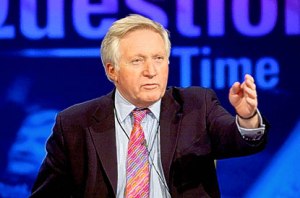
David Dimbleby, host of Question Time

Recently, an event of surpassing lunacy took place on British television. The weekly popular current affairs programme, “Question Time”, invited Nick Griffin to appear as one of the five politicians who respond to questions from a studio audience.  There are some clips from the programme on the BBC website.

Now Nick Griffin is not just any old boring political hack; he is the Leader of the BNP, the British National Party.

For our American friends who may not be up to speed on the minutiae of British politics, this is a minority party which is strongly anti-immigrant. Moreover, Nick Griffin himself is homophobic, has flirted with leaders of the KKK and is said to be sympathetic to Nazi ideas, though this he denies, alleging that the British Nazis hate him.

The latter, by the way, are a group of microscopic importance on the British political scene; extremism having never taken root in British politics.

Read more about Griffin