I sense the levels of inequity in today’s world reaching crisis levels!
This is the next essay in my irregular series of The Natural order. The last one, on life and death, was published a couple of weeks ago.
Now it would be tempting to rant on at great length about the ‘haves’ and the ‘have-nots’ but there’s a sense of caution about so doing. Because, to be blunt about it, the lifestyle that Jean and I enjoy here on our rural retreat in Southern Oregon is, compared to millions, a blissful luxury.
So all I will do is to refer to some recent articles and essays that seem, to me anyway, to speak volumes about the terrible and growing levels of inequity between the majority of citizens and ‘the 1%‘!
Patrice Ayme of the blog Patrice Ayme’s Thoughts has long written about inequality. I recommend you browse his many essays on the subject of plutocracy but this one, USA: Rich Plutos, Poor People, comes to mind fairly quickly; from which I quote:
Plutocracy is a redistribution of wealth, power, income, from We The People to a small minority of controlling parasites. Plutocracy paralyzes the minds with a warped case of inverted decency. Plutocracy is neither optimal for the society, nor the economy.
Plutocracy affects the USA more than Europe, and the minds, even more than the stomachs. The fact that average Americans feel that they are much better off than in the rest of the world reinforces the plutocratization of the USA. Including astounding tolerance for the amazingly corrupt so-called Supreme Court (Supremely plutocratic!).
I’m “Black”, Mom Was White, & Thus We’re In The Black.
Turning back to this place, not so long ago I published a two-part essay on the loss of democracy. In the first part, I wrote:
But if you think this is an American problem, let me take you back a couple of days to my post that reflected the feeling that it was all getting too much: I just want to throw up! Reason? Because in that post I referred to a recent essay by George Monbiot called The Shooting Party. Here are the opening chapters (and you will have to go here to read the numbered references):
As the food queues lengthen, the government is giving our money to the super-rich.
By George Monbiot, published in the Guardian 29th April 2014
So now you might have to buy your own crutches, but you’ll get your shotgun subsidised by the state. A few days after False Economy revealed that an NHS group is considering charging patients for the crutches, walking sticks and neck braces it issues (1), we discovered that David Cameron has intervened to keep the cost of gun licences frozen at £50: a price which hasn’t changed since 2001 (2).
The police are furious: it costs them £196 to conduct the background checks required to ensure that shotguns are issued only to the kind of dangerous lunatics who use them for mowing down pheasants, rather than to the common or garden variety. As a result they – sorry we – lose £17m a year, by subsidizing the pursuits of the exceedingly rich (3). The Country Land and Business Association – the armed wing of the Conservative party – complains that it’s simply not fair to pass on the full cost of the licence to the owners of shotguns (4); unlike, say, the owners of passports or driving licences, who are charged on the basis of full cost recovery.
Three days later – on Friday – the government announced that it will raise the subsidy it provides for grouse moors from £30 per hectare to £56 (5). Yes, you read that right: the British government subsidises grouse moors, which are owned by 1% of the 1% and used by people who are scarcely less rich. While the poor are being forced out of their homes through government cuts, it is raising the payments – across hundreds of thousands of hectares – that some owners use to burn and cut the land (helping to cause floods downstream), shoot or poison hen harriers and other predators, and scar the hills with roads and shooting butts (6). While the rest of us can go to the devil, the interests of the very rich are ringfenced.
Shortly, I’m going to refer to another Monbiot essay recently published that underscores, once again, the corruption of fairness that is happening in the United Kingdom.
Before that, let me remind all you great readers the lesson we should, and must, learn from Nature. Again, using something recently posted:
OK, I opened today’s post with the sub-heading “Probably just now the most important lesson to be learnt from dogs!” Let me expand on that.
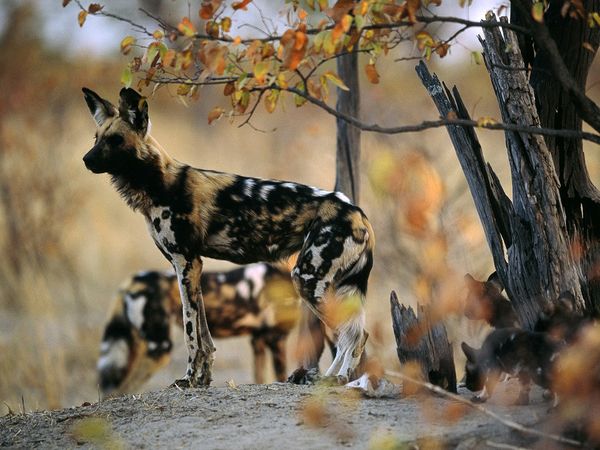
Dogs, like many other ‘pack’ animals, have a relatively flat hierarchy across their group. Typically, a wild dog pack numbered upwards of 30 animals although in modern times we have only the African Wild dog left to study. Nevertheless, the African Wild dog offers mankind the key lesson about cooperation and social equality. Here’s an extract from a National Geographic article [my emphasis]:
African Wild Dog Lycaon pictus
Known as African wild, painted, or Cape hunting dogs, these endangered canines closely resemble wolves in their pack-oriented social structure. Photograph by Chris Johns
The African wild dog, also called Cape hunting dog or painted dog, typically roams the open plains and sparse woodlands of sub-Saharan Africa.
These long-legged canines have only four toes per foot, unlike other dogs, which have five toes on their forefeet. The dog’s Latin name means “painted wolf,” referring to the animal’s irregular, mottled coat, which features patches of red, black, brown, white, and yellow fur. Each animal has its own unique coat pattern, and all have big, rounded ears.
African wild dogs live in packs that are usually dominated by a monogamous breeding pair. The female has a litter of 2 to 20 pups, which are cared for by the entire pack. These dogs are very social, and packs have been known to share food and to assist weak or ill members. Social interactions are common, and the dogs communicate by touch, actions, and vocalizations.
African wild dogs hunt in formidable, cooperative packs of 6 to 20 (or more) animals. Larger packs were more common before the dogs became endangered.
So back to the domesticated dog. There are just three ‘roles’ to be found: the female alpha dog, the male beta dog and the omega dog that can be of either gender. Even though in a group of dogs (we have eight here at home) the alpha and beta dogs are dominant and will eat first, there is no question of denying the other dogs in the group access to food, water and love from us humans.
The lesson we must learn from dogs is obvious and there’s no need for me to spell it out!
This, then, is the power of the natural order as it applies to animal ‘communities’.
Nature, one way or another, will show us that the natural order is the only ruling order on this natural planet.
So with those tones of mine hopefully ringing in your ears, have a read of this recent Monbiot essay republished with Mr. Monbiot’s kind permission.
ooOOoo
Land of Impunity
May 5, 2014
Politicians and government contractors now seem to be able to get away with almost anything.
By George Monbiot, published in the Guardian 6th May 2014.
What do you have to do to fall out of favour with this government? Last month, the security company G4S was quietly rehabilitated (1). It had been banned in August 2013 from bidding for government contracts (2), after charging the state for tagging 3,000 phantom criminals (3). Those who had died before it started monitoring them presented a particularly low escape risk. G4S was obliged to pay £109m back to the government.
Eight months later, and before an investigation by the Serious Fraud Office has concluded, back it bounces, seeking more government business. Never mind that it almost scuppered the Olympics (4). Never mind Jimmy Mubenga, an asylum seeker who died in 2010 after being “restrained” by G4S guards(5), or Gareth Myatt, a 15-year-old who died while being held down at a secure training centre in 2004(6). Never mind the scandals and crises at Oakwood, the giant prison it runs(7). G4S, recently described by MPs as one of a handful of “privately-owned public monopolies”(8), is crucial to the government’s attempts to outsource almost everything. So it cannot be allowed to fail.
Was it ever banned at all? Six days after the moratorium was lifted, G4S won a new contract to run services for Her Majesty’s Revenue and Customs(9). A fortnight later, it was chosen as one of the companies that will run the government’s Help to Work scheme(10). How did it win these contracts if, in the preceding months, it wasn’t allowed to bid?
When I first worked in Brazil, in the late 1980s, the country was widely described as o pais de impunidade: the land of impunity. What this meant was that there were no political consequences. Politicians, officials and contractors could be exposed for the most flagrant corruption, but they remained in post. The worst that happened was early retirement with a fat pension and the proceeds of their villainy safely stashed offshore. It’s beginning to look a bit like that here.
This is not to suggest that the people or companies I name in this article are crooked or corrupt. It’s to suggest that the political class no longer seems to care about failure.
The failure works both ways of course. As Polly Toynbee has shown, the pilot projects for the Help to Work scheme which G4S will run reveal that it’s a complete waste of time and money(11). Yet the government has decided to go ahead anyway, subjecting the jobless to yet more humiliation and pointlessness. Contrast the boundless forgiveness of G4S to the endless castigation for being unemployed.
A record of failure reflects the environment in which such companies are hired: one in which ministers launch improbable schemes then look the other way when they go wrong. G4S had to pay back so much money for the phantom criminals it wasn’t monitoring because it had been doing it for eight years, and no one in government had bothered to check(12). There is no such thing as failure any more, just lessons to be learnt.
Accountability has always been weak in this country, but under this government you must make spectacular efforts to lose your post. At the Leveson inquiry in April 2012, the relationship between the then culture secretary Jeremy Hunt and the Murdoch empire that he was supposed to be regulating was exposed in gory detail(13,14). Though he was meant to be deciding impartially whether or not to allow the empire to take over the broadcaster BSkyB, he was secretly exchanging gleeful messages with James Murdoch and his staff(15).
We all knew what it meant. The emails, the Guardian observed, were likely to “sever the slim thread connecting Hunt to his cabinet job.”(16) “After this he’s toast … it’s over for Hunt,” wrote Tom Watson MP(17). “He cannot stay in his post,” said Ed Miliband. “And if he refuses to resign, the prime minister must show some leadership and fire him.”(18) We waited. Hunt remained culture secretary for another four months, then he was promoted to secretary of state for health.
On 2 September 2012, the Guardian revealed that the housing minister, Grant Shapps, had founded a business which “creates web pages by spinning and scraping content from other sites to attract advertising”: a process that looks to me like automated plagiarism(19). He had been promoting the business under the name of Michael Green, who claimed to be an internet marketing guru. Again it looked fatal. Two days later, in the same reshuffle that elevated Hunt, he was promoted to Conservative party chairman.
A real Mr Green – Stephen this time – was ennobled by David Cameron and appointed, democratically of course, as minister for trade and investment. In July 2012, a US Senate committee reported that while Lord Green was chief executive and chairman of HSBC, the bank’s compliance culture was “pervasively polluted”(20). Its branches had “actively circumvented US safeguards … designed to block transactions involving terrorists, drug lords, and rogue regimes.” Billions of dollars from Mexican drug barons, from Iran and from “obviously suspicious” travellers’ cheques “benefiting Russians who claimed to be in the used car business” sluiced through its tills(21). Out went dollars and financial services to banks in Saudi Arabia and Bangladesh linked to the financing of terrorists. The Guardian reported that HSBC “continued to operate hundreds of accounts with suspected links to Mexican drug cartels, even after Green and fellow executives were told by regulators that HSBC was one of the worst banks for money laundering.”(22)
Green refused to answer questions and sat tight(23). He remained in post for another 17 months, until he gracefully retired in December 2013.
After it had become obvious to almost everyone that it was impossible for them to remain in the Cabinet, David Cameron refused to sack either Liam Fox or Maria Miller. Forgiveness and redemption, by all means. But they are not unconditional: without contrition or even acknowledgement that wrong has been done, there’s no difference between giving people a second chance and engaging in an almighty cover-up.
There has seldom, in the democratic era, been a better time to thrive by appeasing wealth and power, or to fail by sticking to your principles. Politicians who twist and turn on behalf of business are immune to attack. Those who resist are excoriated.
Here’s where a culture of impossible schemes and feeble accountability leads: to cases like that of Mark Wood, a highly vulnerable man who had his benefits cut after being wrongly assessed by the outsourcing company Atos Healthcare as fit for work, and starved to death(24) – while those who run such companies retire with millions. Impunity for the rich; misery for the poor.

 Learning from Dogs