Tag: PLOS ONE study

More yawning!

This time from dogs

Two days ago, I wrote a post Empathy and bonding that revolved around some recent science about yawning in wolves.  The crux of the post was an essay in the Smithsonian by Helen Thompson. The article was called Yawning Spreads like a Plague in Wolves.

In my research for that post, I came across another Smithsonian article regarding the contagious nature of yawning in dogs.  I wanted to republish that here as a follow-up to the yawning in wolves piece.

ooOOoo

Dogs Yawn Contagiously Too

Like humans, dogs are prone to yawning when they see someone else do it—and a new study shows that they yawn most frequently in response to their owner.

By Joseph Stromberg
smithsonian.com
August 7, 2013
dog-1
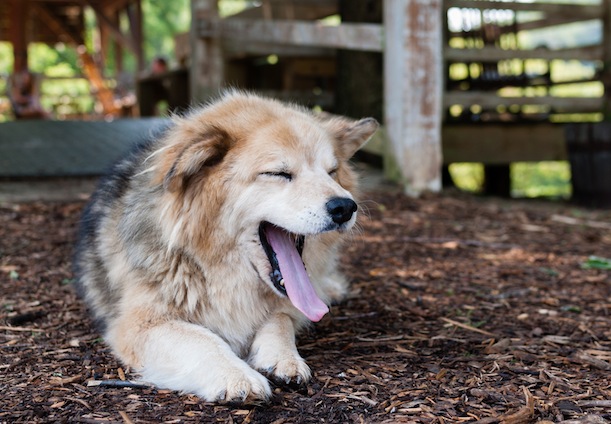
New research shows that, like humans, dogs are prone to yawning when they see someone else do it—and they yawn most frequently in response to their owner. Image via Flickr user The Eggplant

Animals: they’re just like us. They have unique, individual personalities. They remember their friends after years apart.

And now, in one of the most groundbreaking scientific discoveries of the decade—and perhaps even the century—researchers from the University of Tokyo have discovered that, like humans, dogs yawn contagiously.

Okay, we kid. But in all seriousness, the finding does shed a bit of light on that most mysterious of behaviors, the yawn. Despite years of research, scientists still don’t understand why we do it in the first place. Most believe we yawn to help cool down when our brains are overheated. The fact that yawning is contagious in 60 to 70 percent of people, many argue, is a function of empathy, as people who score higher on empathy tests are more likely to experience contagious yawning.

In the new study, published today [Ed. August 7th, 2013] in PLOS ONE, the researchers found that more than half the dogs they tested yawned contagiously—and, most interesting, they were more likely to yawn after watching their owner yawn than seeing it done by an unfamiliar human. If empathy truly is at the heart of contagious yawning, these findings could suggest that canines, too, are capable of true empathy.

dsds
Image via Flickr user The hills are alive

This isn’t the first study to show that dogs yawn contagiously, but it is the first to get the dogs’ owners involved. The researchers visited the homes of 25 dogs from different breeds (ranging from golden retrievers to labs to chihuahuas) and had their owners sit in front of them, call their name, and then yawn. For a control, they also had their owners simply open and close their mouths, without a yawn’s characteristic jaw-stretching, deep inhalation or long sigh. As a comparison, they also had people that the dogs had never met before perform both actions. (Incidentally, the paper is vague on how they got the owners and strangers to yawn—although, as you might have discovered since starting this post, simply reading about yawning might have done the trick.)

In total, the 25 dogs yawned 22 times after seeing people yawn, and just 5 times after seeing people open and close their mouths. They were nearly three times more likely to yawn contagiously after seeing their owner yawn as compared to seeing a random person do it. This last finding, they say, provides further evidence for the role of empathy in yawning, as dogs are presumably more likely to empathize with their owners than another person.

Why would empathy be the explanation for why yawns are contagious? As social animals, humans often inadvertently copy the emotions and behaviors of those around them, whether it’s a smile or a frown.

Yawns, presumably, are no exception. And if the underlying function of yawning is to dissipate heat and cool the brain down, mimicking the yawns of others would make a lot of sense. “If I see a yawn, that might automatically cue an instinctual behavior that if so-and-so’s brain is heating up, that means I’m in close enough vicinity, I may need to regulate my neural processes too,” Steven Platek, a psychology professor at Georgia Gwinnett College, told my colleague Marina Koren in her recent post on the science of yawning.

Other work has found that chimpanzees yawn contagiously. That research, along with the new finding, suggests that to some extent, chimps and dogs operate based on the same sorts of social cues as we do.

ooOOoo

What more can I add!

Especially with a yawn coming up! (A younger version of me, you do understand!)

man-yawning

Empathy and bonding.

Who would have thought that yawning revealed so much more than one’s tonsils!

Alex Jones, he of the blog The Liberated Way, recently posted You need room to grow. On reading the post a section stood out for me:

The human eye needs the stimulation of sunlight and the outdoors to develop properly. The BBC [Ed: Massive rise in Asian eye damage] reports that a recent study of students in South Asian cities found 90% of the samples were short-sighted, a condition called myopia that needs glasses. Modern South Asian students spend a large part of their lives indoors studying or involved with electronic technology such as the internet. Young children in the UK are rapidly getting myopia as young as three because of being indoors and on computers for long periods of time according to the Daily Mail.

That got me thinking about both the ‘old’ and ‘new’ styles of social bonding.  In defence of our digital world, there is no question that social media programs (apps?) such as Facebook, Linked-In and Twitter are incredible means of communicating with people that one doesn’t know directly.  Even the funny old world of blogging delivers that. I would have stopped writing for Learning from Dogs years ago if it weren’t for the many ‘friends’ that have been made across the ‘blogosphere’!

But (and you knew there was a ‘but’ coming, didn’t you!), social intimacy, as in being able to rub shoulders with people, is the vital core to how we ‘wear’ the world around us.

That was brought home to me by a recent article on the Smithsonian website, an article that I am taking the liberty of republishing in this place. The article is about the contagious nature of yawning; not just for us humans but for wolves.

Note: there were many links to other content in the article making it almost impossible to replicate. So please go to the original to follow up those links.

ooOOoo

Yawning Spreads Like a Plague in Wolves

Evidence of contagious yawning in chimps, dogs and now wolves suggests that the behavior is linked to a mammalian sense of empathy

By Helen Thompson smithsonian.com
August 27, 2014

Chimps do it, birds do it, even you and I do it. Once you see someone yawn, you are compelled to do the same. Now it seems that wolves can be added to the list of animals known to spread yawns like a contagion.

Among humans, even thinking about yawning can trigger the reflex, leading some to suspect that catching a yawn is linked to our ability to empathize with other humans. For instance, contagious yawning activates the same parts of the brain that govern empathy and social know-how. And some studies have shown that humans with more fine-tuned social skills are more likely to catch a yawn.

Similarly, chimpanzees, baboons and bonobos often yawn when they see other members of their species yawning. Chimps (Pan troglodytes) can catch yawns from humans, even virtual ones, as seen in the video below. At least in primates, contagious yawning seems to require an emotional connection and may function as a demonstration of empathy. Beyond primates, though, the trends are less clear-cut. One study found evidence of contagious yawning in birds but didn’t connect it to empathy. A 2008 study showed that dogs (Canis lupus familiaris) could catch yawns from humans, and another showed that dogs were more likely to catch the yawn of a familiar human rather than a stranger. But efforts to see if dogs catch yawns from each other and to replicate the results with humans have so far had no luck.

Now a study published today in PLOS ONE reports the first evidence of contagious yawning in wolves (Canis lupus lupus). “We showed that the wolves were able to yawn contagiously, and this is affected by the emotional bond between individuals, which suggests that familiarity and social bonds matter in these animals the same way as it does in humans,” says study co-author Teresa Romero, who studies animal behavior at the University of Tokyo.

The prevalence of contagious yawning in primates and other mammals could give us some clues to the evolution of empathy—that’s in part what makes the phenomenon so interesting and so controversial. If dogs can catch yawns from humans, did they pick up the behavior because of domestication, or does the trait run deeper into evolutionary history?

The Tokyo team took a stab at those questions by looking at contagious yawning in dog’s closest relatives, wolves. For 254 hours over five months, they observed twelve wolves (six males and six females) at the Tama Zoological Park in Tokyo. They kept tabs on the who, what, when, where, how many and how long of every yawn, then separated out data for yawns in relaxed settings, to minimize the influence of external stimuli.

Next, they statistically analyzed the data and looked for trends. They found that wolves were much more likely to yawn in response to another’s yawn rather than not, which suggests that contagious yawning is at play.

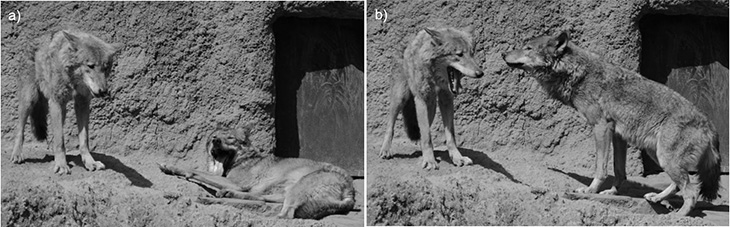
Smithyawning
In image A, an individual (right) yawned during a resting period, and a few seconds later, image B shows the subject (on the left) yawned contagiously. (Teresa Romero)

Wolves were more likely to catch the yawn if they were friends with the yawner. Females were also quicker on the yawn uptake when watching the yawns of those around them—possibly because they’re more attuned to social cues, but with such a small group it’s hard to say for sure.

The results seem to add to the case for empathy as the primary function of contagious yawning. “We have the strongest responses to our family, then our friends, then acquaintances, and so on and so forth,” says Matt Campbell, a psychologist at California State University, Channel Islands. “That contagious yawning works along the same social dimension supports the idea that the mechanism that allows us to copy the smiles, frowns and fear of others also allows us to copy their yawns.”

Empathy likely originated as an ancestral trait in mammals, and that’s why it emerges in such disparate species as wolves and humans. “More and more research is supporting this idea that basic forms of empathy are very ancient, and they are present in a wide number of species, at least in mammals,” says Romero. Elephants, for example, comfort their upset friends. Even rats exhibit a basic helping behavior toward other friendly rodents.

Why does contagious yawning between members of the same species show up in wolves and not dogs? The difference probably comes down to study design, not biology. “Most likely, dogs also catch yawns from [other dogs], as now shown for wolves,” says Elaine Madsen, a cognitive zoologist at Lund University in Sweden. Further studies might reveal the extent to which human interaction has affected present-day dogs’ susceptibility to catching another species’ yawns, she says.

It’s impossible to say what true function contagious yawning serves in wolves, but the researchers argue that such behavior could cultivate social bonds. “If an individual is not in sync with its group, it risks being left behind. That is not good,” says Campbell. Just watching wolves yawn can’t definitively prove that empathy drove the behavior, but it’s certainly compelling evidence that wolves might feel for their fellow lupines.

ooOOoo

Fascinating. As too is an article also on the Smithsonian website about dogs yawning.  Going to republish that in a few days.

However, this post was prompted by the reminder that there is no substitute for social bonding with others who we meet physically. That is why the Smithsonian essay seemed such an important reminder.  As was written (my emphasis):

Among humans, even thinking about yawning can trigger the reflex, leading some to suspect that catching a yawn is linked to our ability to empathize with other humans. For instance, contagious yawning activates the same parts of the brain that govern empathy and social know-how. And some studies have shown that humans with more fine-tuned social skills are more likely to catch a yawn.

Time for an afternoon nap!