To lead the project which took an old clay pit in a remote corner of the UK and converted it into a world class environmental visitor attraction is a tremendous achievement.
Homo sapiens? A game show!
Tim Smit had some fun with the business community at the 2009 Annual Convention of the UK Institute of Directors. Everyone, including he, was in their best business attire, but very few people could get away with crumpled shirt and jeans!
However, he has a serious message about the environment (1:55) and he knows a thing or two about people as well!
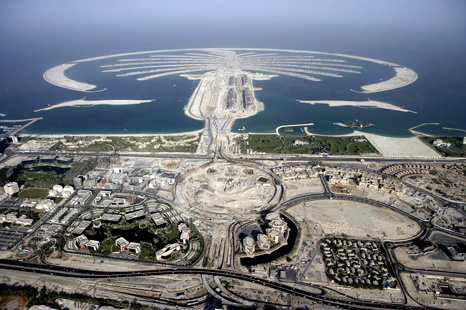
As part of my job I often spend time in the UAE. Many different nationals coming here on the promise of work so that they can send some of the hard-earned money back to their families, often the only means of family survival.
Thus I was touched this morning by a lovely welcome from a Filipino woman who works in a Lebanese café which I often frequent. I asked after her young daughter …
Yes, she said, she is now 7 years old, and she will see her daughter again in 8 months time, because she is leaving the job when her visa expires, which will enable her to get her passport back, and then her return airfare will be paid so that she can return home.
“My daughter was 2 and a half when I last saw her.”
There are thousands of people like her in the same situation, and they still carry on with a smile knowing that others depend on them for life!
How Peter L Bernstein’s work helps us make the safest decision with regard to global warming.
Probably like me you hadn’t heard of Peter Bernstein. He was instrumental in understanding risk and that alone makes him worth knowing about. Here’s the entry from Wikipedia:
Peter Lewyn Bernstein (January 22, 1919 – June 5, 2009) was a financial historian, economist and educator whose development and refinement of the efficient market theory made him one of the country’s [USA] best known authorities in popularizing and presenting investment economics to the general public.
Watch the YouTube video before reading on:
You could not have missed a fundamental message in the interview – if the consequence of something is critically harmful then don’t take ANY risks. Bernstein’s book on risk is Against the Gods.
It would be fair to say that my knowledge about what I am writing in this Post is minimal to the point of total ignorance. So why open my mouth and prove it! Because the conquest of fundamental questions about our world is not only an example of mankind at its greatest but also something of broad appeal.
That is proved by the continuing popularity of the BBC Television Series – Horizon. In that series there have recently been two fascinating programmes: Who’s afraid of a big Black Hole? and How long is a piece of string? (Readers outside the UK will not be able to view these programmes.)
Here are the programme summaries:
Black holes are one of the most destructive forces in the universe, capable of tearing a planet apart and swallowing an entire star. Yet scientists now believe they could hold the key to answering the ultimate question – what was there before the Big Bang?
The trouble is that researching them is next to impossible. Black holes are by definition invisible and there’s no scientific theory able to explain them. Despite these obvious obstacles, Horizon meets the astronomers attempting to image a black hole for the very first time and the theoretical physicists getting ever closer to unlocking their mysteries. It’s a story that takes us into the heart of a black hole and to the very edge of what we think we know about the universe.
and
Alan Davies attempts to answer the proverbial question: how long is a piece of string? But what appears to be a simple task soon turns into a mind-bending voyage of discovery where nothing is as it seems.
An encounter with leading mathematician Marcus du Sautoy reveals that Alan’s short length of string may in fact be infinitely long. When Alan attempts to measure his string at the atomic scale, events take an even stranger turn. Not only do objects appear in many places at once, but reality itself seems to be an illusion.
Ultimately, Alan finds that measuring his piece of string could – in theory at least – create a black hole, bringing about the end of the world.
Regular readers of this Blog will know that Naked Capitalism is a daily read for this author. Yves Smith always includes her ‘antidote du jour’ picture of animals. How Yves finds these is beyond me but her antidote of the 14th November really was special. The original author of the piece, Tom Sears, is encouraging the distribution of his story and pictures and it’s a pleasure to do so via Learning from Dogs.
Black bears typically have two cubs; rarely, one or three. In 2007, in northern New Hampshire, a black bear Sow gave birth to five healthy young. There were two or three reports of sows with as many as 4 cubs, but five was, and is, very extraordinary. I learned of them shortly after they emerged from their den and set myself a goal of photographing all five cubs with their mom – no matter how much time and effort was involved. I knew the trail they followed on a fairly regular basis, usually shortly before dark. After spending nearly four hours a day, seven days a week, for more than six weeks, I had that once-in-a-lifetime opportunity and photographed them. I used the equivalent of a very fast film speed on my digital camera. The print is properly focused and well exposed, with all six bears posing as if they were in a studio for a family portrait.
I stayed in touch with other people who saw the bears during the summer and into the fall hunting season. All six bears continued to thrive. As time for hibernation approached, I found still more folks who had seen them, and everything remained OK. I stayed away from the bears as I was concerned that they might become habituated to me, or to people in general, and treat them as `approachable friends’. This could easily become dangerous for both man and animal.
After Halloween, I received no further reports and could only hope the bears survived until they hibernated.
This spring, just before the snow disappeared, all six bears came out of their den and wandered all over the same familiar territory they trekked in the spring of 2007.
I saw them before mid-April and dreamed nightly of taking another family portrait, a highly improbable second once-in-a-lifetime photograph.
On 25 April 2008, I achieved my dream.
When something as magical as this happens between man and animal, Native Americans say, “We have walked together in the shadow of a rainbow”. And so it is with humility and great pleasure that I share these exhilarating photos with you. Do pass them on!
A personal reflection on this rather strange way of travelling!
The recent Post about young Jessica Watson sailing alone around the world raised a few comments but also reminded me of my own experiences of solo sailing.
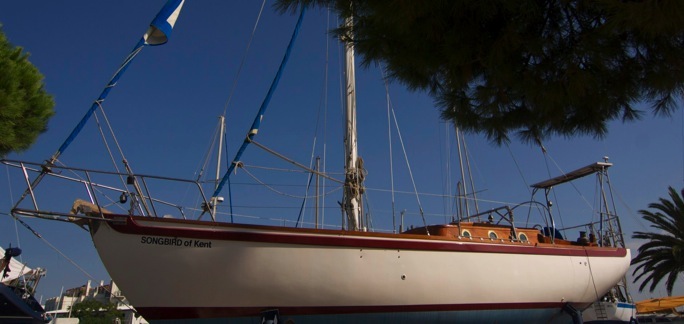
Some years ago, having successfully sold my own IT company, I warmed to the idea of being a full-time yachtie! A second-hand Tradewind 33 was discovered on the Island of Corfu. (Now here’s a surprise! I was just browsing the web looking for a picture of a Tradewind and came across my old yacht currently up for sale. Her name is Songbird of Kent! Picture below.)
Tradewind 33 - Songbird of Kent
Anyway, the deal was done and having sold my house in England I flew out to Corfu to collect Songbird of Kent. Inevitably it was a number of months before the boat was ready to head out into the Mediterranean but in early Spring 1988 it was time to explore the long coastlines of Greece and Turkey.
After a fantastic summer cruising from one idyllic anchorage to another mostly with friends or family on board, it was time to find a winter haven. Many recommended Larnaca Marina in Cyprus. Thus it was late in the summer of 1988 that I said goodbye to friends and set out on my own to cross from Antalya in Turkey to Cyprus and for Larnaca, on the SE side of the island.
That sea crossing, only a little over 200 nautical miles, was to become a regular solo experience at the start and end of each summer season. Impossible to do in a single day it was always a night at sea and rarely, if things didn’t go well with the weather, a couple of nights. I hated it! Maybe it was the sudden transition from coastal sailing to a deep water crossing, often going from having friends on board to being alone, but whatever it was I never enjoyed my time on my own and knew that long-distance solo sailing was never going to be my scene.
We keep chickens at our home in Devon, England and, thus, we have an account with a local farming supplies organisation called Mole Valley Farmers. Once a month we get a small news letter which I find fascinating. The first page always has The Chairman’s Newsletter and I love reading about the current price of grain, what’s current in the dairy world and a bit about food politics – usually very little about chickens but then I’m biased!
The Chairman quoted a British Government minister at a recent conference making a reference to the need to increase food production but then spending most of his speech talking about “rewilding” the countryside by reintroducing lynx and elk. (The link is to a slightly tongue-in-cheek article in the Times Online.)
Quite how that would help food production was “incomprehensible” but it shows a complete lack of understanding about the serious threat to the UK, and other countries, as we now import so much of our basic food needs and many local farmers have been underpriced out of farming by the monopoly of the supermarkets. An interesting parallel with the banks and greed in general.
With a world food shortage affecting many parts of the world it makes me wonder what is in store for us, especially our children. So far, I am unaware of anyone in UK politics making a link between pollution, food shortages, global warming and the fact that unless we wake up soon, we stand a big risk of reproducing ourselves out of existence.
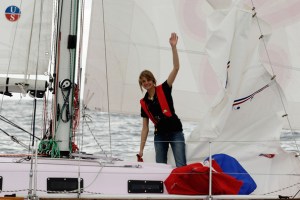
Jessica Watson is a teenager. She is hoping to break the record for the youngest person to sail solo, non-stop and unassisted around the World. Whatever modern materials and technology can do to make sailing easier, sailing solo for weeks on end is grindingly tough at any age. She’s a wonderful example of the next generation!
Jessica left Sydney Harbour on October 18, 2009 sailing her sloop Ella’s Pink Lady. Her course is an estimated 23,000 nautical miles requiring her to be roughly 230 days at sea.
As was said, this is no mean feat for any person. Read more about her on her website and her Blog.
Energy contradictions underline some very strange attitudes. I went for a bike ride this afternoon ….. there is a super 6km circuit that goes from our village Unterthingau along a country road, up past a farm with magnificent views over the Allgäu countryside then along to Oberthingau and back home ….. On the way there are horses and cows munching happily in fields and of course the snow-capped Alps in the background …. The exercise and the fresh air were great, but during the ride I was struck by a couple of things. On the skyline in the direction of Kempten was – as usual – a line of a dozen wind turbines. All were – as usual – immobile, save one which was doing its best to turn languidly, and hardly succeeding.
A private house in the village
Now the Germans do things properly, as we know. This area is pristine, hardly a blade of grass or a stone out of place; it is stunning. So when it comes to energy-saving, they do it seriously (up to a point).
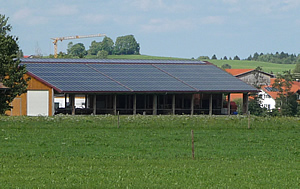
For a start, there are solar panels covering many roofs; the farmers get a subsidy for the installations and sell any surplus to the German National Grid. And then there are those windmills …. but the point is, they are usually motionless. There may be plenty of winter snow in this area, but there isn’t much wind.
Solar panels on cowshed ...
This confirmed my view that windmills in most places in Europe are never going to solve the energy shortage. They are contributing almost nothing now, and of course only produce anything at all when there’s wind. Full marks to the Germans for trying, but it’ll never be enough.
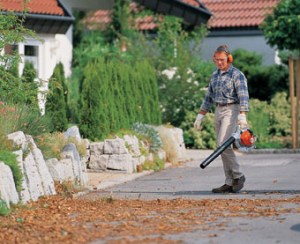
leaf-blower ....
Then as I rode through Oberthingau I saw a local resident blowing leaves off his forecourt with one of those “leaf-blower” machines …. This struck me as bizarre.
In truth, I’ve NEVER understood those things. What is the point? You blow the leaves from one place to another and later on when there is a little wind it’ll blow them straight back again. If he had been hoovering UP the leaves, fine, but blowing them from one place to another? Why not use a broom? And what have they got against leaves, anyway?
And I thought, on the one hand we are rushing around like headless chickens trying to think of ways of generating energy and on the other we are totally wasting it on ludicrous non-essentials.
As has been claimed and to my mind proven for Africa, what is needed is not giant, national and international projects (though more nuclear power-stations would help) but micro-projects for the masses, and especially a cosmic change in the mindset. You only have to look around to see examples of humungous waste of energy. Get rid for a start of most traffic lights! Dangerous? Errrmmm, no actually … experiments have shown that when there are no lights people drive more cautiously …. Get rid of those barriers on motorways that go up and down thousands of times every day. How many people actually drive through a toll barrier without paying? And even if they do, the operator can take their number and report them; why on earth do we need an energy-consuming barrier?
It’s individual mindsets that need to change … Do people really have to fire up their car to drive 300 metres to the baker’s on Saturday mornings? What happened to walking? The British “school run” is a classic example; kids are driven to school, don’t get enough exercise and so get fat, the roads are clogged up (and dangerous) and loads of CO2 is produced. Insane …..
Of the six active authors on this Blog, four have been or still are pilots. Of course, only young Bob Derham is a ‘real’ pilot having been an Air Transport pilot for almost as long as Pontious Pilate (sorry, that’s an awful pun!).
Anyway, there has been a growing collection of some incredible photographs from odd sources around the Web and it seemed time to share a few.
Here’s a wonderful picture of an F-15C Eagle Fighter circling over the Kennedy Space Centre in Florida with Shuttle Mission STS 108 on the launch pad.




 unassisted around the World. Whatever modern materials and technology can do to make sailing easier, sailing solo for weeks on end is grindingly tough at any age. She’s a wonderful example of the next generation!
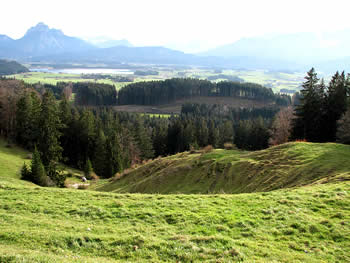 I went for a bike ride this afternoon ….. there is a super 6km circuit that goes from our village Unterthingau along a country road, up past a farm with magnificent views over the Allgäu countryside then along to Oberthingau and back home ….. On the way there are horses and cows munching happily in fields and of course the snow-capped Alps in the background …. The exercise and the fresh air were great, but during the ride I was struck by a couple of things. On the skyline in the direction of Kempten was – as usual – a line of a dozen wind turbines. All were – as usual – immobile, save one which was doing its best to turn languidly, and hardly succeeding.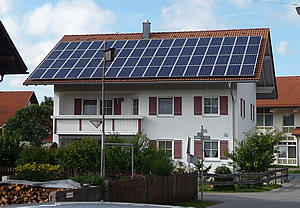

 Learning from Dogs