Tag: Peak oil

Questions are never stupid!

A powerful guest post from Patrice Ayme on where next for American energy.

Introduction.

I must have spent an age musing over what to call this Post.  Patrice called it simply ‘Energy Question For The USA’ and it’s a highly appropriate question.  But in the end I chose the title ‘Questions are never stupid’ because I was mindful of the well-known saying, “There is no such thing as a stupid question, only a stupid answer!

So the smart question raised by Patrice is not only very highly appropriate for 2012, it’s also a question that just has to have a smart answer.  Because we are on the brink of it being too late to be flirting with stupid answers.  What many scientists are saying, in one form or another, is that if we don’t embrace the journey of moving away from carbon-based sources of energy for society now and find those alternate sustainable sources by the end of this decade then the laws of unintended consequences will kick in with a vengeance.  The end of the decade is eight years away!

Here’s a picture of my grandson who was one-year-old just a week ago.

Trusting his elders!

That picture reminds me of the comment early on in James Hansen’s book, Storms of my Grandchildren, where he writes ‘I did not want my grandchildren, someday in the future, to look back and say, “Opa understood what was happening, but he did not make it clear.

So on to the Guest post from Patrice.  It’s not an easy, quick read but I’ll tell you what it is!  It’s the sort of ‘wake-up’ call this fine Nation and this even finer Planet should be getting from countless politicians and leaders.  So do read it and, even better, add your comments, and wonder why we seem so content on fiddling while Rome burns!

oooOOOooo

Energy Question For The USA

THE AGE OF OIL PRODUCED THE AMERICAN CENTURY. NOW WHAT?

No Vision, No Mission, No Energy

***

Another editorial of Paul Krugman firing volleys at republican “paranoia” for accusing Obama of driving up oil prices. As he observes in “Paranoia Strikes Deeper“: …“the president of the United States doesn’t control gasoline prices, or even have much influence over those prices. Oil prices are set in a world market, and America, which accounts for only about a tenth of world production, can’t move those prices much. Indeed, the recent rise in gas prices has taken place despite rising U.S. oil production and falling imports.”

American households tend to borrow as much as they can. Thus, when oil prices increase markedly, Americans have to cut in crucial budgets, such as house payments. I said at the time that it would lead to a peak in housing prices, and it did.

Why such a drastic influence of oil prices on the economy of the USA? Because Americans, except in a few places such as New York, commute by private car to work. So Americans have to feed the car, if they want to feed themselves.

It was not this way a century ago, or so. At the time public transportation systems using electric tramways and trains were found all over, even in Los Angeles. Car companies put an end to that outrage in the late fifties by buying, and then destroying, all the public transportation system they could put their greedy hands on.  Fossil fuel plutocrats were delighted.

But let’s set aside Krugman’s fake indignation. He is smart enough to know that Romney will do what Romney needs to do to win the Obama, I mean, the election. Waxing lyrical about Romney doing as Obama, does not beat going lyrical about sunrise.

Gasoline prices in the USA are way down in real dollars to what they used to be, decades ago. And so is the gas tax. This means that, far from adapting to the gathering multiply-pronged world ecological and energy crisis, the USA has gone the other way, denying there is any crisis. “What? Me worry?” That’s got to be anti-American indeed.  No, real blooded Americans are all into strip searches and the death panel at the White House.

In Europe, gas prices are more than twice that of the USA, thanks to heavy taxes (stations in France have sported two euros a liter, that is 8 euros per gallon, or more than $10.50). [UK unleaded petrol price, as of today, is the equivalent of $8.70 per gallon, Ed.]

This means that far from being down and out, Europe is efficient enough to operate at that high price level. It also means that Europe is much more motivated than the USA to get much more efficient. In other words, high gasoline prices in Europe are a safety margin. The high prices force the European free market to adapt to a situation that the free market of the USA will encounter someday. Adaptation takes decades: new energies take on the average, historically speaking, 50 years to become dominant. Same, one would guess, for energy efficiencies.

Basically, if oil prices doubled from here, gasoline prices would double in the USA. Whereas, even if the Europeans decided to keep the same high taxes, gasoline prices would only augment by 50%. And, in the much more efficient European economy, with plenty of public electric transportation available, the noxious effects on the European economy would be much less than one would expect from a 50% oil price rise.

The world gets 55 × 1018 joules of useful energy from 475 × 1018 joules of primary energy produced by fossil fuels, biomass and nuclear power plants. That tremendous inefficiency (less than 13%!)  needs to be corrected. It will be, if, and only if, prices are kept high. Thus energy taxes are necessary to adapt to the looming penury.

Why looming penury? Because the reserves of other fossil fuels may have been vastly overestimated (by a factor of 5 in the case of coal). Various fossil fuel lobbies have an interest to over-estimate the reserves (because it keeps the world addicted, as they present their industry as a long range solution, which it is not).

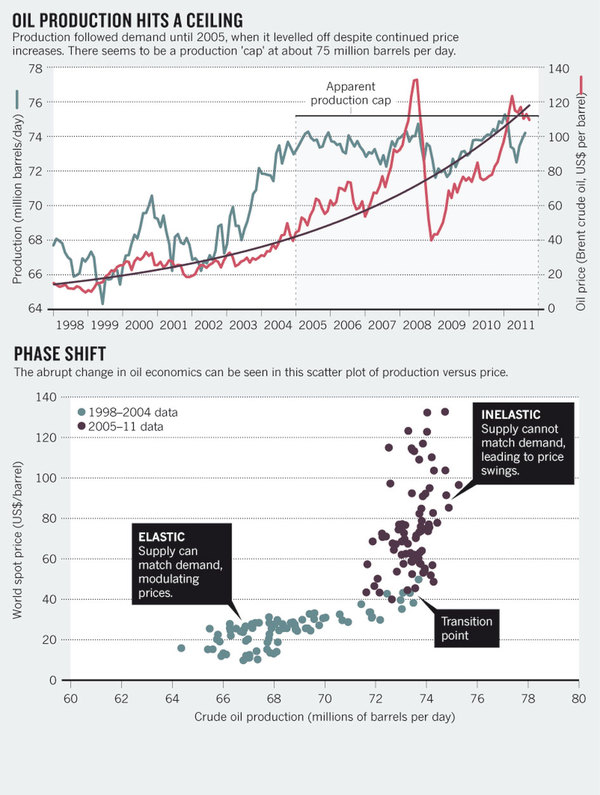
Looking at the raw production numbers, as exhibited below in the graphs, paints a completely different story: production from existing fields is going down dramatically (at 5% rate, per year).  In other words we are in the treachorous waters between the catastrophe of CO2 poisoning and the disaster of running out of energy to burn.

The unavoidable rise of fuel prices will be less grave in Europe than in the USA, because many Europeans would opt for the available electric-based public transportation system (the combination of much more efficient electric motors and central generation is much more efficient than distributing oil to put in SUVs all over, as done in the USA; SUVs, because there are too many holes in the asphalt. A problem partly related to high oil prices!).

Yet, the increase of the cost of imported oil corresponds exactly to the Italian deficit ($55 billion). Although that deficit increase had many causes, oil price increase was by far the most important. And the same for other Southern European countries. So the rise of oil prices was the barrel that broke the back of European debt.

In the USA, ten out of 11 post WWII recessions were followed by oil price spikes. Why are American minds so closed up to the looming strangulation of their economy by oil? Because the fossil fuel plutocracy is on a rampage in the USA. It uses a red hot propaganda to persuade the vast American public of undifferentiated sheep that there is no CO2 ecological crisis, and no energy crisis. (Although the latest polls indicate that two thirds of the public, in a splendid turn-around, believe that there is indeed a man-made climate change crisis; never mind that the New York Times had the latest tornado rampage, with 40 dead, presented as discreetly as possible.)

Why are the fossil plutocrats hysterical? Well we are past Peak Cheap Oil. Moreover, the “majors“, the world’s largest oil companies, have been pushed out of more and more countries, and replaced by national oil companies. Desperate, the majors have gone for riskier and riskier drilling in the deep ocean. Now Chevron, and Transocean, after a 4-day leak off Brazil, see prosecutors asking for lengthy prison sentences and enormous fines.

Most of these oil companies are American, so they have pushed forfracking (destroying the underground with poisons to extract fossil fuels). Superficially, it works: USA imports of fossil fuels went quickly from 60% down to 40%.

However, that did not make a dent in the world price situation, because the demand keeps rising, but the world, overall, is PAST PEAK OIL (as I have long argued and the Nature article alluded to below confirmed, using the obvious argument found in the graphs).

So, basically, American fracking finances Chinese oil consumption. Here are some graphs extracted from Nature and the USA government:
When the horrid sun of diminishing resources rises over the parched American oil desert, while fracking reveals itself to be an unfathomable catastrophe, the howling is going to be very great, and one more reason for a depression will blossom.

Much of the USA’s superiority, in the last 150 years, has come from abundant and cheap oil. First in the North-East, then down to Oklahoma, Texas, Colorado, California. Compare with Western Europe, which had basically no oil.

Oil was not just a question of cheap, convenient energy. Oil has, short of nuclear energy, the highest energy density of any material (OK, nuclear energy is millions of time more energy dense).

Oil gave the USA enormous diplomatic and conspiratorial leverage. American oil plutocrats helped Lenin and Stalin develop their colossal fields in the Caucasus and Caspian. One of those plutocrats, Harriman, son of a railroad magnate, and brother of another Harriman, was one of the main operators of the democratic party. Let alone banker to Hitler. He was decorated both by Stalin, and by Hitler. He then went on as U.S. ambassador to major European capitals, and stayed one the main operators of the government of the USA for decades. “Democrats” have long been impure.

Interestingly, I searched the Internet for a document mentioning Harriman’s Stalino-Hitlerian decorations, but could not find it (I have seen the pictures in the past). All I could read is how much Harriman resisted Stalin each time they met, and that was all the time (a total lie that Harriman resisted Hitler, or Stalin: Harriman was an accomplice of Stalin, and helped give him half of Europe, in exchange for manganese and other stuff. But now Internet agents are obviously paid to reconstruct a truth where American plutocrats look good,  knights in shining armor, fighting Stalin or Hitler, each time they met for tea, dinner, lunch, breakfast, and interminable conferences, for years on end, decade after decade).

A famous example of the clout oil provided the USA with: Texaco fueled Hitler’s conquest of the Spanish republic (this one is hard to hide, because the U.S. Congress slapped Texaco with a symbolic fine, well after the deed was done). That used to amuse Hitler a lot (Hitler gave elaborated reasons to his worried supporters for being in bed with American plutocrats; as the Nazi Party was officially socialist, and anti-plutocratic, that awkward situation may have led him to declare war to the USA on December 11, 1941, to ward off the German generals’ argument that he was just a little corporal in above his head).

Another example: Mussolini was hanged from an American gas station in Milan. Italian communists hanged him from his sponsors’ works.

The fueling of the fascists by American fossil fuel companies helped bring the American Century to the world in general, and Europe in particular. Without Stalin and American plutocratic oil, Hitler’s Panzers could not have moved in 1939 or 1940.

The dignified Elie Wiesel, instead of crying crocodiles tears, wondering how such a thing as Auschwitz was possible, should ask how and why the Nazi extermination machine was fuelled by American plutocrats, and how come he, himself, never talks about that.

Wiesel got the Nobel Peace Prize, just as Jimmy Carter (who launched the American attack on Afghanistan). Was it for disinformation? (And how come waging war in Afghanistan is a big plus for the Peace Prize? Is it related to the same mood which made Sweden help Hitler before and during WWII, and never having a serious look at that, ever since? I know the prize is ostensibly given by Norwegians.)

Wikipedia is big on the notion of “weasel words“, and rightly so. Deeper than that is what I would call weasel logic. And ever deeper, weasel worlds. To talk about Hitler without ever wondering who his sponsors were, and what they were after, is to live in a weasel world.

I like Elie Wiesel personally. Yet, just as I like Krugman, Obama, and countless others, such as the infamous Jean-Paul Sartre, he likes power even more than truth. OK, It is unfair to put Sartre, who really espoused the most abject terrorism, with the others… As long as individuals prefer power to truth, the spontaneous generation of infamy is insured.

Total oil sales, per day are about 100 million barrels (in truth the cap is lower, see graph above), at, say $100, so ten billion dollars a day, 3.6 trillion a year. The USA uses about 25% of that. Some have incorporated the price of the part of the gigantic American war machine and (what are truly) bribes to feudal warlords insuring Western access to the oil fields, and found a much higher cost up to $11 a gallon.

Ultimately, and pretty soon, in 2016, specialists expect oil prices to explode up, from the exhaustion of the existing oil fields. Then what?

Moreover, in 2016, the dependence upon OPEC, or, more exactly Arab regimes, is going to become much greater than now. What’s the plan of the USA? Extend ever more the security state, and go occupy the Middle East with a one million men army? To occupy, or not to occupy, that is the question.

Is it time for a better plan? And yes, any better plan will require consumers to pay higher energy prices. As consumers apparently want the army to procure the oil, they ought to pay for it.

***

Patrice Ayme

***

Note 1: Flying cost at least ten times more in CO2 creation than taking a train. And jet fuel is not taxed, at least until the carbon plan of the European Union starts charging next year, in 2013. In spite of the screaming from the USA and its proxies: it’s funny how attached to subsidies American society can be.

Note 2: Refusing to pay for necessary military expenses through taxation and mobilization, was a big factor in the downfall of the Roman Principate.

The Principate then tried to accomplish defense on the cheap, by using more and more mercenaries. Many of these mercenaries or their children and descendants were poorly integrated in Roman republican culture (say emperors Diocletian or Constantine, let alone Stilicho the Vandal, a century later), so they established theDominate, itself a negation of the Roman republic. Amusingly the Western Franks, those salt water (“Salian“) Franks remembered the Roman republic better than all these imports from the savage East… who could not remember it, they, and their ancestors, having never known it.

Guess what? The USA’s army presently employs 300,000 “private contractors” (aka, mercenaries). Curiously, in that case, it’s not so much to save money, than to extract more money from the system (but that’s another story). Still, it will have the same effect.

oooOOOooo
Transitions, pt Two

Reflections on these present times, concluding part.

I closed yesterday with, So maybe there’s a blindness with humans, and then set out the characteristics of that blindness.  One of those characteristics being,

Our obsession with how things are now prevents us from reflecting on those signs that indicate changes are under way, even when the likely conclusions are unmistakeable.  The ecological and climatic changes being the most obvious example of this strange blindness that mankind possesses.

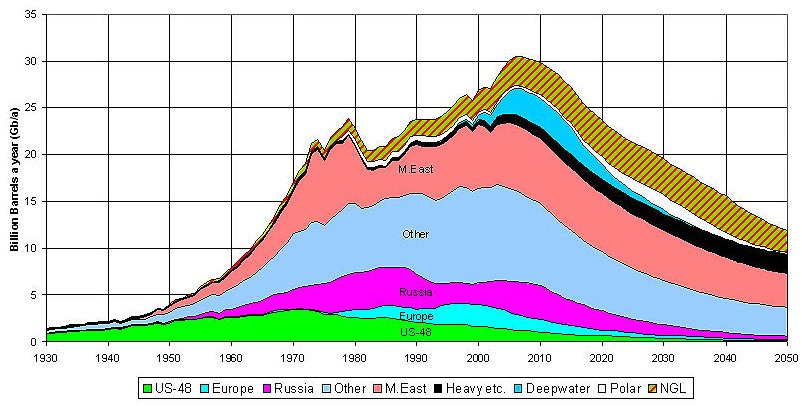
Let’s move this on a little.  The arguments from a wide range of scientists are overwhelmingly in favour of the proposition that mankind is using vastly more resources from the planet than the planet can provide.  Take oil.  This graph show past and projected oil production for the whole Earth out to 2050, less than 40 years away.

Here’s an extract from that website which I encourage you to read in full,

The part before 2007 is historical fact. The part that comes afterward is an ASPO extrapolation.

This graph is worth careful attention as a lot of world history is written into it. Note the steep rise in oil production after World War II. Note that 1971 was the peak in oil production in the United States lower 48. There is a sliver of white labled Arctic oil. That is mostly Alaskan Prudhoe Bay oil, which peaked in 1990. Prudhoe Bay was almost big enough to counteract the lower 48 peak of 1971. The sliver is very narrow now. The OPEC oil embargo of 1973 is very visible. The oil produced by non-OPEC countries stayed nearly constant while OPEC production nearly halved. The embargo caused the world economy to slow. But the high cost of energy spurred the development of energy efficient automobiles and refrigerators and a lot of other things. Note the effect of the collapse of the Russian economy in 1990 on Russian oil production. Note the rapid increase in oil production when the world economy boomed near the end of the twentieth century. Oil was $12 a barrel at that time. Note that European (North Sea) oil peaked in 2000. Note especially what would have happened if the 1973 embargo had not occurred. It is possible that the world would now be on the steep part of the right side of the Hubbert curve.

Take population growth. Here’s a graph that shows that going through seven billion, which is due shortly, is likely to be way short of the eventual peak.  Likely peak might be in the range of  eight to ten billion!  Just take a look at that graph,

Take global warming.  Here’s a graph from NASA, from which I quote,

The five warmest years since the late 1880s, according to NASA scientists, are in descending order 2005, 1998, 2002, 2003 and 2006. (reported in the year 2007!)

No apologies for bashing you around the head with these graphs and figures – most people have a good sense about these aspects of our life on this planet.  But, in a very real sense, that’s the point.

The point that despite powerful and obvious evidence, mankind has great difficulty accepting obvious trends and understanding that whatever ‘today’ feels like, ‘tomorrow’ is almost certainly not going to be more of the same.

At the risk of hammering this point to death, here are two pictures and some text to show how quickly ‘today’ changes and becomes ‘tomorrow’.

Scientist left speechless as vast glacier turns to water

by Helen Turner, Western Mail

THESE images show the astonishing rate of break-up of an enormous glacier in north Greenland – from ice to water in just two years.

The before and after photographs, which left a Welsh scientist who led the 24-month project “speechless”, reveal the worrying effects of climate change in an area previously thought too cold to be much affected.

The Petermann glacier pictured August, 5th, 2009
Petermann glacier, pictured from same position, July 24th, 2011

Dr Alun Hubbard, a reader at Aberystwyth University’s Centre for Glaciology, returned from the Petermann Glacier in north-west Greenland a month ago, but did not see the stark images documenting the changes until this week.

He said: “Although I knew what to expect in terms of ice loss from satellite imagery, I was still completely unprepared for the gob-smacking scale of the break-up, which rendered me speechless.  It was just incredible to see. This glacier is huge, 20km across, 1,000m high.”

“It’s like looking into the Grand Canyon full of ice and coming back two years later to find it’s full of water.”

“It’s quite hard to get your head around the scale of the change.  To be able to see that, everything changed in such a short period of time, I was speechless.”

Do read the full article on the Wales Online website here.

Stay with me a little longer, if you will.

Yves Smith in her wonderfully broad and addictive Blog, Naked Capitalism, had the first part of a powerful interview with Satyajit Das published on the 7th.  Here are a couple of extracts,

 It’s amazing how much money you can make just shuffling paper backwards and forwards. Malcolm Gladwell wrote a piece praising John Paulson who made a killing from the subprime disaster as an entrepreneur. But what did he make? What did he leave behind? Paul Volcker, the former chairman of the Federal Reserve, argued: “I wish someone would give me one shred of neutral evidence that financial innovation has led to economic growth — one shred of evidence. US financial services increased its share of value added from 2% to 6.5% but is that a reflection of your financial innovation, or just a reflection of what you’re paid?”

Just let that quote from Paul Volcker stay with you for a while.  Satyajit goes on to say,

Management and directors of financial institutions cannot really understand what is going on – it’s simply not practical. They cannot be across all the products. For example, Robert Rubin, the former head of Goldman Sachs and Treasury Secretary under President Clinton, encouraged increased risk taking at CitiGroup. He was guided by a consultant’s report and famously stated that risk was the only underpriced asset. He encouraged investment in AAA securities assuming that they were ‘money good’. He seemed not to be aware of the liquidity puts that Citi had written which meant that toxic off-balance sheet assets would come back to the mother ship in the case of a crisis. Now, if he didn’t understand, others would find it near impossible. And I’m talking about executive management.

Non executives are even further removed. Upon joining the Salomon Brothers Board, Henry Kaufman, the original Dr. Doom found that most non-executive directors had little experience or understanding of banking. They relied on board reports that were, “neither comprehensive … nor detailed enough … about the diversity and complexity of our operations.” Non-executive directors were reliant “on the veracity and competency of senior managers, who in turn … are beholden to the veracity of middle managers, who are themselves motivated to take risks through a variety of profit compensation formulas.”

Kaufman later joined the board of Lehman Brothers. Nine out of ten members of the Lehman board were retired, four were 75 years or more in age, only two had banking experience, but in a different era. The octogenarian Kaufman sat on the Lehman Risk Committee with a Broadway producer, a former Navy admiral, a former CEO of a Spanish-language TV station and the former chairman of IBM. The Committee only had two meetings in 2006 and 2007. AIG’s board included several heavyweight diplomats and admirals; even though Richard Breeden, former head of the SEC told a reporter, “AIG, as far as I know, didn’t own any aircraft carriers and didn’t have a seat in the United Nations.”

In other words, there is no shortage of information from all corners of the world to show, with very little doubt, that the last few decades have seen unprecedented mistakes by national governments, mistakes in corporate governance, a lack of understanding of economic fundamentals, poor financial and social management, and on and on and on.

But practically all of us, and I mean all of us, didn’t see it at the time, didn’t see where it was heading and only now, when it is full in our faces, do we get it and see it for what it has really been, a long period of over two decades where the ‘me‘ has been more important than the ‘us‘.

That me versus us even being promoted, if that’s the right word, by a British Prime Minister twenty-five years ago.  That quote from Margaret Thatcher back in 1987,  “And, you know, there is no such thing as society. There are individual men and women, and there are families.” (Margaret Thatcher, talking to Women’s Own magazine, October 31 1987)

Let me draw this all together, yesterday’s part and this concluding part.

There is significant evidence, real hard evidence, that the patterns of mankind’s behaviours of the last few decades cannot continue.  Simply because mankind will go over the edge of self-extinction.  Darwin’s evidence and all that!  We have to accept that humans will see the bleedin’ obvious before it is too late.  We have to keep the faith that our species homo sapiens is capable of huge and rapid change when that tipping point is reached, so eloquently written by Paul Gilding in his book, The Great Disruption, reviewed by me here.  We have to embrace the fact that just because the world and his wife appears to be living in total denial, the seedlings of change, powerful change, are already sprouting, everywhere, all over the world.

So let’s welcome those changes. Let’s nurture those seedlings, encourage them to grow and engulf our society with a new richness, a new fertile landscape.

Let’s embrace the power of now, the beauty of making today much better and letting go of tomorrow.

For today, I am in charge of my life,

Today, I choose my thoughts,

Today, I choose my attitudes,

Today, I choose my actions and behaviours.

With these, I create my life and my destiny.

It’s very difficult to make predictions, especially when they involve the future!

20:20 hindsight

One of the great aspects of modern web-based communications is that much of what is said, written and recorded is available to peruse long after the item was ‘broadcast’.

Prof. Ehrenfeld

A few days ago, I introduced Prof. David Ehrenfeld via a short, but stunningly clear, five-minute YouTube video.  I promised to follow that up with more material.

So here’s a book review undertaken by Prof. Ehrenfeld.  The book in question is The Long Emergency: Surviving the Converging Catastrophes of the Twenty-First Century. James Howard Kunstler. x + 307 pp. Atlantic Monthly Press, 2005. $23.  Here’s the review in full from The American Scientist website.  Read it carefully and ponder that this review goes back to Autumn 2005, about five and half years ago. Great foresight.

James Howard Kunstler begins The Long Emergency with the hope that “the American public will wake up from its sleepwalk and act to defend the project of civilization” while there is still time. “Throughout this book,” he writes, “I will concern myself with what I believe is happening, what will happen, or what is likely to happen, not what I hope or wish will happen.” The reality that our society is currently refusing to face, Kunstler says, is that time is just about up for industrial civilization as we have known it.

Kunstler’s thesis is straightforward: Malthus was right, but cheap oil has postponed the day of reckoning, creating a century-long “artificial bubble of plenitude” and generating a host of intractable problems partly or entirely related to our prolonged energy spending spree. These problems include serious damage to our agricultural infrastructure, global climate change and the reorganization of living places into unsustainable suburbs and cities. Now cheap oil is disappearing fast, leaving only the problems behind.

What sets The Long Emergency apart from numerous other books on this theme is its comprehensive sweep—its powerful integration of science, technology, economics, finance, international politics and social change—along with a fascinating attempt to peer into a chaotic future. And Kunstler is such a compelling, fast-paced and sometimes eloquent writer that the book is hard to put down.

Beginning with the story of Edwin L. Drake, who drilled the world’s first oil well in northwestern Pennsylvania in August 1859, Kunstler takes us through the development of the global oil-based economy of the 20th and early 21st centuries. He carefully traces the origins of the idea, first proposed by geologist M. King Hubbert, that oil consumption by modern industrial society will draw down current and potential supplies in a predictable way. Hubbert’s 1956 prediction of the date of “peak oil” production in the United States (which he put at sometime between 1966 and 1972) was strikingly accurate—the peak occurred in 1970. After Hubbert’s death in 1989, the distinguished petroleum geologists Colin Campbell and Jean Laherrère, Princeton geologist Kenneth Deffeyes, University of Colorado physicist Albert Bartlett and others adapted his model and applied it to global oil production, yielding a prediction that the global peak would occur between 2000 and 2010.

As pointed out by Richard A. Kerr and Robert F. Service in the July 1, 2005, issue of Science, petroleum geologists tend to accept this “pessimistic” prediction of the date when the global peak will be (or has been) reached, whereas “optimistic” dates farther in the future are being advanced primarily by resource economists. Kunstler sides with the geologists, and his fast-paced but detailed discussion of the economics of oil supports this position. In his chapter “Geopolitics and the Global Oil Peak,” he comes to grips with a complex mix of elements: Middle Eastern and Islamic nationalism, terrorism, Chinese industrial growth and the overwhelming problems of Russia, the world’s second-largest producer of oil. These are set against a backdrop of diminishing supply, as one country after another, including Saudi Arabia, passes its oil peak. Kunstler’s explanations of why the Saudis can no longer control world oil prices (they lack the reserves to increase production much beyond what they are already pumping) and of the immense significance of that loss of control are particularly insightful. American politicians have not yet grasped this new reality.

The book’s lengthy discussion of the alternatives to cheap oil that are so beloved by techno-optimists is straightforward and sobering. Kunstler gives all of the alternatives a critical but fair inquiry, from conventional energy sources such as coal and natural gas, through oil shales and tar sands, synthetic oil, renewable energy (including wind, solar and hydroelectric power and biomass), nuclear fission and nuclear fusion, hydrogen, thermal depolymerization (turning organic waste into oil), methane hydrates and even zero-point energy.

Most of these technologies founder on “the classic problem of energy economics: energy returned over energy invested (ERoEI). “The figure in the case of tar sands and oil shale is approximately three barrels of oil produced for every two barrels of oil-equivalent invested. In the case of ethanol produced from agribusiness corn or sugar cane, the ratio may be less than one. Some alternatives, such as methane hydrates, are dangerous to handle. Hydrogen is not a primary fuel: Its production requires considerable energy. Also, because of the low density of hydrogen gas, it must be stored and transported under high compression, or liquefied at very low temperatures, or combined with other compounds. Each of these options costs still more energy, and they introduce an assortment of complications and hazards into the delivery system. Although hydrogen will have its uses, Kunstler says, his verdict is unequivocal: “There is not going to be a ‘hydrogen economy.'” Nor is he sanguine about such far-out schemes as a process for deriving zero-point energy from the dark matter of the universe; he reminds us that “A useful maxim in engineering states that when something sounds too good to be true, it generally is not true.”

Kunstler’s moderate treatment of nuclear power (fission) has angered some environmentalists. I think he makes a good case, however, that during the transition period to a post-petroleum economy, the United States, which produces much of its electricity from a rapidly declining supply of natural gas, will not be as well off as France, which gets 80 percent of its electric power from nuclear energy. Nevertheless, he does not see nuclear power as more than a short-term stopgap. Its ultimate limitations come first from safety issues with regard to plant operations and the disposal of waste fuel (although he points out that coal has cost far more lives than nuclear power, especially in the West). Second is the large amount of oil needed to mine and process nuclear fuel and to build and maintain nuclear plants. And the third, formidable objection Kunstler makes is that “Atomic fission is useful for producing electricity, but most of America’s energy needs are for things that electricity can’t do very well, if at all. For instance, you can’t fly airplanes on electric power from nuclear reactors”—although, as he notes, the U.S. military has tried.

Kunstler describes a host of natural disasters that will interact with the energy crisis to cause social upheaval on a global scale. No country will be exempt, he says. Some of these disasters, such as climate change, are the direct result of our profligate use of cheap energy. Others, including the widespread shortage of fresh water, have been greatly augmented by the drain on resources brought about by the explosion of high-oil-input agriculture, industrialization and changes in living habits. All of those natural disasters, however, including the emergence of new infectious diseases and the re-emergence of old ones, will be much harder to cope with when cheap energy is no longer available. Our efforts will also be confounded by diminishing returns on technology and by “technological regress—the loss of information, ability, and confidence.”

The Long Emergency is more than a list of disasters, present or impending. It is an attempt to understand how we got to where we are. Nearly 100 years of cheap oil have allowed us, even prompted us, to construct an economic and social system that depends utterly (often without our knowledge) on a continuous, never-failing energy subsidy. The system cannot stand on its own feet. It is unstable, lacking internal restraints and negative feedbacks, and most of all it undermines all stabilizing alternatives, such as diverse small businesses and local community support systems. Kunstler’s understanding of history and economics helps him delineate this clearly.

My only complaint about the book is that it lacks an index, which is inexcusable for a text so crammed with names and facts. Kunstler’s use ofentropy as a synonym for social disorder may bother readers who prefer that the term be reserved for discussions of thermodynamics, but an accepted definition of the word is “inevitable and steady deterioration of a system or society.”

One question that most readers of this review will ask is, When will the coming collapse occur? As Kunstler notes, Deffeyes—perhaps not entirely in jest—has predicted on National Public Radio that the global oil peak will occur on Thanksgiving Day, 2005, with “‘an uncertainty factor of only three or four weeks on either side.'” But the closest thing to a hint of Kunstler’s position on the subject is found in his remark in the last chapter that “The denizens of Bergen County, New Jersey, or Fairfield County, Connecticut, today may never believe how desperate their localities may become in 2025.” He is probably wise to be vague. As the great biochemist Erwin Chargaff remarked in his 1978 autobiography, Heraclitean Fire, “On the whole, professional pessimists prove right at the end if one does not hold them too tightly to a time scale.”

The last (and longest) chapter of The Long Emergency is also the most innovative and controversial one. Having made a powerful case that it is too late to avoid serious trauma, Kunstler speculates on what life will be like during the painful transition period, as cheap petroleum wanes. The question is well worth asking, if only to stimulate creative thinking about alternatives to a high-energy lifestyle. The book is not a survivalist tract, but Kunstler argues persuasively that life will be better in some geographic regions of the country than in others and better in some kinds of communities than in others. Factors such as the availability of water, the degree of dependence on automobiles and air-conditioning, the regional tolerance for violence and the persistence of strong communities lead him to conclude that the states of New England, the mid-Atlantic, and the upper Midwest that make up the “Old Union” of the Civil War period, along with the Pacific Northwest, will fare much better than the Southwest, the Rocky Mountain states and the Southeast.

Within each region, however, conditions will not be uniform. Kunstler, whose earlier book The Geography of Nowhere established him as heir presumptive to the intellectual legacy of Lewis Mumford, describes America’s automobile-dependent suburbs as “the greatest misallocation of resources in the history of the world.” It is the suburbs, he thinks, that will suffer the most during the coming energy crisis. (I concur, having taught the same message in field courses in suburban New Jersey for 30 years.) And cities, with their skyscrapers and total food dependence, will not, Kunstler claims, be far behind the suburbs in misery.

There is much more in the final chapter than I can do justice to in a review: The many topics discussed include, among others, the new economy and new commerce that will accompany the end of oil-dependent consumer culture (he predicts the demise of the chain stores and the rise of scavenging), possible political fragmentation of the nation, changes in education, the end of romantic childhood and changes in race relations. The picture he paints is incomplete—he doesn’t say what will happen to health care, the arts or entertainment in the long emergency—but there is material enough to provoke scientists and laypeople alike into considering what lies ahead.

Kunstler, like George Orwell, understands that being honest about the past and present is the only way to prepare ourselves for an uncertain future. Civilization, he believes, will survive the end of cheap oil, but not without great loss. “How many … familiar things in time may go?” he wonders. “What will abide in our collective memory?” Not all readers will accept his answers to these questions, but I think we must be grateful to him for showing us the need to ask them.

A timely reminder that so very often it is knowing what questions to ask that matters most!