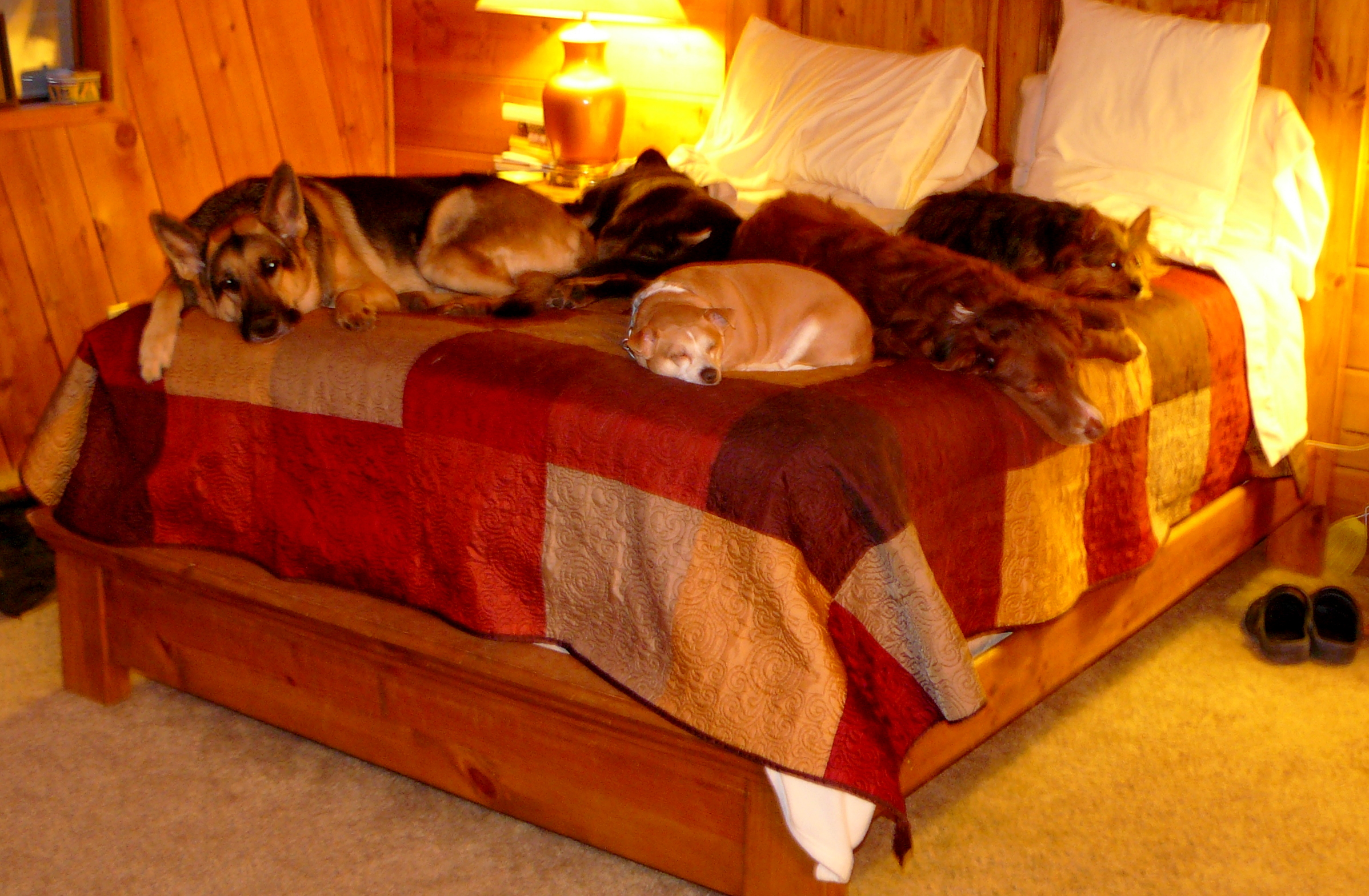
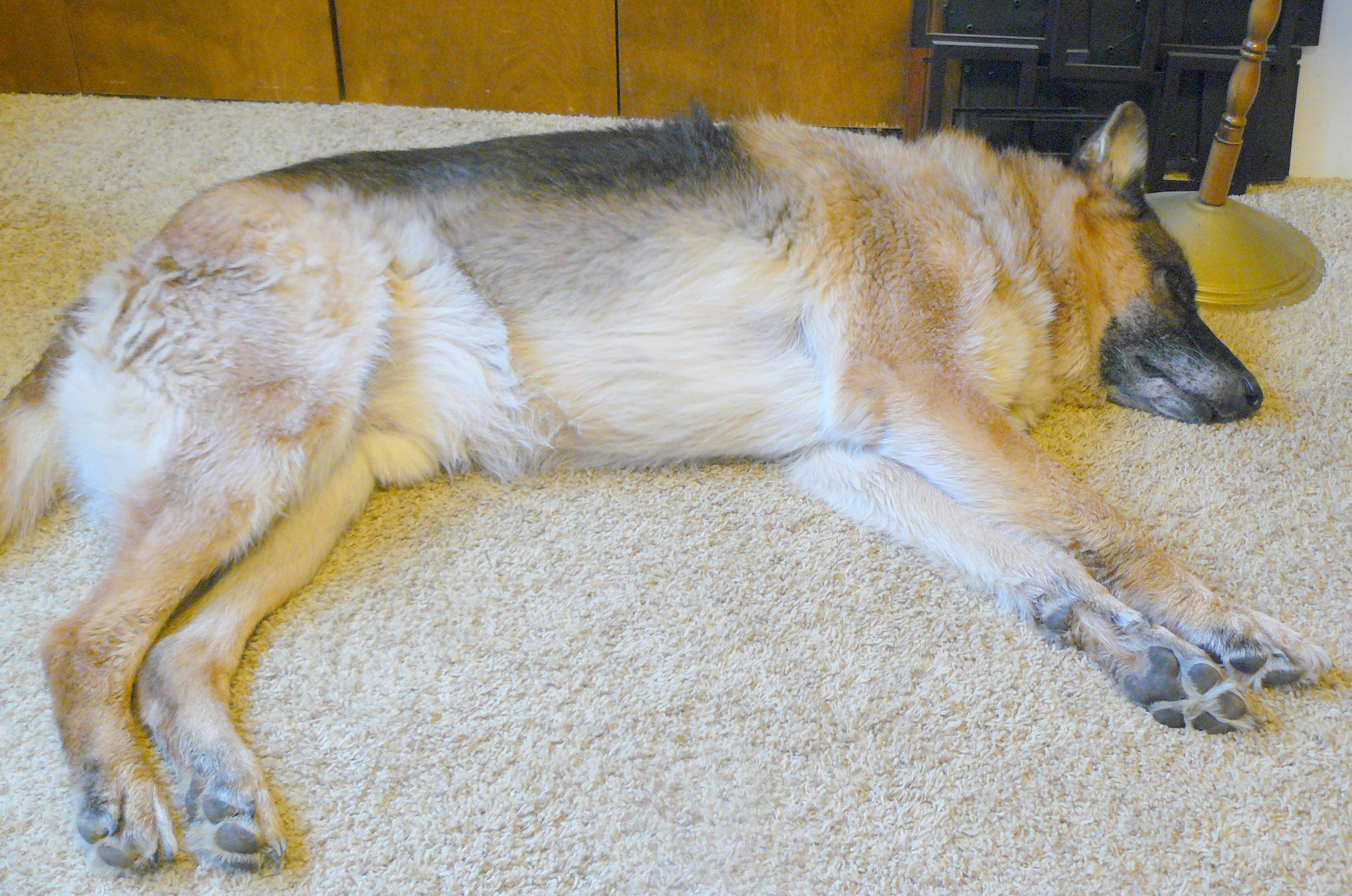
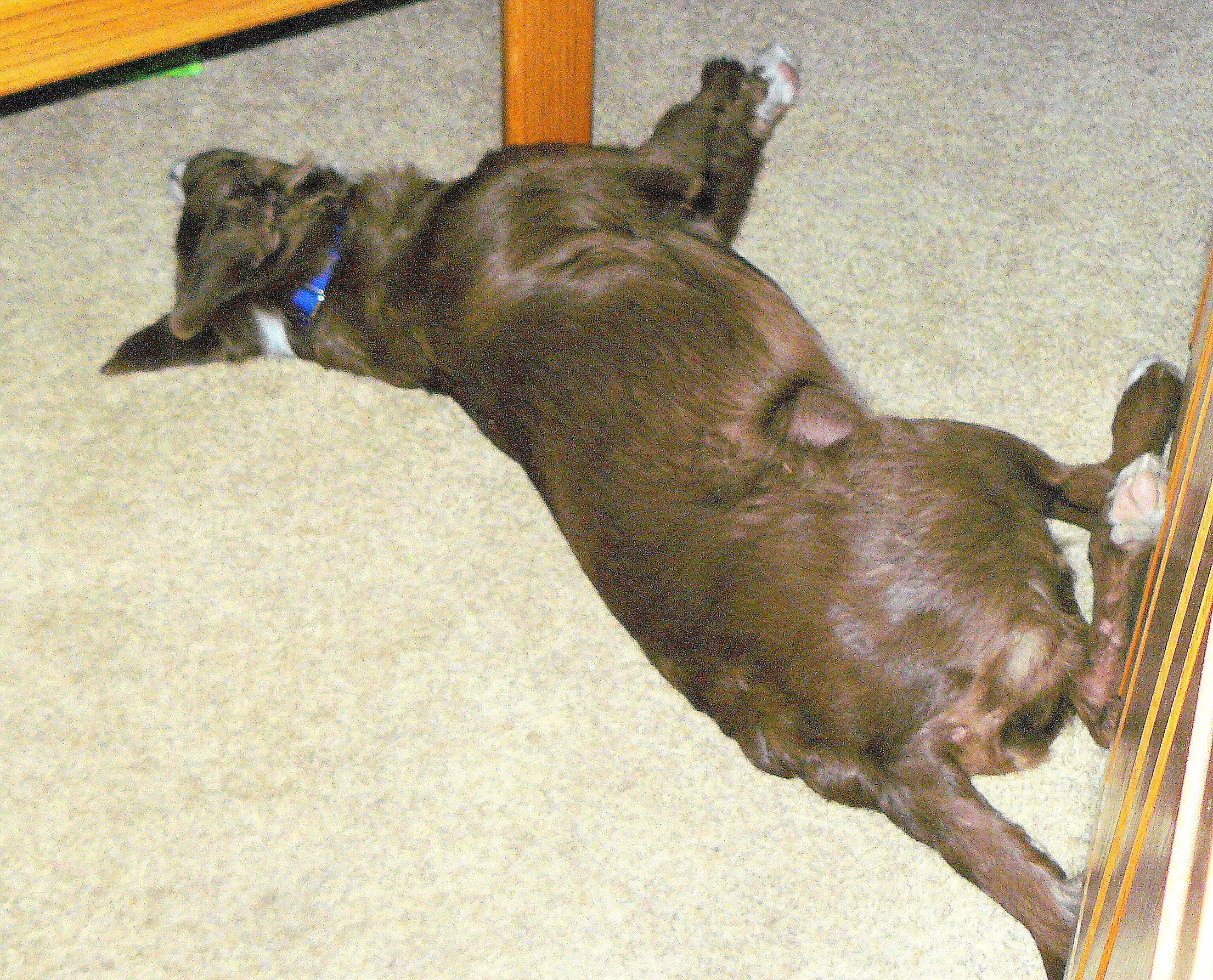
The last few nights have been so cold we have needed to put an extra dog on the bed!
Dogs are animals of integrity. We have much to learn from them.
Tag: Oliver
The last few nights have been so cold we have needed to put an extra dog on the bed!
“There are no strangers here; Only friends you haven’t yet met.” William Butler Yeats
Day Six: A Character-Building Experience
Today’s Prompt: Who’s the most interesting person (or people) you’ve met this year?
Our stories are inevitably linked to the people around us. We are social creatures: from the family members and friends who’ve known us since childhood, to the coworkers, service providers, and strangers who populate our world (and, at times, leave an unexpected mark on us).
Today, write a post focusing on one — or more — of the people that have recently entered your life, and tell us how your narratives intersected. It can be your new partner, your newborn child, or the friendly barista whose real story you’d love to learn (or imagine), or any other person you’ve met for the first time in the past year.
Today’s twist: Turn your post into a character study.
“In displaying the psychology of your characters, minute particulars are essential. God save us from vague generalisations!” – Anton Chekhov, Letter to Alexander Chekhov; May 10, 1886
Describing people — whether real or fictional — in a way that channels their true essence is an invaluable skill for any writer. Through the careful accumulation of details, great authors morph their words into vivid, flesh-and-bones creations in our minds. How can you go about shaping your portrait of a person? Some ideas to explore:
Don’t just list their features. Tell us something about how their physical appearance shapes the way they act and engage with others. For example, see how the author of this moving photo essay, which documents the final weeks of a woman dying of cancer, captures the kernel of the woman’s spirit with a short, masterful statement: “Her eyes told stories that her voice didn’t have the power to articulate and she had a kindness that immediately made me feel like we had been friends for years.”
Give us a glimpse of what makes this person unique. We all have our own quirks, mannerisms, and individual gestures, both physical and linguistic.
“Our stories are inevitably linked to the people around us.”
That is so true. But so many of my stories have also been linked to the dogs around me. So for today’s Writing 101 theme instead of writing about a person, I shall write about a dog. Specifically, young Oliver who entered our lives at 11:10 PDT on June 16th, 2014.
oooo

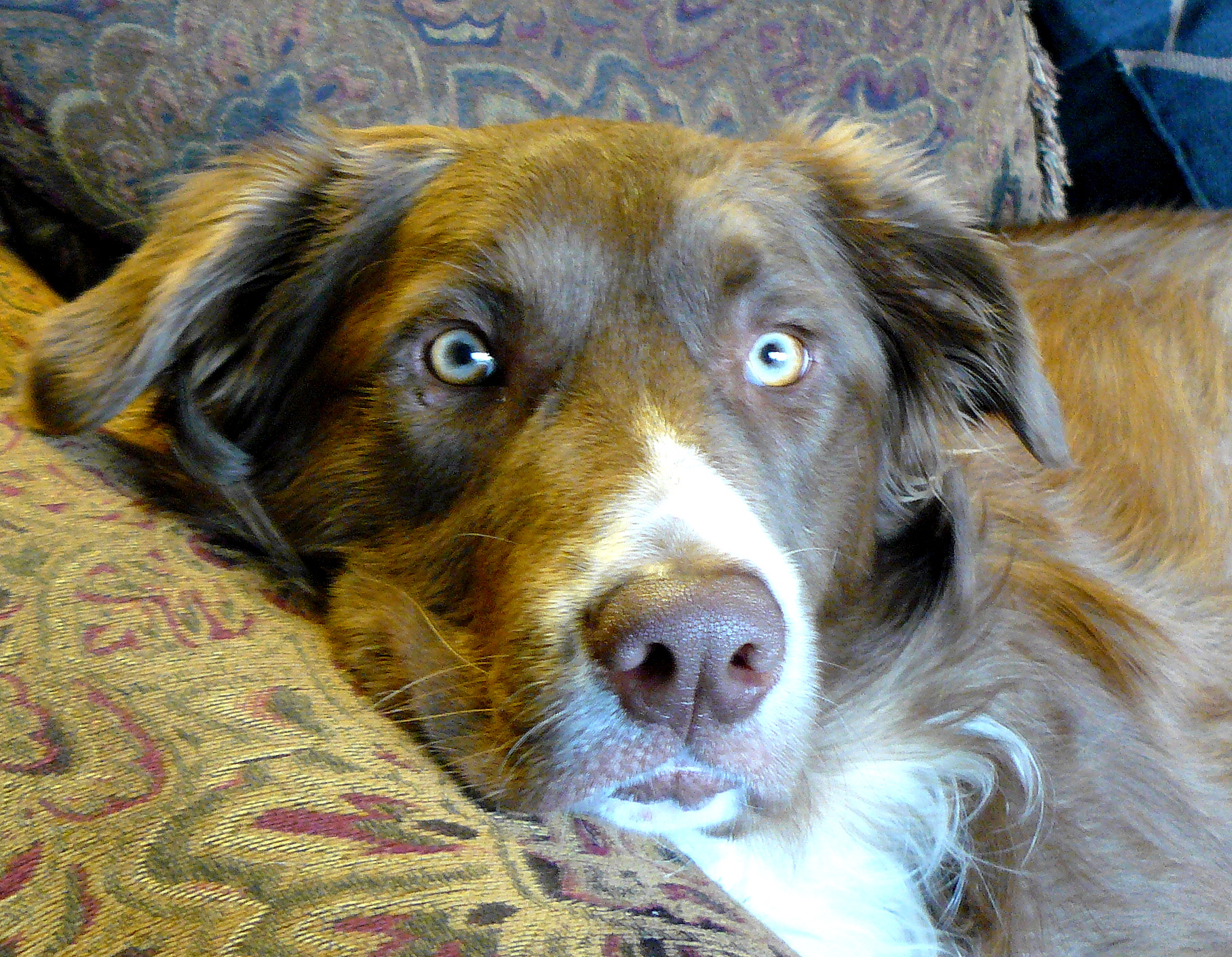
It was the eyes that got me! Right from the first moment that he and I looked at each other.
Those yellow-green eyes just had a power of attraction that was beyond my rational understanding. As if those eyes carried some haunting echo of that ancient time, millennia ago, when a young wolf looked upon the face of early man and each registered a mutual attraction.
Dear Oliver was born on the 28th February, 2014 and rapidly became a lively puppy: too lively for the couple who had taken him on. They lived close to us and Jean and I were called early in June that same year and asked if we might consider being his new parents. We went around on the morning of the 16th June to assess this young dog, especially from the angle of how well he would get on with our other dogs, before making our minds up for sure.
Within minutes, however, we knew without any doubt that under the skin of this lively, bouncy young dog there was a heart of gold and he came home with us that same morning.
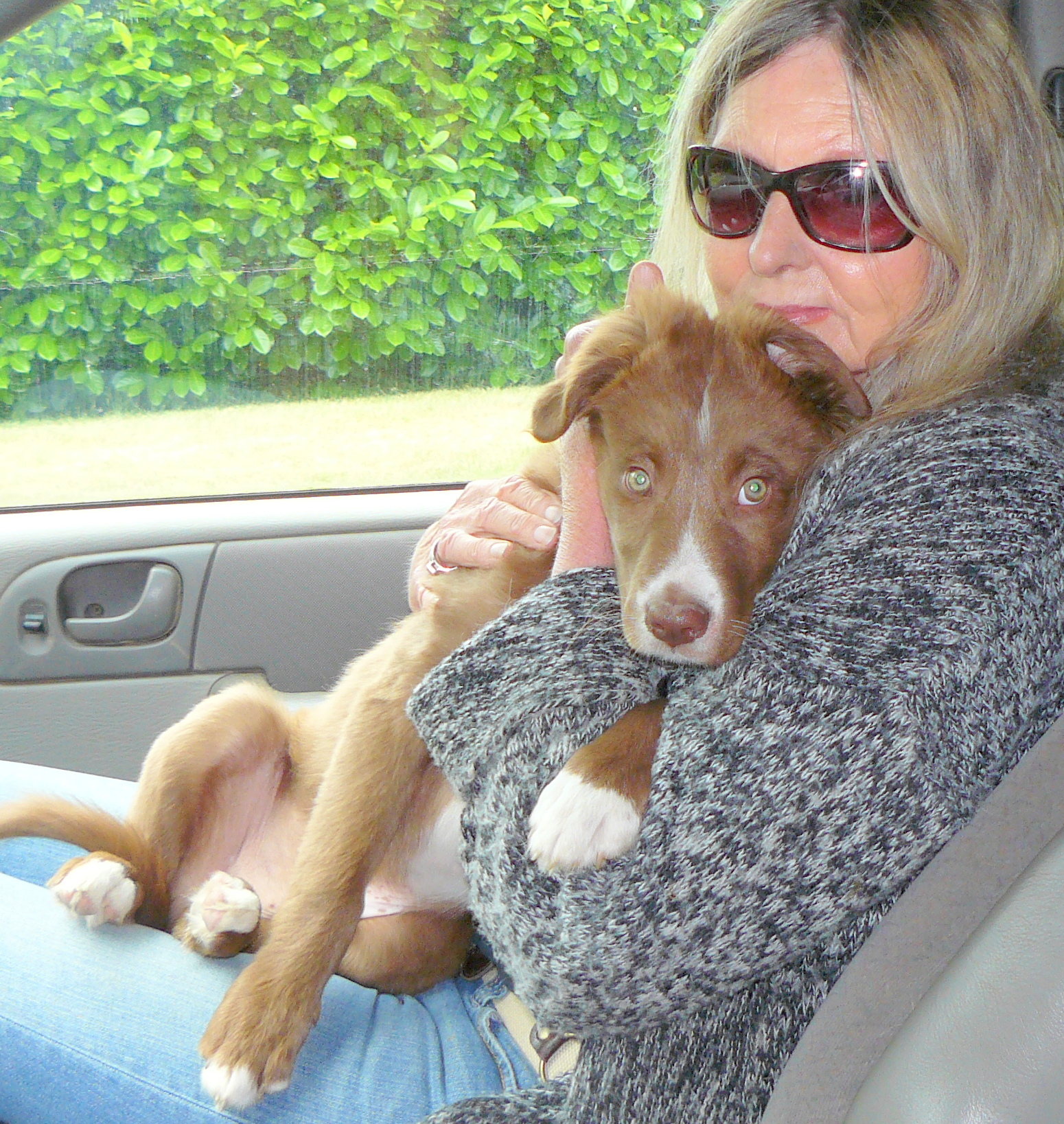
Young Oliver had every reason to be a lively, bouncy young dog. For he was the offspring of Chocolate Labrador and Border Collie parents! One can’t get much more of a lively mix than that! So those early days with Oliver in the house turned out to be fun!
Those early days also showed that Oliver’s heart of gold extended from people to other dogs. Within minutes of arriving home he was fearlessly loving up to Pharaoh. That meant that Pharaoh and all the other dogs were going to love him back in return.
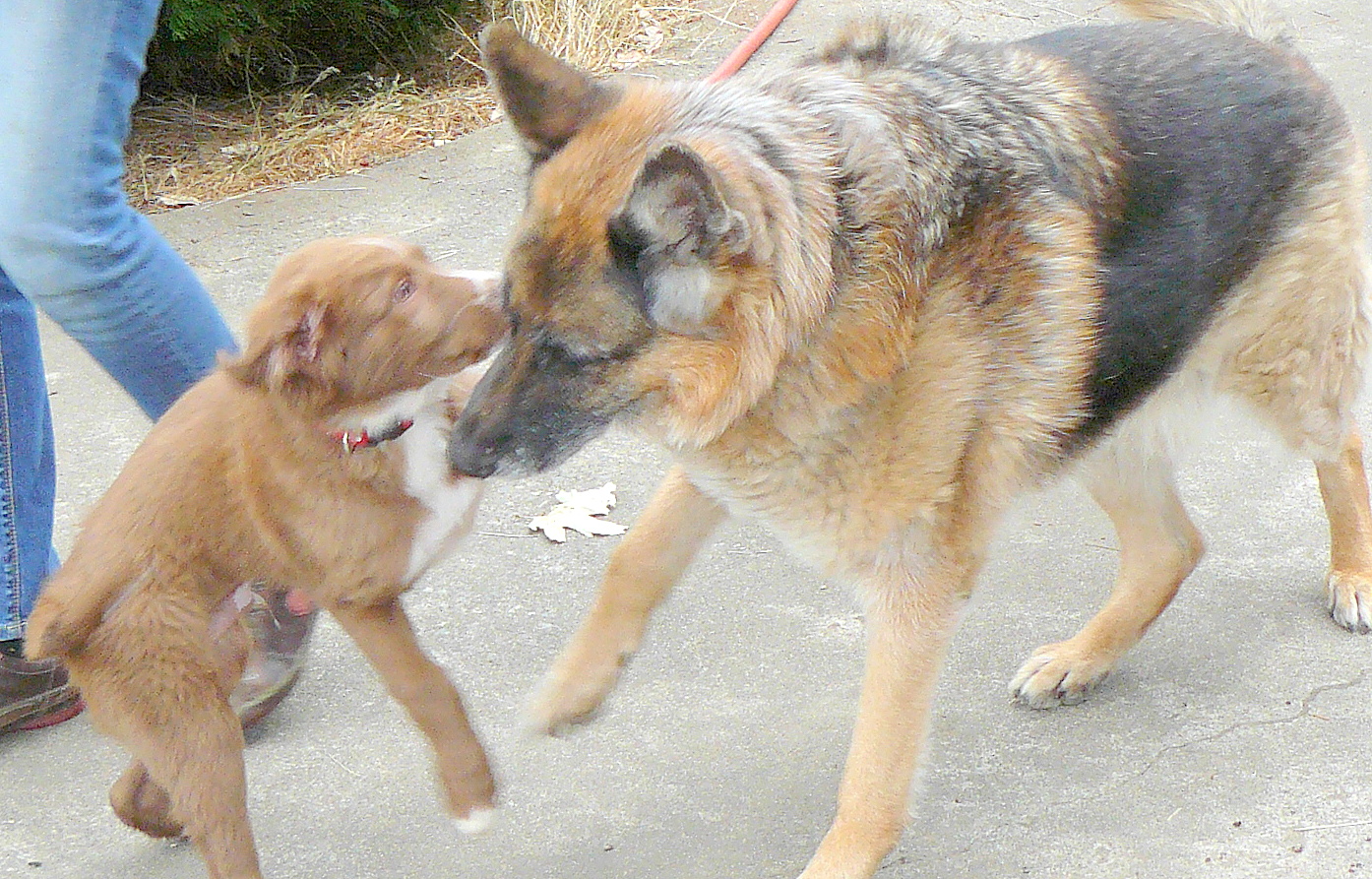
So quickly young Oliver became a wonderful member of the family with not one of the other eight dogs taking even a hint of umbrage at this new puppy in their midst. Oliver’s character is gloriously open and honest, as matched in his face.
Over the weeks as we got to know Oliver better and better he has shown that he has the most beautiful disposition.
Now as I write this some ten months after we welcomed Oliver I find it impossible to imagine life without him. Or more accurately written that it would be impossible to imagine life without those eyes!
Our latest member of our family is one-year-old today!
(NB: I am presently away with my son enjoying the Wintry delights of Bend, Or and Mount Bachelor.)
Long-term followers of this place (thank you!) will recall a post published last October that included the following two photographs.
oooo
Do you remember when puppy Oliver came to live with us?

Another picture of Oliver sitting on the lap of yours truly taken in the last couple of days.
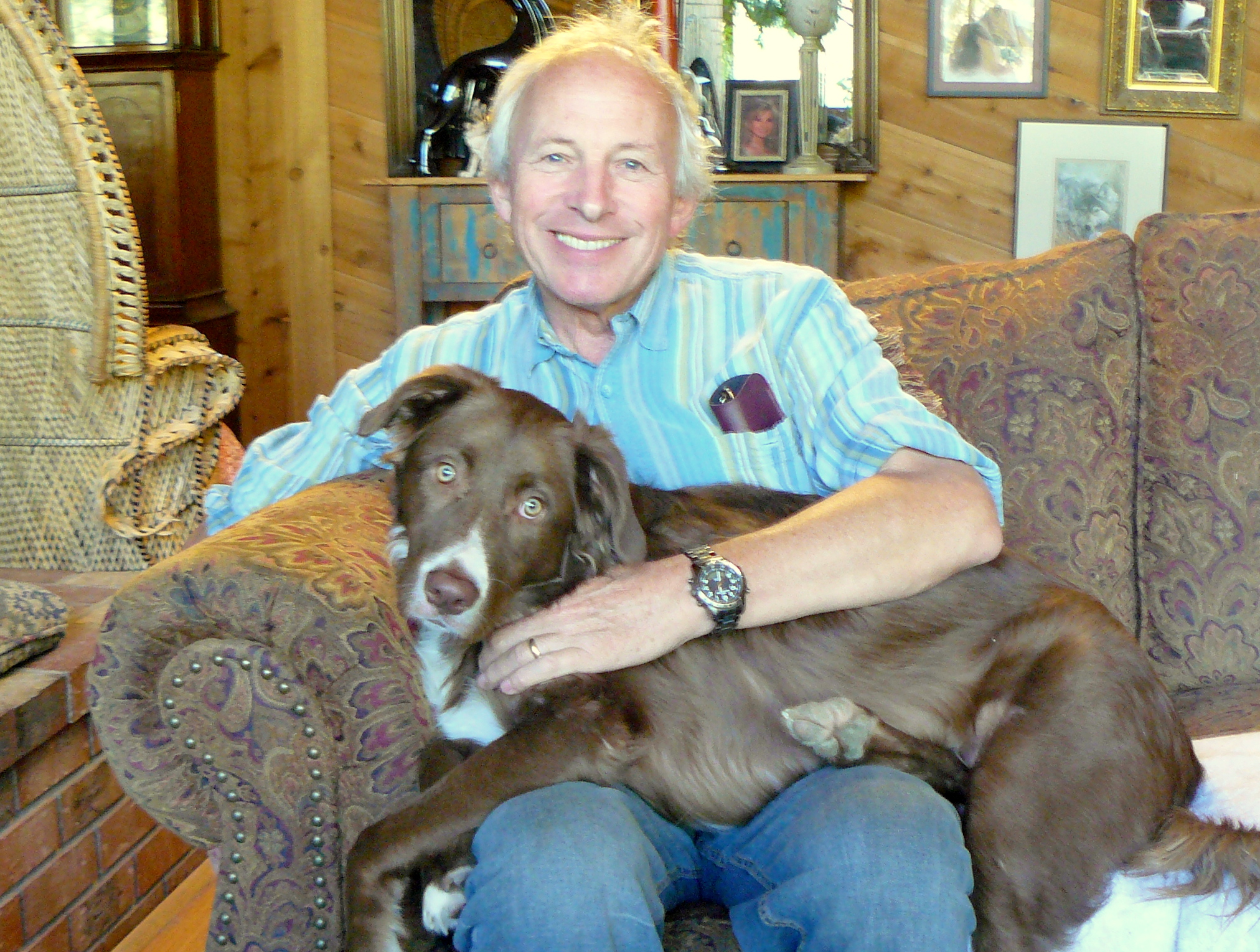
oooo
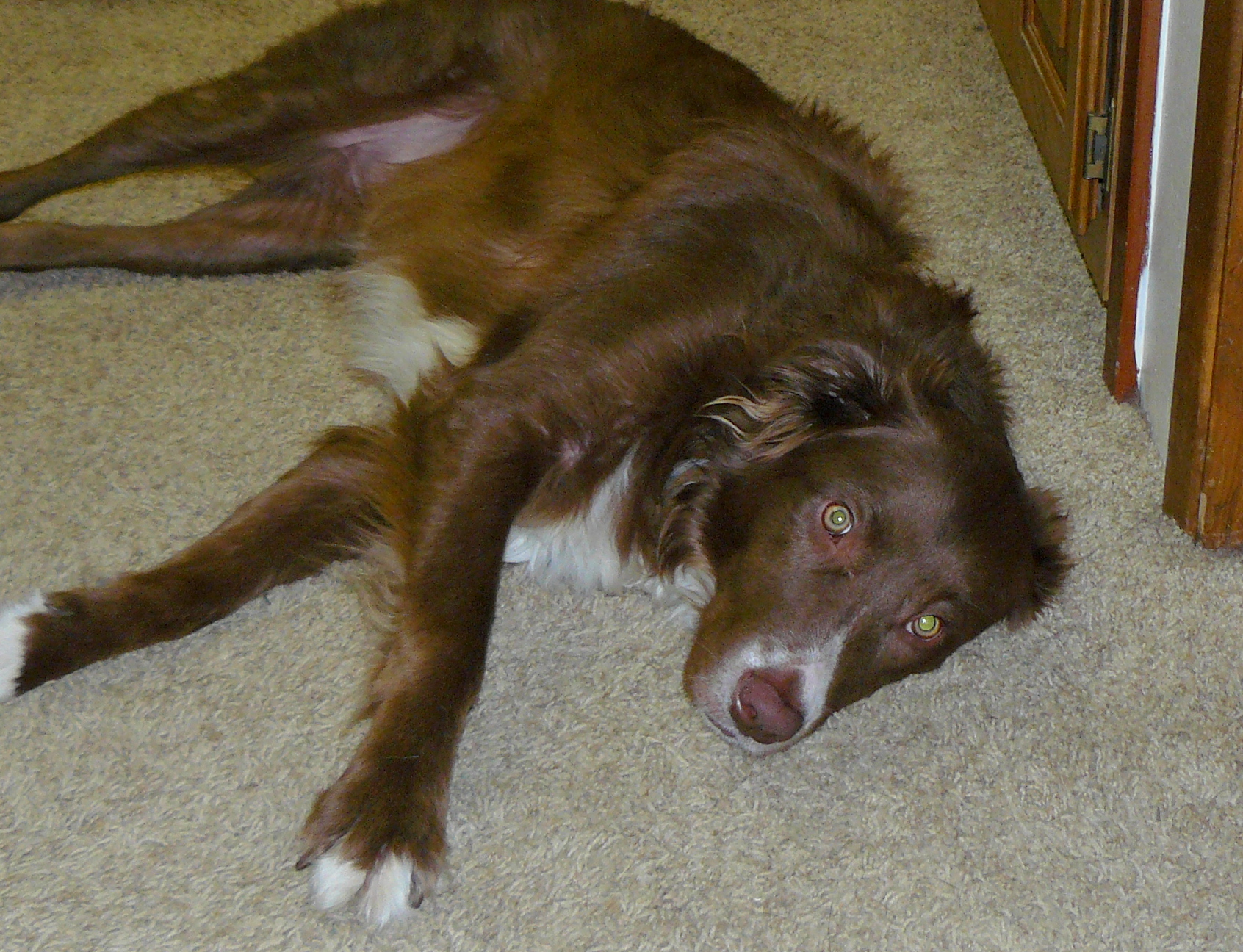
Here is a current photograph of the beautiful young man taken earlier this week.

oooo
And another one taken later that day when I was writing this post in readiness for today.
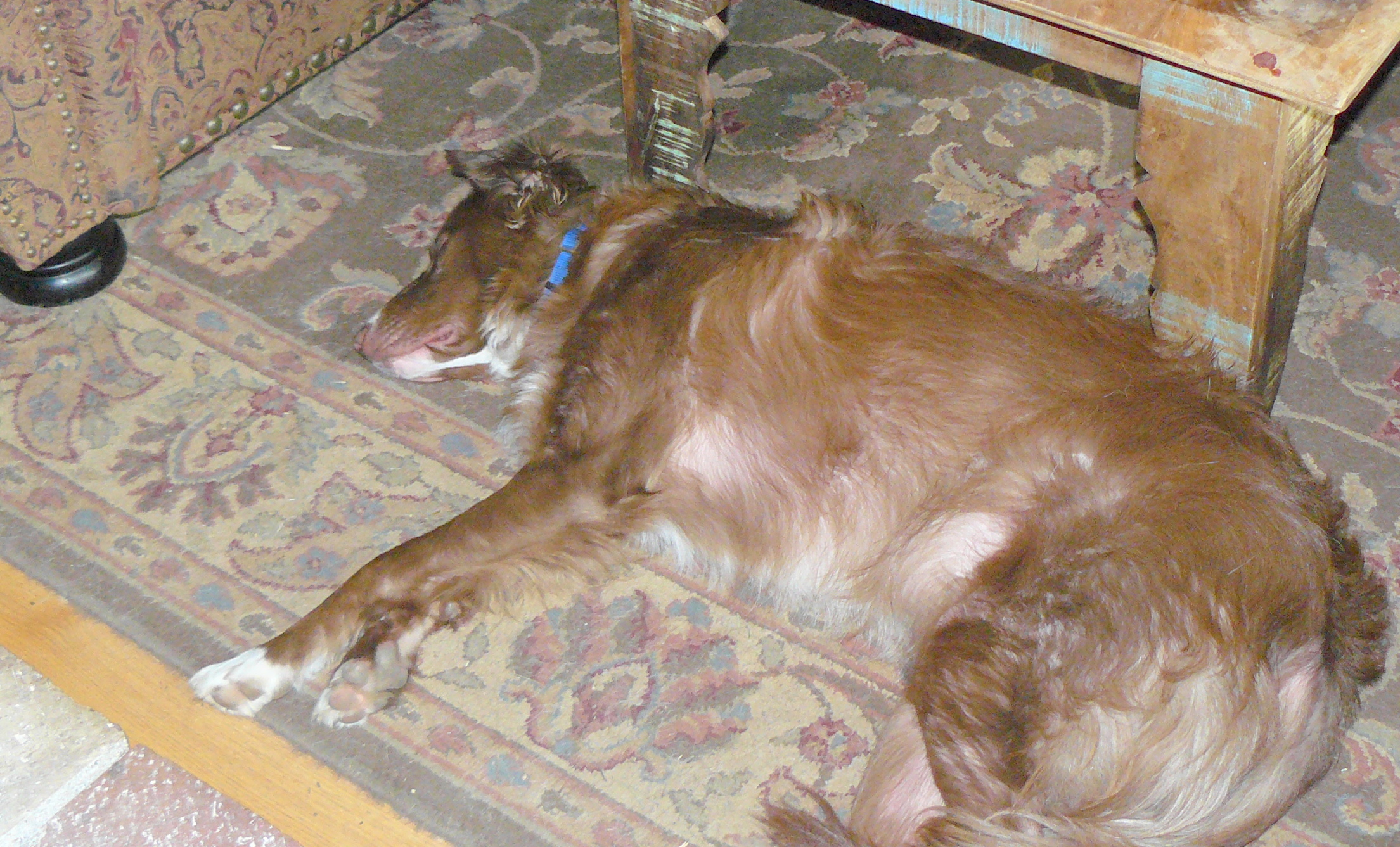
The incredible power of the nose of a dog.
Young Oliver had an upset tummy during the night resulting in the bedroom carpet needing a little ‘sorting out’ after midnight. Thus I was very grateful that a human’s sense of smell is very much inferior to that of the dog!
I couldn’t escape the irony that today’s post was inspired by an email from friend Dan Gomez. His email included the link to an article on the Brain Links website. It was called How a Dog Actually “Sees” the World Through Smell. Here’s how the article opened:
“The world of scents is at least as rich as the world of sight.”
Even though smell is the most direct of our senses and the 23,040 breaths we take daily drag in a universe of information — from the danger alert of a burning odor to the sweet nostalgia of an emotionally memorable scent — our olfactory powers are not even mediocre compared to a dog’s. The moist, spongy canine nose is merely the gateway into a remarkable master-machine which can detect smells in concentrations one hundred-millionth of what we humans require to smell something, and then transmute them into immensely dimensional and useful information about the world. So magnificent is the dog’s olfactory brawn — including the ability to sniff out skin, breast, bladder, and lung cancers with an astounding degree of accuracy and to literally smell fear — that to our primitive human perception it appears like nothing short of magic.
The article also included this short TED Talk but I have taken the liberty of including the paragraph that preceded the YouTube video.
How that neurobiological magic happens is what cognitive scientist Alexandra Horowitz — who heads the Dog Cognition Lab at Barnard College but has also produced a canon of invaluable insight on how we humans construct our impressions of reality — explains in this short animation from TED-Ed, based on her illuminating book Inside of a Dog: What Dogs See, Smell, and Know (public library):
Do go across and read the full article.
Mind you, referring back to our overnight doggy incident, I did find one paragraph slightly at odds with my personal views on the subject. It was this one:
We humans tend not to spend a lot of time thinking about smelling. Smells are minor blips in our sensory day compared to the reams of visual information that we take in and obsess over in every moment.
I’m here to tell you that at 1am yesterday morning, my sense of smell was anything other than a minor blip!
OK, before I close, I just want to alert all you dear readers to the fact that from later today until early March my son, Alex, is visiting us. His plans are to find somewhere in Oregon to enjoy some skiing but the very mild Winter so far may put a spanner in those works.
For obvious and natural reasons, writing posts for Learning from Dogs will not be a daily high priority. So if you read a number of posts previously published in earlier times you will understand why. Thank you.
A wonderful message from Sue of Sue Dreamwalker. Reders will recall that last Saturday, under the post title of And we’re back!, I offered a beautiful story told by the coal-mouse bird about the power of change. It included this sentence: “You see, it takes just one snowflake to make a difference.” In a very real sense, an example of that power of one snowflake was perfectly conveyed in Sue’s post a few days previously. Just read it, republished here with Sue’s blessings, and you will understand.
ooOOoo

What do you see in this Reality?
Do not your eyes view what is real to see?
Can you not touch the tangible fusion?
Or do we gaze into the ethers of illusion,
What trickery mocks us as we take in the lies
Binding our thoughts in roots of indoctrination
Following the herd, bleating like sheep Held captive, half asleep.
What happened to the land of the Free?
Conform or suffer, or pay the penalty
What is your reality?
Come, let me walk you through the misty vale.
To where this illusion significantly pales
We are magnificent magicians whose thoughts cast their magic
Where all is possible, where to doubt is tragic
Seek and Find, let go of fear
Dance in joy as Light penetrates your sphere
For you have forgotten our Time’s lost spell
As into the abyss of darkness you dwell.
Open your eyes and open your hearts.
Let the Light dispel all dark
Fear nothing, hate less, and embrace ALL
Seek a new illusion before you fall.
Stop following blindly, grasp hold of Love today
Remember your tomorrows, forget your yesterdays
Reach for the memory held high up in the stars
And heal from within, let go of all your scars
Sit in the silence; begin to know who you are
As illusion drifts away revealing Ancient Stars
Your time is but a moment, live each moment well,
For soon the illusion shatters, broken like a spell.
© Sue Dreamwalker 2010-2014 All rights reserved.
I resurrected this poem which I published 4 years ago.. As it seems we are bombarded on all sides from the negative energies which are being put out..
Detach and spend some time in your Quiet zones of thought.. Bring in the Peace around you, and know that we are Magnificent BEings who have remarkable powers..
The Power of Thought!
What we Think we Create
We are the ones creating the chaos… So choose to create Peace.. Don’t allow yourselves to get caught up within the Fear being put out..
Know your time is but a moment, Live each moment well
For soon the Illusion shatters,
Broken like a Spell.
Enjoy your week
Blessings
Sue
ooOOoo
Whatever is going on in the world, whatever has the power to create fear in our minds, in the end it comes down to another power, the power of thought, and our choice of the behaviors that we offer the world.
That is why dogs are so important. Because they almost predominantly love sharing and living their lives in the company of humans.
Do you remember when puppy Oliver came to live with us?
Another picture of Oliver sitting on the lap of yours truly taken in the last couple of days.
We have family guests with us for the next seven days.
Jean’s brother, Reg, and his lady are arriving today so for a while blogging will be less of a priority than usual.
Although I have spoken to Reg over the telephone on numerous occasions, this will be the first time we have met and I am looking forward to better knowing him.
Thus, as in previous times when we have had friends and family staying with us, I will be reposting popular items from previous times on Learning from Dogs, or republishing things that have caught my eye in recent days.
As with today’s post.
Reg, shares the same birth year as me: 1944!
Thus we are staring over the edge of our eightieth decade!
So this short talk by Isabel Allende seems like a worthwhile topic for today!
Published on Sep 3, 2014
Author Isabel Allende is 71. Yes, she has a few wrinkles—but she has incredible perspective too. In this candid talk, meant for viewers of all ages, she talks about her fears as she gets older and shares how she plans to keep on living passionately.
Want to know more about Isabel Allende? Her website is here.
Yet another thing we can learn from dogs! Living passionately right up to the last days.
Not without a touch of serendipity.
I’m speaking of meditation.
That is all I seem to do when I approach the subject: speak and think about it but never do it!
However, I think I may be approaching a turning point. All thanks to a follower of Patrice Ayme’s blog. It was a comment from ‘R.’ in response to my question on this PA post. Here’s how the comments flowed (hope this isn’t too long-winded but I wanted to select all that seemed appropriate to the post):
R:
I run 5d/wk, and I notice my thinking/contemplation is “heightened” during cardio. I believe this is no different than the “high” you get when taking some drugs (mushroom, weed, etc).
Physical exercise also helps keep my rest of the day sharp. But this is just keeping the engine (physical body) fit, thus helps thinking straight. Nothing more.
Meditation/awareness is the main key. And you need some way to be in it 24/7, not just during (or little while after) exercise . And “calm and collected” is the way for it. You can sustain this through out the day, and even during sleep/dream states (according to advanced meditators). “Calm” not as in “looking at navel”; calm as in “focused, in control, zen-like”. This involves moral conditioning too, as it’s hard to be calm if you have any shred of fear. And the way to lose fear, is through ideal morals (aka dharma, natural law).
There are higher meditative states (permanent, sustained), humans can get into. Temporary highs are just that.
—-
Patrice:
R: To be answered mostly in a separate comment. Meditative states are numerous. They are even necessary to some physical activities. It can be called concentration in some cases. Deep diving in apnea is an example. There is a case when meditation is life saving. Miss the meditation, miss the resuscitation.paul, like any new habit, meditation takes time to cultivate. It is after all a life long endeavor of “understanding one’s self”. It is easier if we dont view it as some new task (or half-hour daily exercise in navel-gazing).
—-
Me:
Having re-read the essay and others’ comments, causes me to speak a little about my own short-term memory failings. I’m 70 later this year and in the last, oh I don’t know ( can’t remember 😉 ), 2 or 3 years, my ‘event’ memory has declined dreadfully. But it’s not uniform. Even after 2 years, I still struggle to find certain shops in nearby Grants Pass but do recall clearly when our bridge washed out after we moved into the house in October, 2012.
There is no discernible pattern, and other men of my general age frequently suffer the same way.
If there were mental exercises that helped stem this problem, I would love to know more; assuming I could remember the details!
—-
R:
If i may, try meditation. A simple meditation exercise is just to be aware of yourself in all activities you do (initially we find ourselves lost often, but if you keep at it, soon % of being with yourself greatly exceeds losing self. calm, control and clarity is developed.). A good barometer/progress is to see if the daily activities drive you, or you drive the daily activities.
Of course physical exercises/fitness are absolute minimum. For old-age i would recommend yoga (fancy word for stretching and proper breathing)
Meditation while doing yoga with proper breathing (pranayama) gives out of this world results (this whole process is collectively called “yoga”).
And you can “be in it” 24/7 (as yoga includes sitting, sleeping poses too; It just an art of proper physical + mental positioning through out the day).
If eastern keywords are disturbing, ignore those. Just like everything else, the more you do something, the more you become that. This is particularly (exponentially) true for mind stuff.
—-
Patrice:
R: Paul is obviously a very reflective person. I do not exactly know what would be the distinctive definition(s?) between reflective and meditative states. I do know, though, that some sports (solo climbing and apnea) require total neurological control.
R:
Reflection/contemplation/meditation all of these help in mind (habits, inertia, anything thats limiting/holds-back) transformation.
Meditation is reflection on self. Reflection on daily activities takes time away from reflection on self. Increasing self awareness makes apparent all blind spots (wisdom).
If you are a physically able, healthy human, almost all your problems (aka “suffering”) are mind related. Physical body (including physical brain) just needs basic (of course healthy) sustenance.
Me:
R, yes I concur entirely about the majority of ‘problems’ being mind related. I have on my bookshelf next to me Roy Masters’ book ‘How Your Mind Can Keep You Well – An Introduction to Stress Management.
But if there’s one thing I would like to crack is starting and maintaining a programme of meditation. So many have recommended this approach and, rationally and emotionally, I know it will offer benefits. However, for some reason I can’t translate that ambition into actually starting.
Would love to listen to your advice about how to get started. You don’t have a blog do you? If not, fancy writing a guest post for Learning from Dogs! 😉 Contact details on the home page.
(Sorry Patrice – didn’t mean to hog the channel!)
Patrice:
Hog all you want, Paul. Even when I disagree with you, I find you interesting. Meditation and memory are vast questions. I pointed out that too much memory could be bad, basically. The first thing to get good memory, is to stop stressing about it, and thinking about what we really care about, without getting drawn to, and drowned, in formalism.
PAR:
Paul, If you are just looking for basic stress relieving meditation, this one looks good.
‘R’ then very kindly sent me the following:
To permanently establish this habit, first our mind needs to be convinced of the benefits.
Like any hobby, we need to develop an interest in the topic. And this means reading up on theory, on what is mediation, why do we need it, what happens if we pretend it doesn’t exist.
There are different styles of meditation, and different end goals, different schools of thought.
Self-inquiry is my preferred approach, as it’s the only thing you can rely on (your own self). There is a lot of literature on this. But all of this is just food for thought, nothing more.
There is also vast Buddhist literature: you can ignore all the theology and just focus on basics. Theory becomes a burden , so all conceptual knowledge has to be discarded. So I don’t advocate any philosophy or sect or schools of thought: Only believe in your realisations.
The end-goal of all this is full wisdom; reality as-is; liberation (end of suffering); control of one’s self; “the world is truly yours”; you are capable of handling anything; you can exercise “real free-will”; you are at ease being you; your knowledge will be flaw-less; and, finally, you will naturally empathise with others (as you will be aware what others are going through).
This is not some mumbo-jumbo, you will realize and experience it for your self.
This is about wisdom as in practical common-sense.
I am totally convinced by those heartfelt words. I’m sure there are others who, like me, have talked about meditation but done no more, hence me sharing this with you.
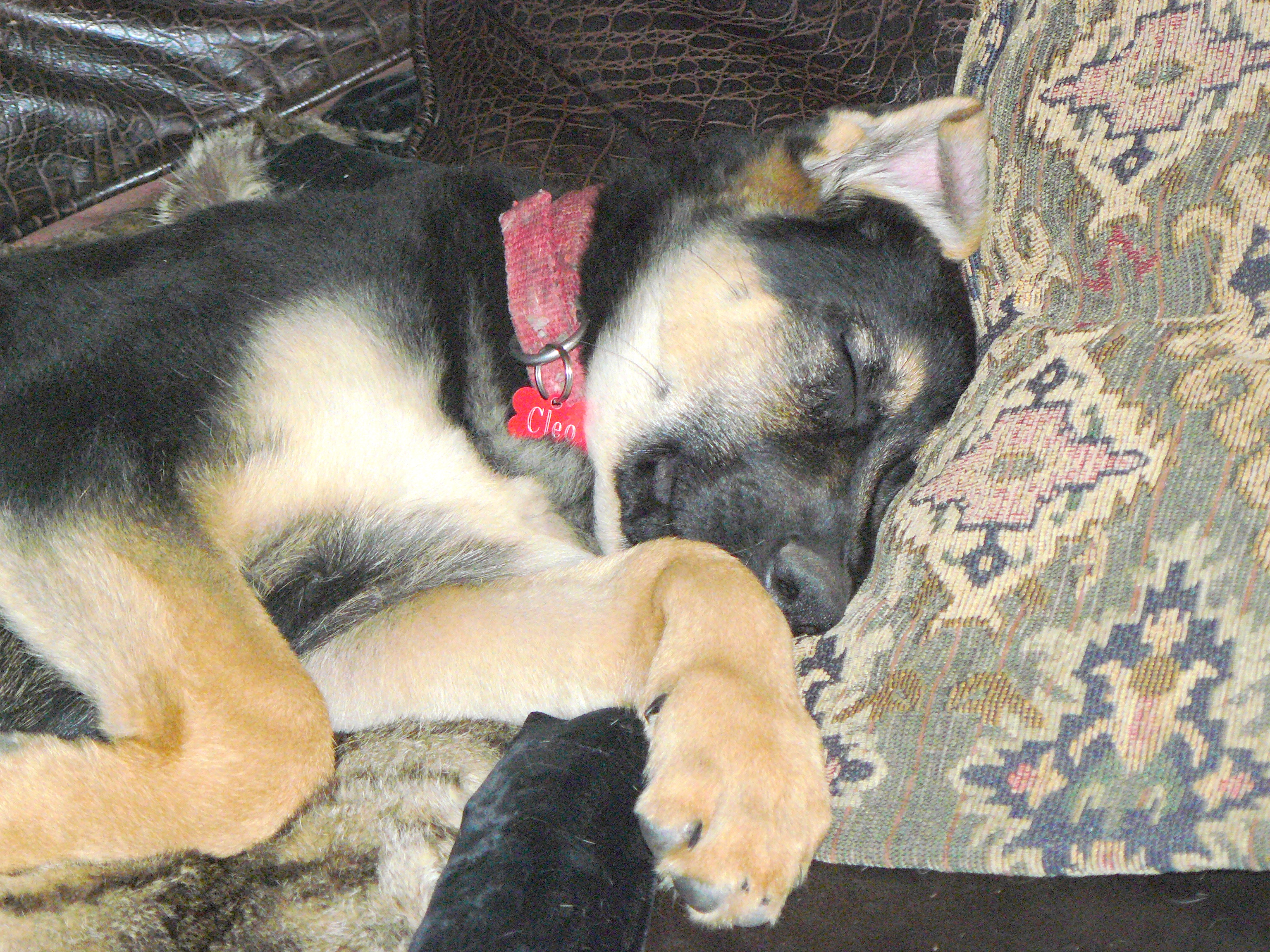
Anything to learn from dogs?
Are you kidding!
oooo
oooo
My case rests!
 Learning from Dogs