The lesson of love from our dogs just keeps rolling along.
Neighbour Dordie had the following sent to her in an email and, subsequently, passed it on to me.
I share it with you and hope that it brightens your day.
ooOOoo
After losing his parents, this three-year-old orangutan was so depressed he wouldn’t eat and didn’t respond to any medical treatments. The veterinarians thought he would surely die from sadness.
The zoo keepers found an old sick dog on the grounds in the park at the zoo where the orangutan lived. They took the dog to the animal treatment center; the dog arriving at the same time that the orangutan was there being treated.
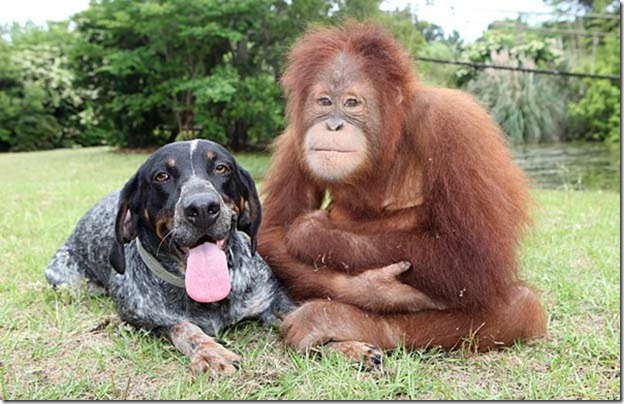
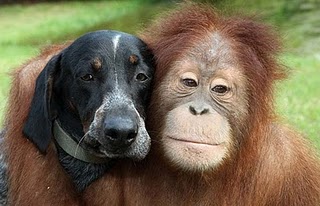
The two lost souls met and have been inseparable ever since. The orangutan found a new reason to live and each always tries his best to be a good companion to his new-found friend. They are together 24-hours-a-day in all their activities.
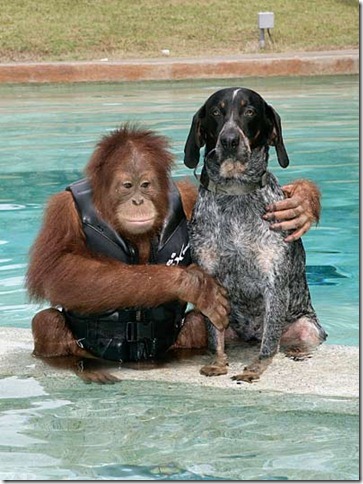
They live in Northern California where swimming is their favorite past-time, although Roscoe (the orangutan) is a little afraid of the water and needs his friend’s help to swim.
Remaining with the theme of love, love lost and new love.
John Hurlburt sent me the following last week and it is so perfect as a sequel to the writings of the last two days. That was John’s poetry last Saturday on Learning from Dogs, by the way.
oooOOOooo
Two lost souls
After losing his parents, this three year old orangutan was so depressed he wouldn’t eat and didn’t respond to any medical treatments. The veterinarians thought he would surely die from sadness.
The zoo keepers found an old sick dog on the grounds in the park at the zoo where the orangutan lived and took the dog to the animal treatment center. The dog arrived at the same time the orangutan was there being treated.
The two lost souls met and have been inseparable ever since. The orangutan found a new reason to live and each always tries his best to be a good companion to his new found friend. They are together 24 hours a day in all their activities.
They live in Northern California where swimming is their favorite past-time, although Roscoe (the orangutan) is a little afraid of the water and needs his friend’s help to swim.
Together they have discovered the joy and laughter in life and the value of friendship.
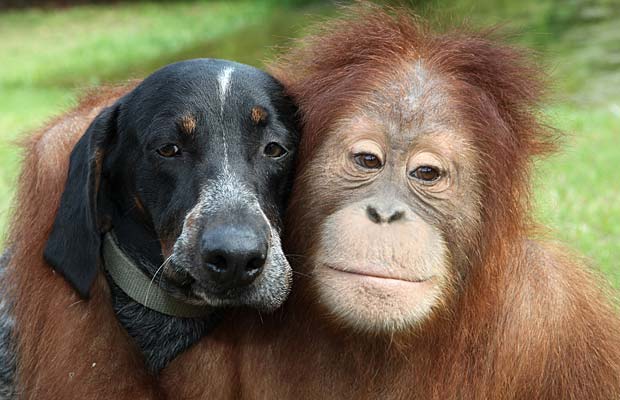
They have found more than a friendly shoulder to lean on.
Long Live Friendship!
I don’t know, but some say life is too short, others say it is too long, but I know that nothing that we do makes sense if we don’t touch the hearts of others. While it lasts!
May you always have love to share, health to spare, and friends who care…..even if they are a little hairy at times.
oooOOOooo
I must say that the generosity of so many of my readers in sending me these beautiful examples of what is really important in this world of ours touches me deeply. Thank you, John. Thank you, one and all.
Forgive me, dear readers, but something light and simple for today. I don’t mean in the sense of the content, far from it, just easy for me to put the post together as it is from a presentation that I gave a year ago.
Here’s a picture of our solar system.
Most of us are reasonably familiar with this visual concept of our solar system, but what of it’s age? That’s much more difficult to embrace in a way that we can relate to.
So let’s use something to represent the age of our solar system, the distance from Phoenix to Payson.
In round terms, Payson is 80 miles North-East from Phoenix. Put another way, that’s 422,400 feet!
So if those 80 miles represented the age of our solar system, what would be the significant milestones on this metaphorical journey?
Phoenix represents the start, the ‘start’ of our solar system some 4.54 billion years ago
It was 1,075,000,000 years before Blue-green algae appeared. That is the equivalent of travelling 18.94 miles from Phoenix North-East along Highway 87. Or looking back, those algae appeared some 3.465 billion years ago.
But on we travel, metaphorically an unimaginable 3,459,800,000 years after the arrival of Blue-green algae until the next milestone; the earliest hominids. In terms of our Highway that’s a further 60.97 miles. Again, looking back that was 5,200,000 years ago.
The sharp-eyed among you will see that 18.94 miles added to 60.97 miles is 79.91 miles. Goodness that’s awfully close to the total distance of 80 miles between Phoenix and Payson! In fact, the 0.09 miles to run is the equivalent of 484 feet!
So let’s look at those last 484 feet.
The first 465.20 feet represents the approximately 5 million years after the earliest hominids appeared before H. sapiens arrived, some 200,000 years ago.
The appearance of Homo sapiens brings us to just 18.6 feet from Payson.
But first, we travel 9.3 feet and see the arrival of dogs, generally regarded to have separated, in DNA terms, from the Grey Wolf 100,000 years ago.
And are you 60 years old? You were born just 0.0669 inches or 7/100ths of an inch from Payson! If my maths is correct (someone please check!) 0.0669 inches is about 34 times the thickness of the human hair! That’s very close to Payson!
Don’t know about you but it puts the age of our solar system into a perspective one might be able to get one’s arms around.
On the scale used above, one inch represents 895.68 years, one foot the equivalent of 10,748.11 years and a mile represents 56,750,000 years.
Anybody want to hazard a guess as to the state of our planet in one further inch?
The difference an inch makes! 895.68 years!
OK, let me stay more or less on topic and just round things off.
EarthSky website seems to have some great items, including this one.
Ten things you may not know about the solar system
9 ) Pluto is smaller than the USA
The greatest distance across the contiguous United States is nearly 2,900 miles (from Northern California to Maine). By the best current estimates, Pluto is just over 1400 miles across, less than half the width of the U.S. Certainly in size it is much smaller than any major planet, perhaps making it a bit easier to understand why a few years ago it was “demoted” from full planet status. It is now known as a “dwarf planet.”
How far do the stars stretch out into space? And what’s beyond them? In modern times, we built giant telescopes that have allowed us to cast our gaze deep into the universe. Astronomers have been able to look back to near the time of its birth. They’ve reconstructed the course of cosmic history in astonishing detail.
From intensive computer modeling, and myriad close observations, they’ve uncovered important clues to its ongoing evolution. Many now conclude that what we can see, the stars and galaxies that stretch out to the limits of our vision, represent only a small fraction of all there is.
Does the universe go on forever? Where do we fit within it? And how would the great thinkers have wrapped their brains around the far-out ideas on today’s cutting edge?
For those who find infinity hard to grasp, even troubling, you’re not alone. It’s a concept that has long tormented even the best minds.
Over two thousand years ago, the Greek mathematician Pythagoras and his followers saw numerical relationships as the key to understanding the world around them.
But in their investigation of geometric shapes, they discovered that some important ratios could not be expressed in simple numbers.
Take the circumference of a circle to its diameter, called Pi.
Computer scientists recently calculated Pi to 5 trillion digits, confirming what the Greeks learned: there are no repeating patterns and no ending in sight.
The discovery of the so-called irrational numbers like Pi was so disturbing, legend has it, that one member of the Pythagorian cult, Hippassus, was drowned at sea for divulging their existence.
A century later, the philosopher Zeno brought infinity into the open with a series of paradoxes: situations that are true, but strongly counter-intuitive.
In this modern update of one of Zeno’s paradoxes, say you have arrived at an intersection. But you are only allowed to cross the street in increments of half the distance to the other side. So to cross this finite distance, you must take an infinite number of steps.
In math today, it’s a given that you can subdivide any length an infinite number of times, or find an infinity of points along a line.
What made the idea of infinity so troubling to the Greeks is that it clashed with their goal of using numbers to explain the workings of the real world.
To the philosopher Aristotle, a century after Zeno, infinity evoked the formless chaos from which the world was thought to have emerged: a primordial state with no natural laws or limits, devoid of all form and content.
But if the universe is finite, what would happen if a warrior traveled to the edge and tossed a spear? Where would it go?
It would not fly off on an infinite journey, Aristotle said. Rather, it would join the motion of the stars in a crystalline sphere that encircled the Earth. To preserve the idea of a limited universe, Aristotle would craft an historic distinction.
On the one hand, Aristotle pointed to the irrational numbers such as Pi. Each new calculation results in an additional digit, but the final, final number in the string can never be specified. So Aristotle called it “potentially” infinite.
Then there’s the “actually infinite,” like the total number of points or subdivisions along a line. It’s literally uncountable. Aristotle reserved the status of “actually infinite” for the so-called “prime mover” that created the world and is beyond our capacity to understand. This became the basis for what’s called the Cosmological, or First Cause, argument for the existence of God.
A chance email from Dan G. opens up a whole treasure trove.
Here’s what Dan sent to me,
True Friends
After losing his parents, this 3 year old orangutan was so depressed he wouldn’t eat and didn’t respond to any medical treatments. The veterinarians thought he would surely die from sadness. The zoo keepers found an old sick dog on the grounds in the park at the zoo where the orangutan lived and took the dog to the animal treatment center. The dog arrived at the same time the orangutan was there being treated. The 2 lost souls met and have been inseparable ever since.
The orangutan found a new reason to live and each always tries his best to be a good companion to his new found friend. They are together 24 hours a day in all their activities.
Roscoe and Surya
They live in Northern California where swimming is their favorite past time, although Roscoe (the orangutan) is a little afraid of the water and needs his friend’s help to swim.
Roscoe and SuryaRoscoe and Surya
Together they have discovered the joy and laughter in life and the value of friendship.
Roscoe and SuryaRoscoe and Surya
They have found more than a friendly shoulder to lean on.
Roscoe and SuryaLove across the species boundary
Long Live Friendship!!!!!!!
I don’t know……some say life is too short, others say it is too long, but I know that nothing that we do makes sense if we don’t touch the hearts of others…….while it lasts!
So after I had seen the pictures above, it was pretty easy to find this YouTube video.
Then if that wasn’t amazing and wonderful, try this,
Well that’s enough for today. But tomorrow, I will continue with Part Two which recounts the amazing year that Joe Hutto spent in the Florida wildlands with ….. (you’ll have to wait for tomorrow!)
 The zoo keepers found an old sick dog on the grounds in the park at the zoo where the orangutan lived. They took the dog to the animal treatment center; the dog arriving at the same time that the orangutan was there being treated.
 The two lost souls met and have been inseparable ever since. The orangutan found a new reason to live and each always tries his best to be a good companion to his new-found friend. They are together 24-hours-a-day in all their activities.
 They live in Northern California where swimming is their favorite past-time, although Roscoe (the orangutan) is a little afraid of the water and needs his friend’s help to swim.
 Together, they have discovered the joy and laughter in life and the value of friendship.
 They have found more than a friendly shoulder to lean on.
 Long Live Friendship!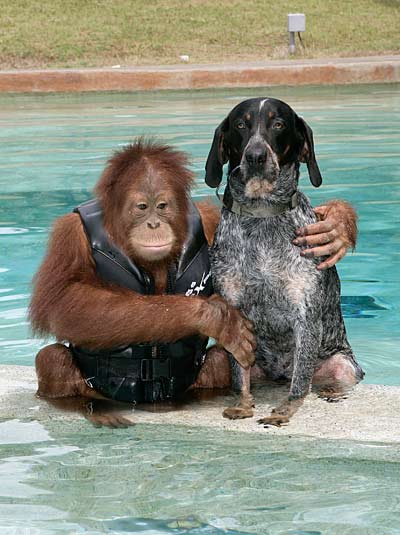







 Learning from Dogs