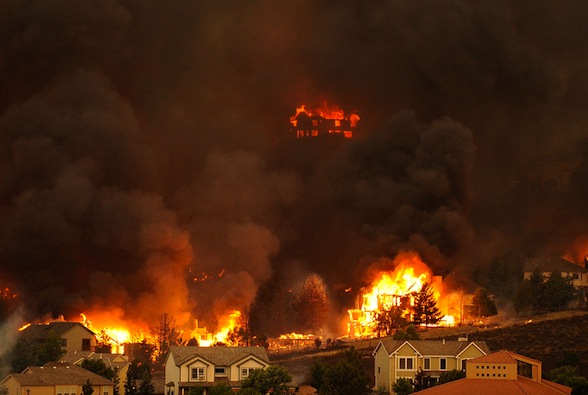
This summer has seen nature visiting on man a series of catastrophes. To name just a few, we have the record-breaking rainfall in Britain in June, the Colorado wildfires and the 1,400,000 storm-struck households in the eastern US.
Colorado burning
Inevitably, many wonder if this is connected to climate change as a result of mankind’s behaviours. Many now believe so.
But we have to stand on the rock of science.
So it was great to come across a recent article on Grist that led me to this organisation, Climate Communication. As they say on the About Us page,
Climate Communication is a non-profit science and outreach project funded by the Rockefeller Brothers Fund and the ClimateWorks Foundation. Climate Communication operates as a project of the Aspen Global Change Institute, a non-profit organization dedicated to furthering the scientific understanding of Earth systems and global environmental change.
That review on Climate Communication includes the following video,
Not convinced?
Then try this evidence from an interview with Kevin Trenberth of the National Center for Atmospheric Research shown on PBS Newshour,
Want more? Go for it!
The PBS video came from the British Guardian newspaper (link thanks to Naked Capitalism). The Guardian reported,
Is it now possible to blame extreme weather on global warming?
Wildfires, heatwaves and storms witnessed in the US are ‘what global warming looks like’, say climate scientists
Posted by Leo Hickman
Tuesday 3 July 2012
Whenever an episode of extreme weather – heatwave, flood, drought, etc – hits the headlines, someone somewhere is sure to point the finger of blame at human-induced climate change.
Such claims are normally slapped down with the much-aired mantra: “You cannot blame a single episode of bad weather on global warming.” But with the on-going record high temperatures affecting large parts of the US, there seems to be a noticeable reduction in such caveats and notes of caution.
This week, scientists have been queuing up, it seems, to explain how the wildfires in Colorado, the heatwave across the eastern seaboard, and the “super derecho” are all indicative of “what global warming looks like“. Most pulled back, though, from directly blaming global warming for such weather events.
“In the future you would expect larger, longer more intense heat waves and we’ve seen that in the last few summers,” Derek Arndt of NOAA Climate Monitoringtold the Associated Press.” The same report added: “At least 15 climate scientists told the Associated Press that this long hot US summer is consistent with what is to be expected in global warming.”
So, can we now say, or not, that specific extreme weather events are caused, or at least exacerbated, by global warming? Has anything changed in climate scientists’ understanding of the attribution – or “anthropogenic fingerprint” – of such events? Are they now more confident about making such links?
I put this question to a number of climate scientists ….
Leo Hickman then reports the assessments of eight leading scientists. Go and read their words here. If you can do it now!
The science is solid!
So as you watch these scientists talking about the meaning of climate extremes think what you can do today to reduce your own impact on this planet. Just as importantly, think how you can influence those around you and those that represent you that now is the time to wake up to the fact that nature is telling us to slow down!
The growth in awareness of what we are doing to the planet is astounding. There is hope, we have to promote hope and we have to acknowledge that hope is a powerful agent of change.
All my life, well all the years that I have appreciated a ‘tea-break’, stopping for a cup of hot tea has been laden with symbolism. A chance to let the brain catch up with whatever one is doing. When working with others an opportunity to stand back and evaluate how the particular project is going. When sharing a project with a loved one, an opportunity to lay down memories for future years, and so forth. (Jean and I were building a chicken coop yesterday afternoon.) Sure there are millions of people that share these feelings.
Anyway, as many of you have been aware, the last 10 days or so on Learning from Dogs have been pretty ‘full-on’ in terms of man and Planet Earth. It started with me publishing on the 27th February a Post called Please help! – A plea to those who understand climate science so much better than I do!. Then on the 2nd March, I republished a Post from Patrice Ayme called The collapse of the biosphere.
That there were a total of 6,313 viewings of those Posts and 69 comments (OK, that doesn’t mean different individuals) was incredibly gratifying – a very big ‘thank you’ to all of you that read the Posts, and likewise to those that commented.
But one of the most wonderful aspects for me was the incredible sharing of ideas and resources. So the point of today’s Post is to bring all those links and contacts onto one ‘page’, so to speak.
Martin Lack was the first to point me in the direction of the book, Merchants of Doubt. There are a number of videos on YouTube but the one below is a good introduction to Naomi Oreskes.
On October 28, 2010 historian of science Naomi Oreskes gave a presentation at Forum Lectures (US Embassy Brussels), based on her new book, Merchants of Doubt: How a Handful of Scientists Obscured the Truth on Issues from Tobacco Smoke to Global Warming, about how right wing scientists founded the George Marshall Institute which has become a key hub for successfully spreading fear, uncertainty and doubt about climate change, along with other environmental issues, and how myths about science enable these political strategies to work.
An in-depth video of over an hour from the University of Rhode Island’s Spring 2010 Vetlesen Lecture Series, hugely worth watching, is here.
Then there is the powerful blog site, De Smog Blog. As the site explains, “The DeSmogBlog Project began in January 2006 and quickly became the world’s number one source for accurate, fact based information regarding global warming misinformation campaigns. TIME Magazine named DeSmogBlog in its “25 Best Blogs of 2011” list.”
Moving on. One of the challenges is knowing how to look up some reasonably reliable information about a person who is claiming this or that. That’s where SourceWatch is invaluable. The website describes itself, “The Center for Media and Democracy publishes SourceWatch, this collaborative resource for citizens and journalists looking for documented information about the corporations, industries, and people trying to influence public policy and public opinion. We believe in telling the truth about the most powerful interests in society—not just relating their self-serving press releases or letting real facts be bleached away by spin.”
Let me give you an example of how SourceWatch works. In my Post A skeptic’s view, Dan offered extensive comment about U.S. Senator James Inhofe’s book The Greatest Hoax. A quick search on SourceWatch revealed (a) (my emboldening)
Arthur B. Robinson is one of the three co-founders of the Oregon Institute of Science and Medicine, a group best known for organising a petition disputing the scientific evidence for human-induced global warming.
On January 7, 2009, the Willamette Week reported that Robinson is “in the vanguard of a small but vocal and persistent collection of scientists, industry advocates and commentators who dismiss human culpability for climate change. … Robinson’s critics say his analysis is simplistic, but it remains persuasive a decade later with powerful policymakers like U.S. Senator James Inhofe (R-Okla.), a visible and effective player in blocking a bill to limit greenhouse-gas emissions last fall.
James Mountain Inhofe, usually known as Jim Inhofe, has been a Republican Senator for Oklahoma since winning a special election in 1994.
Oil
James M. Inhofe has voted in favor of big oil companies on 100% of important oil-related bills from 2005-2007, according to Oil Change International. These bills include Iraq war funding, climate change studies, clean energy, and emissions.
On to another book. I forget who recommended the book by James Hansen, Storms of my Grandchildren but it’s another ‘must-read’ for all those wanting to better understand the risks that lay ahead. As the book’s website explains,
In Storms of My Grandchildren, Dr. James Hansen—the nation’s leading scientist on climate issues—speaks out for the first time with the full truth about global warming: The planet is hurtling even more rapidly than previously acknowledged to a climatic point of no return.
On that website there is a section Hansen On The Issues that includes this 2-minute YouTube video of Dr. Hansen talking about his book.
I can’t close without mentioning some other wonderful websites. There is Skeptical Science, described thus,
Explaining climate change science & rebutting global warming misinformation
Scientific skepticism is healthy. Scientists should always challenge themselves to improve their understanding. Yet this isn’t what happens with climate change denial. Skeptics vigorously criticise any evidence that supports man-made global warming and yet embrace any argument, op-ed, blog or study that refutes global warming. This website gets skeptical about global warming skepticism. Do their arguments have any scientific basis? What does the peer reviewed scientific literature say?
Then there’s ClimateSight, a wonderful effort by Kate, “Kate is a B.Sc. student and aspiring climatologist from the Canadian prairies. She started writing this blog when she was sixteen, simply to keep herself sane, but hopes that she’ll be able to spread accurate information about climate change far and wide while she does so.” Kate’s interest and passion in the subject is unmissable and it’s a real pleasure to subscribe to her postings.
Bill McKibben’s famous site, 350.org, is a must for the thousands of people that are working for a better future. As the mission statement opens up,
350.org is building a global grassroots movement to solve the climate crisis. Our online campaigns, grassroots organizing, and mass public actions are led from the bottom up by thousands of volunteer organizers in over 188 countries.
350 means climate safety. To preserve our planet, scientists tell us we must reduce the amount of CO2 in the atmosphere from its current level of 392 parts per million to below 350 ppm. But 350 is more than a number—it’s a symbol of where we need to head as a planet.
350.org works hard to organize in a new way—everywhere at once, using online tools to facilitate strategic offline action. We want to be a laboratory for the best ways to strengthen the climate movement and catalyze transformation around the world.
RealClimate is a commentary site on climate science by working climate scientists for the interested public and journalists. We aim to provide a quick response to developing stories and provide the context sometimes missing in mainstream commentary. The discussion here is restricted to scientific topics and will not get involved in any political or economic implications of the science. All posts are signed by the author(s), except ‘group’ posts which are collective efforts from the whole team. This is a moderated forum.
There are so many more fabulous sources of real caring about the society we are and, more importantly, the society we hope to be. In this category comes Wibble. Then there’s Dogs of Doubt, that I shall be referring to tomorrow on Learning from Dogs, and The Green Word and so on and so on. It shows the power of ‘hands across the ether’ that the modern world of web sites now offers. I put great faith in this power becoming the power of truth and the power of change. (If you have a blog or a website that resonates with the ones mentioned here, please do drop me an email giving me details.)
Finally, I’m closing with this. If it all sometimes feels too much for you and you want to drift away into the world of the inner consciousness, into the world of dreamtime, then you can do no worse than to call by Sue Dreamwalker‘s wonderful website. Try this, for example. Dan and I had no idea what we were getting into. 😉
Starting to feel like a long way from John Masefield’s poem Sea Fever.
The call of the sea.
One of my all-time favourite poems.
I must go down to the seas again, to the lonely sea and the sky,
And all I ask is a tall ship and a star to steer her by,
And the wheel’s kick and the wind’s song and the white sail’s shaking,
And a grey mist on the sea’s face, and a grey dawn breaking.
I must go down to the seas again, for the call of the running tide
Is a wild call and a clear call that may not be denied;
And all I ask is a windy day with the white clouds flying,
And the flung spray and the blown spume, and the sea-gulls crying.
I must go down to the seas again, to the vagrant gypsy life,
To the gull’s way and the whale’s way, where the wind’s like a whetted knife;
And all I ask is a merry yarn from a laughing fellow-rover,
And quiet sleep and a sweet dream when the long trick’s over.
Why do I start this piece with that poem?
Well, read this,
Carbonic acid is a weak acid that is created when carbon dioxide (CO2) is dissolved in water (H2O), resulting in the chemical formula H2CO3. When the acid dissociates, or gives up a hydrogen ion, the resulting molecule is called a bicarbonate ion. Carbonic acid appears frequently in the natural world. It can be found in sodas, champagne, and blood. The acid even appears in rain.
But like so many things in nature, it’s all about balance.
Besides, it’s not all about “climate change”. Half of the CO2 is presently dissolving in the oceans, so a rise of two degrees Celsius means extremely acid oceans (CO2 turns into carbonic acid after it reacts with water). At the present rate of acidification, marine life will dissolve big time by 2100. That’s how a lot of the oxygen is produced, by photosynthesizing unicellular animals, with acid sensitive skeletons. Atmospheric poisoning deniersdo not want just to warm us up.
On that same day of March 2nd, Yves Smith of Naked Capitalism published an item that reinforced what Patrice wrote. Yves very kindly gave me permission to republish her Post in full, as follows:
Science has published a troubling but not entirely surprising article on the fact that the oceans are acidifying at the fastest rate in 300 million years. Actually, it could be the fastest rate over an even longer time period, but we can only go back with any degree of accuracy for 300 million years
….there are side effects to our love affair with CO2 that are not often mentioned. In fact, whether the earth cools or warms is absolutely irrelevant to these effects. I repeat: Absolutely irrelevant.
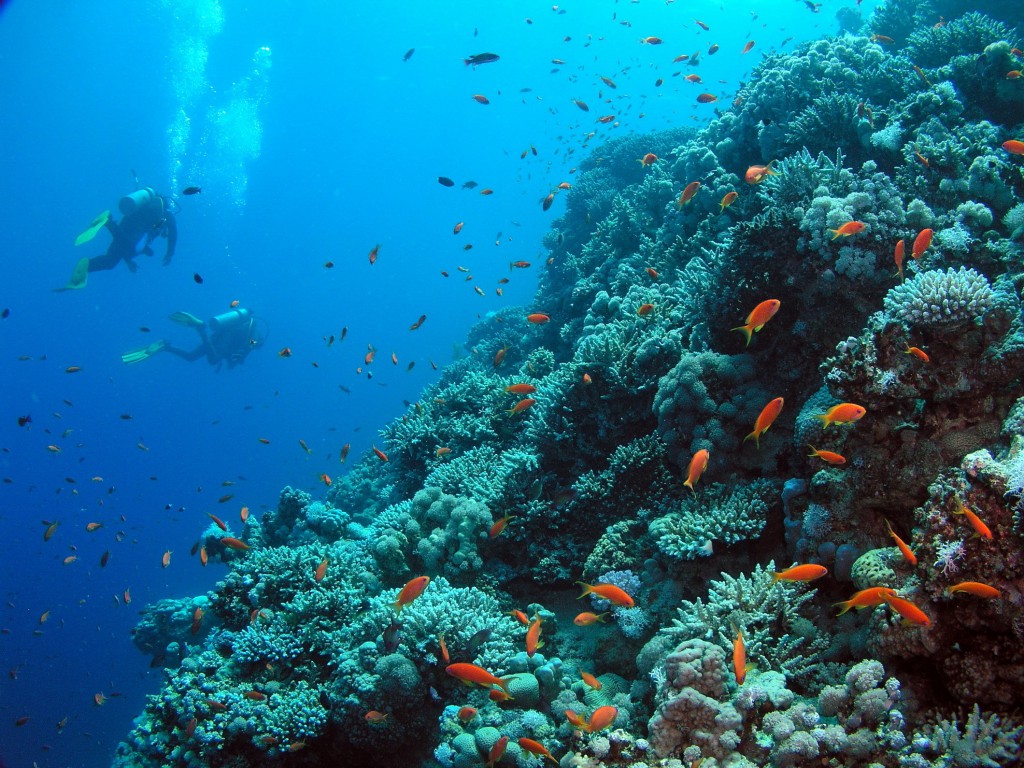
One of the most startling effects is the acidification of the oceans. Since 1750, the oceans have become increasingly acidic. In the oceans, CO2 forms carbonic acid, a serious threat to the base of the food chain, especially on shellfish of all sizes. Carbonic acid dissolves calcium carbonate, an essential component of any life form with an exoskeleton. In short, all life forms with an exoskeleton are threatened: shell fish, an important part of the food chain for many fish; coral reefs, the habitat of many species of fish….
The formation of carbonic acid does not depend upon temperature. Whether the oceans warm or cool is irrelevant. Of concern only is the amount of CO2 that enters the oceans.
Fast forward to today. Consider the scope of the paper in Science, per a very good discussion in ars technica:
A new paper in Science examines the geologic record for context relating to ocean acidification…The research group (twenty-one scientists from nearly as many different universities) reviewed the evidence from past known or suspected intervals of ocean acidification…They find that the current rate of ocean acidification puts us on a track that, if continued, would likely be unprecedented in last 300 million years.
There is an important driver of this process that this overview mentions only in passing further on, and it’s useful to have it in mind when you review the discussion of the historical record:ocean acidification depends primarily on the rate of atmospheric CO2 increases, not the absolute concentration. Look at how attenuated the rate of past CO2 changes was in the past versus the speed now:
The first period the researchers looked at was the end of the last ice age, starting around 18,000 years ago. Over a period of about 6,000 years, atmospheric CO2 levels increased by 30 percent, a change of roughly 75 ppm. (For reference, atmospheric CO2 has gone up by about the same amount over the past 50 years.) Over that 6,000 year time period, surface ocean pH dropped by approximately 0.15 units. That comes out to about 0.002 units per century. Our current rate is over 0.1 units per century—two orders of magnitude greater, which lines up well with a model estimate we covered recently.
The last deglaciation did not trigger a mass extinction, but it did cause changes in some species…
During the Pliocene warm period, about 3 million years ago, atmospheric CO2 was about the same as today, but pH was only 0.06 to 0.11 units lower than preindustrial conditions. This is because the event played out over 320,000 years or so. We see species migration in the fossil record in response to the warming planet, but not ill effects on calcifiers…
Next, the researchers turned their focus to the Paleocene-Eocene Thermal Maximum (or PETM), which occurred 56 million years ago. Global temperature increased about 6°C over 20,000 years due to an abrupt release of carbon to the atmosphere (though this was not as abrupt as current emissions). The PETM saw the largest extinction of deep-sea foraminifera of the last 75 million years, and was one of the four biggest coral reef disasters of the last 300 million years…
The group also examined the several mass extinctions that defined the Mesozoic—the age of dinosaurs. The boundary between the Triassic and Jurassic included a large increase in atmospheric CO2 (adding as much as 1,300 to 2,400 ppm) over a relatively short period of time, perhaps just 20,000 years. The authors write, “A calcification crisis amongst hypercalcifying taxa is inferred for this period, with reefs and scleractinian corals experiencing a near-total collapse.” Again, though, it’s unclear how much of the catastrophe can be blamed on acidification rather than warming.
Finally, we come the big one—The Great Dying. The Permian-Triassic mass extinction (about 252 million years ago) wiped out around 96 percent of marine species. Still, the rate of CO2 released to the atmosphere that drove the dangerous climate change was 10-100 times slower than current emissions…
In the end, the researchers conclude that the PETM, Triassic-Jurassic boundary, and Permian-Triassic boundary are the closest analogs to the modern day, at least as far as acidification is concerned. Due to the poor ocean chemistry data for the latter two, the PETM is the best event for us to compare current conditions. It’s still not perfect—the rate of CO2 increase was slower than today…
The authors conclude, “[T]he current rate of (mainly fossil fuel) CO2 release stands out as capable of driving a combination and magnitude of ocean geochemical changes potentially unparalleled in at least the last ~300 [million years] of Earth history, raising the possibility that we are entering an unknown territory of marine ecosystem change.”
Translation: “We’re probably fucked, but the data is so far outside of historical parameters, we can’t say anything with a high degree of certainty.”
My post yesterday generated quite a lot of heat so here’s a respite.
I saw the following video on Naked Capitalism but was sure that previously I had included it on Learning from Dogs. So if you have seen it before, apologies, and if not, enjoy. Here’s a comment left on YouTube to give you a flavour.
It’s so moving to see how everything we humans think we know about flight and took so long to learn completely and flawlessly executed by such a majestic bird as this owl. Note the fact that the head never moves, only the body. Note the adjustments made in each wingstroke, then compare the end of the flight to what a pilot must do to facilitate a landing. Humans deploy the plane’s flaps; the owl does everything with the subtlest of adjustments. Absolutely gorgeous!
My rather slow response to my Versatile Blogger award!
Last Friday morning, the 16th, I turned on my PC to discover that lovely Kathryn Johnston of 4amWriter had nominated Learning from Dogs for the Versatile Blogger Award. I was blown away especially as since then the connections I have made with other writers have been wonderful.
However, a more prompt acknowledgement on LfD seems to have escaped me until today. I quickly learnt that there is a proper protocol associated with the response to the award.
Thank the award-giver and link back to them in your post.
Share 7 things about yourself.
Pass this award along to 15 blogs you enjoy reading.
Contact your chosen bloggers to let them know about the award.
So here goes!
Award logo
So first, a very big thank you to Kathryn of 4amWriter for including me in her list. As she said on her post, “This title says it all! If you love dogs, this is a must-visit!” That’s generous of Kathryn. Dogs are a very powerful reminder of an uncomplicated way to live, as described on the Home Page. The Vision behind the Blog is:
Our children require a world that understands the importance of faith, integrity and honesty
Learning from Dogs will serve as a reminder of the values of life and the power of unconditional love – as so many, many dogs prove each and every day
Constantly trying to get to the truth …
The power of greater self-awareness and faith …
Seven things about me!
H’mm, what to say.
Born in London 6 months before the end of WWII,
Been a business-to-business salesman most of my life,
Started my own business in 1978 and remained in ‘self-employment’ until quite recently,
Lived on my own boat, based in Larnaca, Cyprus, for 5 years,
A keen glider pilot for many years at Rattlesden Gliding Club in Suffolk, later a private pilot,
Always wanted to write,
And, finally, happier than I have ever been being married to Jean, having met in Mexico in 2007, moving out there with Pharaoh, my GSD, in 2008 and subsequently arriving in Payson, Arizona in 2010 with 11 dogs and 6 cats!
So here are the 16 Blogs (I use that description loosely) that I wish to pass this award to:
Yves Smith of Naked Capitalism. How Yves finds the time to produce the huge volume of articles and website links every day is beyond me.
James Kwak and Simon Johnson of Baseline Scenario. James and Simon were, for me, an early source of openness about the key issues affecting the global economy that slammed into our collective faces in 2008.
Patrice Ayme of the Blog of his own name. Patrice’s sub-heading on his Blog reads, “Intelligence at the core of humanism.” Again, a prolific writer with a huge intellect that he puts to wonderful use. Just pick anything that he has written to see that proved in spades.
Bill McKibben of 350.org. The headline on the website says, “We’re building a global movement to solve the climate crisis.” Say no more!
Michelle of Dog Kisses’s blog. Wonderful blog – just go there and enjoy it.
Sue of Sue Dreamwalker. Again, just a wonderful Blog – do please visit.
Vlatko, the owner of Top Documentary Films. We do not subscribe to any television channels at home so Vlatko’s resource is so valuable for us. Huge selection of free documentary films to watch.
Deanna Raeke and Andrea Rosebrock of the Blog For The Love of a Dog. Very active in fighting all corners on behalf of man’s oldest companion.
Rob Hopkins and his team at Transition Network. Rob is one of the leading voices for changing to a sustainable relationship with this planet. He is based in Totnes, Devon, my local town for many years when I lived in the village of Harberton. His books on Transition are masterpieces.
Victoria Brown, Daniel Honan and team at Big Think. As their headline says, “A forum where top experts explore the big ideas and core skills defining the 21st century.” Fabulous resource.
All the Directors and team at Sustainable Arizona. As is described on their site, Sustainable Arizona is about, “Our nonprofit organization is made up of volunteers and professionals committed to making sustainable development possible. We accomplish this by encouraging businesses that add true value to our communities while preserving the environment.“
Anthony Watts of Watt’s Up With That. With over 9,000 followers and over 98 million viewers this very reasonably can be regarded as the world’s most viewed climate website. Anthony’s 3 million monthly visitors puts my 40,000 into perspective!
The whole team at the US-based National Wildlife Federation. Their Mission: As America’s largest conservation organization, National Wildlife Federation works with more than 4 million members, partners and supporters in communities across the country to inspire Americans to protect wildlife for our children’s future!
Peter Russell of Spirit of Now. Peter writes on his Blogsite, “There are many observations I make in daily life—some profound, some mundane—mostly concerning the natural world around, or the nature of the inner world of mind. Some incline us to wonder and awe. Others make us think, and question our assumptions.” Never before have we needed so much to think about the way we think!
Nakibul Hoq, blogging from Bangladesh in the city of Dhaka under the Blog name of Freedom to Survive.
I shall be passing on the ‘award’ to all bloggers today.
Let me close again by saying such a big thank you to Kathryn of 4amWriter and, from that, how quickly I came across Limebird Writers who, I know, will be a great source of support as I face 2012 and ‘the novel’!
John O’Donohue, in yesterday’s post, touched on the essence of today’s theme, “The greatest philosophers admit that to a large degree all knowledge comes through the senses. The senses are our bridge to the world.”
Dogs, of course, demonstrate powerfully how their senses provide a ‘bridge to the world’.
This odd collection of writings (ramblings?) that comprise Learning from Dogs is based around the ‘i’ word – Integrity. The banner on the home page proclaims Dogs are integrous animals. We have much to learn from them. Ergo, dogs offer a powerful metaphor for the pressing need for integrity among those that ‘manage’ our societies.
Thus my senses are more tuned, than otherwise, to the conversations in the world out there that support the premise that unless we, as in modern man, radically amend our attitudes and behaviours, then the species homo sapiens is going to hell in a hand-basket!
End of preamble!
Professor Bill Mitchell is one person who recently touched my senses. As his Blog outlines he is an interesting fellow,
(Photo taken in August 2011 in Melbourne, Australia)
He is also a professional musician and plays guitar with the Melbourne Reggae-Dub band – Pressure Drop. The band was popular around the live music scene in Melbourne in the late 1970s and early 1980s. The band reformed in late 2010.
He also plays with a Newcastle swing blues band – The Blues Box. You can find music and other things on his Home Page.
Professor Mitchell’s Blog is not for the faint-hearted, it can be pretty technical at times. Nevertheless, I have been a daily subscriber for a couple of months now.
Economists have a strange way of writing up briefing documents. There is an advanced capacity to dehumanise economic advice and ignore the most important economic and social problems (unemployment and poverty) in favour of promoting non-issues (like public debt ratios). It reminds me sometimes of how the Nazis who were brutal in the extreme in the execution of their ideology sat around getting portraits of themselves taken with their loving families etc. The training of economists creates an advanced state of separation from human issues and an absence of empathy.
In a sense, we all understand this, this use of language to separate us from our collective humanity. A random Google search came up with this. A statement by British Prime Minister, David Cameron, to Parliament on the 24th regarding Europe, as in,
Mr Speaker, let me turn to yesterday’s European Council.
This European Council was about three things.
Sorting out the problems of the Eurozone.
Promoting growth in the EU.
And ensuring that as the Eurozone develops new arrangements for governance, the interests of those outside the Eurozone are protected.
This latter point touches directly on the debate in this House later today, and I will say a word on this later in my statement.
Resolving the problems in the Eurozone is the urgent and over-riding priority facing not only the Eurozone members, but the EU as a whole – and indeed the rest of the world economy.
Britain is playing a positive role proposing the three vital steps needed to deal with this crisis – the establishment of a financial firewall big enough to contain any contagion; the credible recapitalisation of European banks; and a decisive solution to the problems in Greece.
Read the last paragraph. Wonderful words that seem to make sense to the casual listener but picking up on Prof. Bill, an utter ‘separation from human issues and an absence of empathy‘. There is no humanity in those words from the British Prime Minister. We all know there are hundreds of other examples from mouthpieces all across our global society. Back to Bill Mitchell’s article,
Greece has failed. To say this is not another report of investment banks or research centers, but directly Troika officials who have just completed their review on Hellenic public finance. Linkiesta is in possession of the entire report of the troika, composed of officials from the International Monetary Fund (IMF), European Central Bank (ECB) and European Commission.
I have a rule of thumb that I use when considering documents such as these. The rule is to assess how strong the concern for unemployment is. How often is unemployment mentioned? The answer is zero. The document never mentions the word or concept.
So obsessed are the Troika and their bean counters about public debt stabilisation that they have completely lost sight of one of the worst problems an economy can encounter – the failure to generate work for all.
Read those last words again, “completely lost sight of one of the worst problems an economy can encounter – the failure to generate work for all“. One last extract from the article,
There is absolutely no historical evidence which shows that when all nations are contracting or stagnant and private spending is flat (or contracting) that cutting public spending will create growth.
So why did these economists think that a nation would grow when all components of spending were strongly indicated to fall or were being actually cut? The answer lies in acknowledging that they operate in an ideologically blinkered world and are never taken to account for their policy mistakes. They are unaccountable and do not suffer income losses when the nations they dispense advice to and impose policies on behave contrary to the “expectation” which results in millions being unemployed.
In my view, my profession should be liable for the advice it gives and economists should be held personally liable for damages if their advice causes harm to other individuals. If the economists in the IMF and elsewhere were held personally responsible then the advice would quickly change because they would be “playing” with their own fortunes and not the fortunes of an amorphous group of Greeks that they have never met.
Very powerful words that strike at the heart of the matter, that of integrity. (If you want to read it in full, then the article is here.)
Let me move on a little. The 24th also saw a powerful essay on Yves Smith’s Blog Naked Capitalism, from Philip Pilkington, a journalist and writer living in Dublin, Ireland. Here’s a taste of what Mr. Pilkington wrote.
Every now and then a terrible thought enters my mind. It runs like this: what if the theatre of the Eurocrisis is really and truly a political power-game being cynically played by politicians from the core while the periphery burns?
Yes, of course, we can engage in polemic and say that such is the case. But in doing so we are trying to stoke emotion and generally allowing our rhetorical flourish to carry the argument. At least, that is what I thought. I had heard this rhetoric; I had engaged in it to some extent myself; but I had never really believed it. Only once or twice, in my nightmares, I had thought that, maybe, just maybe, it might have some truth.
Can you see the parallels between Prof. Mitchell and Philip Pilkington? The latter wrote, “a political power-game being cynically played by politicians from the core while the periphery burns“, the former wrote, “If the economists in the IMF and elsewhere were held personally responsible then the advice would quickly change because they would be “playing” with their own fortunes and not the fortunes of an amorphous group of Greeks that they have never met.”
It’s clearly obvious to all those that have commented to both the Bill Mitchell and Philip Pilkington items. That is, in my words, a complete lack of integrity, truth and a commitment to serve the people, from so many in places of influence and power.
We all sense this, hear it so clearly, a separation from human issues and an absence of empathy.
We have so much to learn, so much sense to learn, from dogs!
————–
Footnote. Had just completed the above when I came across a piece by Patrick Cockburn in last Sunday’s Independent newspaper, that starts thus,
World View: A sense of injustice is growing. Elite politicians and notorious wrongdoers appear immune as ordinary Greeks reel from wage and job cuts
Up close, the most striking feature of the reforms being forced on Greece by its international creditors is their destructiveness and futility. The pay cuts, tax rises, cuts and job losses agreed to by parliament in Athens last week will serve only to send the economy into a steeper tailspin, even if it extracted a much-needed €8bn in bailout money from the EU leaders. “Nothing but a lost war could be worse than this situation,” one left-wing ex-minister tells me. “What is worse, no party or political group in Greece is offering real solutions to our crisis.
Acceptance of what has happened is the first step to overcoming the consequences of any misfortune.
William James, January 11th, 1842 - August 26th, 1910
The above is a quotation attributed to the late American philosopher, William James, comprehensively written about on the Stanford Encyclopaedia of Philosophy.
When drafting this post last Wednesday, I used the quotation and reference to William James to soften, as it were, me reproducing an item on Yves Smith’s fabulous blog, Naked Capitalism.
I did have second thoughts about including the video below and the summary of what was written by Yves. The second thoughts were around me not wanting Learning from Dogs to stray into sensationalism or hot pop topics.
The reason I did publish this post was that maybe, just maybe, young Mr. Alessio Rastani is saying it how it really is. How we all have been lulled over the years into believing so much rubbish from so many movers and shakers in the world of power and politics. Whereas, in truth, most people who stop and reflect on the world we are presently living in, intuitively sense, that something has broken.
The good news that may be interpreted from Mr. Rastani’s predictions is that we are now living through a period of change, the end of an era, and that the opportunity for a better, more caring world is wide open.
Introduced on the Naked Capitalism site, as follows,
This segment on BBC may not go viral, but it seems to be getting traction, based on the e-mails (hat tip readers Paul S and Marcus) and alerts in the comments section.
This is not an entertaining Rick Santelli-style rant, it’s a cool assessment of how the Euromarket crisis is likely to end, which he thinks is very badly. The flummoxed reaction of the BBC host suggests that the trader, Alessio Rastani, was a booking mistake.
But consider his second message: that Goldman and people rule the world and like him don’t care about what happens to the real economy. A depression is just a great investment opportunity if you see it coming and position yourself accordingly. Rastani is the bland, reasonable face of predatory capitalism.
But in the best interests of scepticism and balance, I also reproduce what was published in the UK’s Telegraph newspaper on the 27th September,
The soundbites won Mr Rastani instant fame. He became a viral hit and was trending on Twitter. BBC business editor Robert Peston was among the fans. “A must watch if you want to understand the euro crisis and how markets work,” he told his army of 82,000 followers on Twitter on Tuesday.
The interview contained such gems as “Governments don’t rule the world, Goldman Sachs rules the world [and] Goldman Sachs does not care about the rescue package.”
But on Tuesday night the BBC was left facing questions about just how qualified Mr Rastani is to speak about the markets.
In the interview Mr Rastani described himself as an independent trader. Elsewhere he claims he’s an “investment speaker”. Instead of operating from a plush office in Canary Wharf Mr Rastani works and lives with his partner Anita Eader in a £200,000 semi in Bexleyheath, south London. The house, complete with a mortgage from Royal Bank of Scotland, belongs to her not him.
He is a business owner, a 99pc shareholder in public speaking venture Santoro Projects. Its most recent accounts show cash in the bank of £985. After four years trading net assets are £10,048 – in the red.
How a man who has never been authorised by the Financial Services Authority and has no discernible history working for a City institution ended up being interviewed by the BBC remains a mystery.
The incongruity led to some commentators speculating Mr Rastani was a professional hoaxer. The BBC denied the allegation: “We’ve carried out detailed investigations and can’t find any evidence to suggest that the interview with Alessio Rastani was a hoax.”
However, the BBC declined to comment on what checks, if any, it had done prior to the interview.
Mr Rastani was a little more forthcoming.
“They approached me,” he told The Telegraph. “I’m an attention seeker. That is the main reason I speak. That is the reason I agreed to go on the BBC. Trading is a like a hobby. It is not a business. I am a talker. I talk a lot. I love the whole idea of public speaking.”
So he’s more of a talker than a trader. A man who doesn’t own the house he lives in, but can sum up the financial crisis in just three minutes – a knack that escapes many financial commentators.
“I agreed to go on because I’m attention seeker,” he said on Tuesday. “But I meant every word I said.”
Want a brilliant idea for tomorrow? Stay in the present!
Dogs do this wonderfully. I am told that followers of Zen Buddhism discover peace and grace from embracing the present. But is there more to this? Is there some deeper psychology involved? Does our species have an intrinsic challenge in terms of staying in the present?
My musings on this arise from a couple of recent conversations.
The first was with Peter McCarthy from the Bristol area of West England. Peter and I go back a few years (at my age, everything goes back a few years!) and at one stage I did some work for Peter’s company, Telecom Potential. Just a quick aside, Peter’s company was based in the magnificent Clevedon Hall, a mansion built in 1853 as a family home for Conrad William Finzel, a German-born businessman. Here’s a picture of one of the rooms,
A room at Clevedon Hall
Peter, like me, is sure that the period in which the world now appears to be, is not some cyclical downturn, not some temporary departure from the national growth and employment ambitions promoted by so many countries. No! This one is different.
Peter is sure that a major transition is under way, as big as any of the great societal upheavals of the past. And, for me, a fascinating comment from Peter was his belief that the key attitude required for the next years would be innovation. Peter reminded me that we tend to think of innovation as applying to things physical, scientific and technical. But Peter sensed that it would be in the area of social innovation where key changes would arise and, from which, these large societal changes would flow.
Then a day later I was chatting with one of the founders of a brilliant new authentication process, Pin Plus. It is a very smart solution to a major global problem, the weaknesses of traditional password user-authentication systems.
On the face of it, Pin Plus is obviously a better and more secure way of authenticating users, and a number of key test customers have borne this out. Jonathan C was speaking of the challenges of convincing companies to have faith in this new process. This is what he said,
More than once, indeed many times, I am told by prospects something along the lines that the IT world has been looking so hard and so long for a password solution that a solution can’t possibly exist.
Let’s ponder that for a moment. Are we saying that a far-sighted approach to the potential for change is not an easy place for some, probably many, human brains?
Indeed, Jonathan and I mused that here we were, both speaking via Skype, an internet telephony service, both of us looking at different web sites in support of many of the points that we were discussing and totally dependent, in terms of our mentoring relationship, on the technology of the internet, a multi-node packet-switched communications system that was a direct result of the American shock of seeing the Russians launch the world’s first artificial satellite, Sputnik 1, into low earth orbit on the 4th October, 1957.
Launch of Sputnik 1
At that time, it would have seemed impossible for anyone on the planet to see that the American response to Sputnik 1 would eventually lead to the vast packet-switched network that is now the modern Internet.
But why do we regard the ability to look into the future so utterly out of reach of the common man? Look at this, the Internet Timeline here. Look how quickly the response to Sputnik1 gathered pace. See how Leonard Kleinrock of MIT way back in May, 1961, presented a paper on the theory of packet-switching in large communications networks.
So maybe there’s a blindness with humans. A blindess that creates the following bizarre characteristics,
Whatever is going on in our lives at present we assume will go on forever. I.e. the boom times will never end, or the period of doom and gloom is endless.
Our obsession with how things are now prevents us from reflecting on those signs that indicate changes are under way, even when the likely conclusions are unmistakeable. The ecological and climatic changes being the most obvious example of this strange blindness that mankind possesses.
Yet, unlike animals and some spiritual groups of humans, truly living in the present appears incredibly difficult for man.
However, the history of mankind shows that our species is capable of huge change, practically living in constant change for the last few millennia, and that a very small proportion of a society, see yesterday’s article, is all that is required to create a ‘tipping point’.
I want to continue with this theme but conscious that there is still much to be written. So, dear reader, I shall pause and pick this up tomorrow.
I subscribe to Naked Capitalism, as many of you will be aware, and in their 20th July release were the following photos,
In fact, a quick Google search reveals that the photographs have been widely circulated over recent years and in all probability the source and original story are long lost by now.
Watch this video – any chit-chat from me is superfluous.
Smithfield, Alabama
If a tornado picked you up, threw you across the sky, and set you down in an unfamiliar place far away from home, and you broke two legs in the process, could you find your way back? That’s exactly the incredible story of Mason, a terrier mix in Alabama.
Credits.
I first saw the item as a link in the daily digest from Naked Capitalism. As ever, I am indebted to the fantastic work that Yves and her team does in scouring the world for interesting news items.
The link went to a website that was just loaded with ads but in the article was another link to Fox 6. There was the story as well, as this extract explains,
BIRMINGHAM, AL (WBRC) –
Update**:As of Wednesday night, Mason has been x-rayed and put on an IV. His vets at the Vulcan Park Animal Clinic plan to operate on his two broken legs Friday. They will use plates and maybe pins to help realign his bones. Doctors think it will be a long, but ultimately successful recovery.
Amazing stories of survival from the April 27th tornadoes don’t just include people. There are some amazing 4-legged tales of endurance being told including the story of one dog who just returned home yesterday. He is clearly battered, but alive.
Mason, a terrier mix, now rests inside the Vulcan Park Animal Care Clinic where he’s waiting to find out what kind of surgery he will need to repair 2 badly broken legs. This is only the 2nd night he’s spent under any kind of roof in the last 2 weeks and the story of how he got there is almost too amazing to believe.
On April 27th, Mason was hiding in his garage in North Smithfield when the storm picked him up and blew him away. His owners couldn’t find him and had about given up when they came back Monday to sift through the debris, and found Mason waiting for them on the porch.
Do support the Fox 6 website by reading the story in full.
Finally, the original link, as mentioned above, did contain this great news update,
Because of the generosity of Vulcan Park Animal Care in Birmingham, a center that volunteered their services to help the ailing pup, Mason is now on the mend — and needless to say, being showered with affection. Last Friday, Mason underwent surgery to fix metal plates to both his broken limbs, which will keep them stabilized as they heal. Mason will remain at Vulcan Park for about six more weeks, as his family works to restore some sense of order to their shattered home.
Just another account of how remarkable man’s best friend truly is.







 Learning from Dogs