Tag: Messerli Research Institute

Friendship between dogs.

A remarkable report about how dogs share.

Apologies for the short intro but my internet connection is still not 100% and I didn’t want to fuss around and lose the window in which to present this fascinating article on ScienceAlert sent to me by Dan Gomez.

ooOOoo

DSCN55181_1024

Dogs give food to their ‘friends’ in first-of-its-kind study

Treats for everybody! But more for pals.
PETER DOCKRILL 17 DEC 2015

Voluntary acts of kindness and positive outward gestures without thought of reward are two of the more redeeming aspects of human society, but to what extent do these prosocial behaviours exist in other animals?

A new study by researchers in Austria suggests that dogs are prosocial among their own kind too, with an experiment involving the voluntary offering of food between the animals showing that dogs also understand the concept of giving.

“Dogs and their nearest relatives, the wolves, exhibit social and cooperative behaviour, so there are grounds to assume that these animals also behave prosocially toward conspecifics,” said Friederike Range, an ethnologist at the Messerli Research Institute. “Additionally, over thousands of years of domestication, dogs were selected for special social skills.”

But measuring prosocial behaviour in dogs isn’t easy, says Range, because they’re so very social with humans. It can be difficult to tell between seemingly prosocial acts and behaviours that could actually just be the dog obediently reacting to cues and unintended communications from researchers.

So to take people out of the equation as much as possible, Range and his colleagues conducted an experiment where two dogs were set up by themselves in cages side by side. One of the dogs, called the donor dog, had the ability to extend one of two trays toward a receiver dog, using its mouth to pull on a string.

One of these trays contained a treat, while the other was empty. The dogs had been trained over weeks to understand how the tray-pulling system worked, and the donor dog in each instance knew that it would receive nothing itself if it gave the treat to its fellow canine (other than the pleasure perhaps of knowing it had done a kindness to its counterpart).

The researchers found that dogs, in the absence of any ulterior motive, do indeed exhibit prosocial behaviour, by voluntarily giving food to other dogs. But, having said that, they can be accused of preferential treatment.

“Dogs truly behave prosocially toward other dogs. That had never been experimentally demonstrated before,” said Range. “What we also found was that the degree of familiarity among the dogs further influenced this behaviour. Prosocial behaviour was exhibited less frequently toward unfamiliar dogs than toward familiar ones.”

In other words, dogs look out for their friends more than they do random strangers, but the same could be said of our own prosocial behaviour. Humans have the capacity for kindness, but we demonstrate it more frequently with those with which we are more familiar.

The findings are reported in Scientific Reports, but now that we know dogs are prosocial, that of course means there are other puzzles for the researchers to solve. Why do dogs act this way? Is it a result of domestication, their cognitive complexity, or has it been shaped by the species’ reliance on cooperative activities, such as foraging together? As dog lovers, we can’t wait to hear the answers.

ooOOoo

What amazing creatures they are!

Nowhere to hide now!

Have a dog or two in the house? Hide your feelings then!

I have previously remarked on how quickly our dogs pick up on key words and phrases spoken by either Jean or me.  In my case, long before I met Jean when I was living in Devon with Pharaoh, I quickly learnt that voicing the word ‘walk’ caused an eruption of interest from his nibs. Then I foiled his intelligence by spelling the word out: w-a-l-k.  That lasted all of a fortnight (or two weeks in American speak) before Pharaoh knitted the letters into that walk word.

Here in Oregon our living-room/bedroom group of dogs (Pharaoh, Hazel, Cleo, Sweeney and Oliver) pick up on so many human comments, sayings, and behaviours that at times it feels as though Jean and I need to go somewhere private in order to discuss anything that affects our lovely dogs.

All of which is a preamble to a fascinating article recently seen on the Smithsonian Magazine website.

Our furry friends might be able to infer our mood based on our facial expressions - just like human buddies do. (Photo: JLPH/cultura/Corbis

Our furry friends might be able to infer our mood based on our facial expressions – just like human buddies do. (Photo: JLPH/cultura/Corbis)

Dogs Can Tell Whether You’re Making a Happy or Mad Face

For the first time, science shows that a non-human animal can recognize the emotional state of another species

By Rachel Nuwer
smithsonian.com
February 12, 2015

Facial expressions are a key asset in our arsenal of communication methods. Without saying a word, we can alert those around us to our emotional state—ranging from elation to sorrow—simply by flexing a few muscles. Such expressions have evolved to help us connect with one another, avoid danger and work together.

Fellow humans, however, are not the only ones potentially tuning in to the information our expressions convey. According to the results of a study published today in Current Biology, dogs have hacked this silent method of communication, at least enough to distinguish between angry and happy facial expressions.

Dogs and humans share a tight evolutionary bond, which is why veterinarian researchers from the University of Vienna decided to focus on these two species for their study. Dogs are already known to be whizzes at reading us. For instance, they can discriminate between familiar and unfamiliar faces even if just part of the face is shown in a photograph. Whether they actually recognize emotions, however, had not been conclusively investigated before.

It would be wrong to republish the full article without permission but I do want to share another photograph from the article and the closing paragraphs.

aa
A canine research subject differentiates between angry and happy eyes. Photo: Anjuli Barber, Messerli Research Institute

Before the authors delve into the greater animal kingdom, though, they plan to further explore their canine findings. Experiments with puppies could lend insight into whether facial expression recognition is something dogs learn over their lives or if it’s something more innate. And trials with wolves could indicate whether human breeders bestowed emotion recognition in their canine companions via artificial selection, or whether that trait was something dogs’ ancient relatives developed on their own simply by living in the vicinity of humans.

While the initial controlled laboratory findings don’t prove that your dog is watching your every facial move for clues about how you are feeling, they do open up the possibility that dogs are even more empathetic best friends than we thought.

Many of you who have dogs in your lives will intuitively know this to be true. But having the scientific underpinning is wonderful confirmation of that truth.

I’m sure I am not alone in having a dog come up to me and lick the tears off my face.

What incredible loving and trusting relationships we have with our dogs.

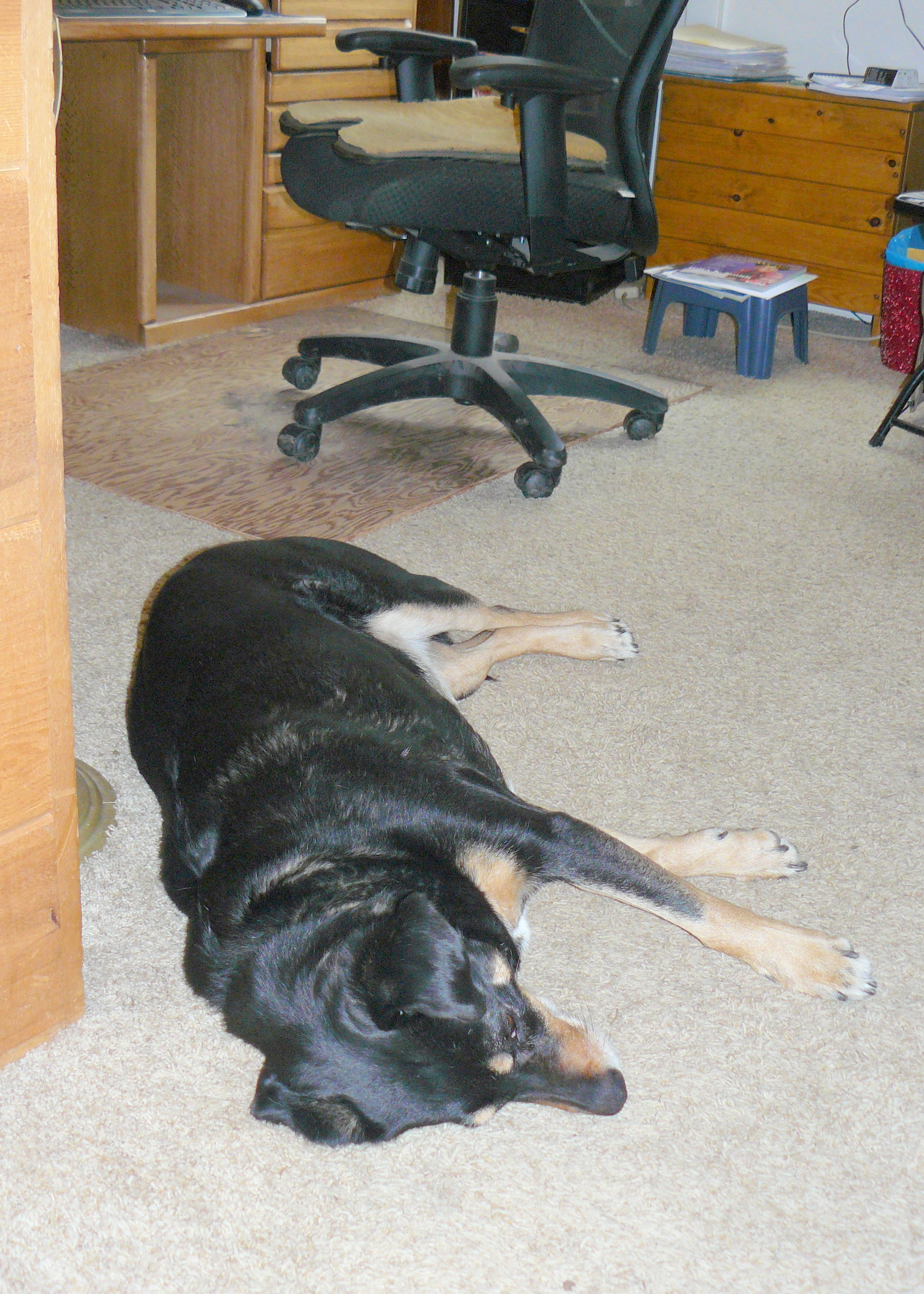
To underline my last sentence, on a whim I just took the following photograph of Hazel who very rarely isn’t by my side.

Picture taken at 10:35 yesterday morning in my 'home office' when I had finished writing today's post.
Picture taken at 10:35 yesterday morning in my ‘home office’ when I had just finished writing today’s post.

Dogs and wolves – fascinating research.

Something new to learn every day!

I have been saving this report for a few weeks.  Following yesterday’s great news about the latest concerning wolves in Oregon, today seemed a perfect follow-on with a report first published in online journal PLOS ONE. However, what follows is a full republication of the report as I read it on the Science Daily website.

ooOOoo

Teaching young wolves new tricks: Wolves are considerably better imitators than dogs

Date: January 31, 2014

Source: Veterinärmedizinische Universität Wien

Summary: Although wolves and dogs are closely related, they show some striking differences. Scientists have undertaken experiments that suggest that wolves observe one another more closely than dogs and so are better at learning from one another. The scientists believe that cooperation among wolves is the basis of the understanding between dogs and humans.

Wolves are considerably better imitators than dogs. Credit: Walter Vorbeck
Wolves are considerably better imitators than dogs.
Credit: Walter Vorbeck

Although wolves and dogs are closely related, they show some striking differences. Scientists from the Messerli Research Institute at the University of Veterinary Medicine, Vienna have undertaken experiments that suggest that wolves observe one another more closely than dogs and so are better at learning from one another. The scientists believe that cooperation among wolves is the basis of the understanding between dogs and humans.

Their findings have been published in the online journal PLOS ONE.

Wolves were domesticated more than 15,000 years ago and it is widely assumed that the ability of domestic dogs to form close relationships with humans stems from changes during the domestication process. But the effects of domestication on the interactions between the animals have not received much attention. The point has been addressed by Friederike Range and Zsófia Virányi, two members of the University of Veterinary Medicine, Vienna (Vetmeduni Vienna) who work at the Wolf Science Center (WSC) in Ernstbrunn, Niederösterreich.

Wolves copy other wolves solving problems

The scientists found that wolves are considerably better than dogs at opening a container, providing they have previously watched another animal do so. Their study involved 14 wolves and 15 mongrel dogs, all about six months old, hand-reared and kept in packs. Each animal was allowed to observe one of two situations in which a trained dog opened a wooden box, either with its mouth or with its paw, to gain access to a food reward. Surprisingly, all of the wolves managed to open the box after watching a dog solve the puzzle, while only four of the dogs managed to do so. Wolves more frequently opened the box using the method they had observed, whereas the dogs appeared to choose randomly whether to use their mouth or their paw.

Watch closely …

To exclude the possibility that six-month old dogs fail the experiment because of a delayed physical or cognitive development, the researchers repeated the test after nine months. The dogs proved no more adept at opening the box than they were at a younger age. Another possible explanation for the wolves’ apparent superiority at learning is that wolves might simply be better than dogs at solving such problems. To test this idea, the researchers examined the animals’ ability to open a box without prior demonstration by a dog. They found that the wolves were rarely successful. “Their problem-solving capability really seems to be based on the observation of a dog performing the task,” says Range. “The wolves watched the dog very closely and were able to apply their new knowledge to solve the problem. Their skill at copying probably relates to the fact that wolves are more dependent on cooperation with conspecifics than dogs are and therefore pay more attention to the actions of their partners.”

The researchers think that it is likely that the dog-human cooperation originated from cooperation between wolves. During the process of domestication, dogs have become able to accept humans as social partners and thus have adapted their social skills to include interactions with them, concomitantly losing the ability to learn by watching other dogs.

—-

Story Source: The above story is based on materials provided by Veterinärmedizinische Universität WienNote: Materials may be edited for content and length.

—-

Journal Reference:

  1. Friederike Range, Zsófia Virányi. Wolves Are Better Imitators of Conspecifics than DogsPLoS ONE, 2014; 9 (1): e86559 DOI: 10.1371/journal.pone.0086559

ooOOoo

So if you, like me, are one of many people who believe that your dog knows what you are thinking, then we need to thank the wolf!