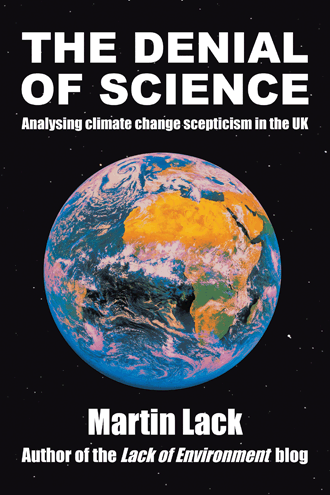
A review of the recently published book by Martin Lack.
In many ways it would be terribly easy to find fault with this book. If it had been written as a book, been through the edits that a new book requires, then published, those faults would be a significant criticism.
But it was not written as a book! It was originally written as an academic text. As Martin explains in the Preface:
This book is based on research originally undertaken – and a dissertation written – as part of my MA in Environmental Politics from Keele University in Staffordshire (in 2010-2011).
Then in the following paragraph goes on to say:
Academics generally disapprove of the publication of academic research via non-academic, non-peer-reviewed routes. However, I am trying to reach more than just an academic audience.
Three sentences later:
However, this book retains many of the features of a piece of academic research, …. (All quotes from page viii of the preface)
To a person unaccustomed to reading academic research, as is this reader, the structural and presentational differences between a ‘normal’ non-fiction book and a dissertation are significant. That needs to be borne in mind as you turn to page one.
OK, now that I have got that off my chest, on to the substance of the review.
Turning to the outside back cover, one sees Martin clearly explaining that the book is not about climate science, rather an analysis of why some people dispute “the reality, reliability and reasonableness of this science.”
That alone justifies the work that Martin put into his research and dissertation and his subsequent decision to adapt his findings into a book.
The pace and scale of the changes that are being visited on Planet Earth is truly frightening. The number of feedback loops that we are locked into now don’t even bear thinking about. Just take the continuing and accelerating loss of the Arctic ice-cap and extrapolate that for a couple of decades (touched on in my recent post More new tomorrowsand see footnote.)
We are not talking of subtle changes over many generations. We are talking about irreversible and irrevocably massive changes to our environment within the lifetimes of just about every living person on this planet. (I’m 70 next year and while I have no idea how many years I have left, I rate it as at least 50:50 that before I take my last breath, the coming destruction of biosphere will be blindingly obvious to me, Jean and 99.9% of the world’s population.)
Makes me want to shout out ……
There is not much time left to leave a sustainable world for future generations. Come on politicians and power-brokers; start acting as though you truly understand the urgency of the situation!
Ah, that feels much better!
Back to the book!
Martin examines 5 categories that display denial behaviours, to a greater or lesser extent. These categories are: Organisations; Scientists, Economists, Journalists and Politicians. Oh, and a 6th catch-all category: Others.
Each section dealing with a category is structured in the same way: Preliminary Research; Key Findings and Summary. Tables are used extensively to allow easy review of the findings.
Again, what needs to be hammered out is that this format is very unlike a typical non-fiction book. Because it’s fundamentally an academic dissertation! But, so what!
What is important is for the widest possible audience to understand the breadth and extent of the denial going on. Denial that is, literally, playing with the future of humanity on this planet; the only home we have.
Let me reinforce that last sentence by picking up on what Martin writes on his closing page (p.76):
Furthermore, there is strong circumstantial evidence to suggest that this scepticism is being fuelled by those with a vested interest in the continuance of “business as usual” by seeking to downplay, deny or dismiss the scientific consensus on the extent of ACD.
Martin Lack’s book may be unconventional in many ways. But as a tool to show how those who deny the science of climate change deny the right of future millions to live in a sustainable manner, it is most powerful. It is a valuable reference book that should be in every library and every secondary school across the globe!
The Denial of Science is published by AuthorHouse 02/23/2013
oooOOOooo
Footnotes:
To add weight to the points made in this review, do look in on tomorrow’s post.
I have no commercial links to Martin Lack; indeed, I purchased the copy of the book that I used for this review.
Sometimes one wonders what happened to common sense!
Today’s Post is motivated by a number of items that have crossed my screen over the last few days which when looked at collectively might remind one of the old saw, “You don’t have to be mad to work here, but it does help!”
Sit with me, metaphorically, and allow me to muse.
First was a recent Post on 350 or bust that included the March 2012 TED Conference in Long Beach, California where NASA climate scientist Dr. James Hansen explains why he must speak out about climate change. (See the video later on.) That Post refers to an item on Martin Lack’s Blog, Lack of Environment, where Martin as well as including the video below also lists the challenges that we on this single, finite planet face. Here is that list,
The Earth’s current energy imbalance is 0.6 Watts per sq.m.; a rate of energy input 20 times greater than the energy output of all human activity; and equivalent to the detonation of 400,000 Hiroshima-type atomic bombs every day.
Since measurements began in 2003, there has been a noticeable acceleration in the annual rate of mass loss from both the Greenland and Antarctica ice caps.
The last time atmospheric CO2 was 390 ppm, sea levels were 15 m higher than they are today, which implies even if we stopped burning all fossil fuels tomorrow, this is where they would end up several centuries from now because the warming “is already in the pipeline” (i.e. because the Earth must warm-up in order to restore its energy balance).
Unless we stop burning fossil fuels soon, sea level rise will continue to accelerate, which is likely to cause between 1 and 5 metre rise by 2100AD (depending on how quickly we now decide to stop burning them).
Palaeoclimatology tells us that 350 ppm is the safe limit for avoiding significant disruption to the planet’s ecological carrying capacity (i.e. in terms of both populations of individual species and overall biodivesity); and it now seems likely that between 20%-50% of all species will be “ticketed for extinction” by the end of the century.
If we had started to get off fossil fuels in 2005, it would have required 3% reduction per year in order to restore energy imbalance by 2100AD. If we start next year, it will require 6% p.a. If we wait 10 years it will require 15% p.a.
Recent droughts in Texas, Oklahoma and New Mexico were 3 Standard Deviations outside the norm. Events such as these cannot therefore be ascribed to natural variability; anthropogenic climate disruption (ACD) is happening just as Hansen said it would 24 years ago (if we did not change course – which we haven’t).
Pursuing emissions limits (i.e. Cap and Trade) will not work because there is no actual incentive to reduce emissions without any self-imposed restraint being to the advantage of others who do not do the same (i.e. the Tragedy of the Commons problem).
Hansen uses the analogy of an approaching asteroid – the longer we wait to prevent it hitting us the harder it becomes to do so.
Do watch that Hansen video,
Second is that yesterday Martin Lack published an item that really does seem to endorse the view that there is no sign of intelligent life living on Planet Earth (not counting dogs!).
Think about it. The planet is warming up. The use of carbon-based fuels is a strong suspect, putting it mildly, of the rising levels of CO2 in our atmosphere, 394.45 on April 5th, so rather than change the incentives for using such fuels, we are taking advantage of this warming planet causing the melt of the Arctic ice cap by allowing Shell to drill for oil in the Arctic. But even crazier than that, Shell have contracted for a Finnish icebreaker to assist them in breaking up the ice! (I really do feel a headache coming on!)
The pristine and beautiful Arctic: Shell wants to exploit it for oil. We want it protected.
Dozens of Greenpeace Nordic activists have boarded and occupied a Shell-contracted icebreaker in Helsinki harbour as it prepares to leave for the Alaskan Arctic.
Drilling in this fragile ecosystem – home to the polar bear, narwhal, Arctic fox and other iconic species – is unacceptable. A spill or accident in these waters would be disastrous and the harsh conditions would make responding to such a disaster almost impossible.
Demand Shell stop their plans to put the fragile Arctic and its biodiversity at risk. We’ll keep you updated on our campaigns.
Write to Mr. Peter Voser.
Mr Peter Voser, Shell
The Arctic isn’t a place you can exploit, it’s a place we have to protect. Time and time again, experts have expressed serious doubts about the possibility of cleaning up an oil spill in the Arctic. The technical challenges posed by drilling there are obvious and no matter how much you try to convince people that your company can operate safely in such a harsh environment, we know the truth.
Because of this, I demand that you scrap your Arctic plans immediately.
Yours sincerely,
————–
By the end of this week we want 500,000 people shouting at Shell that it must end its campaign of Arctic destruction. Click here now. [N.B. This is a time-sensitive campaign response – please visit Greenpeace website and enter your name and email address and they will email Shell on your behalf.]
We can change things! Together we can stop Shell and other oil companies from destroying the Arctic. Not everyone can board a ship to demand that change. But today, you can email Shell and ask them to stop drilling for oil and ask 10 of your friends to do the same. Together, we can save the Arctic!
Rosa Gierens
Greenpeace Nordic activist from Finland.
In closing, luckily there are many voices being raised about putting an end to this madness; see the recent item from Patrice Ayme. Hopefully, all these voices will bring about the changes to the way so many of us are governed. As Patrice commented recently on Learning from Dogs, “Hope is the breathing of the planet“. Maybe, just maybe, hope will win through. No better put than by James Hansen,
Most impressive is the work of the Citizens Climate Lobby, a relatively new, fastgrowing, nonpartisan, nonprofit group with 46 chapters across the United States and Canada. If you want to join the fight to save the planet, to save creation for your grandchildren, there is no more effective step you could take than becoming an active member of this group.”
– Dr. James Hansen, head of Goddard Institute for Space Studies, NASA
Oh, and before I forget, a tornado touched down in Southern France! Not common and not making sense!
At times it does seem as though we, as in mankind, are truly beyond help!
If you detect a note of frustration in the title of today’s Post and the sub-heading above, then you are not mistaken. It comes from a series of communications that have impinged upon my consciousness over the last twelve hours or so.
I’m going to take the liberty of reproducing it in full.
As the U.S. simmers through its hottest March on record — with more than 6,000 record-high temperatures already set this month — a new study released Sunday shows that average global temperatures could climb 2.5 to 5.4 degrees by 2050 if greenhouse-gas emissions continue unabated.
The study findings are based on the results of 10,000 computer model simulations of future weather overseen by researchers at Oxford University in the United Kingdom.
“These are the first results to suggest that the higher warming scenario could be plausible,” said study lead author Dan Rowlands of Oxford.
It is a faster rate of warming than most other models predict.
Most scientists say that increasing amounts of carbon dioxide in the atmosphere from the burning of fossil fuels such as oil, gas and coal are causing the planet to warm to levels that cannot be explained by natural variability.
The study was published online Sunday in the journal Nature Geoscience and backs up similar predictions from the Intergovernmental Panel on Climate Change in 2007.
The climate models used in the study accurately reproduced actual, observed temperature changes over the last 50 years. Assuming that models that simulate past warming realistically are the best candidates for future warming predictions, the authors conclude in the study that a warming of 2.5 to 5.4 degrees by 2050, compared with the 1960-90 average, is in the “likely range” of climate warming.
The Earth’s average temperature during the decade of 2000-10 was almost a full degree higher than the average from 1960-90, Rowlands said.
I don’t feel too bad at ‘borrowing’ the story above because I also subscribe to the UK’s Met Office News Blog and, guess what, in my ‘in-box’ this morning were two news stories from the Met Office. Let me take them in this order.
The first one I want to refer to here is this Citizen science looks at future warming uncertainty and includes the link to the Nature Geoscience magazine article that prompted the story in The Arizona Republic.
This is how it develops,
A project running almost 10,000 climate simulations on volunteers’ home computers has found that a global warming of 3 degrees Celsius by 2050 is ‘equally plausible’ as a rise of 1.4 degrees.
The study addresses some of the uncertainties that previous forecasts, using simpler models or only a few dozen simulations, may have over-looked.
Importantly, the forecast range is derived from using a complex Met Office model that accurately reproduces observed temperature changes over the last 50 years.
The results suggest that the world is very likely to cross the ’2 degrees barrier’ at some point this century if emissions continue unabated.
It also suggests that those planning for the impacts of climate change need to consider the possibility of warming of up to 3 degrees (above the 1961-1990 average) by 2050, even on a mid-range emission scenario. This is a faster rate of warming than most other models predict.
Just go and read that last paragraph again: “This is a faster rate of warming than most other models predict.”
Then the next item from the Met Office blog was this, Why is it so warm? It’s referring to the specific weather conditions in the UK at present:
The last few days have been unseasonably warm but why is this happening so early in the year? The answer lies largely in the air flow directly above the United Kingdom but more importantly where that air has come from.
Just a few paragraphs down we read, “we have seen a new record high for Scotland in March as the temperature reached 22.8 °C [73.04 °F] at Fyvie Castle in Aberdeenshire on Sunday 25 March.” So another temperature record!
I had a quick call with Martin Lack about an hour before starting this Post and he pointed me to the Australian website of CSIRO. There we find the latest State of the Climate report, from which we read,
The previous State of the Climate, released in March 2010 highlighted a multi-decadal warming trend over Australia’s land and oceans, an increase in record hot days and decrease in record cold days across the country, a decrease in rainfall in southwest and southeast Australia, an increase in global sea level, and increases in global greenhouse gas concentrations.
Do read the full report starting here. Or if you want a video to watch, then here it is:
Dr Karl Braganza from the Climate Monitoring Section of the Bureau of Meteorology discusses the State of the Climate in 2012.
Scientists from around the globe are meeting in London in March to discuss ‘solutions, at all scales, to move societies on to a sustainable pathway’. Planet Under Pressure 2012 is designed to bring together senior policymakers, industry leaders, NGOs, young scientists, the media, health specialists, and academics from many disciplines.
25 March 2012
Meeting to discuss ‘solutions, at all scales, to move societies on to a sustainable pathway’. Any rational thinking person on this planet if given a chance to reflect on the science knows we have to change our ways. And the means to do it are clear; we are not talking rocket-science here.
So when Martin Lack catches my attention with a recent piece entitled The seven woes of the Tea Party and I am linked to this article by Rick Santorum, I feel as though it must be me! This is what Mr. Santorum writes:
The Elephant in the Room: Challenging science dogma
As with evolution, the ‘consensus’ on climate change has become an ideology.
Questioning the scientific consensus in pursuit of the truth is an important part of how science has advanced through the centuries. But what happens when the scientific consensus becomes an ideology that trumps the pursuit of truth? Answer: Those making legitimate inquiries are ostracized, the careers of dissenters are destroyed, and debate is stifled.
Unfortunately, I am referring not only to the current proponents of the theory of man-made global warming.
With the penultimate paragraph reading thus,
Why? Well, maybe because Americans don’t like being told what to believe. Maybe because we have learned to be skeptical of “scientific” claims, particularly those at war with our common sense – like the Darwinists’ telling us for decades that we are just a slightly higher form of life than a bacterium that is here purely by chance, or the Environmental Protection Agency’s informing us last week that man-made carbon dioxide – a gas that humans exhale and plants need to live, a gas that represents less than 0.1 percent of the atmosphere – is a dangerous pollutant threatening to overheat the world.
Frankly, I am lost for words and probably best that I am! Lost because irrespective of political ‘left’ or ‘right’ the science of where this so-called intelligent species we call homo sapiens is heading, is beyond question. I use the phrase ‘beyond question’ not as a statement of fact but as a statement of truth. For science, as this non-scientist understands it, is about distinguishing the truth from ‘non-truth’.
Our beautiful companions for thousands of years truly do know better. That’s the truth you see in those eyes below.
The truth is always clear, Mr. Man. Just open your eyes!
All my life, well all the years that I have appreciated a ‘tea-break’, stopping for a cup of hot tea has been laden with symbolism. A chance to let the brain catch up with whatever one is doing. When working with others an opportunity to stand back and evaluate how the particular project is going. When sharing a project with a loved one, an opportunity to lay down memories for future years, and so forth. (Jean and I were building a chicken coop yesterday afternoon.) Sure there are millions of people that share these feelings.
Anyway, as many of you have been aware, the last 10 days or so on Learning from Dogs have been pretty ‘full-on’ in terms of man and Planet Earth. It started with me publishing on the 27th February a Post called Please help! – A plea to those who understand climate science so much better than I do!. Then on the 2nd March, I republished a Post from Patrice Ayme called The collapse of the biosphere.
That there were a total of 6,313 viewings of those Posts and 69 comments (OK, that doesn’t mean different individuals) was incredibly gratifying – a very big ‘thank you’ to all of you that read the Posts, and likewise to those that commented.
But one of the most wonderful aspects for me was the incredible sharing of ideas and resources. So the point of today’s Post is to bring all those links and contacts onto one ‘page’, so to speak.
Martin Lack was the first to point me in the direction of the book, Merchants of Doubt. There are a number of videos on YouTube but the one below is a good introduction to Naomi Oreskes.
On October 28, 2010 historian of science Naomi Oreskes gave a presentation at Forum Lectures (US Embassy Brussels), based on her new book, Merchants of Doubt: How a Handful of Scientists Obscured the Truth on Issues from Tobacco Smoke to Global Warming, about how right wing scientists founded the George Marshall Institute which has become a key hub for successfully spreading fear, uncertainty and doubt about climate change, along with other environmental issues, and how myths about science enable these political strategies to work.
An in-depth video of over an hour from the University of Rhode Island’s Spring 2010 Vetlesen Lecture Series, hugely worth watching, is here.
Then there is the powerful blog site, De Smog Blog. As the site explains, “The DeSmogBlog Project began in January 2006 and quickly became the world’s number one source for accurate, fact based information regarding global warming misinformation campaigns. TIME Magazine named DeSmogBlog in its “25 Best Blogs of 2011” list.”
Moving on. One of the challenges is knowing how to look up some reasonably reliable information about a person who is claiming this or that. That’s where SourceWatch is invaluable. The website describes itself, “The Center for Media and Democracy publishes SourceWatch, this collaborative resource for citizens and journalists looking for documented information about the corporations, industries, and people trying to influence public policy and public opinion. We believe in telling the truth about the most powerful interests in society—not just relating their self-serving press releases or letting real facts be bleached away by spin.”
Let me give you an example of how SourceWatch works. In my Post A skeptic’s view, Dan offered extensive comment about U.S. Senator James Inhofe’s book The Greatest Hoax. A quick search on SourceWatch revealed (a) (my emboldening)
Arthur B. Robinson is one of the three co-founders of the Oregon Institute of Science and Medicine, a group best known for organising a petition disputing the scientific evidence for human-induced global warming.
On January 7, 2009, the Willamette Week reported that Robinson is “in the vanguard of a small but vocal and persistent collection of scientists, industry advocates and commentators who dismiss human culpability for climate change. … Robinson’s critics say his analysis is simplistic, but it remains persuasive a decade later with powerful policymakers like U.S. Senator James Inhofe (R-Okla.), a visible and effective player in blocking a bill to limit greenhouse-gas emissions last fall.
James Mountain Inhofe, usually known as Jim Inhofe, has been a Republican Senator for Oklahoma since winning a special election in 1994.
Oil
James M. Inhofe has voted in favor of big oil companies on 100% of important oil-related bills from 2005-2007, according to Oil Change International. These bills include Iraq war funding, climate change studies, clean energy, and emissions.
On to another book. I forget who recommended the book by James Hansen, Storms of my Grandchildren but it’s another ‘must-read’ for all those wanting to better understand the risks that lay ahead. As the book’s website explains,
In Storms of My Grandchildren, Dr. James Hansen—the nation’s leading scientist on climate issues—speaks out for the first time with the full truth about global warming: The planet is hurtling even more rapidly than previously acknowledged to a climatic point of no return.
On that website there is a section Hansen On The Issues that includes this 2-minute YouTube video of Dr. Hansen talking about his book.
I can’t close without mentioning some other wonderful websites. There is Skeptical Science, described thus,
Explaining climate change science & rebutting global warming misinformation
Scientific skepticism is healthy. Scientists should always challenge themselves to improve their understanding. Yet this isn’t what happens with climate change denial. Skeptics vigorously criticise any evidence that supports man-made global warming and yet embrace any argument, op-ed, blog or study that refutes global warming. This website gets skeptical about global warming skepticism. Do their arguments have any scientific basis? What does the peer reviewed scientific literature say?
Then there’s ClimateSight, a wonderful effort by Kate, “Kate is a B.Sc. student and aspiring climatologist from the Canadian prairies. She started writing this blog when she was sixteen, simply to keep herself sane, but hopes that she’ll be able to spread accurate information about climate change far and wide while she does so.” Kate’s interest and passion in the subject is unmissable and it’s a real pleasure to subscribe to her postings.
Bill McKibben’s famous site, 350.org, is a must for the thousands of people that are working for a better future. As the mission statement opens up,
350.org is building a global grassroots movement to solve the climate crisis. Our online campaigns, grassroots organizing, and mass public actions are led from the bottom up by thousands of volunteer organizers in over 188 countries.
350 means climate safety. To preserve our planet, scientists tell us we must reduce the amount of CO2 in the atmosphere from its current level of 392 parts per million to below 350 ppm. But 350 is more than a number—it’s a symbol of where we need to head as a planet.
350.org works hard to organize in a new way—everywhere at once, using online tools to facilitate strategic offline action. We want to be a laboratory for the best ways to strengthen the climate movement and catalyze transformation around the world.
RealClimate is a commentary site on climate science by working climate scientists for the interested public and journalists. We aim to provide a quick response to developing stories and provide the context sometimes missing in mainstream commentary. The discussion here is restricted to scientific topics and will not get involved in any political or economic implications of the science. All posts are signed by the author(s), except ‘group’ posts which are collective efforts from the whole team. This is a moderated forum.
There are so many more fabulous sources of real caring about the society we are and, more importantly, the society we hope to be. In this category comes Wibble. Then there’s Dogs of Doubt, that I shall be referring to tomorrow on Learning from Dogs, and The Green Word and so on and so on. It shows the power of ‘hands across the ether’ that the modern world of web sites now offers. I put great faith in this power becoming the power of truth and the power of change. (If you have a blog or a website that resonates with the ones mentioned here, please do drop me an email giving me details.)
Finally, I’m closing with this. If it all sometimes feels too much for you and you want to drift away into the world of the inner consciousness, into the world of dreamtime, then you can do no worse than to call by Sue Dreamwalker‘s wonderful website. Try this, for example. Dan and I had no idea what we were getting into. 😉
Towards the end of the lecture that Lord Martin Rees gave at University of Melbourne’s Medical School in 2010, he spoke of the way that Planet Earth has warmed up these last 100 years, warmed up uniquely. Why the word ‘uniquely’? Because, for the first time in the ancient life of our planet, that warming is the result of the activity of a life species living on that planet; mankind. It’s difficult to comprehend how special, how fragile and, therefore, how vulnerable is mankind’s ability to survive on Planet Earth. That’s why a recent item on Martin Lack’s excellent blogsite Lack of Environment is published on Learning from Dogs with Martin’s kind permission. But first let me quote a little from WikiPedia about the ‘goldilocks principle’,
In astronomy and astrobiology, the habitable zone is the region around a star where a planet with sufficient atmospheric pressure can maintain liquid water on its surface.[1]1 Since liquid water is essential for all known forms of life, planets in this zone are considered the most promising sites to host extraterrestrial life. The terms “ecosphere” and “Liquid Water Belt” were introduced by Hubertus Strughold and Harlow Shapley respectively in 1953.[2] Contemporary alternatives include “HZ”, “life zone”, and “Goldilocks Zone.”[3]
“Habitable zone” is sometimes used more generally to denote various regions that are considered favorable to life in some way. One prominent example is the Galactic habitable zone’ (the distance from the galactic centre). Such concepts areinferred from the empirical study of conditions favorable for life on Earth. If different kinds of habitable zones are considered, their intersection is the region considered most likely to contain life.
The location of planets and natural satellites (moons) within its parent’s star’s habitable zone (and a near circular orbit) is but one of many criteria for planetary habitability and it is theoretically possible for habitable planets to exist outside the habitable zone. The term “Goldilocks planet” is used for any planet that is located within the CHZ[4][5] although when used in the context of planetary habitability the term implies terrestrial planets with conditions roughly comparable to those of the Earth(i.e. an Earth analog). The name originates from the story of Goldilocks and the Three Bears, in which a little girl chooses from sets of three items, ignoring the ones that are too extreme (large or small, hot or cold, etc.), and settling on the one in the middle, which is “just right”. Likewise, a planet following this Goldilocks Principle is one that is neither too close nor too far from a star to rule out liquid water on its surface. While only about a dozen planets have been confirmed in the habitable zone, the Kepler spacecraft has identified a further 54 candidates and current estimates indicate that there are “at least 500 million” such planets in the Milky Way.[6]
Is it time to say goodbye to the Goldilocks Planet?
I hope not, because the next-nearest one yet discovered is 600 light years away! However, if we are indeed now passing a tipping point (i.e. as the widespread rapid thawing of Siberian permafrost suggests) both mitigation and adaptation will be almost impossible. Therefore, if we cannot reverse the damage already done (i.e. how can we make permafrost re-freeze or reverse the retreat of mountain glaciers?), we may have to accept that temperatures will eventually rise to a level at which the Antarctic first became glaciated 35 million years ago; and that sea levels will now rise continuously for several centuries – making any permanent settlement anywhere near the coast impossible (seeJames Hansen in Storms of my Grandchildren).
If your response to all this is to accuse me of being alarmist, all I can say is that I am afraid denial is definitely not a good evolutionary survival mechanism. Furthermore, as American high school science teacher – and now climate change activist – Greg Craven has said,“Unfortunately, the experiment is already running; and we are all in the test-tube!” I believe we must therefore hope that humanity will not repeat the folly of the former inhabitants of Easter Island; who chopped down all their trees for firewood and allowed all the decent soil to be washed away so they could not grow anything.
I think it is fair to say that 2011 was a difficult year for humanity and the planet; and 2012 could be worse. We now seem to be facing both a financial and an environmental crisis: Even at the tender age of 46, I can appreciate that the prospect of 6 years of austerity measures (here in the UK) is completely without precedent; worse even than the great depression of the 1920s. In the UK, public sector workers have been demanding a better pension! What about a better economic system, or even a better planet? If necessary, please forgive my impertinence but, how can people demand justice for themselves whilst ignoring all the injustices we are inflicting on those least able to adapt; and/or bequeathing to our descendants?
This is almost as pessimistic as my recent answer on ClimateSight to the question “Why are people who want to reduce – and possibly eliminate pollution – and create a safer world, considered obstructionist naysayers?“, which is… “If everyone lived as we do in ‘the West’, the planet’s ecological carrying capacity would only be about 3 billion [Paul and Anne Ehrlich (1996)]. Therefore we cannot solve poverty without allowing a lot of people to die or by wealthy people agreeing to moderate their over-consumption of the Earth’s resources. Sorry to be so blunt but, this is the simple answer to the question.” …Despite what detractors say this is not misanthropic eco-Socialism, it is reality. There is not enough decent farmland and/or resources of every kind for 7 billion people or more to live like we currently do in ‘the West’. If we are not going to deny the legitimate aspirations of poorer peoples to attain a better standard of living, we will have to moderate our over-consumption and/or pollution of the Earth’s resources. We cannot have it both ways.
Conclusion
If we continue to burn all the Earth’s fossil fuels – just because they are there and because we can – we will most certainly have to say good bye to our Goldilocks Planet. However, now that we know that what we are doing is causing the problem, would it not be a good idea to stop doing it? You know: When in a hole, stop digging, etc… As the Good Book says, “As a dog returns to its vomit, so a fool repeats his folly” (Proverbs 26:11).
Suggested New Year’s Resolution:
If we want things to change, I believe we must acknowledge that Clive Hamilton is right: climate change is a failure of modern politics – representative democracy is not working! Therefore, we must all take a much more active role in the process of government – this is called participatory democracy – and we must start by demanding that our politicians dismantle (or at least stop being misled by) the fossil fuel lobby who do not want their business as usual programme interrupted.
Having said all that, I would still like to sincerely wish you all the best for 2012 (although I hope the Mayan Calendar is wrong).
A timely video from the International Space Station (ISS)
Little did I realise when I posted yesterday’s item that a couple of subsequent actions would make today’s article easy to write (trust me it isn’t always this easy!).
Mike T., a flying buddy from my old days in England, sent me this link to a 5-minute video made up of a series of films shot from the ISS. DO WATCH THE VIDEO IN FULL SCREEN MODE!
The details of how the film was taken and much more interesting information is at the very end of this article.
Then Martin Lack who writes the blog, Lack of Environment, submitted a comment with a link to a piece that he had written on the 19th August that I would like to re-publish in full.
Why are we still waiting for the EU to act?
What can we learn from the fact that the EU has still not stopped buying over 90% of Syria’s oil exports? If nothing else, it tells me that we need fossil fuel too much!
But I think the problem of wrong priorities goes much deeper than that… This is because the Limits to Growth argument (which underlies my concern over AGW) is, even though the protestor-in-the-street may not realise it, the root cause of all the problems we are now seeing in Afghanistan, Bahrain, Cairo, Damascus etc., etc… right through to Zimbabwe: Treating the symptoms of food shortages or corruption (or whatever they may be) will not succeed unless we address the root cause, which is the inevitable consequences of perpetual growth in consumption of resources and/or waste production on a finite planet [see E.F. Schumacher’s Small is Beautiful (1973)].
This 5 minute videomakes sobering viewing, but it also perfectly summarises everything I have learnt in the last 12 months; and all I have posted on my oldMyTelegraph blog in the last 5 months!
It may not be rocket science, but can we reach Escape Velocity?
This stuff is not rocket science, but it is very unwelcome news to people with a vested interest in the continuance of “business as usual”. Unfortunately, we literally cannot go on the way we are; something has got to change…
Extract of paper presented by Dr Myles Allen at 4 Degrees and Beyond Conference (2009)
So a big thank you to Mike T. and Martin Lack for a number of lessons:
how clever man is in terms of space technology besides much more
the beauty of our planet – it’s all we have to live on
the amount of electric light that shines into outer space, as seen by the ISS.
how much of that lighting might be generated by coal and oil!
if we don’t learn to live in harmony, as in sustainably, with this planet of ours, the implications are going to be very serious.
Finally, as mentioned earlier the details of that video on Vimeo.
Time lapse sequences of photographs taken with a 4K-camera by Ron Garan fragileoasis.org/bloggernauts/Astro_Ron and the crew of expedition 28 & 29 onboard the International Space Station from August to October, 2011. All credit goes to them, who to my knowledge shot these pictures at an altitude of around 350 km. I intend to upload a FullHD-version presently.
HD, refurbished, smoothed, retimed, denoised, deflickered, cut, etc. All in all I tried to keep the looks of the material as original as possible, avoided adjusting the colors and the like, since in my opinion the original footage itself already has an almost surreal and aestethical visual nature.
Music: Jan Jelinek | Do Dekor, faitiche back2001 w+p by Jan Jelinek, published by Betke Edition janjelinek.com | faitiche.de
Image Courtesy of the Image Science & Analysis Laboratory, NASA Johnson Space Center, The Gateway to Astronaut Photography of Earth eol.jsc.nasa.gov
1. Aurora Borealis Pass over the United States at Night
2. Aurora Borealis and eastern United States at Night
3. Aurora Australis from Madagascar to southwest of Australia
4. Aurora Australis south of Australia
5. Northwest coast of United States to Central South America at Night
6. Aurora Australis from the Southern to the Northern Pacific Ocean
7. Halfway around the World
8. Night Pass over Central Africa and the Middle East
9. Evening Pass over the Sahara Desert and the Middle East
10. Pass over Canada and Central United States at Night
11. Pass over Southern California to Hudson Bay
12. Islands in the Philippine Sea at Night
13. Pass over Eastern Asia to Philippine Sea and Guam
14. Views of the Mideast at Night
15. Night Pass over Mediterranean Sea
16. Aurora Borealis and the United States at Night
17. Aurora Australis over Indian Ocean
18. Eastern Europe to Southeastern Asia at Night
Three guest posts from Martin Lack of Lack of Environment, today Part Two
As previously mentioned, Martin came to the attention of Learning from Dogs when making a comment to the second part of my Sceptical Voices essay. This is the second part of an essay that Martin wrote that is worthy of deep consideration. Part One can be read here; the concluding Part Three next Monday, the 10th.
————————-
Can modernisation be “ecological”? – Part 2
What is the problem with Modernity?
The problem is that the accumulation of personal wealth has become the sole objective of many people in modern society; and perpetual growth is posited as a means whereby even the poorest might achieve it. However, the New International Version of the Bible records the Apostle Paul as having written, “For the love of money is a root of all kinds of evil…” (1 Timothy 6:10); and economists and politicians have argued about this for centuries…
According to Jon Elster, it was Karl Marx that coined the term ‘money fetishism’ to describe the belief that money (and/or precious metals) have intrinsic (use) value rather than just instrumental (exchange) value, which Marx felt was as misguided as the religious practice of endowing inanimate objects with supernatural powers (Elster 1986: 56-7). However, the terms use value and exchange value were first put forward by Aristotle (384-322 BC) who, according to Daly, also recognised the danger of focusing on the latter (i.e. whereby the accumulation of wealth becomes an end in itself). Therefore, Daly suggests that the paperless economy (where no useable commodities actually change hands) is the ultimate destiny for money fetishism (Daly 1992: 186).
In 1987, the World Commission on the Environment and Development (WCED) was clearly keen to try and settle an argument and, therefore, made the following quite astonishing assertion: “Growth has no set limits in terms of population or resource use beyond which lies ecological disaster” (Brundtland et al 1987: 45). Instead, WCED gave us the much-touted – but ill-defined – concept of sustainable development (SD). However, in stark contrast to the WCED report, Carter much more recently observed that SD “…will require a fundamental transformation in attitudes to economic growth, consumption, production and work” (Carter 2007: 48). This appears to be a subtle acknowledgement of the legitimacy of Herman Daly’s insistence of the need for a move to a steady-state economy; precisely because infinite growth is impossible in a closed system.
A basic tenet of Daly’s thesis is that economic activity does not take place in a vacuum and that economic – not just ecological – collapse awaits us unless we recognise the limited capacity of the ecosystem within which we operate: “Of all the fields of study, economics is the last one that should seek to be ‘value-free’, lest it deserve Oscar Wilde’s remark that an economist ‘is a man that knows the price of everything and the value of nothing.’” (Daly 1992: 4).
On 22 December 2010, the BBC broadcast a Panorama programme entitled “What Price Cheap Food” containing the startling revelation that, in the two years between 1 November 2008 and 1 November 2010, town planners approved applications for at least 577 new supermarkets across the UK. The programme also revealed that so-called “mega farms” (i.e. factory farming of cows and pigs – “dairy-go-rounds” and “sty scrappers” respectively) will be the next ‘big idea’ imported from the USA. The potential mega farm operators argue that there is significant scope for recycling and energy from waste schemes to be incorporated, although environmentalists would question (1) the wisdom of concentrating potentially polluting activities; and (2) the ethics of factory farming (which undoubtedly goes against the grain of green consumerism). However, although the potential for economies of scale cannot be denied, this could all be seen as symptomatic of what Daly called “growthmania“.
Growthmania versus Limits to Growth
One of the world’s most famous deniers of Limits to Growth arguments is Julian Simon, who once famously won a bet with Paul Ehrlich that the price of any commodity would reduce with the passage of time. Nevertheless, how can anyone deny that the Earth’s resource base or its capacity to accommodate human beings is anything other than limited? Quite easily, apparently: In 1994, Simon claimed that “humanity now has the ability (or knowledge) to make it possible to feed, clothe, and supply energy to an ever-growing population for the next 7 billion years.”
However, the stupidity of such a dangerously fallacious argument was exposed 2 years later by Paul and Anna Ehrlich, who pointed out that at 1994 growth rates, “it would take only 774 years for the 1994 population of 5.6 billion to increase to the point where there were 10 human beings for each square meter of ice-free land on the planet!” Furthermore, they pointed out that if growth did not decline from 1994 levels, it would take only 1900 years for the mass of the human population to equal the mass of the Earth! (Ehrlich and Ehrlich 1996: 66).
Fortunately, the UN now believes (May 2011) that the human population on this planet will probably stabilise by the end of the current Century at somewhere between 10 and 15 billion. The only trouble with that is that, we may well have already exceeded the ecological carrying capacity of the planet, and are therefore causing extreme stress to the global ecosystem; of which the most obvious symptom is AGW.
—————-
References:
Daly, H. (1992), Steady State Economics (2nd ed), London: Earthscan.
Elster, J. (1986), An Introduction to Karl Marx, Cambridge: Cambridge University Press.
Ehrlich, P. and Ehrlich, A. (1996), Betrayal of Science and Reason, New York: Island Press.
Three guest posts from Martin Lack of Lack of Environment, today Part One
Martin came to the attention of Learning from Dogs when making a comment to the second part of my Sceptical Voices essay. Since then, he and I have exchanged a number of emails. Over the next few days, I would like to re-publish an essay that Martin wrote that is worthy of deep consideration. Here is Part One. Part Two will be on Friday and Part Three next Monday, the 10th.
————————-
Can modernisation be “ecological”? – Part 1
This is the first of a series of posts based on an essay with this title that I wrote earlier this year as part of the requirements for my MA in Environmental Politics.
Introduction
There are two possible ways of understanding the question; as to require a critique ofEcological Modernisation (EM) as a school of environmental thought or perhaps, far more demandingly, a critique of modernity itself. Although the main intention of this essay is to do the latter; it will inevitably do the former as well.
Definitions
In order to answer this question, it is essential to define what is meant by ‘ecological’; ‘modernisation’; and the theory of EM to which it has given rise:
– In the context of the question, ‘ecological’ is taken to mean thinking, behaviour, and policy that are ‘environmentally-friendly’; rather than merely or predominantly anthropocentric (i.e. concerned with human needs and interests).
– To understand what is implied by the term ‘modernisation’, it is necessary to define what is meant by the word ‘modernity’ because people often conflate the term with industrialisation or even capitalism. However, whereas both of the latter were forged in the industrial revolution of the late eighteenth and early nineteenth century, modernity has its roots in the scientific revolution of “the Enlightenment” in the eighteenth century.
– The theory – if not the practice – of EM emerged from Germany in the early 1980s. Whereas the social scientists Joseph Huber and Martin Jänicke are most-commonly credited with having originated the term, it is probably Arthur Mol that brought it to the attention of the English-speaking world in 1996, when he quoted Huber as having (somewhat enigmatically) said, ‘…all ways out of the environmental crisis lead us further into modernity.’ Thankfully, Mol then went on to explain that EM theory therefore seeks to repair “…a structural design fault of modernity: the institutionalised destruction of nature.” (Mol 1996: 305).
In addition to the above, it is important to differentiate the terms ‘modernity’ and ‘civilisation’: Civilisation pre-dates the Enlightenment by several millennia; and is often equated with the development of agriculture, settled communities, and cities. However, since past civilisations have come and gone, is there any reason to think that our modern civilisation will be any different? This should not be seen as the question of a wannabe anarchist; as it is merely an acknowledgement of human history.
According to John Dryzek, the rhetoric of the EM discourse is reassuringly optimistic; and would have us believe that we can retain a healthy environment without having to sacrifice the benefits of progress (Dryzek 2005: 171). More recently, echoing both Mol and Dryzek, Neil Carter has defined EM as a “…policy strategy that aims to restructure capitalist political economy along more environmentally benign lines based on the assumption that economic growth and environmental protection can be reconciled.” (Carter 2007: 7).
It is in this context that Carter used the term “decoupling” to refer the idea of breaking any direct causal link between economic growth and environmental degradation; but also suggested that “dematerialisation” of manufacturing processes (i.e. the reduction of environmental resources consumed per unit of production) would be essential (2007: 227). However, if we take the manufacturing of motor cars as an example, the rate of fossil fuel consumption will always accelerate unless the percentage increases engine fuel efficiency is greater than the percentage increases in the number of cars. Therefore, since the former must exponentially decline towards zero, the logical conclusion is that we must control the demand for the latter.
—————
References:
Carter, N. (2007), The Politics of the Environment (2nd ed), Cambridge: Cambridge University Press.
Dryzek, J. (2005), The Politics of the Earth (2nd ed), Oxford: Oxford University Press.
Mol, A. (1996), ‘Ecological Modernisation and Institutional Reflexivity: Environmental Reform in the Late Modern Age’, Environmental Politics, 5(2), pp.302-23.





 Learning from Dogs