Three years ago today.
I was working outside until late afternoon and didn’t leave myself sufficient time for a new post for today. So, as I do on these occasions, I pick one from previous times. Like Meet Molly from this day three years ago.
ooOOoo
A most heart-warming story! Beats the heck out of murders, politics and terrorists!
This was sent in by John Hurlburt for Jean who has been a bit of a ‘horse lady’ in her times and is devoted to the two miniature horses we have here in Oregon.
oooOOOooo
Meet Molly
 Molly is a gray speckled pony who was abandoned by her owners when Hurricane Katrina hit southern Louisiana . She spent weeks on her own before finally being rescued and taken to a farm where abandoned animals were stockpiled. While there, she was attacked by a dog and almost died. Her gnawed right front leg became infected and her vet went to Louisiana State University (LSU) for help.
However, LSU were overwhelmed and Molly became a ‘welfare’ case. You know where that goes, don’t you!
Then surgeon Rustin Moore met Molly and changed his mind. He saw how Molly was careful to lie down on different sides so she didn’t seem to get sores. He saw how Molly allowed people to handle her. She protected her injured leg. She constantly shifted her weight and didn’t overload her good leg. She was a smart pony with a serious survival ethic.
Surgeon Moore agreed to remove her leg below the knee and a temporary artificial limb was built. Molly walked out of the clinic and, in a very real sense, that’s where her story really begins.
“This was the right horse and the right owner!” Moore insisted.
Molly happened to be a one-in-a-million patient. She’s tough as nails, but sweet, and she was willing to cope with pain. She made it obvious she understood that she was in trouble. The other important factor, according to Moore , is having a truly committed and compliant owner who is dedicated to providing the daily care required over the lifetime of the horse.
Molly’s story turns into a parable for life in Post-Katrina Louisiana. The little pony gained weight and her mane finally felt a comb. Then, amazingly, a prosthesis designer built her a leg.
The prosthetic has given Molly a whole new life, Allison Barca DVM, Molly’s regular vet, reports:
And she asks for it. She will put her little limb out and come to you and let you know that she wants you to put it on. Sometimes she wants you to take it off too. And sometimes, Molly gets away from Barca. “It can be pretty bad when you can’t catch a three-legged horse,” she laughs.
Most important of all, Molly has a job now. Kay, the rescue farm owner, started taking Molly to shelters, hospitals, nursing homes, and rehabilitation centers. Anywhere she thought that people needed hope. Wherever Molly went, she showed people her pluck. She inspired people, and she had a good time doing it.
“It’s obvious to me that Molly had a bigger role to play in life,” Kay said. “She survived the hurricane, she survived a horrible injury, and now she is giving hope to others.”
Allison Barca concluded, “She’s not back to normal, but she’s going to be better. To me, she could be a symbol for New Orleans itself.”

Wherever Molly goes, she leaves a smiley hoof print behind. Literally as well as metaphorically.
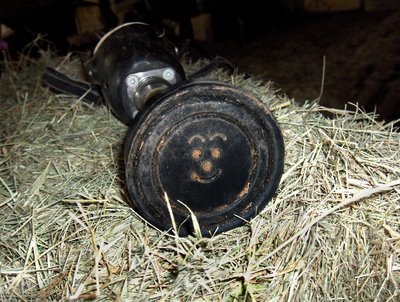
Leave you with that wonderful feeling of love for Molly? Feel free to share it with all the animal lovers that you know.
ooOOoo
See you tomorrow!

 Learning from Dogs