The voice of science
This summer has seen nature visiting on man a series of catastrophes. To name just a few, we have the record-breaking rainfall in Britain in June, the Colorado wildfires and the 1,400,000 storm-struck households in the eastern US.
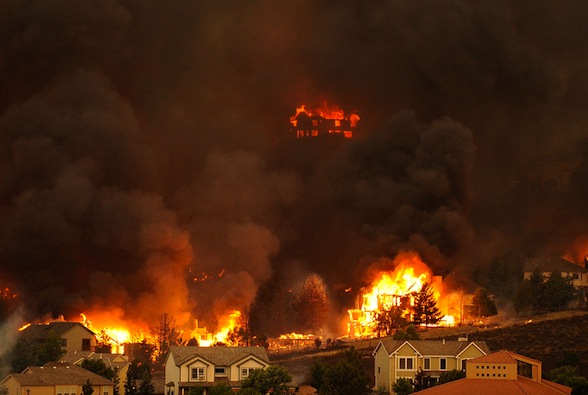
Inevitably, many wonder if this is connected to climate change as a result of mankind’s behaviours. Many now believe so.
But we have to stand on the rock of science.
So it was great to come across a recent article on Grist that led me to this organisation, Climate Communication. As they say on the About Us page,
Climate Communication is a non-profit science and outreach project funded by the Rockefeller Brothers Fund and the ClimateWorks Foundation. Climate Communication operates as a project of the Aspen Global Change Institute, a non-profit organization dedicated to furthering the scientific understanding of Earth systems and global environmental change.
The article on Grist that had caught my eye was this one, Did climate change ’cause’ the Colorado wildfires? and within that article there was the link to Climate Communication, viz: That much we know with a high degree of confidence, as this excellent review of the latest science by Climate Communication makes clear.
That review on Climate Communication includes the following video,
Not convinced?
Then try this evidence from an interview with Kevin Trenberth of the National Center for Atmospheric Research shown on PBS Newshour,
Want more? Go for it!
The PBS video came from the British Guardian newspaper (link thanks to Naked Capitalism). The Guardian reported,
Is it now possible to blame extreme weather on global warming?
Wildfires, heatwaves and storms witnessed in the US are ‘what global warming looks like’, say climate scientists
Posted by Leo Hickman
Tuesday 3 July 2012Whenever an episode of extreme weather – heatwave, flood, drought, etc – hits the headlines, someone somewhere is sure to point the finger of blame at human-induced climate change.
Such claims are normally slapped down with the much-aired mantra: “You cannot blame a single episode of bad weather on global warming.” But with the on-going record high temperatures affecting large parts of the US, there seems to be a noticeable reduction in such caveats and notes of caution.
This week, scientists have been queuing up, it seems, to explain how the wildfires in Colorado, the heatwave across the eastern seaboard, and the “super derecho” are all indicative of “what global warming looks like“. Most pulled back, though, from directly blaming global warming for such weather events.
“In the future you would expect larger, longer more intense heat waves and we’ve seen that in the last few summers,” Derek Arndt of NOAA Climate Monitoring told the Associated Press.” The same report added: “At least 15 climate scientists told the Associated Press that this long hot US summer is consistent with what is to be expected in global warming.”
So, can we now say, or not, that specific extreme weather events are caused, or at least exacerbated, by global warming? Has anything changed in climate scientists’ understanding of the attribution – or “anthropogenic fingerprint” – of such events? Are they now more confident about making such links?
I put this question to a number of climate scientists ….
Leo Hickman then reports the assessments of eight leading scientists. Go and read their words here. If you can do it now!
The science is solid!
So as you watch these scientists talking about the meaning of climate extremes think what you can do today to reduce your own impact on this planet. Just as importantly, think how you can influence those around you and those that represent you that now is the time to wake up to the fact that nature is telling us to slow down!
As I said in a comment to a post on Tuesday,
The growth in awareness of what we are doing to the planet is astounding. There is hope, we have to promote hope and we have to acknowledge that hope is a powerful agent of change.
 Learning from Dogs