Tag: Learning

We may need a new term for Fed “Profits”

It’s more than semantics to understand what we mean by The Fed’s profits.

The Federal Reserve, it has been reported, earned record “profits” of over $46 billion in the year ending December 31, 2009.  The previous record profit was $34.6 billion in 2007. The Fed earned $31.7 billion in 2008. The financial crisis has apparently been very good for the Fed, although, as a non-profit entity, all its profits are turned over to the Treasury.  As an aside, I wonder what the Treasury plans to do with its windfall?Reduce taxes? Hmmm.

Be careful, however.  “Profits” are a bit of a misnomer for the Fed’s activities, because they pay for what they do by creating money out of thin air.  To buy a financial instrument such a treasury bill or mortgage-backed security, which is added to the left-hand-side of their balance sheet as an asset valued at cost, they create (and I do mean “create,” in the true sense of the word) an equivalent amount of deposits on the right-hand-side of their balance sheet. It does not “cost” them resources as it would you, or me, or a business.  The “expense” is deducts from revenues to arrive at this period’s profits consist mainly of employee salaries.  Fed BS Dec 2009

So if the Fed purchased a bunch of assets with reserves that they created, where do the “profits” come from?  Keep in mind, there are two major drivers of profits.  One is efficiency, or doing more with your resources. The second is pricing power, being able to charge an above-competitive price for a good or service either because you own something scarce or you make up the rules of the game.

First, two minor sources of income to the Fed are the interest and fees it charges for operating the financial system, such as check clearing and interbank electronic payments, and those it charged participants in the emergency loan programs it undertook to support credit cards and auto loans.

By far the largest source of revenue to the fed, however, came from its open market operations and the purchase of toxic assets.  The Fed had about $1.8 trillion in U.S. government debt and mortgage-related securities on its books by the end of 2009, four times the level in 2008, and the interest payments it collected on this huge pile of assets generated much of their (so-called) profits.  But interest payments are only one source of returns on financial assets. The other is “capital gains” or “price appreciation.”  If and when the Fed sells these assets, some of them considered “toxic,” there is a real risk that they will incur significant capital losses.   For example, the central bank recorded a $3.8 billion decline in the value of loans it made in bailing out Bear Stearns and AIG.

So the Fed’s profits are this period’s interest income minus the Fed’s minimal operating expenses; the capital base on which it earns income is basically “free.”  And all of these figures focus on one-period accounting entries, ignoring the huge potential negative stock of value the Fed’s activities are generating.

Don’t misunderstand. The Fed provides an invaluable service to the national and world economies, and they generally execute those services very well.  But when they begin to try to act like a business, replacing existing investment banking with their own activities, and parade around profit figures as if they meant the same thing as private industry profits, we must step back and take a moment to understand that Fed profits mean something entirely different from corporate profits.

By Sherry Jarrell

Dad, what job am I going to do?

Approaching that big boundary between learning and earning.

It seems like only yesterday that my first daughter Natalie was born.  Now Natalie is approaching 17, going to college and will soon be learning to drive. She did very well in her GCSE [UK exams taken around the age of 16. Ed] exams, but at the moment has no real idea of what she wants to do.

Perhaps not what you would expect her Dad to say but I think that is great.  Because she can continue with a broad based approach to learning and from this she will eventually channel her interests and knowledge in a particular direction.

For A levels [University entrance exams taken around the age of 18. Ed] she is taking French, Psychology, Law, and Textiles!

Clearly for a young person another language enhances the ability to communicate with the wider world.  Psychology is an interesting and a useful insight into fellow humans.  Law will help to make her aware of what she will be expected to deal with but textiles, that was an initial puzzle to me.

The college were very unhappy about Natalie taking up textiles because she had not done art at school but, to be honest, that was because the school, at the time, had put pressure on her to drop art in favour of another subject that fitted into the weekly program of lessons.

But in just three months Natalie has shown great flair for textiles and I am amazed by the work she has produced. However, when I called her this evening from abroad (I’m currently in the Middle East), she was feeling very unsure because her form master has been putting pressure on her to decide what she wants to do when she leaves college.

If you are lucky enough to know your career path then life is easy but actually I am pleased that my daughter is building her knowledge in an open way. I only ask that she does her best.

Exam results might seem important on the day of announcement, and they may well be of serious consideration when applying for jobs in competition with other applicants, but who is the person?

Social awareness is hugely important, and trying different jobs earning money in the school holidays has given her an insight into various ways that people earn their living.

My suggestion is for her to not even worry about exams.  Just enjoy the information she is learning.  In France last year she was chatting away to locals in French, and laughing, because the level of understanding was already there.

Take the pressure off ! Make learning fun. Take the subjects you want. Enjoy education. There is greater variety with regard to work these days.  Natalie will not end up in an office as she fears. Her general level of education and happy disposition will guide her to something different.

It is difficult to try an explain all this, but success in adult life is not a multitude of qualifications and lots of money, it is a balance of finding something that is of interest, pays a suitable wage, and makes you happy.

When I was at school nobody suggested making stained glass windows, or restoring paintings, or moving to Greece and working with different textiles but many things are possible now.

I only hope that she will trust herself, and then when she finally discovers something she really likes, she will be happy.

By Bob Derham

Time Flies!

Family echoes.

Today is my 54th birthday.  I am now the age that my mother was when she died, on January 8th, 1985.  I knew then that she died too young, that she had so much more living to do.

Two weeks before her death, I visited her in the convalescent hospital where she had been for months.  She was going home!  The doctors had given her a clean bill of health.   She ordered a new skirt to celebrate and had it shipped to her home.  We got out maps of London and made plans to take a trip there together, as adults, as friends, the following summer.  I went back to school, happy to have had such a nice visit, happy she would soon be going home.

About ten days later, on January 5th, 1985, I got a call from my brother, telling me that mother had septic shock, that she might not make it, and that I needed to get there, fast.  I bought a one-way ticket and packed a dark suit.   She was still alert when I finally arrived.  The nurses remembered me, and let me stay with her, even when visiting hours were over.  I got to talk to her, and ask her what she wanted me to do for her, what she wanted the doctors to do for her, what measures she wanted taken.  She wanted to live.  She was getting weak, working to breath, waiting for the antibiotics to work. Or not. The doctors recommended a ventilator, to help her conserve her strength.  Before they put it in, she had one last thing to say:  “I love my children.”   She died that night.

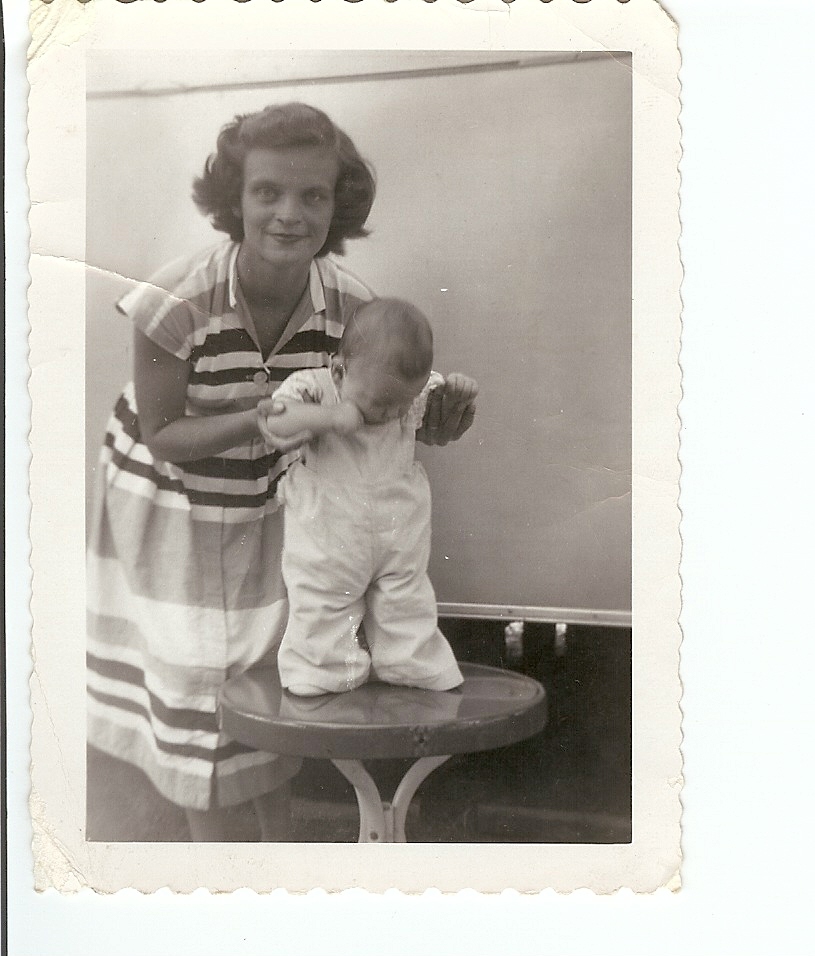
Lillian Harris, Sherry's mother, at age 20 with her first child Brenda

I remember thinking at the time how sad it was that she had never gone to college, never had a career, never fulfilled her dreams.  That she had fallen in love at 18, gotten married, and devoted her entire adult life to her children.    That her last thought was of her children. I was single and doing odd jobs while earning a doctorate.  I had a cat and helped take care of my 90-year-old neighbor, but having children was the furthest thing from my mind.

Fast forward to today, January 12, 2010.   I am now the age my mother was when she died.  I did go to college, I do have a career, and I have chipped away at those dreams.    But those are the side bars of my life.  Like every parent out there, the moment my first child was born, I understood what my mother meant.  I understood how much you could love someone, how you could put their interests ahead of your own,  and how you could not be happy unless they were okay.  And, as the years go by and I get older, I understand what a precious gift my mother gave me when she said those last words.  She taught me that time flies, and you never know what day might be your last.  She taught me to treasure every second with your children because, before you know it, they have grown up and are out the door. Just yesterday, they were toddlers; blink, and they are turning 30.

Time passes so fast.   Make it worth it.

By Sherry Jarrell
[Readers may find that an earlier Post by Sherry fits very beautifully with this moving account published today. Ed.]

Frozen in ice

Serendipity

Vickers aircraft

Thanks to a small piece on AOPA Online (Aircraft Owners and Pilots Association), a wonderful insight into a hitherto unheard of organisation and a most charming story.

That organisation is Mawson’s Huts Foundation, an Australian organisation that describes itself as:

The Mawson’s Huts Foundation has been established to conserve in perpetuity for the Australian people the unique, historical buildings known as Mawson’s Huts, base for one of the most significant expeditions in Antarctic history. The Foundation’s website provides a variety of resources concerning current and future efforts to conserve the huts and information about the archaeology and heritage of the site.

Sir Douglas Mawson was an Australian Antarctic explorer and geologist born in 1882.  More background from the Mawson’s Huts website:

Sir Douglas Mawson, a geologist, who led the Australasian Antarctic Expedition of 1911, landed a party of

Sir Douglas Mawson

18 at Cape Denison on Commonwealth Bay in January, 1912, and remained there until December 1913. The site was not visited again until Mawson returned in 1931 with the British, Australian and New Zealand Antarctic Research Expedition and then not again until the 1950’s. Only a concerted public campaign would save and conserve this historic site for all Australians, and the Mawson’s Huts Foundation was formed in 1996 for this purpose.

Read more about this story

Remarkable people: John S Denker

Scientist and pilot

John S Denker is both a scientist and pilot. Now, I have no doubt that there are many scientists who are pilots, and that many of them combine these interests in a variety of ways. So in what way is he “remarkable”?

Experts as communicators

Sometimes experts dedicate considerable effort to communicate their understanding for the benefit of people who are much less knowledgeable. It is probably important that this happens, because it is the main means by which substantial topics are understood in any depth by other people. Without the experts’ thorough knowledge of a specific subject area, very little understanding is likely to be transferred. Continue reading “Remarkable people: John S Denker”

Remarkable people: Kevin Richardson

Trust is both taught and learnt!

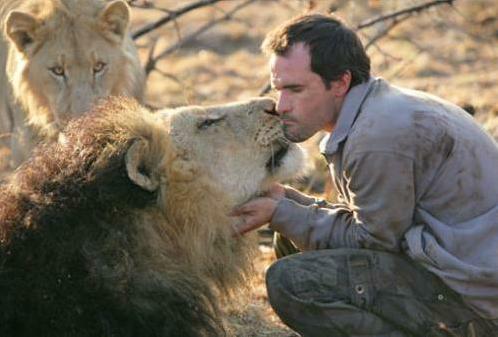
Thanks to Naked Capitalism, we posted an item on the 19th December about an unknown wild-life ranger working in the wildlife refuge area of Lanseria, South Africa.  Here was one of the pictures included in that Post:

The Post finished with an appeal to anyone that knew the name of this Ranger.  Many of you did and responded; thank you!

Read who this Ranger is

Dark Matter

Not really understanding but knowing it’s important!

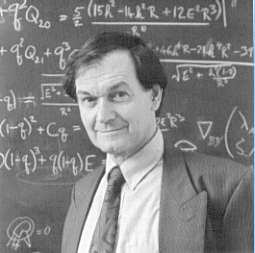
I recently read a glowing review of the latest book by Sir Roger Penrose, the eminent mathematical physicist, called The Road To Reality. Having previously read his book The Emperors’ New Mind and just understanding it, I thought

Roger Penrose

his next one would be a welcome companion for long winter evenings.  Wrong!

I managed to the bottom of the third page of the preface before “According to the mathematician’s “equivalence class” notion …..” had me grasping for meaning.  Well over a 1,000 pages of content was destined to gather dust on the bookshelf.

But wrong again!

The idea of matter out there in the universe that is essential to the universe as we know it but is unseen has been sufficiently fascinating for the popular media to refer to it from time to time.  Most people are familiar with the term even if like me don’t really have a clue as to what dark matter is all about.

So a recent press release in a popular English newspaper suggesting that dark matter has been ‘discovered’, if discover is the appropriate term, had me reaching out for Penrose’s book again.  There under the chapter headed Speculative theories of the early universe was, on page 773, a few sentences that almost made sense.  Let me quote them:

For many years, it had become clear that the dynamics of stars within galaxies does not make sense, according to standard theory unless there is a good deal of more material in the neighbourhood of the galaxy than is directly seen in stars.  A similar comment applies to the dynamics of individual galaxies within clusters.  Overall, there seems to be about 10 times more matter than is perceived in ordinary baryonic form.  This is the mysterious dark matter whose actual nature is still not agreed upon by astronomers, and which may even be of some material different from any that is definitely known to particle physicists – though there is much speculation about this at the present time.

Read more about Dark Matter

Crimes and accidents: the extent of responsibility

How bad can a car accident be?

On 28 February 2001 a vehicle came off the M62 motorway at Great Heck, near Selby, [North Yorkshire, England. Ed] ran down the railway embankment and onto the East Coast Main Line, where it was struck by a passenger train. The passenger train was derailed and then struck by a freight train travelling in the opposite direction. 6 passengers and 4 staff on the trains were killed. The driver of the vehicle was found guilty of causing the deaths of 10 people by dangerous driving.

So begins the report “Managing the accidental obstruction of the railway by road vehicles” from the UK Department for Transport (DfT).

If you were aware of this incident at the time, you might remember that it attracted considerable discussion and press coverage, here are  some examples.

At the time,  a variety of causes were cited for the accident and for the failure of various mechanisms to prevent the accident.

“Whose fault was it?”

Most of the discussion seemed to be based on trying to find someone to blame for everything that happened and the main target was the driver of the vehicle who was alleged to have been driving while unfit to drive due to lack of sleep, and to have fallen asleep at the wheel.

However, I thought that the public response to the incident was a matter of considerable concern; and I continue to think so.

Clearly people can expect to be held responsible for their actions. When their action or lack of action causes damage, they can expect to be held responsible for that damage. However, there are surely limits to that responsibility.

Also, it is interesting that this incident was described at the beginning of the DfT report which was otherwise entirely about ways of reducing incursion of road vehicles onto railways. So, if it is accepted that insufficient fences, banks, ditches or other obstructions had been provided, the implication is that the motorist could expect some protection to exist and is therefore not wholly responsible for the consequences of it not existing.

Level of responsibility

If, as alleged, the driver was unfit to drive then he can expect to be held responsible for his actions. But, in much of the discussion about this incident, there was very little importance attached to the issue that the probability was infinitesimally small that he would fall asleep at exactly the location which resulted in his vehicle entering a railway line, and at the time when not one but two trains were about to pass that point. I would hazard a guess that he could not have planned it so accurately if he had intended to cause the incident!

Having, by extremely bad lack, ended up on a railway line and before the railway collision occurred, he was aware of the danger of collision and was already using this mobile phone to attempt to warn the authorities of the situation. But even if he had been injured and unable to warn anyone, to what extent was he responsible for the full range of consequences of this extremely unlikely incident?

According to one of the press reports:

The HSE report described the accident as ‘wholly exceptional’ and concluded: ‘There was nothing the railway industry could reasonably have done to prevent the collisions.’

Chief Inspector of Railways Vic Coleman said: ‘It’s clear that the chain of events that led to this catastrophe were determined by sheer chance.’

The DfT report, and the fact that the work to generate it was instigated, suggests that the Department for Transport did not agree with the Health and Safety Executive (HSE) that there ‘There was nothing the railway industry could reasonably have done to prevent the collisions.’

Distinguishing the criminal from the accident elements

How do we distinguish crimes from accidents? In particular, in complex incidents such as this, how do we distinguish the criminal elements from the accidental elements of an incident?

In my opinion, there is no benefit in penalising, or even reprimanding, people for actions which led to consequences which either they were completely unable to foresee or which were so improbable as to be bordering on fantasy. On the contrary, it is an opportunity to learn more about the consequences of one’s actions; this can be a positive process of extending one’s understanding, rather than a negative process of “not doing that again”.

In particular, in cases like the Selby incident, clearly someone should be penalised if it is determined that they were driving dangerously; but it seems to me that the severity of the penalty should be based on the severity of crime, which relates to the severity of the likely consequences of their actions and, presumably, whether this is a recurrence of this or other offences.

It also seems to me that the severity of crime is largely independent of the actual consequences of the incident. In other words, someone should expect to be penalised just as severely when there were no consequences as when there were.

I understand that many people would like to find someone to blame for all damage which occurs. But is this reasonable? There are, after all, such things as accidents!

Our blame culture

My view is not that held by the authorities, at least not in the UK. The sentencing guidelines of the Crown Prosecution Service in cases of dangerous driving take the view that the consequences are relevant.

As is probably apparent, I respectfully disagree. This blame culture does not, in my view, serve any purpose and may even reduce safety. Safety experts in the aviation industry seem to take a completely different view from that in the motoring world and reap the long term benefits of improved safety as a consequence.

You may take a different view!

By John Lewis

Copenhagen – that’s clear then.

Will we ever know the truth, the whole truth, and nothing but the truth?

It’s a week since the start of The United Nations Climate Change Conference – Copenhagen, 2009 and it’s clearly been a media success if nothing else.

My instinct has, for many years, been the assumption that mankind behaves in many ways that harm our environment and that, ultimately, harming the very planet upon which our survival depends could happen.  Stupid, yes!  But in line with some of the more strange behaviours of homo sapiens.

But like millions of people, I do not have either the scientific background or the time available to test the statements made by so many governments and other ‘wise’ bodies as to whether the science of climate change, global warming or whatever, is real and irrefutable.  One thinks that would be relatively easy to do and that after all the years and millions of dollars spent on climate research, the proof would be there.  Cause and effect were perfectly understood.

Read more of this Post

Forwards to bygone times!

Sign of the times?

Woodstove

We have been looking for ways of cutting down our energy requirements and coupled with trying to grow as many of our own veggies as possible, 2 small flocks of chickens for eggs, we have now acquired a reconditioned, wood-burning cooker.

It arrived last Wednesday and weighs in at just under a third of a ton. It was manoeuvred into place by 2 men, some planks of wood and a few rollers made from off-cut, scaffolding poles.

Our youngest son and I fitted the flue and fired it up on Thursday evening. What a transformation!

The quality of heat and ambience it creates in the kitchen/dining room is amazing. It is like being transported back to a bygone era where everything seemed less stressed and slower. Whoever gets up in the morning lights it first and it seems to be able to rise from cold to a useful temperature in 20 minutes. It uses a very small amount of wood to keep it in all day and we have switched off all the heating in the adjoining rooms. We cooked a roast dinner in it on Sunday and a load of mince pies plus bread over the weekend.

It’s not instant and it has its own foibles but we love it – a bit like most of us, I expect!

By Jon Lavin