There’s a fascinating video on the http://www.TED.com website given by Prof Dan Gilbert. Prof Dan is Professor of Psychology at Havard and there’s a good resume on WikiPedia.
Dan Gilbert doesn’t have an instruction manual that tells you how to be happy in four easy steps and one hard one. Nor is he the kind of thinker who needs Freud, Marx, and Modernism to explain the human condition.
Gilbert, the Director of Harvard’s Hedonic Psychology Laboratory, is a scientist who explores what philosophy, psychology, neuroscience, and behavioral economics have to teach us about how, and how well the human brain can imagine its own future, and about how, and how well it can predict which of those futures it will most enjoy.
There can’t be a human that hasn’t pondered on what makes them happy. Gilbert sets out some fascinating and possibly counter-intuitive ideas. Here’s the video
In the laboratory of the hermits, no one noticed that the monkeys could talk.
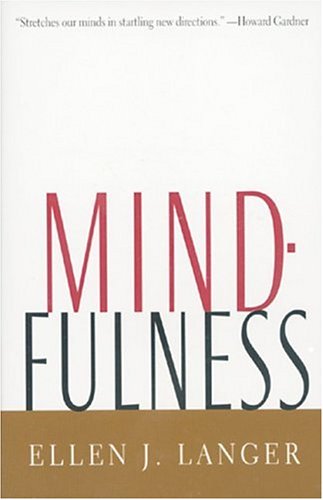
Mindfulness
When a book ends with the above line, you know it’s going to be interesting.
When the inside front page carries a short review from Prof Alan Dershowitz of Havard Law School that reads, “One simply can’t finish this book and see the world in the same way”, you know the book is important.
Yes to both.
On Page 2, Ellen writes,
Unlike the exotic “altered states of conciousness” that we read so much about, mindfulness and mindlessness are so common that few of us appreciate their importance or make use of their power to change our lives.
This is a book for so many different aspects of life. From fields like aviation where mindlessness can, literally, kill to mindful new perspectives for people looking to explore new horizons for the soul.
Langer demonstrates a rare capacity both to see what is extraordinary about human events and to envision even more enlivening human possibilities. – Lee Ross, Stanford University.
[Apologies to our readers but a consistent error in all the links to previous posts within this and earlier posts has now been corrected. You can view all the previous sections of his lecture by clicking the links in this Post. Ed.]
We live on a finite Earth. But really understanding what that means is difficult. I guess because most of us think that in our own little way we can’t really be doing any harm to the planet – I mean what’s another few grams of CO2?
Al Bartlet, University of Colorado
Well here’s Dr Albert Bartlett of the Department of Physics at the University of Colorado chatting about arithmetic! And if you go to his website, you will come across this quote on the home page:
“Can you think of any problem in any area of human endeavor on any scale, from microscopic to global, whose long-term solution is in any demonstrable way aided, assisted, or advanced by further increases in population, locally, nationally, or globally?”
Want to sit in on his famous lecture, “Arithmetic, Population and Energy: Sustainability 101”? Well you can.
The lecture is broken down into 8 10-minute videos, each of them on YouTube. The first two instalments are here , Part Three and Four here
Parts Five and Six were in this post. These are the concluding two parts.
We live on a finite Earth. But really understanding what that means is difficult. I guess because most of us think that in our own little way we can’t really be doing any harm to the planet – I mean what’s another few grams of CO2?
Al Bartlet, University of Colorado
Well here’s Dr Albert Bartlett of the Department of Physics at the University of Colorado chatting about arithmetic! And if you go to his website, you will come across this quote on the home page:
“Can you think of any problem in any area of human endeavor on any scale, from microscopic to global, whose long-term solution is in any demonstrable way aided, assisted, or advanced by further increases in population, locally, nationally, or globally?”
Want to sit in on his famous lecture, “Arithmetic, Population and Energy: Sustainability 101”? Well you can.
The lecture is broken down into 8 10-minute videos, each of them on YouTube. The first two instalments are here , Part Three and Four here and Parts Five and Six in this post. The concluding two parts are tomorrow. Part Five
We live on a finite Earth. But really understanding what that means is difficult. I guess because most of us think that in our own little way we can’t really be doing any harm to the planet – I mean what’s another few grams of CO2?
Al Bartlet, University of Colorado
Well here’s Dr Albert Bartlett of the Department of Physics at the University of Colorado chatting about arithmetic! And if you go to his website, you will come across this quote on the home page:
“Can you think of any problem in any area of human endeavor on any scale, from microscopic to global, whose long-term solution is in any demonstrable way aided, assisted, or advanced by further increases in population, locally, nationally, or globally?”
Want to sit in on his famous lecture, “Arithmetic, Population and Energy: Sustainability 101”? Well you can.
The lecture is broken down into 8 10-minute videos, each of them on YouTube. The first two instalments are here with Part Three and Four in this post. The remaining four parts over the next two days.
We live on a finite Earth. But really understanding what that means is difficult. I guess because most of us think that in our own little way we can’t really be doing any harm to the planet – I mean what’s another few grams of CO2?
Al Bartlet, University of Colorado
Well here’s Dr Albert Bartlett of the Department of Physics at the University of Colorado chatting about arithmetic! And if you go to his website, you will come across this quote on the home page:
“Can you think of any problem in any area of human endeavor on any scale, from microscopic to global, whose long-term solution is in any demonstrable way aided, assisted, or advanced by further increases in population, locally, nationally, or globally?”
Want to sit in on his famous lecture, “Arithmetic, Population and Energy: Sustainability 101”? Well you can.
The lecture is broken down into 8 10-minute videos, each of them on YouTube. The first two instalments are in this post with each of the following three days having the next two.
Therefore, it has been quite some time since I wrote my original post — which at that point was posted by Professor Jarrell with me as a guest author — in which I laid out my goals pertaining to a discussion of the United States’ education system. Since then I have discussed the positives of our system, the negatives of our system, and pointed out the view of Sir Ken Robinson, who believes that creativity should be given the same status as literacy in education systems.
We are often surprised after researching a topic to find our conclusions to be in opposition with our previous line of thought. However, sometimes it can be equally as surprising to do a great deal of research and then wind up back where you started, simply with a larger factual foundation behind. This has been the case for me throughout this entire discussion of the United States’ education system. Despite the attempt I have made to challenge my own viewpoint and think critically about my own biases, I continue to see the costs of the United States’ education system as far greater than its benefits.
Brick and mortar school building
As I have stated before, there is a great difference between formal education and learning. Or, to be more precise, perhaps I should say that formal education is merely one part, and perhaps not even that large a part, of what “learning” entails. I would suggest that the problem is not so much that the United States’ education system is damaging merely because of its existence, but rather that the greatest damage comes from society expecting far too much from this system. School is no replacement for the learning that entails integration into a complex and competitive global society that necessitates human interaction, critical thinking skills, and creativity. Sure, one can force youths into cinder block rooms and force them to learn multiplication tables and historical dates. And, to an extent, I think this is necessary in a mass society as we have today. However, this formula of forcing youths to learn facts and then having these facts regurgitated has been entrusted with far too much of what we today consider “learning,” and if we are ever to have a positive shift in our society from one of idea-accepters to idea-creators, this must change.
Learning the multiplication tables
Perhaps high school could integrate into their programs a larger degree of extracurricular internships that count for course credit — I am sure that this is an experiment that could be undertaken by a few school districts quite easily, and then expanded if it proves successful. Perhaps also school curriculum could be altered to include more classes on philosophy and economics, which I see as foundational for a solid understanding of our world. However, this alteration of core curriculum would be a much more difficult task to accomplish, and would require some serious time and thought.
I plan to have my final post on education finished very soon. However, with my last week of finals and papers at the undergraduate level (which is finally over!) constantly hoarding my time, I have not yet quite been able to truly decide on which side I plan to end up.
My instinct tells me that the costs of the US schooling system far outweigh its benefits, but I feel I must be sure that this is truly a case that can be supported with logic and not simply my own biases coming through.
However, while I continue to ponder, I thought that readers might find this video interesting. It’s a different take on the nature of institutionalized schooling than is often seen. It’s on the longer side — approximately 20 minutes long — but I definitely think it is worth a watch for anyone pursuing a clear and well thought-out perspective on education, and it’s actually quite humorous and entertaining.
The video is of a presentation by Sir Ken Robinson, an internationally recognized leader in the development of innovation and human resources. His thesis statement is as follows:
My contention is that creativity is as important in education as literacy, and we should treat it with the same status.
I hope the Learning From Dogs community enjoys this video. Upon my return from celebrating my college graduation in Charleston, I plan to present my final finding on whether the costs or the benefits of schooling in the United States outweighs the other.
I’m not sure exactly what the political leanings are of the Learning From Dogs readership — I would hope that a variety of viewpoints are represented — but I know that often communitarian philosophies are held in contempt in libertarian or free market circles because of their association with historical attempts at socialism and communism.
Regardless, I’d love to hear your thoughts, as it’s a philosophy I’ve been thinking about a lot recently. I write:
…I have to admit that one of the key flaws I see in communitarian political philosophies is not so much the non-cohesive nature of the doctrines themselves, but rather the level at which they are prescribed. If communitarianism was only applied at the local level, could it really survive without an element of voluntarism? I feel that capitalist leaning nation-states are begging the question in saying that ideologies like socialism don’t work, because they are assuming that they must be applied at the nation-state level.
This involves the idea that the strictness of economic laws tends to lessen as they move further away from large-scale application, so anti-communitarian claims like the lack of an adequate price mechanism and lack of adequate information tends to become less of a problem for local communities because the nature of economic communication changes as the distance between actors closes. It also involves the idea put forth by such philosophers as David Hume that human beings are naturally sociable creatures, and a communitarian system at the local level would be able to use this sociability to its advantage.
[With this Post, Jon introduces a series of forthcoming articles looking at the inner person and exploring ways in which each of us can enhance our feelings of contentment and happiness. Ed.]
Stop the world, I want to get off!
Starting again requires giving up
Whichever way we look, there appear to be huge problems. Not insurmountable but, metaphorically speaking, sheer vertical cliffs without any easy way up.
One might ponder if the last 50 years, that post-war period of growth and prosperity, have, in reality given society real, sustainable, core improvements or whether all the ‘gains’ have come at such a cost that the net benefit is questionable?
This could be seen as pessimism gone mad. Undoubtedly, there have been some huge gains from a scientific point of view and we now enjoy lives that are greatly enhanced and longer. But not to ask such a fundamental question is to assume the alternative, that everything in the garden is rosy.
Now this may seem a strange introduction to a topic that is going to be deeply personal and private.
But both the private, individual world of the ‘self’ and the great, interconnected world of the planet are indivisible. Every aspect of our lives, our livelihoods, our environment and the future of our children depends on how well, and how sustainably, we manage our personal, local, national and international interests.
For example, if Prof. Lovelock’s theory on the planet being a self-regulating organism is correct, his Gaia theory, then possibly in the lifetimes of our children, and certainly in the lifetimes of our grandchildren, worrying about a job or repaying the mortgage will be irrelevant. Our descendants will be worrying about their very survival!
I called this piece Giving Up. Why?
Because the only way forward is to give up on the present. I will expand on this theme in future Posts.
The future depends on each of us being happy and contented with ourselves and avoiding looking out there for the magic cure to all our troubles. Being, as far as we are able, at peace with our circumstances and able to do the best, individually, as well as the best for our families, our friends and the larger world in which we work and play.
I have heard people ask the question before, “How can I best help the world?” The only truthful answer is to develop ourselves as individuals. In doing this, the field of consciousness that we are all connected to is also lifted or elevated to a higher level.
At this stage of history, either…the general population will take control of its own destiny and will
Noam Chomsky
concern itself with community interests guided by values of solidarity and sympathy and concern for others or alternately there will be no destiny for anyone to control.
-Noam Chomsky
By Jon Lavin
[Anyone who has been affected by this article and wishes to contact Jon may find his contact details here. Ed.]





 Learning from Dogs