Tag: Intergovernmental Panel on Climate Change

Oil, sustainability, and American politics

The strange affairs of humans.

A quick piece of web research turned up a quote by the famous physicist, Richard P. Feynman, as follows,

In physics the truth is rarely perfectly clear, and that is certainly universally the case

in human affairs.

I thought the quote an apt introduction to an article written by Bill McKibben of 350 org fame, recently published on Tom Engelhardt’s TomDispatch blog.  As always, a vote of thanks to Tom for giving me permission to reproduce his pieces.

The topic is the Keystone XL pipeline, recently sidelined by Pres. Obama and now generating some interesting musings about the political strategy that may be at play here.  I have written previously about this pipeline and a quick search from the home page of Learning from Dogs using the search terms ‘keystone pipeline’ will find these articles.

Do read the full article from Bill McKibben.  Despite it’s length it’s full of thought-provoking ideas.  As Tom Engelhardt says in the closing sentences of his introduction, “Mark my words on this one: sooner or later, Americans are going to wake up to climate change, just as they have this year on the issue of inequality, and when they do, watch out.  There will be political hell to pay.Tom”

With no more ado, to the TomDispatch article,

Tomgram: Bill McKibben, Puncturing the Pipeline

Posted by Bill McKibben at 8:07am, November 15, 2011.

What’s the biggest story of the last several weeks?  Rick Perry’s moment of silence, all 53 seconds’worth?  The Penn State riots after revered coach JoePa went down in a child sex abuse scandal? The Kardashian wedding/divorce?  The European debt crisis that could throw the world economy into a tailspin?  The Cain sexual harassment charges?  The trial of Michael Jackson’s doctor?

The answer should be none of the above, even though as a group they’ve dominated the October/November headlines.  In fact, the piece of the week, month, and arguably year should have been one that slipped by so quietly, so off front-pages nationwide and out of news leads everywhere that you undoubtedly didn’t even notice.  And yet it’s the story that could turn your lifeand that of your children and grandchildren inside out and upside down.

On the face of it, it wasn’t anything to shout about — just more stats in a world drowning in numbers.  These happen to have been put out by the U.S. Department of Energy and they reflected, as an Associated Press headline put it, the “biggest jump ever seen in global warming gases.”  In other words, in 2010, humanity (with a special bow to China, the United States, and onrushing India) managed to pump more carbon dioxide into the atmosphere than at any time since the industrial revolution began — 564 million more tons than in 2009, which represents an increase of 6%.

According to AP’s Seth Borenstein, that’s “higher than the worst case scenario outlined by climate experts just four years ago.” He’s talking about the Intergovernmental Panel on Climate Change, or IPCC, which is, if anything, considered “conservative” in its projections of future catastrophe by many climate scientists.  Put another way, we’re talking more greenhouse gases than have entered the Earth’s atmosphere in tens of millions of years.

Consider as well the prediction offered by Fatih Birol, chief economist at the International Energy Agency: without an effective international agreement to staunch greenhouse gases within five years, the door will close on preventing a potentially disastrous rise in the planet’s temperature.  You’re talking, that is, about the kind of freaky weather that will make October’s bizarre snowstorm in the Northeast look like a walk in the park.  (That storm had all the signs of a climate-change-induced bit of extreme weather: New York City hadn’t recorded an October snowfall like it since the Civil War and it managed to hit the region in a period of ongoing warmth when the trees hadn’t yet had the decency to lose their leaves, producing a chaos of downed electrical wires.)  And don’t get me started on what this would mean in terms of future planetary hot spells or sea-level rise.

Honestly, if we were sane, if the media had its head in the right place, this would have been screaming headlines.  It would have put Rick Perry and Herman Cain and the Kardashians andItaly and Greece and Michael Jackson’s doctor in the shade.

The only good news — and because it unsettled the politics of the 2012 election, it did garner a few headlines — was that the movement Bill McKibben and 350.org spearheaded to turn back the tar-sands pipeline from Hades (or its earthly global-warming equivalent, which is Alberta, Canada) gained traction in our Occupy Wall Street moment.  Think of it as a harbinger.  Mark my words on this one: sooner or later, Americans are going to wake up to climate change, just as they have this year on the issue of inequality, and when they do, watch out.  There will be political hell to pay.Tom

Obama’s Positive Flip and Romney’s Negative Flop
Is Global Warming an Election Issue After All? 

By Bill McKibben

Conventional wisdom has it that the next election will be fought exclusively on the topic of jobs. But President Obama’s announcement last week that he would postpone a decision on the Keystone XL pipeline until after the 2012 election, which may effectively kill the project, makes it clear that other issues will weigh in — and that, oddly enough, one of them might even be climate change.

The pipeline decision was a true upset.  Everyone — and I mean everyone who “knew” how these things work — seemed certain that the president would approve it. The National Journal runs a weekly poll of “energy insiders” — that is, all the key players in Washington. A month to the day before the Keystone XL postponement, this large cast of characters was “virtually unanimous” in guaranteeing that it would be approved by year’s end.

Transcanada Pipeline, the company that was going to build the 1,700-mile pipeline from the tar-sands fields of Alberta, Canada, through a sensitive Midwestern aquifer to the Gulf of Mexico, certainly agreed.  After all, they’d already mowed the strip and prepositioned hundreds of millions of dollars worth of pipe, just waiting for the permit they thought they’d bought with millions in lobbying gifts and other maneuvers. Happily, activists across the country weren’t smart enough to know they’d been beaten, and so they staged the largest civil disobedience actionin 35 years, not to mention ringing the White House with people, invading Obama campaign offices, and generally proving that they were willing to fight.

No permanent victory was won. Indeed, just yesterday Transcanada agreed to reroute the pipeline in Nebraska in an effort to speed up the review, though that appears not to change the schedule.  Still, we’re waiting for the White House to clarify that they will continue to fully take climate change into account in their evaluation.  But even that won’t be final.  Obama could just wait for an election victory and then approve the pipeline — as any Republican victor certainly would.  Chances are, nonetheless, that the process has now gotten so messy that Transcanada’s pipeline will die of its own weight, in turn starving the tar-sands oil industry and giving a boost to the global environment.  Of course, killing the pipeline will hardly solve the problem of global warming (though heavily exploiting those tar sands would, in NASA scientist James Hansen’s words, mean “game over for the climate.”)

In this line of work, where victories of any kind are few and far between, this was a real win.  It began with indigenous activists, spread to Nebraska ranchers, and eventually turned into the biggest environmental flashpoint in many years.  And it owed no small debt to the Occupy Wall Street protesters shamefully evicted from Zuccotti Park last night, who helped everyone understand the power of corporate money in our daily lives.  That these forces prevailed shocked most pundits precisely because it’s common wisdom that they’re not the sort of voters who count, certainly not in a year of economic trouble.

In fact, the biggest reason the realists had no doubts the pipeline would get its permit, via a State Department review and a presidential thumbs-up of that border-crossing pipeline, was because of the well-known political potency of the jobs argument in bad economic times. Despite endless lazy reporting on the theme of jobs versus the environment, there were actually no net jobs to be had from the pipeline. It was always a weak argument, since the whole point of a pipeline is that, once it’s built, no one needs to work there.  In addition, as the one study not paid for by Transcanada made clear, the project would kill as many jobs as it would create.

The Washington Post’s Juliet Eilperin and Steven Mufson finally demonstrated this late in the game with a fine report taking apart Transcanada’s job estimates. (The 20,000 jobs endlessly taken for granted assumed, among other stretches, that modern dance troupes would move to Nebraska, where part of the pipeline would be built, to entertain pipeline workers.)  Still, the jobs trope remained, and you can be sure that the Chamber of Commerce will run 1,000 ads during the 2012 presidential campaign trying to hammer it home. And you can be sure the White House knew that, which was why it was such a tough call for them — and why the pressure of a movement among people whose support matters to them made a difference.

Let’s assume the obvious then: that one part of their recent calculations that led to the postponement decision might just be the suspicion that they will actually win votes thanks to the global-warming question in the next election.

For one thing, global warming denial has seen its apogee. The concerted effort by the fossil-fuel industry to underwrite scientific revision met its match last month when a team headed by Berkeley skeptic and prominent physicist Richard Muller– with funding from the Koch Brothers, of all people — actually found that, what do you know, all the other teams of climate-change scientists were, um, right. The planet was indeed warming just as fast as they, and the insurance companies, and the melting ice had been insisting.

Still, scientific studies only reach a certain audience.  Weird weather is a far more powerful messenger. It’s been hard to miss the record flooding along the Mississippi and Missouri Rivers, and across the Northeast; the record drought andfires across the Southwest; the record multi-billion dollar weather disasters across the country this year; the record pretty-much everything-you-don’t-want across the nation. Obama certainly noticed.  He’s responsible for finding the cash every time some other state submerges.

As a result, after years of decline, the number of Americans who understand that the planet is indeed warming and that we’re to blame appears to be on the rise again. And ironically enough, one reason may be the spectacle of all the tea-partying GOP candidates for the presidency being forced to swear fealty to the notion that global warming is a hoax. Normal people find this odd: it’s one thing to promise Grover Norquist that you’ll never ever raise taxes; it’s another to promise that you’ll defeat chemistry and physics with the mighty power of the market.

Along these lines, Mitt Romney made an important unforced error last month. Earlier in the primaries, he and Jon Huntsman had been alone in the Republican field in being open to the idea that global warming might actually be real. Neither wanted to do anything about it, of course, but that stance itself was enough to mark them as realists.  It was also a sign that Romney was thinking ahead to the election itself, and didn’t want to be pinned against this particular wall.

In late October, however, he evidently felt he had no choice but to pin himself to exactly that wall and so stated conclusively: “My view is that we don’t know what’s causing climate change on this planet.” In other words, he not only flip-flopped to the side of climate denial, but did so less than six months after he had said no less definitively: “I don’t speak for the scientific community, of course, but I believe the world’s getting warmer… And number two, I believe that humans contribute to that.”  Note as well that he did so, while all the evidence, even some recently funded by the deniers, pointed the other way.

If he becomes the Republican presidential candidate as expected, this may be the most powerful weathervane ad the White House will have in its arsenal.  Even for people who don’t care about climate change, it makes him look like the spinally challenged fellow he seems to be. But it’s an ad that couldn’t be run if the president had okayed that pipeline.

Now that Obama has at least temporarily blocked Keystone XL, now that his team has promised to consider climate change as a factor in any final decision on the pipeline’s eventual fate, he can campaign on the issue. And in many ways, it may prove a surprise winner.

After all, only people who would never vote for him anyway deny global warming.  It’s a redoubt for talk-show rightists. College kids, on the other hand, consistently rank it among the most important issues. And college kids, as Gerald Seib pointedout in the Wall Street Journal last week, are a key constituency for the president, who is expected to need something close to the two-thirds margin he won on campus in 2008 to win again in 2012.

Sure, those kids care about student loans, which threaten to take them under, and jobs, which are increasingly hard to come by, but the nature of young people is also to care about the world.  In addition, independent voters, suburban moms — these are the kinds of people who worry about the environment.  Count on it: they’ll be key targets for Obama’s presidential campaign.

Given the economy, that campaign will have to make Mitt Romney look like something other than a middle-of-the-road businessman.  If he’s a centrist, he probably wins. If he’s a flip-flopper with kooky tendencies, they’ve got a shot. And the kookiest thing he’s done yet is to deny climate science.

If I’m right, expect the White House to approve strong greenhouse gas regulations in the months ahead, and then talk explicitly about the threat of a warming world. In some ways it will still be a stretch.  To put the matter politely, they’ve been far from perfect on the issue: the president didn’t bother to waste any of his vaunted “political capital” on a climate bill, and he’s opened huge swaths of territory to coal mining and offshore drilling.

But blocking the pipeline finally gave him some credibility here — and it gave a lot more of the same to citizens’ movements to change our world. Since a lot of folks suspect that the only way forward economically has something to do with a clean energy future, I’m guessing that the pipeline decision won’t be the only surprise. I bet Barack Obama talks on occasion about global warming next year, and I bet it helps him.

But don’t count on that, or on Keystone XL disappearing, and go home.  If the pipeline story (so far) has one lesson, it’s this: you can’t expect anything to change if you don’t go out and change it yourself.

Bill McKibben is a founder of 350.org, a TomDispatch regular, and Schumann Distinguished Scholar at Middlebury College. His most recent book is Eaarth: Making a Life on a Tough New Planet.

Copyright 2011 Bill McKibben

Sceptical voices, part two

More musings about determining the truth.

Those who read yesterday’s part one will undoubtedly have seen the added comment from long-time friend of Learning from Dogs, Patrice Ayme.  Yesterday, I promised to conclude Dan’s sceptical approach to climate warming with three articles that he had sent me.  Here they are,

Global Warming

“Global warming” refers to the global-average temperature increase that has been observed over the last one hundred years or more. But to many politicians and the public, the term carries the implication that mankind is responsible for that warming. This website describes evidence from my group’s government-funded research that suggests global warming is mostly natural, and that the climate system is quite insensitive to humanity’s greenhouse gas emissions and aerosol pollution.

Believe it or not, very little research has ever been funded to search for natural mechanisms of warming…it has simply been assumed that global warming is manmade. This assumption is rather easy for scientists since we do not have enough accurate global data for a long enough period of time to see whether there are natural warming mechanisms at work.

The United Nation’s Intergovernmental Panel on Climate Change (IPCC) claims that the only way they can get their computerized climate models to produce the observed warming is with anthropogenic (human-caused) pollution. But they’re not going to find something if they don’t search for it. More than one scientist has asked me, “What else COULD it be?” Well, the answer to that takes a little digging… and as I show, one doesn’t have to dig very far.

But first let’s examine the basics of why so many scientists think global warming is manmade. Earth’s atmosphere contains natural greenhouse gases (mostly water vapor, carbon dioxide, and methane) which act to keep the lower layers of the atmosphere warmer than they otherwise would be without those gases. Greenhouse gases trap infrared radiation — the radiant heat energy that the Earth naturally emits to outer space in response to solar heating. Mankind’s burning of fossil fuels (mostly coal, petroleum, and natural gas) releases carbon dioxide into the atmosphere and this is believed to be enhancing the Earth’s natural greenhouse effect. As of 2008, the concentration of carbon dioxide in the atmosphere was about 40% to 45% higher than it was before the start of the industrial revolution in the 1800’s.

It is interesting to note that, even though carbon dioxide is necessary for life on Earth to exist, there is precious little of it in Earth’s atmosphere. As of 2008, only 39 out of every 100,000 molecules of air were CO2, and it will take mankind’s CO2 emissions 5 more years to increase that number by 1, to 40.

Earth's atmosphere

The “Holy Grail”: Climate Sensitivity Figuring out how much past warming is due to mankind, and how much more we can expect in the future, depends upon something called “climate sensitivity”. This is the temperature response of the Earth to a given amount of ‘radiative forcing’, of which there are two kinds: a change in either the amount of sunlight absorbed by the Earth, or in the infrared energy the Earth emits to outer space.

The ‘consensus’ of opinion is that the Earth’s climate sensitivity is quite high, and so warming of about 0.25 deg. C to 0.5 deg. C (about 0.5 deg. F to 0.9 deg. F) every 10 years can be expected for as long as mankind continues to use fossil fuels as our primary source of energy. NASA’s James Hansen claims that climate sensitivity is very high, and that we have already put too much extra CO2 in the atmosphere. Presumably this is why he and Al Gore are campaigning for a moratorium on the construction of any more coal-fired power plants in the U.S.

You would think that we’d know the Earth’s ‘climate sensitivity’ by now, but it has been surprisingly difficult to determine. How atmospheric processes like clouds and precipitation systems respond to warming is critical, as they are either amplifying the warming, or reducing it. This website currently concentrates on the response of clouds to warming, an issue which I am now convinced the scientific community has totally misinterpreted when they have measured natural, year-to-year fluctuations in the climate system. As a result of that confusion, they have the mistaken belief that climate sensitivity is high, when in fact the satellite evidence suggests climate sensitivity is low.

The case for natural climate change I also present an analysis of the Pacific Decadal Oscillation which shows that most climate change might well be the result of….the climate system itself! Because small, chaotic fluctuations in atmospheric and oceanic circulation systems can cause small changes in global average cloudiness, this is all that is necessary to cause climate change. You don’t need the sun, or any other ‘external’ influence (although these are also possible…but for now I’ll let others work on that). It is simply what the climate system does. This is actually quite easy for meteorologists to believe, since we understand how complex weather processes are. Your local TV meteorologist is probably a closet ’skeptic’ regarding mankind’s influence on climate.

Climate change — it happens, with or without our help.

And the next one,

Earth may be headed into a mini Ice Age within a decade

Physicists say sunspot cycle is ‘going into hibernation’

By Lewis Page

Posted in Science14th June 2011 17:00 GMT

What may be the science story of the century is breaking this evening, as heavyweight US solar physicists announce that the Sun appears to be headed into a lengthy spell of low activity, which could mean that the Earth – far from facing a global warming problem– is actually headed into a mini Ice Age.

Ice skating on the Thames by 2025?

The announcement made on 14 June (18:00 UK time) comes from scientists at the US National Solar Observatory (NSO) and US Air Force Research Laboratory. Three different analyses of the Sun’s recent behaviour all indicate that a period of unusually low solar activity may be about to begin.

The Sun normally follows an 11-year cycle of activity. The current cycle, Cycle 24, is now supposed to be ramping up towards maximum strength. Increased numbers of sunspots and other indications ought to be happening: but in fact results so far are most disappointing. Scientists at the NSO now suspect, based on data showing decades-long trends leading to this point, that Cycle 25 may not happen at all.

This could have major implications for the Earth’s climate. According to a statement issued by the NSO, announcing the research:

An immediate question is whether this slowdown presages a second Maunder Minimum, a 70-year period with virtually no sunspots [which occurred] during 1645-1715.

As NASA notes [1]:

Early records of sunspots indicate that the Sun went through a period of inactivity in the late 17th century. Very few sunspots were seen on the Sun from about 1645 to 1715. Although the observations were not as extensive as in later years, the Sun was in fact well observed during this time and this lack of sunspots is well documented. This period of solar inactivity also corresponds to a climatic period called the “Little Ice Age” when rivers that are normally ice-free froze and snow fields remained year-round at lower altitudes. There is evidence that the Sun has had similar periods of inactivity in the more distant past.

During the Maunder Minimum and for periods either side of it, many European rivers which are ice-free today – including the Thames – routinely froze over, allowing ice skating and even for armies to march across them in some cases.

“This is highly unusual and unexpected,” says Dr Frank Hill of the NSO. “But the fact that three completely different views of the Sun point in the same direction is a powerful indicator that the sunspot cycle may be going into hibernation.”

Hill’s own research focuses on surface pulsations of the Sun and their relationship with sunspots, and his team has already used their methods to successfully predict the late onset of Cycle 24.

“We expected to see the start of the zonal flow for Cycle 25 by now,” Hill explained, “but we see no sign of it. This indicates that the start of Cycle 25 may be delayed to 2021 or 2022, or may not happen at all.”

Hill’s results match those from physicists Matt Penn and William Livingston, who have gone over 13 years of sunspot data from the McMath-Pierce Telescope at Kitt Peak in Arizona. They have seen the strength of the magnetic fields which create sunspots declining steadily. According to the NSO:

Penn and Livingston observed that the average field strength declined about 50 gauss per year during Cycle 23 and now in Cycle 24. They also observed that spot temperatures have risen exactly as expected for such changes in the magnetic field. If the trend continues, the field strength will drop below the 1,500 gauss threshold and spots will largely disappear as the magnetic field is no longer strong enough to overcome convective forces on the solar surface.

In parallel with this comes research from the US Air Force’s studies of the solar corona. Richard Altrock, in charge of this, has found a 40-year decline in the “rush to the poles” – the poleward surge of magnetic activity in the corona.

“Those wonderful, delicate coronal features are actually powerful, robust magnetic structures rooted in the interior of the Sun,” Altrock says. “Changes we see in the corona reflect changes deep inside the Sun …

“Cycle 24 started out late and slow and may not be strong enough to create a rush to the poles, indicating we’ll see a very weak solar maximum in 2013, if at all. If the rush to the poles fails to complete, this creates a tremendous dilemma for the theorists … No one knows what the Sun will do in that case.”

According to the collective wisdom of the NSO, another Maunder Minimum may very well be on the cards.

“If we are right,” summarises Hill, “this could be the last solar maximum we’ll see for a few decades. That would affect everything from space exploration to Earth’s climate.”

The effects on space exploration would be benign, as fewer or no solar storms would make space a much less hostile environment for human beings. At the moment, anyone venturing beyond the Earth’s protective magnetic field (the only people to have done so were the Apollo moon astronauts of the 1960s and ’70s) runs a severe risk of dangerous or fatal radiation exposure during a solar storm.

Manned missions beyond low Earth orbit, a stated aspiration of the USA and other nations, might become significantly safer and cheaper to mount (cheaper as there would be no requirement for possibly very heavy shielding to protect astronauts, so reducing launch costs).

The big consequences of a major solar calm spell, however, would be climatic. The next few generations of humanity might not find themselves trying to cope with global warming but rather with a significant cooling. This could overturn decades of received wisdom on such things as CO2 emissions, and lead to radical shifts in government policy worldwide.

And the last one,

On the Misdiagnosis of Surface Temperature Feedbacks from Variations in Earth’s Radiant Energy Balance

Roy W. Spencer * and William D. Braswell

ESSC-UAH, University of Alabama in Huntsville, Cramer Hall, Huntsville, AL 35899, USA

* Author to whom correspondence should be addressed.Received: 24 May 2011; in revised form: 13 July 2011 / Accepted: 15 July 2011 / Published: 25 July 2011

Abstract: The sensitivity of the climate system to an imposed radiative imbalance remains the largest source of uncertainty in projections of future anthropogenic climate change. Here we present further evidence that this uncertainty from an observational perspective is largely due to the masking of the radiative feedback signal by internal radiative forcing, probably due to natural cloud variations. That these internal radiative forcings exist and likely corrupt feedback diagnosis is demonstrated with lag regression analysis of satellite and coupled climate model data, interpreted with a simple forcing-feedback model. While the satellite-based metrics for the period 2000–2010 depart substantially in the direction of lower climate sensitivity from those similarly computed from coupled climate models, we find that, with traditional methods, it is not possible to accurately quantify this discrepancy in terms of the feedbacks which determine climate sensitivity. It is concluded that atmospheric feedback diagnosis of the climate system remains an unsolved problem, due primarily to the inability to distinguish between radiative forcing and radiative feedback in satellite radiative budget observations.

So back to me!

As you can see there is every opportunity to be confused.  Not embracing contrary views to the ones that you believe, however, is not the way to determine the truth.

So let me close with a couple of my own contrary views.

The first from Bill McKibben published in the Resurgence Magazine,

WHAT COMES NEXT?

We have a tiny window of opportunity to save something of the magnificence of the Earth so let’s all grab it, writes Bill McKibben, founder of 350.org

Asked to name the biggest thing that’s happened over Resurgence’s 45-year career, I think I’d have to say the melt of the Arctic. When this magazine began publishing, there was 40% more summer sea ice in the Arctic. Viewed from space, in those first pictures from the Apollo spacecraft, the planet looked very different than it does now. In recent summers both the north-west and the north-east passages have opened, allowing sailors to circumnavigate the Arctic through waters that no one thought, even a decade ago, humans would ever navigate.

Or maybe I would pick the rapid acidification of the planet’s seas – they’re 30% more acid than they were in 1966. Which means that the small creatures at the base of the marine food chain are having more trouble forming their shells, and that coral reefs – already stressed by warming waters – have a new trauma to deal with.

Another possibility: the Earth’s atmosphere is about 4% moister than it was 45 years ago, simply because warm air holds more water vapour than cold. This loads the dice for deluge, downpour, flood – it’s not surprising that we’re seeing record rainfall and unprecedented floods. Nor, since that water has to come from somewhere, should increasing drought and desertification come as much of a shock.

Here’s what I’m trying to say: when Resurgence began its run, we were still in the Holocene. Humans had altered much of the planet’s natural environment. We had dirty rivers and dirty air, spreading toxins and endangered species. But the basic operating system of the planet was running pretty much the same as it had for the 10,000 years of human civilisation.

Sometime in the intervening decades we moved out of that comfortable and remarkably stable world, and began the transition to What Comes Next?

Any date would be arbitrary, but if you wanted to pick one, you could say 1988. That was the year NASA scientist Jim Hansen warned the US Congress that global warming was indeed real – and it was the year that we passed the benchmark of 350 parts per million (ppm) of CO2 in the atmosphere. At the time we didn’t know it was a benchmark – it was 20 years later that scientists, again led by Hansen, declared that 350ppm was the absolute upper limit if we wanted a planet “similar to the one on which civilisation developed and to which life is adapted”. If we wanted, in other words, that older world we were born onto.

I could list at some length the various woes this new world is already causing: we see rising sea levels displacing farmers across the deltas of Bangladesh, and Aedes aegypti expanding its boundary and spreading dengue fever like wildfire. Speaking of wildfire, we see record amounts, in part because of more heat and drought, and in part because insects (once kept in check by cold weather) are now spreading.

We see millions still homeless from last year’s flood in Pakistan, and billions struggling to pay for food because a string of crop failures that began with last summer’s Russian drought have increased grain prices by 70–80%.

And I could list at even greater length the woes we expect as the century grinds on. After all, we’ve only raised the temperature about a degree so far, and the climatologists tell us to expect four or five unless we stop burning coal and oil and gas much faster than any government currently plans. Temperatures like that will guarantee the melt of Greenland; according to the agronomists they will cut grain harvests by a third or more; they’ll make current shortages of water seem barely worth mentioning.

But for the moment don’t think about consequences, current or future. Just think about the enormity of what we’ve managed to do: we’ve altered the most basic operations of the one planet we’ve got.

The air is profoundly different, the heat balance with our sun profoundly altered. It’s by far the biggest thing humans have ever done or ever contemplated doing, and were some alien watching from a great distance she’d be scratching her head-like appendage. It’s our head-like appendage that’s responsible, of course. That big brain turned out to be incredibly clever, and its cleverest trick was to figure out that buried carbon could make life easy. Everything that we know around us – the whole modern world – derives from that discovery. Much of it is good. But now we’re threatening to take down the good, and much else with it.

So here’s the question for the next 45 years of Resurgence: can the big brain bail us out?

It’s already provided us with the warnings we need, warnings that would not have been available at any other moment in human history. The scientific method, one of the greatest achievements of our civilisation, has produced a robust consensus on this difficult problem in chemistry and physics: since the mid-1990s the Intergovernmental Panel on Climate Change (IPCC) has said in unmistakably plain language that there is no doubt: we have to cut carbon, and quickly.

But so far that warning has had little or no effect: our national governments, with a few noble exceptions, have paid scant attention; our attempts at global governance have been pathetic failures. The chief reason, I think, is the remarkable power of the fossil-fuel industry to stifle change; for 200 years it has grown bigger and richer and more than able to deal with the threat that science now poses to its reign. It literally makes us stupid: earlier this winter the US House of Representatives, by a 60-vote margin, defeated a resolution that merely stated that global warming was real. Exxon has promoted its own version of physics and chemistry, and they’ve managed to fool a good many too.

The real question, then, is going to be: is there a big enough heart connected to that big brain? Will we be able to heed not only the warnings of science but those of our conscience? Will we, gazing out at the growing array of ‘natural disasters’, figure out that we’ve got to make change? Change in our personal lives, yes, but even more change in our political arrangements, since that’s the only chance that actual physics and chemistry really give us for meeting the deadlines they’ve set.

I think the answer is yes – a tentative and uncertain yes, but one based on just enough real-world data to give me hope.

Three years ago we founded 350.org, the first big global grassroots climate campaign. Rooted in science but expressed in imagination, it has grown to pretty mammoth size. Our first two big global days of action, in the waning months of 2009 and 2010, were what CNN called “the most widespread days of political action in the planet’s history”, with nearly 15,000 demonstrations in every country on Earth but North Korea.

And the good news is we didn’t really ‘organise’ it – our tiny staff worked feverishly, but ultimately it was like a potluck supper. People in every corner of the Earth heard the call and did the work, figuring out what would work in their place. (An underwater demonstration on the dying coral reefs of the Maldives; a giant image of King Canute, composed of thousands of volunteers, trying to hold the sea back on the Brighton seashore!)

It’s not enough yet to beat the fossil-fuel industry – our bodies don’t yet add up to their money. But we’re growing constantly (the next big chance to join us: 24 September 2011, a day we’re calling Moving Planet). And – sad, but true – the natural world is going to continue to give us openings to make the case more strongly. Sooner or later our leaders will listen – and we’re committed to making it sooner.

We’re not going to stop global warming: it’s already warmed and it will warm some more. Those Apollo images of our planet are forever sepia-toned. But we’ve got a tiny window left to save something of the Earth we were born onto – its beauty, its bounty, its safety.

That’s our task, and the next 45 years will tell the tale.

Bill McKibben wrote the first book for a general audience on climate change, The End of Nature, in 1989. He is a scholar in residence at Middlebury College in Vermont.

The second from the BBC News website just a few days ago.

Arctic ice hits second-lowest level, US scientists say

Sea ice cover in the Arctic in 2011 has passed its annual minimum, reaching the second-lowest level since satellite records began, US scientists say.

The National Snow and Ice Data Center (NSIDC) says the minimum, reached on 9 September, was 4.33 million sq km.

That value is 36% lower than the average minimum for 1979-2000.

NSIDC said the figure was preliminary, and that “changing winds could still push the ice extent lower” before final numbers are published in early October.

The preliminary value is 160,000 sq km – or 4% – above the record minimum seen in 2007.

The minimum level of cover is far below the average of 1979-2000

“While the record low year of 2007 was marked by a combination of weather conditions that favoured ice loss – including clearer skies, favourable wind patterns and warm temperatures – this year has shown more typical weather patterns but continued warmth over the Arctic,” they wrote.

“This supports the idea that the Arctic sea ice cover is continuing to thin.”

NSIDC director Mark Serreze said: “Every summer that we see a very low ice extent in September sets us up for a similar situation the following year.

“The Arctic sea ice cover is so thin now compared to 30 years ago that it just can’t take a hit any more. This overall pattern of thinning ice in the Arctic in recent decades is really starting to catch up with us.”

In fact, an analysis released last week by researchers at the University of Bremen in Germany, who use a different satellite to assess ice cover, indicated that 2011’s minimum was the lowest on record.

However, there is some controversy surrounding the result; the Bremen team’s higher-resolution data can detect small patches of water where the NSIDC team would not, but the Bremen record goes back only to 2003.

These analyses are for the extent, or area, of Arctic ice, but recent estimates released by the University of Washington’s Polar Science Center give an indication of the total amount of sea ice.

Their data indicate that the ice volume is at an all-time low for the second year in a row.

Analyses of Arctic ice in recent years consistently indicate a change in the nature of the ice itself – from one solid mass that melts and freezes at its edges towards more dispersed, piecemeal ice cover, and from robust “multi-year” ice toward seasonal floes that melt more easily.

The NSIDC data show ice cover extents consistently below earlier averages

You may want to refer to the worrying images of the Petermann Glacier that I published on the 14th September.

—oooOOOooo—

I hope this article, split over two days, has been useful.  Hopefully, they underline the need to work it out for yourself and remain open-minded at all times.

Sanity out of insanity

Dogs are such a great metaphor!

There’s no question that when one stays very still and closely watches a dog’s behaviour you see an amazing level of awareness.  Even when they appear to be deeply asleep anything sensed by their ‘being’ is registered immediately.  A small tale, by way of example.  Many years ago when Pharaoh and I lived in the Devon village of Harberton, we  frequently shopped in the town of Totnes, just 3 miles away.  Many times, I would be walking up the High Street with Pharaoh nicely to heel being passed by many people walking the opposite way on the same pavement.

Totnes High Street

Every once in a while, during the fraction of time that it took for someone to pass us by, Pharaoh would utter a low, throatal growl without even slowing his pace.  I always presumed that something, way beyond my level of consciousness, had disturbed Pharaoh during that instant of time.

Real awareness, or if you prefer, consciousness is not some touchy/feely concept but a true understanding about just what the heck is going on.

So do watch the following video of Peter Russell discussing Rediscovering Ourselves; it’s very relevant.

Then have a read of a couple of items on Peter’s website.  The first is about runaway climate change, and here’s an extract,

Runaway Climate Change

The most dangerous aspect of global warming.

Global Warming is bad enough. Over the last hundred years, average global temperatures have increased by 0.75°C, one third of that rise occurring in the last twenty years. The 2007 report by The Intergovernmental Panel of Climate Change (IPCC) forecast that, by 2090, temperatures will have risen between 2 and 6 degrees.

Even a two degree rise in temperature would be disastrous. Changes in climate will lead to more intense storms, longer periods of drought, crop failures in many developing countries, the destruction of nearly all the coral reefs, the melting of much of the polar ice, the flooding of many low-lying urban areas, the possible collapse of the Amazonian rain forest, and the extinction of 20-30% of the planet’s species. The IPCC projects that this could happen by 2050.

If the temperature were to rise by six degrees, the prognosis is extremely bleak. At this temperature, the entire planet will be ice-free. Sea levels will rise by 70 meters. Many species of tiny plankton will cease to exist, and the problem would echo up the food chain, bringing the extinction of many fish, sea mammals, and the largest whales. Much of the land will now be desert. Hurricanes of unimaginable ferocity will bring widespread ecological devastation. If, as is possible, the ozone layer were destroyed, the burning ultraviolet light could make life on land impossible. Evolution would have been set back a billion years. It would be a planetary catastrophe.

Read the rest of that essay here.  Now on to the next extract, from here,

The Under-rated Approach to Carbon Reduction

As critical as it is to reduce future carbon emissions, it is equally critical, perhaps even more critical, to get much of the CO2 that as already been released—and which is responsible for the current warming—out of the atmosphere and back into the ground where it belongs.

This approach, known as carbon capture and sequestration, has until now been largely ignored, and for several reasons. The atmosphere is so huge, it would seem to be an impossible task. There are possible technologies, but they are not nearly so well-developed as alternative energy sources. Many are still only ideas on paper. Where technologies of carbon capture have been developed they are mostly for capturing CO2 from smokestacks. Valuable as this may be, it is still dealing with the problem of future carbon emissions. What we need are technologies that will remove from the atmosphere the carbon that we already emitted, and then sequestrate it (put it away) in a stable form.

It is to this end that Sir Richard Branson announced his $25 million prize (Virgin Earth Challenge) for technologies that could capture a billion tons of carbon a year from the atmosphere (about one tenth of what we now release each year). Nor is it just Richard Branson who believes we must make this an equally important approach to the problem. His team includes Al Gore, James Lovelock, Sir Crispin Tickell (former UK ambassador to the UN), and James Hansen, the head climate scientist at NASA).

Again, the full article, a ‘must-read, in my opinion, is here.

It is really about awareness!  Dogs have so much to teach us!

Global climate confusion, ongoing

Herman Daly, Ph.D, makes some very powerful points at his keynote address to the AMS workshop on Federal Climate Policy, 13th November, 2007.

Note: This video is only the first 8 minutes from what is clearly a longer address.  I have struggled to find the subsequent parts of this address, although there appear to be other versions of the address on YouTube.  However, the points raised in these first few minutes are compelling,

  • Complexity stifles policy
  • The danger of overwhelming the decision of what to do now
  • Leave it until it’s perfectly clear and the likelihood is that it will be too late
Enjoy this most stimulating speech.
If you are stimulated to dig a little deeper into Hermon E. Daly here are some snippets I came across.

Herman Daly’s Ecological Economics – An Introductory Note

By John Attarian

Mainstream opinion has it that economic growth, the democratization of affluence, and ever-increasing consumption are the formula for individual and social happiness. A thoughtful and well-informed minority emphatically disagrees. Few have contributed more to this dissent than Herman E. Daly, widely regarded as the founding father of ecological economics.

Born in 1938, Daly earned his B.A. at Rice University (1960) and Ph.D. at Vanderbilt University (1967). From 1968 to 1988 he taught economics at Louisiana State University. Then he served as Senior Economist in the World Bank’s Environmental Department until 1994, when he became a professor at the University of Maryland’s School of Public Affairs, his current position.

As a graduate student, Daly believed that growth would solve mankind’s problems, but three experiences radically transformed his outlook. He studied under the economist Nicholas Georgescu-Roegen (1906-1994), whose book The Entropy Law and the Economic Process (1971) explained the decisive economic importance of the second law of thermodynamics (the entropy law) in a closed system, the availability of useful energy always declines. Georgescu-Roegen argued that the economic process transforms natural resources into waste — that is, transforms matter-energy from a state of low entropy into a state of high entropy. Georgescu-Roegen’s great contribution, Daly observes, was “reuniting economics with its biophysical foundations.” Teaching in Brazil in the late 1960s, Daly observed explosive population growth firsthand. Reading Rachel Carson’s Silent Spring was also influential.

Wrong to publish more but if this catches your eye, then the full article is here.  Oh, perhaps I can just include the last two paragraphs of John Attarian’s fine piece ….

Daly co-founded the scholarly journal Ecological Economics in 1989 and still serves as an associate editor. His thought is slowly attracting appreciative notice, and some honors have come his way. For the Common Good won the 1991 Grawenmeyer Award for Ideas for Improving World Order, and in 1996 Daly received the Honorary Right Livelihood Award and the Royal Netherlands Academy of Arts and Sciences Heineken Prize for Environmental Science.

Integrating theology, ethics, science, and economics, Daly’s ecological economics is the kind of comprehensive vision we too seldom see, and one of the most important and promising intellectual developments of our time. Our selection of Daly’s works is a concise yet comprehensive introduction to his thought. May he find the audience he deserves.

Global climate confusion, part two.

More on the many and varied approaches to this complex subject.  Again, a long piece which, dear reader, I hope you will stay with.

As I wrote in response to Per Kurowski’s comment on yesterday’s Part One of this article, ” I am reminded of the saying that in war the first casualty is truth. It ‘feels’a lot like that in this scenario.

Part Two isn’t attempting to indicate the truth, just the many opinions out there.

First, let me quote an email that Patrice sent to me late last night,

Hi Paul!

I think that the propaganda from the fossil fuel and other feudal plutocracies have confused the issue. The primary problem is not “climate change” (aka planetary heating/broiling).I am not confused, because it’s NOT about climate change. Climate change is a second order effect. It may, or may not happen, short term.

The gist of my essay is that climate change will NOT happen, short term, if the sun cools down spectacularly, as it did TWICE in the last five centuries (~ Little Ice Age).

The way to look at things correctly, thus, is CO2 POISONING. Even if the sun cooled down spectacularly, as I emphasized, the ACIDIFICATION of the oceans would proceed unabated. After killing the oceans, if the sun goes back to normal, the greenhouse would rebound enormously.

Although I did not speak of it in that particular essay, we now know the rate of CO2 in the atmosphere, through shell formation in the ocean, for at least 20 million years (and soon at least 100 million; the method should work for half a billion years!). Thus we know the level of CO2 equivalent is the highest in 20 million years (although some have claimed that transitory fluxes much higher than that have occured, from volcanoes; that would not be a problem, as a high flux does not allow storage in the oceans!)

Feel free to quote from this, I just thought of this formulation now, and it may help clarify matters (and it is clearly the idea of the essay).  BTW, let me emphasize that my essay explains why FLOODING, by no means certain on a proxymal massive scale, is, however a clear possibility. London under water seems even a near certainty on the scale of a century (but for enormous works, requiring huge energy!)

Patrice

OK, a useful footnote to yesterday’s piece.  But then if one goes back to Patrice’s original article on his Blog on 31st May, 2009 and reads the comments, you find this, (and I’m going to quote entirely from Mr Day’s comments).

Barry Day says

(QUOTE)What does this mean? We should be cooling down, because the sun’s output has been going down as much as an astounding 6% in some frequencies. But, nevertheless, the lower troposphere has been warming up (END QUOTE)

Ever heard of lag?

“New data show that the balance between the airborne and the absorbed fraction of carbon dioxide has stayed approximately constant since 1850, despite emissions of carbon dioxide having risen from about 2 billion tons a year in 1850 to 35 billion tons a year now.”

“This suggests that terrestrial ecosystems and the oceans have a much greater capacity to absorb CO2 than had been previously expected.”  From Pysorg.com of November 10th, 2009.

Then Barry Day looks at earthquakes,

From EARTHQUAKES – WHAT ARE THE LONG TERM TRENDS?

“Apart from the “long-term” trends shown above, which show an ongoing persistent increase, it is perhaps more stark to record that earthquakes across the planet show a marked increase in activity since 1997. There are more major earthquakes occurring now, and this on an ever more frequent basis.”

From Worldwide Earthquakes [Magnitude 6 to 9.9] have increased by 47 percent in under 3 decades

“A total of  1,085 earthquakes measuring magnitude 6 or greater occurred between 1980 to 1989, averaging 109 per year over the decade. In the 1990s the decadal total increased to 1,492 averaging at 149 major earthquake  per year over the period.

Since January 1, 2000 [ see table below for the date and time] a total of 1,438 major earthquakes have so far occurred worldwide raising the annual total over the last 9 years to 160 with more than 12 and a half months to go to the decade’s end.

The increase from 109 to 160 major earthquakes per year in the 1980 to 2008 period translates to a rise  of 47 percent in just under three decades.” [This reference is dated December 13th, 2008, before the Japanese earthquake, Ed.]

The Barry Day goes on to highlight these references,

From MISTAKES IN IPCC GLOBAL WARMING CALCULATIONS

Abstract
The United Nations Intergovernmental Panel on Climate Change (IPCC) released its Fourth Assessment Report (AR4) in 2007. Here we show that the accurate value for climate sensitivity is 0.277 K/(W/m^2), which is 3 times smaller than the generally accepted value of 0.8 K/(W/m^2). Thus the climate change on doubling CO2 from 300 ppm to 600 ppm will be 1.0 degree, not 3 degrees. Because the IPCC data show that doubling CO2 will not double absorption of infrared radiation, the Beer-Lambert law is not being followed, because of diminishing returns after more-than-50% absorption.

[This is an extremely difficult essay for a non-scientist to follow.  All I can do is to include the source of the article, as below, Ed.]

This article by Roger Taguchi, 234 Knox Crescent, Ottawa, Ontario, Canada K1G 0K8, e-mail address rtaguchi@sympatico.ca, was posted on Monday Aug. 31, 2009.

Then just a small selection from other items posted by Barry (to see the full extent of Barry’s comments, do go to Patrice’s original post here).

Scientists stumble across huge underwater mountain 29 May 09 – Marine scientists have discovered a massive underwater volcano off Indonesia’s western coast. The 4,600m (15,000ft) mountain spans 30 miles at its base, with its summit some 1,300 meters below the surface. Its discovery was “completely unexpected.”
————–
Galapagos volcano erupts – lava flowing into the ocean 12 Apr 09 – Again, we have 2,150-degree lava pouring into the ocean – ten times the boiling point – and we keep blaming humans for heating the seas.
————–
Underwater volcano building new mountain 7 May 09 – “An active underwater volcano near the island of Guam erupts so frequently that it has built a new cone 131ft high (13 stories) and 984ft wide in just three years.
————–
Undersea volcanic eruption in Tonga heating the water? 19 Mar 09 – Sea Surface Temperature (SST) maps show a warm anomaly in the Tonga that extends off to the east. Is that a result of the underwater volcano, or just a coincidence?
————–
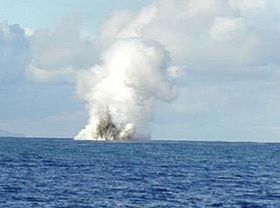
Underwater volcano erupts off Tonga 19 Mar 09 – Spectacular columns of steam and smoke spewed out of the seaabout 6 miles (10 km) from the main island of Tongatapu – an area where up to36 undersea volcanoes are clustered. Large
amounts of pumice from the volcanowill likely clog beaches on the southern coast of nearby Fiji islands shortly.
————–
Global warming may be caused by underwater volcanoes (Which I’ve been saying for years) 8 Dec 08 – A new study shows that the rise in land temperatures can be tied directly to increased heat and humidity coming from warmer oceans, which in turn may be caused solely by natural forces, including underwater volcanoes.
————–
Ocean Floor Geysers Warming The Seas (And we wonder why the oceans are warming) 22 Sep 08 – “It’s like finding Old Faithful in Illinois. When we went out to try to get a feel for how much heat was coming from the ocean floor and
how much sea water might be moving through it, we found that there was much more heat than we expected at the outcrops.”
————–
Geothermal heat may be melting the Greenland glaciers Nov 2007 – “Hansen’s model is wrong! In reality, the Greenland and Antarctic ice sheets occupy deep basins, and cannot slide down a plane. Furthermore glacial flow depends on stress as well as temperature, and much of the ice sheets are well below melting point.
————–
World’s deepest chain of undersea volcanoes to be explored 1 Sep 08 — Scientists at the National Oceanography Centre are set to explore the world’s deepest undersea volcanoes five kilometers beneath the Caribbean.
————–
‘Black smokers’ found in Arctic Ocean 4 Aug 08 – Jets of searingly hot water spewing up from the sea floor have been discovered in a far-northern zone of the Arctic Ocean, Swiss-based scientists announced Monday.
————–
Boiling Hot Water Found in Frigid Arctic Sea 24 Jul 08 – “Many miles inside the Arctic Circle, scientists have found
vents of scalding liquid rising out of the seafloor at temperatures that are more than twice the boiling point of water.
————–
Undersea volcanic activity blamed for mass extinction 93 million years ago 16 Jul 08 – Researchers from the University of Alberta, Canada, find evidence of underwater volcanism in rocks dating to a mass extinction 93 million years ago.
————–
Huge Underwater Volcanoes in the Arctic Ocean, but scientists see no significant connection to melting ice? 27 Jun 08 – The eruptions discharge large amounts of carbon dioxide, helium, trace metals and heat into the water over long distances, but scientists see no significant connection to melting ice.
————–
Giant Undersea Volcano Found Off Iceland (And we wonder why the oceans are warming) 22 Apr 08 – It’s an active volcano that rises about 3,300 feet (1,000 meters) above the surrounding sections, coming within 1,300 feet (400 meters) of the surface.
————–
Hawaiian volcano pumping more lava than usual into the ocean 5 Jul 08 – The Hawaiian Volcano Observatory said Saturday that Hawaii’s Kilauea volcano is pumping more lava than usual into the ocean.
————–
Magma May Be Melting Greenland Ice
18 Dec 07 – I added another article to this posting
13 Dec 07 – Scientists have found at least one natural-magma hotspot under the Greenland Ice Sheet where heat from Earth’s insides could seep through,
————–
Arctic seabed afire with lava-spewing volcanoes 25 Jun 08 – Red-hot magma has been rising from deep inside the earth
and blown the tops off dozens of submarine volcanoes, four kilometers below the ice. And we wonder what is melting the ice.
————–
Underwater Volcanic Eruptions, Not Meteor, May Have Killed Dinosaurs New discovery validates theories in Not by Fire but by Ice 30 Oct 07 – “A series of monumental volcanic eruptions in India may have killed the dinosaurs 65 million years ago, not a meteor impact in the Gulf of Mexico.

Then Barry adds another comment,

We’ve forgotten that this isn’t the first time our seas have warmed. Sea temperatures also shot upward 10º to 18ºF just prior to the last ice age.

As the oceans warmed, evaporation increased. The excess moisture then fell to the ground as giant blizzards, giant storms and floods (Noah’s Deluge type floods), and a new ice age began.

The same thing is happening today.

It’s not global warming, it’s ocean warming, and humans have nothing to do with it. Our seas are being heated, I believe, by underwater volcanism. Here’s why:

We are living in a period of vastly increased volcanism, said Dixy Lee Ray in her 1993 book Environmental Overkill, the greatest in 500 years. Eighty percent of all volcanism (say experts at NOAA) occurs underwater. Therefore, underwater volcanism should also be the greatest in 500 years.

Our seas, heated by underwater volcanism, are leading us directly into the next ice age . . . and we don’t even know it.
That’s what El Niño is all about. Warmer seas send excess moisture into the sky, leading to increased precipitation.
Worldwide flood activity is the worst since before Christopher Columbus. In Poland, it’s the worst in several thousand years. In the U.S., precipitation has increased 20 percent just since 1970. This is no coincidence.

When that precipitation begins falling in the winter, you have the makings of an ice age.

Here are some further references,

From the Nature website of 29th March, 2001,

South America’s oldest trees give up the ghost of climate past.

They’ve been dead for over 50,000 years, but South America’s longest-living trees still have a few tales to tell. A new study of the growth rings of partially fossilized trees in southern Chile hints that the global climate before the last ice age was rather like today’s.

Barry mentions Kavachi Island and I did a quick search and came up with this.

From Wikipedia,

Kavachi is one of the most active submarine volcanoes in the south-west Pacific Ocean. Located south of Vangunu Island in the Solomon Islands, it is named after a sea god of the New Georgia Group islanders, and is also referred to locally as Rejo te Kavachi (“Kavachi’s oven’). The volcano has become emergent and then been eroded back into the sea at least eight times since its first recorded eruption in 1939.

In May 2000, an international research team aboard the CSIRO research vessel FRANKLIN fixed the position of the volcano at 8° 59.65’S, 157° 58.23’E. At that time the vent of the volcano was below sea level, however frequent eruptions were ejecting molten lava up to 70m above sea level, and sulfurous steam plumes up to 500m. The team mapped a roughly conical feature rising from 1,100 m water depth, with the volcano having a basal diameter of about 8 km.

When the volcano erupted in 2003, a 15-meter-high island formed above the surface, but it disappeared soon after. Additional eruptive activity was observed and reported in March 2004 and April 2007.

Kavachi erupting May 14th, 2000.

Barry then looks as CO2 levels, he writes,

Carbon dioxide
If today’s rising carbon dioxide are caused by humans, what caused the dramatic rise in CO2 levels at the dinosaur extinction?

It was a matter of a moment’s search to find this, from Ice Age Now, Home Page here

If today’s rising carbon dioxide are caused by humans, then what caused the dramatic rise in CO2 levels at the dinosaur extinction? 

Research shows that there was “a sudden and dramatic rise” in carbon dioxide in the Earth’s atmosphere at the dinosaur extinction of 65 million years ago. A recent report attributes the rise in CO2 levels to an asteroid impact.
See http://news.bbc.co.uk/1/hi/sci/tech/2038599.stm

I disagree. I think today’s rise in CO2 levels can be attributed to our warming oceans. After all, the oceans are known as a carbon dioxide “sink,” especially when the water is cold. 

But as the water warms up, it releases CO2 into the atmosphere. This happens in much the same way that a warm bottle of home-brewed root beer will release CO2. And if you give that CO2 no way to escape, the bottle will explode.

We’ve got it backwards. We’ve got cause and effect in reverse.

The CO2 is not causing global warming. Instead, our warming oceans are releasing CO2 into the atmosphere.

It’s not global warming, it’s ocean warming, and it’s leading us into an ice age.

Finally, Barry offers this,

No Global Warming
“Even with needed corrections, data still don’t show the expected signature of global warming,” says Dr. Roy Spencer, Senior Scientist for Climate Studies NASA/Marshall Space Flight Center.

Unfortunately, the URL that Barry included didn’t function.  But a quick search on the NASA website came up with this,

Contrary Thermometers

Scientists are working to understand why the lower atmosphere isn’t heating up as fast as some global warming models predict.

July 21, 2000 — The question sounds like a Zen koan: How could the globe be warming and not warming at the same time?

That’s the riddle posed to climatologists by satellite and radiosonde data which show that while the Earth’s surface has been warming over the past decades, the lowest layer of the atmosphere shows a weaker warming trend.

The measurements are surprising, because computer simulations of the world’s climate predict that the two lowest layers of the atmosphere — which together form the “troposphere” — should be warming faster than the Earth’s surface.

Read the full article here.  It’s well worth reading and concludes with these closing paragraphs,

Current models suffer from several shortcomings.

For example, clouds are not well represented by the models. The resolution of current models is too coarse for features as small as clouds, Spencer said. Yet clouds clearly play a crucial role in climate due to their influence on humidity, precipitation and albedo (the percentage of solar energy reflected back into space as light).

“The role of clouds is still regarded as one of the biggest uncertainties in global warming predictions,” Spencer said.

The ability of plants to remove carbon dioxide from the atmosphere and the role of soils have only recently been added to the models, and scientists aren’t confident yet of how the models portray these factors, Spencer said.

“While we know that vegetation takes up some of the carbon dioxide we generate from burning of fossil fuels, how that sink of carbon will change in the future is still pretty uncertain,” Spencer said.

Climate models are also limited by the computing power available.

“The global models would be much better if computers were much faster,” Spencer said. “Instead, a lot of approximations are made to make the models simple enough to do climate simulations over the whole globe.

“Unfortunately,” Spencer continued, “we know that many of the processes that are crudely represented are quite non-linear, and so have the potential to respond in unexpected ways.”

The Global Hydrology and Climate Center is a joint venture between government and academia to study the global water cycle and its effect on Earth’s climate. Jointly funded by NASA and its academic partners, and jointly operated by NASA’s Marshall Space Flight Center in Huntsville, Ala., and the University of Alabama in Huntsville, the Center conducts research in a number of critical areas.

Web Links

Global Hydrology and Climate Center — a joint venture between government and academia to study the global water cycle and its effect on Earth’s climate

Measuring the Temperature of Earth From SpaceEven with needed corrections, data still don’t show the expected signature of global warming

December 1997 is Coldest Month on Record in the Stratosphere

Is Earth’s Temperature Up or Down or Both?Scientist’s investigate reasons for temperature trend “disagreements” between layers of the atmosphere

schematic of layers of Earth’s atmosphere

Java tool for global atmospheric temperature mapsexamine atmospheric temperature features

The Global Hydrology and Climate Center

OK, that’s enough from me for today.  Clearly it would take a great time for a layman, such as yours truly, to go through all this material, and more, to determine the truth of it all, to the very best abilities of science.  For the verdict on whether man’s increased generation of CO2 in the atmosphere is having a global effect on the global climate should be in the hands of scientists.

Once science has shown cause and effect then, and only then, should politicians endeavour to offer the way forward for society.

Having said that, there is no reason at all for mankind to maintain the present disconnect from Planet Earth.  Even if the jury is still well and truly out in terms of the effect of CO2 on the atmosphere, the number of other issues that are just as important for our long-term survival are still prodigious.  There’s an old saying in aviation, “If there’s any doubt, there’s no doubt.”

Always two sides

I am indebted to my life-long friend, Dan Gomez, for this piece.

Background (Personal nostalgia warning!!!)

Dan and I go back too many years; I mean way too many!  He and I met in Spring 1979 when I was addressing a national conference of US Commodore PC dealers in Boston, USA.  I was there to promote a British Word Processing program called Wordcraft, written by Peter Dowson, that I had exclusive rights to.  I was also a Commodore PC dealer in Colchester, Essex, England; indeed I was the 8th dealer appointed in the UK.  The luck in finding Wordcraft is underlined by the fact that between 1970 and 1978 I was a salesman with IBM UK Office Products division and ended up as a word-processing specialist salesman for IBM.

Anyway, in my sales pitch to these US dealers, I used the word ‘fortnight’, a common term in England.  From somewhere out in the audience, this Californian voice shouted out, “Hey Handover, what’s a fortnight?”  Many readers will be aware that Americans don’t use that term.  That Californian voice was Dan!

From that cheeky start came a great relationship including Dan being my West Coast distributor for Wordcraft.  It was Dan’s sister, whom I have also known for countless years, who invited me to her Winter home in San Carlos, Mexico, to spend Christmas 2007 with her and her husband and which was the catalyst of me meeting Jean, who is now by most beautiful wife!

Dan, my Best Man, at the wedding of Jean and me, November 20th 2010

————————ooOOOoo————————

OK, to the theme of this article.

Shortly after the Newsweek ‘Weather Panic‘ article on the 10th, Dan sent me this email,

Paul – Saw your blog vis a vis Newsweek’s recent cover.

Don’t forget to publish the other side of this perennial story without all the sensationalism of selling newspapers and proselytizing to the unwashed masses or you could end up drinking your own cool-aid.  The science of weather cycles, sun activity, ocean currents, high-altitude jet streams, colliding warm/cool fronts have been at work long before any creature walked the earth, let alone man. The facts demonstrate this time and time again. Good science is skeptical science and needs to be viewed carefully by way of verifiable and constant testing of hypotheses.

The below article, although not at all sexy, has a different view, in general, as to the vagaries of weather extremes.  There are many like this and represent unbiased, and to some, unpopular scientific reasoning at work.

Just food for thought.

–DG

He then included this.

Recent Weather Extremes: Global Warming Fingerprint Not

by Chip Knappenberger
March 21, 2011

On occasion, I have the opportunity to assist Dr. Patrick J. Michaels (Senior Fellow in Environmental Studies at the Cato Institute) in reviewing the latest scientific research on climate change. When we happen upon findings in the peer-reviewed scientific literature that may not have received the media attention that they deserved, or have been misinterpreted in the popular press, Pat sometimes covers them over at the “Current Wisdom” section of the Cato@Liberty blog site.

His latest posting there highlights research findings that show that extreme weather events during last summer and the previous two winters can be fully explained by natural climate variability—and that “global warming” need not (and should not) be invoked.

This topic—whether or not weather extremes (or at least some portion of them) can be attributed to anthropogenic global warming (or, as Dr. Pielke Sr., prefers, anthropogenic climate change)—has been garnering a lot of attention as of late. It was a major reason for holding the House Subcommittee hearing last week, is a hot topic of discussion in the press, and is the subject of an in-progress major report from the Intergovernmental Panel on Climate Change (IPCC).

As such, I wanted to highlight some of the findings that Pat reported on. I encourage a visit to the full article “Overplaying the Human Contribution to Recent Weather Extremes” over at Cato@Liberty.

The Great Russian Heat Wave of 2010

A new paper by Randall Dole and colleagues from the Physical Sciences Division (PSD) of the Earth System Research Laboratory (ESRL) of the National Oceanic and Atmospheric Administration (NOAA) examined the events leading up to and causing the big heat wave in Russia last summer (which was also part of an atmospheric pattern that was connected to the floods in Pakistan). Here is what they found:

“Our analysis points to a primarily natural cause for the Russian heat wave. This event appears to be mainly due to internal atmospheric dynamical processes that produced and maintained an intense and long-lived blocking event. Results from prior studies suggest that it is likely that the intensity of the heat wave was further increased by regional land surface feedbacks. The absence of long-term trends in regional mean temperatures and variability together with the [climate] model results indicate that it is very unlikely that warming attributable to increasing greenhouse gas concentrations contributed substantially to the magnitude of this heat wave.”

As Pat commented, “Can’t be much clearer than that.”

Recent Winter Severity

From Pat’s article:

Another soon-to-be released paper to appear in Geophysical Research Lettersdescribes the results of using the seasonal weather prediction model from the European Center for Medium-Range Weather Forecasts (ECMWF) to help untangle the causes of the unusual atmospheric circulation patterns that gave rise to the harsh winter of 2009-2010 on both sides of the Atlantic. A team of ECMWF scientists led by Thomas Jung went back and did experiments changing initial conditions that were fed into the ECMWF model and then assessed how well the model simulated the known weather patterns of the winter of 2009-2010. The different set of initial conditions was selected so as to test all the pet theories behind the origins of the harsh winter. Jung et al. describe their investigations this way: “Here, the origin and predictability of the unusual winter of 2009/10 are explored through numerical experimentation with the ECMWF Monthly forecasting system. More specifically, the role of anomalies in sea surface temperature (SST) and sea ice, the tropical atmospheric circulation, the stratospheric polar vortex, solar insolation and near surface temperature (proxy for snow cover) are examined.”

In a nutshell, here is what Jung et al. found:

“The results of this study, therefore, increase the likelihood that both the development and persistence of negative NAO phase [an atmospheric circulation pattern that was largely behind the harsh winter conditions] resulted from internal atmospheric dynamical processes.”

Or, as Pat put it “Translation: Random variability.”

Pat also examined a third study by Roseanne D’Arrigo and colleagues who found an historical analog of the conditions responsible for the harsh winter of 2009-2010 way back in 1783-1784. The winter of 1783-1784 was a historically extreme one on both sides of the Atlantic and has long been associated with a large volcanic eruption that occurred in Iceland during the summer of 1783. Even Benjamin Franklin connected the winter conditions to the volcano. But D’Arrigo and colleagues now suggest a different mechanism. According to Pat:

But in their new study, Roseanne D’Arrigo and colleagues conclude that the harshness of that winter primarily was the result of anomalous atmospheric circulation patterns that closely resembled those observed during the winter of 2009-10, and that the previous summer’s volcanic eruption played a far less prominent role:

“Our results suggest that Franklin and others may have been mistaken in attributing winter conditions in 1783-4 mainly to Laki or another eruption, rather than unforced variability.

“Similarly, conditions during the 2009-10 winter likely resulted from natural [atmospheric] variability, not tied to greenhouse gas forcing… Evidence thus suggests that these winters were linked to the rare but natural occurrence of negative NAO and El Niño events.”

Bottom Line

The take home message of Pat’s post is worth repeating:

The point is that natural variability can and does produce extreme events on every time scale, from days (e.g., individual storms), weeks (e.g., the Russian heat wave), months (e.g., the winter of 2009-10), decades (e.g., the lack of global warming since 1998), centuries (e.g., the Little Ice Age), millennia (e.g., the cycle of major Ice Ages), and eons (e.g., snowball earth).

Folks would do well to keep this in mind next time global warming is being posited for the weather disaster du jour. Almost assuredly, it is all hype and little might.

Be sure to check out Pat’s full article which includes much more in depth coverage of these three soon-to-be-released scientific studies.

————————ooOOOoo————————

I need to mull over this when I am back home with more time.  In the meantime, comments from readers most welcomed.

Gondolas for New York?

Can we really make sense of the science of climate change?

Those that come to this Blog on a regular basis, and many thanks to you, by the way, will know that, overall, I take the stance that climate change, global warming, etc., etc. is real.  At the very least to me it is reasonably described by the saying that most pilots are familiar with, “If there’s any doubt, there’s no doubt.”  In other words, if something is worrying you don’t hesitate to get your ‘arse’ on the ground.

The planet’s climate systems are incredibly complex and like processes and systems much less complex than the earth’s atmosphere getting to real hard evidence is challenging.  Please accept that my personal position is unchanged; for me there are sufficient signs to suggest that climatic changes may be more likely, than less likely, to substantially harm humankind’s existence on Planet Earth within the next generation.

However, Dan Gomez, my very good Californian friend of 40-plus years, is much more sceptical.  I respect his intellect greatly and, therefore, respect his opinions.  Dan recently sent me a number of documents that raise valid questions.  Over time I want to share these with you and invite anyone who wishes to comment on Learning for Dogs to do so, or even better submit a guest post.

But before going to the first of Dan’s documents, let me share something that was reported by BBC News recently.  It’s this.

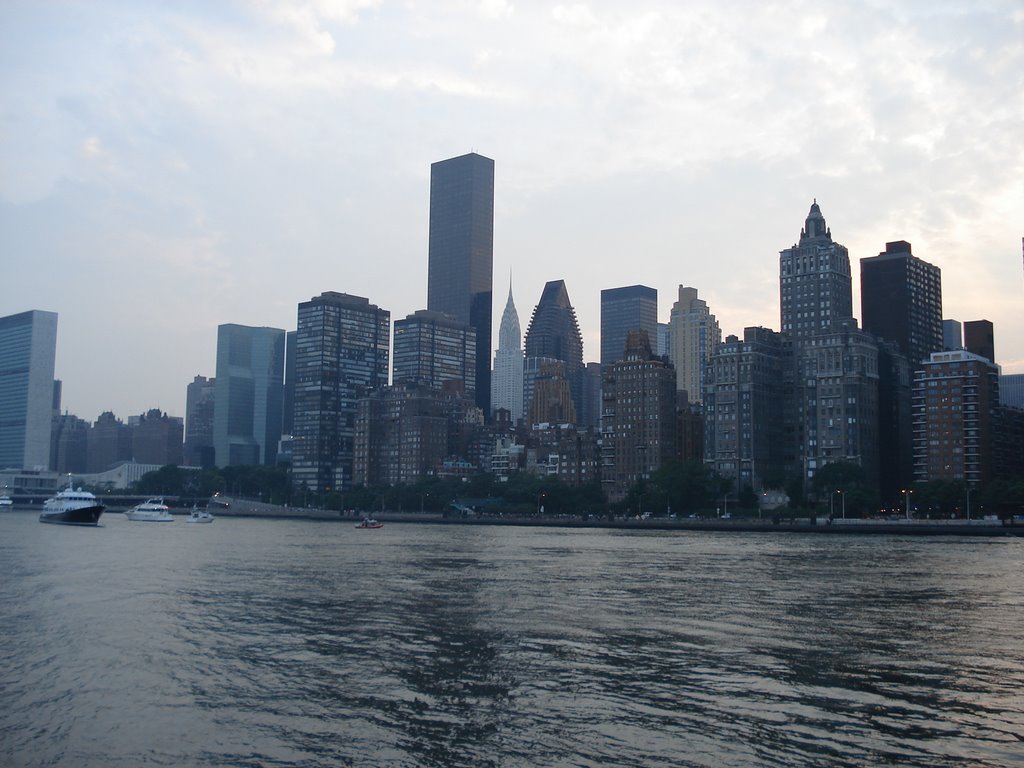
New York is a major loser and Reykjavik a winner from new forecasts of sea level rise in different regions.

The Intergovernmental Panel on Climate Change (IPCC) said in 2007 that sea levels would rise at least 28cm (1ft) by the year 2100.

But this is a global average; and now a Dutch team has made what appears to be the first attempt to model all the factors leading to regional variations.

Other researchers say the IPCC’s figure is likely to be a huge under-estimate.

Whatever the global figure turns out to be, there will be regional differences.

That IPCC report may be accessed here and the main website of the IPCC is here.  But even the BBC’s report shows that scientists are still learning more, as time goes on.

Ocean currents and differences in the temperature and salinity of seawater are among the factors that mean sea level currently varies by up a metre across the oceans – this does not include short-term changes due to tides or winds.

So if currents change with global warming, which is expected – and if regions such as the Arctic Ocean become less saline as ice sheets discharge their contents into the sea – the regional patterns of peaks and troughs will also change.

“Everybody will still have the impact, and in many places they will get the average rise,” said Roderik van der Wal from the University of Utrecht, one of the team presenting their regional projections at the European Geosciences Union (EGU) meeting in Vienna.

“But places like New York are going to have a larger contribution than the average – 20% more in this case – and Reykjavik will be better off.”

The news item also contains some fascinating evidence of the influence of gravity from the mass of the polar ice caps.  Read the full article here.

Gondola's for hire in a few year's time?

Now on to one of Dan’s documents.  It is from the website detailing the history of plant fossils of West Virginia.  The document refers to the climate of the carboniferous period.  Here’s how it starts.

West Virginia today is mostly an erosional plateau carved up into steep ridges and narrow valleys, but 300 million years ago, during the Carboniferous Period, it was part of a vast equatorial coastal swamp extending many hundreds of miles and barely rising above sea level. This steamy, tropical quagmire served as the nursery for Earth’s first primitive forests, comprised of giant lycopods, ferns, and seed ferns.

North America was located along Earth’s equator then, courtesy of the forces of continental drift. The hot and humid climate of the Middle Carboniferous Period was accompanied by an explosion of terrestrial plant life. However by the Late Carboniferous Period Earth’s climate had become increasingly cooler and drier. By the beginning of the Permian Period average global temperatures declined by about 10° C.

Interestingly, the last half of the Carboniferous Period witnessed periods of significant ice cap formation over polar landmasses– particularly in the southern hemisphere. Alternating cool and warm periods during the ensuing Carboniferous Ice Age coincided with cycles of glacier expansion and retreat. Coastlines fluctuated, caused by a combination of both local basin subsidence and worldwide sea level changes. In West Virginia a complex system of meandering river deltas supported vast coal swamps that left repeating stratigraphic levels of peat bogs that later became coal, separated by layers of fluvial rocks like sandstone and shale when the deltas were building, and marine rocks like black shales and limestones when rising seas drowned coastlands. Accumulations of several thousand feet of these sediments over millions of years caused heat and pressure which transformed the soft sediments into rock and the peat layers into the 100 or so coal seams which today comprise the Great Bituminous Coalfields of the Eastern U.S. and Western Europe.

One needs to read the full article to properly understand this period of history of the planet.  But it includes revealing diagrams like this one.

Global Temperature and Atmospheric CO2 over Geologic Time

Here’s how it concludes.

What will our climate be like in the future? That is the question scientists are asking and seeking answers to currently. The causes of “global warming” and climate change are today being popularly described in terms of human activities. However, climate change is something that happens constantly on its own. If humans are in fact altering Earth’s climate with our cars, electrical powerplants, and factories these changes must be larger than the natural climate variability in order to be measurable. So far the signal of a discernible human contribution to global climate change has not emerged from this natural variability or background noise.

Understanding Earth’s geologic and climate past is important for understanding why our present Earth is the way it is, and what Earth may look like in the future. The geologic information locked up in the rocks and coal seams of the Carboniferous Period are like a history book waiting to be opened. What we know so far, is merely an introduction. It falls on the next generation of geologists, climatologists, biologists, and curious others to continue the exploration and discovery of Earth’s dynamic history– a fascinating and surprising tale, written in stone.


Truth fears no questions.  ~Unknown