Tag: Integrity

A very beautiful friendship

Foreword by Jon

Although I have only seen a trailer for this film, I watched the interviews and excerpts Paul has linked in this article and found them very moving.

In these days of uncertainty and fear it is heartening to see and read about a relationship founded on unconditional love.

It signifies to me that it is the quality of our relationships that makes the difference in life, not material possessions – and then how we go about finding more examples of these in our everyday lives.

Jon Lavin

This is all about Trust

The prompt for writing this particular Post was the other evening Jean and I watched the film The Soloist.  I’ll come on to that later.

Before I do, I want to look at another aspect of learning from dogs; that is the question of trust.  We have so much to learn from dogs with regard to trust.

Because dogs spend so much of their time living in the present, just being a dog in the ‘now’ moment as it were, they seem to be able to read another dog very quickly.  Dogs don’t have ‘hidden agendas’.

You see we humans can be (and should be) as happy in the present as dogs are.  But so often our fears, worries and concerns for the future hinder our ability to experience the present, to enjoy the NOW.

Look at the faces of others around you when you have a moment.  (Or, indeed look at your own right now in the mirror.) Do you see a face serenely happy unencumbered with the past or the future?  Rarely is my guess.

That’s why a dog can read another dog in micro-seconds and know everything about that other animal. There are no secrets – what you see is what you get.

Look at this picture.

Pharaoh and Poppy

This is Poppy (8 lbs/3.5 kg) picking up food droppings from Pharaoh (90 lbs/40 kg).  In fact, within seconds of taking this picture, Poppy had pushed between Pharaoh’s front legs and put her face in the dish and started eating Pharaoh’s food, at which point Pharaoh went over the Poppy’s dish and started eating from there. (NB. Anyone that has  dogs in their home will know how possessive they can be at feeding time.)

Immediately when Pharaoh met Poppy, when he and I ended up in Mexico in 2008, they instantly trusted each other.  This is a beta level (second in status to the alpha, i.e. dominant) pure bred German Shepherd bonding with a Yorkie mix female dog that was found, hairless and starving, on a Mexican construction site – rescued by Jean after almost certainly being thrown out after she had made some Mexican a few pesos from selling her puppies.

Here’s another picture of these two:

Total trust!
Jamie Foxx and Robert Downey Jr in The Soloist

Now to the film.  It wasn’t a blockbuster and didn’t get rave reviews but if viewed from the simple perspective of trust and friendship it delivers a powerful message that is beautifully compelling.

There’s an official trailer on YouTube here but the better review is this extract from the 60 Minutes programme below.

You need to watch this film to see how trust is built up, and out of that trust comes a wonderful friendship.  But you will get a taste of the sheer beauty of this true story by this 12 minute YouTube video.  Try and put aside these few minutes so you can watch this without interruption.

And here’s a link to another extract from the 60 Minutes programme concentrating on Mr Ayers playing his heart out.

If you want to read the column in the LA Times that Steve Lopez wrote in December 2004 about Mr Ayer’s Christmas present, just click here.

Finally, the film closes with these words from the actor who portrays Mr Lopez.  Please read them to yourself, aloud if you can.

Points West by Steve Lopez

A year ago I met a man who was down on his luck and thought that I might be able to help him. I don’t know that I have. Yes, my friend Mr. Ayers now sleeps inside.  He has a key, he has a bed, but his mental state and his well-being are as precarious now as they were the day we met.

There are people who tell me that I helped him, mental health experts who say that the simple act of being someone’s friend can change the brain chemistry, improve his functioning in the world.

I can’t speak for Mr Ayers in that regard, maybe our friendship has helped him, but maybe not.

I can however speak for myself.  I can tell you that by witnessing Mr Ayers’ courage, his finality, his faith in the power of his art, I’ve earned the dignity of being loyal to something you believe in, holding on to him.  Above all else, I believe him, without question that it will carry you home.

And now recall that when you were reading those words, you were totally and completely living in the present. Keep that feeling of grace close to you forever.

By living in the present, you offer yourself as a friend to the world.

By Paul Handover

Pass the parcel

Congratulations to Martin Wolf of the Financial Times

An article was published in the FT on the 29th June that beautifully describes the ways in which we are all being so beautifully ‘screwed’ by the world of finance.  (Note, you may need to register to see this article, but please do.  Registration is free and the FT is full of great content.)

It starts like this:

This global game of ‘pass the parcel’ cannot end well

By Martin Wolf

Published: June 29 2010 23:31 | Last updated: June 29 2010 23:31

Paul here. Pass the parcel is a game for kids’ parties that involves passing a multi-wrapped ‘present’ around where the kid holding the parcel when the music stops gets to unwrap one sheet, then passes it on, etc., etc., until the kid holding the parcel with just one wrapper on it when the music stops gets the present.

Martin continues:

Our adult game of pass the parcel is far more sophisticated: there are several games going on at once; and there are many parcels, some containing prizes; others containing penalties.

So here are four such games. The first is played within the financial sector: the aim of each player is to ensure that bad loans end up somewhere else, while collecting a fee for each sheet unwrapped along the way. The second game is played between finance and the rest of the private sector, the aim being to sell the latter as much service as possible, while ensuring that the losses end up with the customers. The third game is played between the financial sector and the state: its aim is to ensure that, if all else fails, the state ends up with these losses. Then, when the state has bailed it out, finance can win by shorting the states it has bankrupted. The fourth game is played among states. The aim is to ensure that other countries end up with any excess supply. Surplus countries win by serially bankrupting the private and then public sectors of trading partners. It might be called: “beggaring your neighbours, while feeling moral about it”. It is the game Germany is playing so well in the eurozone.

It’s an article that really does need to be read in full. Martin concludes thus:

Yet it is quite clear that an isolated discussion of the need to reduce fiscal deficits will not work. These cannot be shrunk without resolving the overindebtedness of damaged private sectors, reducing external imbalances, or both.

The games we have been playing have been economically damaging. We will be on the road to recovery, when we start playing better ones.

Now I really don’t want Learning from Dogs to focus on ‘doom and gloom’. There’s more than enough of that to go round twice and thrice.

But when someone writes in such a great clarifying way – then it deserves the widest promulgation. The more we all know about the games being played, the better we can change the rules to benefit society.  Well done, Martin.

By Paul Handover

On being … well, honest!

Conscientiousness isn’t all it’s cracked out to be!

(Foreword from Paul.)

Jon is one of those rare individuals who not only has been committed to a path of self-awareness for more than 30 years but who has also studied incredibly hard so as to be able to help others and do so from a base of real competence, as his own Blog describes.  I can speak as a current ‘client’ of Jon who is assisting me in my own journey.

But then I realised the great strength in what Jon has written.  It is this.

There are many notable teachers out there who thousands upon thousands have turned to for a deeper understanding of what life is all about.  As far back as time itself teachers have surfaced and given spiritual guidance to those that come in need.  But it’s very difficult to read or listen to these great teachers and connect with the fact that they were born, as we are all born, with nothing.  And all of them, like many of us, went through Hell on wheels to come out the other side with a greater self-awareness and a deeper understanding of the real truths in nature.  Like all of us who wish to rise above our present place they first acknowledged their own frailties. It is the starting point.

So, let me get to the point.  Jon has the awareness and understanding to offer real help to those that seek answers that are currently beyond reach.  Jon’s article is an wonderful illustration that he experiences the same fears and feelings of helplessness that you and I feel.  You and I and Jon and all of humanity are much more closely connected than we realise.

Paul H.

—————————————–

To see in is to see out!

I’ve been running my own business for about 12 years now. In the beginning it started because I had a thirst for wanting to make a difference in small business in our local area and a passion for wanting to do it through working with people directly, on their behaviours. Still have, really.

I think this came as a form of acknowledgement to the few exceptional people managers I experienced while I was employed, and the all too common, terrible ones.

I was also mentored by a group of people to whom no developmental tool was barred. My eyes were well and truly opened to how a change of view could change outcomes.

The final boot up the backside was redundancy in the late 90s. I was all ready to go and just needed a kick.

My work ethic, trained at home and then through an engineering apprenticeship, was to conscientiously work hard and try hard and to treat people the way you want to be treated. Nothing wrong with that. I assumed automatic reward would follow as long as I did those things.

Over time I wised up and became a bit less idealistic and a little more politically aware but carried on in much the same way.

Much later I found myself embarking on a whole new adventure, with a lovely wife and family, all dependent on me, with a few contacts to start getting work from!

It took a year before the first jobs came in that didn’t necessitate robbing the almost non-existent savings and redundancy payment just to keep food on the table. Then, work slowly picked up and it started to get quite good for a one-man band. We were able to go on holiday once a year, camping, but still great, and then abroad.

All the time, I beavered away, trying hard, being very conscientious, as I’d been brought up to be, but slowly getting very stressed.

Time was when it took Friday night to de-stress, then 3 days, then 10 days and recently, not at all.

So faced with this present downturn, which is likely to go on for much longer than any of the others I’ve seen and survived, I’m wondering just what new strategy to adopt. Money is already getting very tight and everything is feeling very ‘hand to mouth’. Can’t really see one month in front of the other.

I notice our local farmer who I went to school with but didn’t really know.

I’ve got degrees, lived abroad, can speak Finnish fluently, (what use is that, I hear you say!), and can turn my hand to most things, but I still feel quite dis-empowered and at a bit of a loss.

My farmer friend is always smiling, he’s got a flock of geese he’s fattening up, the same with his beef cattle, does livery for half a dozen horses or so, has fields planted with various cereal crops, and has his finger in lots of different pies – and definitely does not look stressed. He is also renting his land plus another farm.

I honestly don’t know what to make of this all except for a few really important things – the importance of diversification, relationships and appreciating what you’ve got, especially people things, here, in the now.

I have also come to the realisation that I still haven’t cracked the main thing with being self-employed, and that is replacing fear with trust.

It’s been said by various enlightened people that we see a reflection of the world we hold in mind. Going forward into this brave new world I would like to see opportunities rather than fear, I will diversify into things which make more use of my wide range of talents, and I will swap fear for trust.

By Jon Lavin

Fire lighting

The answer to whom we turn to when the times are tough.

Light your own fire!

Regular readers of Learning from Dogs will know that a few days ago, Sherry wrote a piece entitled Light My Fire? It expressed her view that lately she was finding it a problem to be inspired, finding the passion as Sherry put it.

I have been thinking about Sherry’s article for the last few days and a couple of peripheral things come to mind.

We tend to get more of what we notice and orient towards. By allowing ourselves to become absorbed in the negative, that is what we tend to notice.  The fact is that the media thrive and make vast sums of money focusing on the negative. Just compare the amount of negative with the positive in any news cast.

That is not to say that we should not be aware of the negative or hide our heads in the sand. We can however change the way we view things and that has to come from within.

In fact, the answer rarely lies “out there”.

Change in how we view things, i.e. our attitude, needs to start coming from “within” ourselves.

The one thing that characterises these times is uncertainty.

A lot of us don’t even know where the next bit of money to pay the bills is coming from. In spite of the tendency to look ‘out there’ for strong direction, I still feel that the inner resolve has got to come for inside.

Another thing, I don’t believe it’s possible to think ourselves out of this one.

Although it’s a subject I go on a lot about, the sense of direction and well being has to come from us, or rather the feeling of interconnectedness that we share with everything. At a level, we are all connected.

We are all connected.

The one thing that gets us all through is a faith in some higher consciousness, that we can all tap into when we remember and ask for that miracle of clarity.

This is not thinking. The opposite in fact. This is a process of trust and ‘allowing’.

Allowing requires a power that few can sustain for long as we’re all geared to doing.  ‘Allowing’ requires us to turn off the noise machine that is in our head and creating a quietness and space for awareness to surface.

Paul recently wrote an article on Living in the Present that describes this way of letting go rather well.  I know for a fact that Paul is new to these ideas but already he is finding a peace and clarity emerging that shows that there’s always a good time to start – NOW!

Back to my thoughts. I am not advocating lying down and letting the world roll over us – the opposite in fact. By bringing awareness into this whole mess, we are more likely to take the right action.

I have honestly noticed that the more effort and circular thinking I have put into my present financial difficulties, and I’m a real expert in worry and circular thinking, the worse things have got.

I notice that by returning to silence and simply observing, a background is created that allows solutions and options to rise.

By asking to be shown the way forward and then letting go of the need for an instant solution, subtle options and ways forward present themselves.
Then right action follows.

An acceptance that in any moment we are all operating at our maximum level of consciousness. We are all doing the best we can. If we knew better, we would do better.

Therefore, what is going on in the world is a reflection of ourselves and is absolutely perfect for where the sum total of all of us are. (“Perfect”, does not mean we have to like it but it is, never the less, inevitable)

It follows, therefore, that the best way to help the world is to work on ourselves by striving to be the best we can, in every way. And the only way to do that is with awareness.

I think it was Abraham Maslow who coined the phrase, “Self Actualising”, meaning, being the best we can in every way, mentally and physically.

During these undoubtedly troubled times in the earth’s history, we all tend to turn to someone or something to provide a sense of direction.  That someone you need to turn to is yourself.

By Jon Lavin

Letter from Payson – The Farmers Market

A foreigner but not a foreigner!

Despite the fact that we have now been living in Payson, Arizona, since the end of February and, therefore, a degree of familiarity exists in both directions, the local Saturday Farmers Market prompted this thought.

Why do I not feel a foreigner here?

There is no question that America, in general, and Arizona, in particular, is very different to England.  In many ways the differences are far greater than, say, England and Australia, or England and New Zealand (I’m picking other English speaking countries to avoid to obvious difference between countries of different languages).

Local goats' cheese

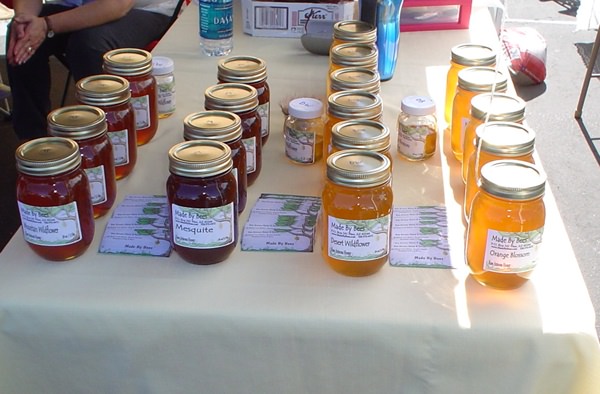
I love Farmers Markets.  They seem to encapsulate the wholeness of locals growing meat and produce for other locals. They seem to serve as a reminder of the integrity that is needed just as much in food as in all other areas of life.

Of course, I am not so naive to think that we could wind the food revolution back to before the days of supermarket chains – food is wonderful value nowadays especially for those families on tight incomes.

But I can’t be the only one that ponders what the long term effect of all those

Local jellies (jams to Brits!)

E-numbers and other strange ingredients that one reads on most packets of most items, and whether or not fruit is sprayed with anything that we should know about, and so on and so forth.

That’s why that place in my psyche is ‘stroked’ so well by wandering around the Farmers Market.

One would expect if there was going to be any place where yours truly, dressed and sounding like the Englishman that he is, is going to feel foreign, it would be at the Payson Farmers Market.  I don’t even try to hide my origins, responding to a “Howdy folks” from the stall-holder with a quintessentially English “Good Morning!

Inevitably there are reasons why I am made to feel welcome here in Payson, my hunch is that it is much to do with this being a pioneering town for most of the last 100 years, and therefore co-operation, collaboration and a welcoming attitude were key elements of sustaining a way of life, but, in the end, analysis is pointless.

What matters is how we are made to feel, and we are made to feel very welcome.

Indeed, Payson with it’s predominance of right-wing, independent thinking, tough ‘cow-boy’ inhabitants echoing a recent past, may have an important lesson for all of us, across the globe, as the forces of disconcerting change build and build: be local, think local, preserve local.

I’m very proud to be slowly but surely turning into a Payson local.

By Paul Handover

BP and Congress

Truth – 0, Lawyers – 1

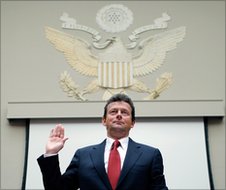
Hayward of BP taking the oath

I can’t possibly add anything of substance to the hours and millions of words spoken about this tragic event.

All I felt as I watched the Congressional Hearing live on CNN was both embarrassment and sadness as a fellow Englishman demonstrated how the lawyers have won.

Hayward, from the couple of hours that I saw, said nothing of substance, nothing of real value and nothing that recognised how the American people, and the world in general, deserved openness and in-depth answers.

Very poorly advised, in my opinion.

Tragic.

By Paul Handover

BP – where lies the truth?

Among the calamities of war may be jointly numbered the diminution of the love of truth, by the falsehoods which interest dictates and credulity encourages.‘ (Samuel Johnson, from The Idler, 1758)

I have used this quotation simply because we need to remind ourselves that the media, politicians, journalists and many ordinary folk find it easier to be extreme, opinionated, outlandish and provocative (ergo, ignorant) than to be thoughtful and reflective about an incredibly complex situation.  Rant and blame, while making for great reading or viewing, is not helpful.

This all came to mind from reading a recent article in The Financial Times (you may need to register to view it) which was titled:

Britain should back down over BP

By Clive Crook

That article starts like this:

A week ago I criticised the US media for childishly demanding that President Barack Obama “just do something” about the oil spill in the Gulf of Mexico, observing there was much to be said for a leader who stayed calm in a crisis. Next day, no doubt as a result, Mr Obama became pointedly less calm. He called for some “ass to kick”, a very Bushian sentiment, and dialled up the invective against BP – which he likes to call by its old name, British Petroleum, to underline the company’s alien perfidy.

The US outcry against the company is still building, and the administration, intent on deflecting its critics, has put itself in the vanguard. Criminal investigations and efforts to remove a statutory cap on the company’s liability are under way. It is ominous that lawyers are working hard, with the administration’s blessing, to enlarge the very concept of civil liability.

And concludes thus:

The question of whether even this company’s mighty resources are adequate to meet these demands cannot be dismissed. In such circumstances, I cannot see why BP has hesitated to suspend its dividend. The idea that it can take this calamity in its stride and proceed on the basis of business as usual is absurd, and politically foolish too, since it is a provocation to critics intent on vengeance.

The Gulf disaster will have far-reaching economic and energy-policy implications. The right liability and mandatory insurance regimes for deepwater drilling are high on the list. No doubt the White House should worry less about kicking ass and more about thinking these questions through. But British complaints that BP is being “scapegoated” will not help reason to prevail. Let us not add insult to injury.

Frankly, I don’t have either the knowledge or the competence to judge the validity of Mr Crook’s article and, as so often in cases like this, took to reading the comments as they can frequently shed more light on a particular issue.

And that is how I came across the following comment from RiskManager. Whoever you are, well done on taking the time to put what feels like some badly needed balance into this issue. This in no way lessens the terrible harm being metered out on innocents, just as in any ‘war’, but this is not about winning – it is about learning.

From RiskManager

Unlike ANY U.S. company EVER in a similar situation (Exxon, Union Carbide, Accidental Petroleum, etc. etc. – its ALL of them), BP has indeed done the right thing since the blowout by immediately admitting its liability/responsibilities. It has mobilised the largest containment and clean up operation ever and immediately issued compensation to those affected. The effort to stem the well, something never done before at this depth, has seen the assembly of the best experts in the world and the greatest concentration of sub-sea equipment perhaps ever seen. That efforts have failed so far to stem the leak is a fact that testifies to the challenge of the task, a challenge that cannot be understood until the failed Blowout Preventer (BOP) is recovered and we find out why the accident happened and why the top-kill did not work. What is going on inside the BOP?

And there it is. Today we just do not know. The failsafe in place, a modern BOP, failed. We don’t yet know why. BP may well. Transocean and Cameron the same. When we do recover the failed BOP which is under subpoena already all the questions will be answered. Until then it is fatuous and unhelpful to go round looking for bottoms to boot.

Why the gas kick happened down the well seems to me to be secondary. Things happen. That’s why we have a failsafe, that’s why there was BOP installed and paid for by BP, the failsafe device.

An editorial in The Daily Telegraph of yesterday said….

“It should not be difficult to rewrite the rules to make sure that no deep-water drilling is permitted without a fail-safe arrangement in place from the start,…..”

No, these are the current rules. The fail-safe arrangement was the blowout preventer, the one that failed. Note how BP always refer to it as the “failed blowout preventer”. Always.

The BOP has multiple (five I think) valves, of varying types with at least one that is meant to shear the casing, the drill pipe and anything else.

One valve was operated from the surface by the tool pusher who testified as such, indeed he operated it before the Offshore Installation Manager gave permission as mud circulation had been lost. That failsafe BOP valve failed.

The next I believe is a failsafe that shuts when contact is lost with the rig, like a dead mans handle on a train. As the Deepwater Horizon rig sank and contact was physically broken (or before), it also failed.

The others (three ?? ) are I believe all meant to be operable by sub sea vehicles (ROV’s). The first days after the blowout were spent trying to shut these valves as per the design of the failsafe device, the blowout preventer. All these valves failed.

That’s a lot of failure. Why??

Now, if BP should have known about whatever is found to have happened in the failsafe BOP then it is their fault. If sub-contractors installing and operating the BOP or is manufacturers lied or were negligent it is there fault.

If the blowout preventer had worked as intended, as the failsafe final defence device, there would have been no loss of life and no oil spilled.

Given the sums of money involved I suggest the UK immediately prepares to seize US assets of potentially liable companies or associates in the event that BP is found to be the victim of its supplier’s negligence. Unlike BP these companies have already sought protection of US law, are paying dividends and are saying nothing at all as BP gets a kicking

At the end of the day, we (you and I) need the deepwater oil as the worlds easy and cheap to produce oil reserves are controlled by the OPEC cartel and restricted to about a 40% of global production from 80% of reserves. But however many failsafes, however many regulations, human activities entail risk. The deep water drilling was thought to be safe with a modern BOP. It wasn’t. Now we need a BOP and inspection/testing regime that really is failsafe and expertise in responding if that fails. I would have thought the facility to install a new shear ram at the well head below the BOP after a blowout would do the job, or a fitting at the top of the LMRP that a ready built new valve could be installed on top of post blowout would do the job..

Ironically BP will certainly be the world experts in these matters after this accident and response.

P.S. Shortly after completing this Post, I read the following from the BBC. (Extract provided only – see link for full BBC article.)

Barack Obama calls for clean energy push

President Obama

US President Barack Obama has called on his Democratic Party and other supporters to back a government campaign for clean energy.

In a statement aimed both at paid-up Democratic Party members and at millions of individuals who backed his 2008 presidential bid online, the president asked his network to lend their name to a campaign to change the way America produces and consumes its energy.

“We are working to hold BP accountable for the damage to the lands and the livelihoods of the Gulf Coast, and we are taking strong precautions to make certain a spill like this never happens again,” Mr Obama said.

“Beyond the risks inherent in drilling four miles beneath the surface of the Earth, our dependence on oil means that we will continue to send billions of dollars of our hard-earned wealth to other countries every month – including many in dangerous and unstable regions,” he said.

“In other words, our continued dependence on fossil fuels will jeopardise our national security. It will smother our planet. And it will continue to put our economy and our environment at risk.

“We cannot delay any longer, and that is why I am asking for your help.”

Let me close as I started, by using an old saying:

“It’s an ill wind that blows no good.” (John Heywood (c.1497-1580))

By Paul Handover

BP and the mirror on the wall.

This is very, very uncomfortable.

Reflecting the truth?

Trying to say anything new about the implications of the terrible disaster in the Gulf of Mexico would be impossible.

All I can do is to admit my very great discomfort at knowing that later today, I shall be returning to Phoenix by flying across the Atlantic in a Boeing 747.

A small amount of web research suggests that there are about 600 transatlantic flights a day and that my B747 will use roughly 10 tons of fuel an hour, i.e. conservatively 100 tons for the flight LHR-PHX.

So 600 x 100 = 60,000 tons of fuel every day just in flights across the Atlantic!

So pointing the finger at BP is, in a very real sense, misdirected.  BP are only responding to our need for oil, in all its forms.

Do watch the videos from Prof Al Bartlett being shown on this Blog from tomorrow to understand the mathematics behind our unsustainable way of life.

By Paul Handover

Ticker Guy

Karl Denninger is a hero!

Karl Denninger - Mr Market Ticker

Several times a week, I drop into Karl Denninger’s blog The Market Ticker.  While frequently the articles are too technical for me, it’s still, nonetheless, possible to get the drift of Karl’s messages.

As his overall theme is strongly coincident with my own views on my pension investments, and which have served me proud over the last 10 years, especially the last 2 years, it’s natural that I like what Karl does.

But the point of this Post is to underline just how much time and effort Karl puts in to his work, all of which is free to the world at the click of a mouse.

Are there others who devote equal amounts of time to their Blogs and websites?  Yes, many!  And many of them are also heroes (and heroines!)

Of course, I have no doubt that The Market Ticker is part of Karl’s business strategy but, again, he could choose other ways to make his income without sharing, for free, so many valuable ideas.

Here are a couple of examples to underline my deep respect for this man. (Taken from Market Ticker on the 13th May.)

Read more of this Post

The Fourteenth Banker

What interesting times we live in.

Came across a relatively new Blog with the title The Fourteenth Banker.  Caught my eye because of the similarity to the book written by Simon Johnson and James Kwak of Baseline Scenario fame.  Here’s an extract from the ‘About’ piece of this new Blog.

In response to the comments of folks in the Congress and oversight regimes, I have created this blog as a home for bankers who need to speak out and do not have a central clearinghouse or a safe place to do so.     Big banks now treat their employees like property, bought and owned.     Typically employees must subject themselves to all sorts of potential sanctions, forfeitures of compensation, clawbacks and even lawsuits if they speak in ways we often have thought were protected speech.   I am not talking about revealing confidential customer or proprietary information, I am talking about simply commenting on a company, management philosophy, making general observations or raising concerns.     It makes one appreciate unions even if not historically supportive of unions.   At least management and labor can have a debate.    Not so in today’s large banks.    Gag orders are written in the most intimidating way, included in Codes of Ethics, attached to incentive plans, posted on the company home pages.     We should ask ourselves, what is the big secret?

Do support the Blog by calling by.  Here’s a taste of what they are writing about:

Lying at Leyman

What is a million between friends?

Read this piece from Bloomberg Businessweek How Much Did Lehman CEO Dick Fuld Really Make?

This can only be called what it is. Delusion. Delusion about self, society, morality, values and anything else you can name. These are symptoms of a grave illness which is too common among those in power. In fact, the illness may be the requisite to power.

By Paul Handover