This second offering from Dan is very different to yesterday’s deep space theme.
Yesterday, I published an item sent in by Dan that included a video of an area of deep space photographed by the Hubble Space Telescope. Do take a look if you missed it yesterday – it is truly astounding.
Today, something from Dan that is altogether much more pragmatic, albeit very funny. Enjoy!
Dan sent me an email with a link to a most astounding video. But before we get to that, just take a look at these images. Here are the first three from the set of eight.
Eight breathtaking images of baby stars
1. Beautiful newborns
In a universe of fantastic images, a newborn star is a mystical masterpiece. Cradled within the dusty arms of a nebula, a baby star seems to blink its way to a new life. The lifespan of a star is a series of sequences. A star may spend most of its life in a “main sequence phase” where nuclear fusion of hydrogen into helium is happening in its core. But before this happens, it lives as a protostar, or baby star.
Thanks to NASA’s advanced infrared space telescopes such as Hubble and Spitzer, we are able to view these star births as never before. Pictured here are newborn stars peeking out “from beneath their natal blanket of dust” in the Rho Ophiuchi dark cloud as seen by the Spitzer Space Telescope. (Text: Katherine Butler)
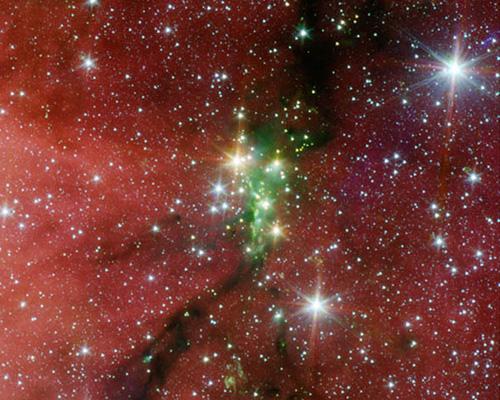
2. Young stars in Serpens
Here the Spitzer Space Telescope reveals the Serpens South star cluster, in which 50 or so young stars exist. They are seen as the “green, yellow, and orange-tinted specks sitting atop the black dust lane.” A supernova or galaxy collision can cause a star to form when huge clouds of hydrogen and helium collapse under mutual gravity. As the cloud collapses, it heats up and starts to spin. Since protostars are covered in dust, they can be seen only through infrared telescopes like Hubble and Spitzer. As Universe Today writes, “After about 100,000 years or so, the protostar stops growing and the disk of material surrounding it is destroyed by radiation.” Then this star, now called a T Tauri or pre-main sequence star, is visible from Earth.
3. Bubbly little star
We are used to images of babies blowing bubbles, and it looks like the infants of the cosmos do the same. This image, taken by the Spitzer Space Telescope, shows the HH 46/47 baby star blowing bubbles into space via powerful jets of gas. Located about 1,140 light-years from Earth, HH 46/47 is the bright white star at the middle of the image. Two bubbles reach out in opposite directions and are formed when the jets collide with the dust and gas surrounding the star. As Universe Today reports, “Astronomers think that young stars accumulate material by gravitationally pulling in gas and dust. This process ends when the star gets large enough to create these jets. Any further material is just blown away into space.”
Go and view the remaining five stunning images here.
Now to what was sent by Dan.
Check out this mind-bending video that talks about the “Hubble Ultra Deep Field” image captured by NASA astronomers nearly a decade ago — a photograph that some call “the most important image ever taken.”
It all started back in 1996 when a group of astronomers pointed the Hubble Space Telescope at an empty patch in the sky close to the Big Dipper in hopes of seeing something, anything. At the time, it was considered to be a risky move, given that demand for use of the telescope was so high. What if the experiment yielded no results? What if nothing but an empty image was the final result?
After ten full days of exposing the telescope’s CCD camera sensor to this seemingly vacuous patch of sky, a breathtaking image was produced. Over three thousand galaxies appeared in one image — some as dots, others as spirals. It was a visual reminder of just how big our universe really is. The photo is called the “Hubble Deep Field“:
In 2004, astronomers pointed Hubble near constellation Orion and opened the shutter for a whopping 11 days. Using sensitive detectors and specialized filters, the telescope was able to capture an image with over 10,000 galaxies. This image became known as the “Hubble Ultra Deep Field.”
Scientists later used redshift calculations of the galaxies to turn the photograph into a “fly-thru” view of the photo:
It didn’t end there. Last year, NASA scientists created the Hubble Extreme Deep Field, which has an equivalent exposure time to 23 days and features. It’s the “deepest image of the sky ever obtained” that reveals “the faintest and most distant galaxies ever seen”:
And just think: scientists created these photos by pointing their mega-camera at a tiny speck of the night sky that appears to be completely devoid of visible stars!
oooOOOooo
“… a tiny speck of the night sky that appears to be completely devoid of visible stars!”
Dan said in his email, “Are we really here? What are the chances?”
You really have to wonder! Incredibly long odds. Both to us being here and to us being the only conscious, intelligent species in the universe.
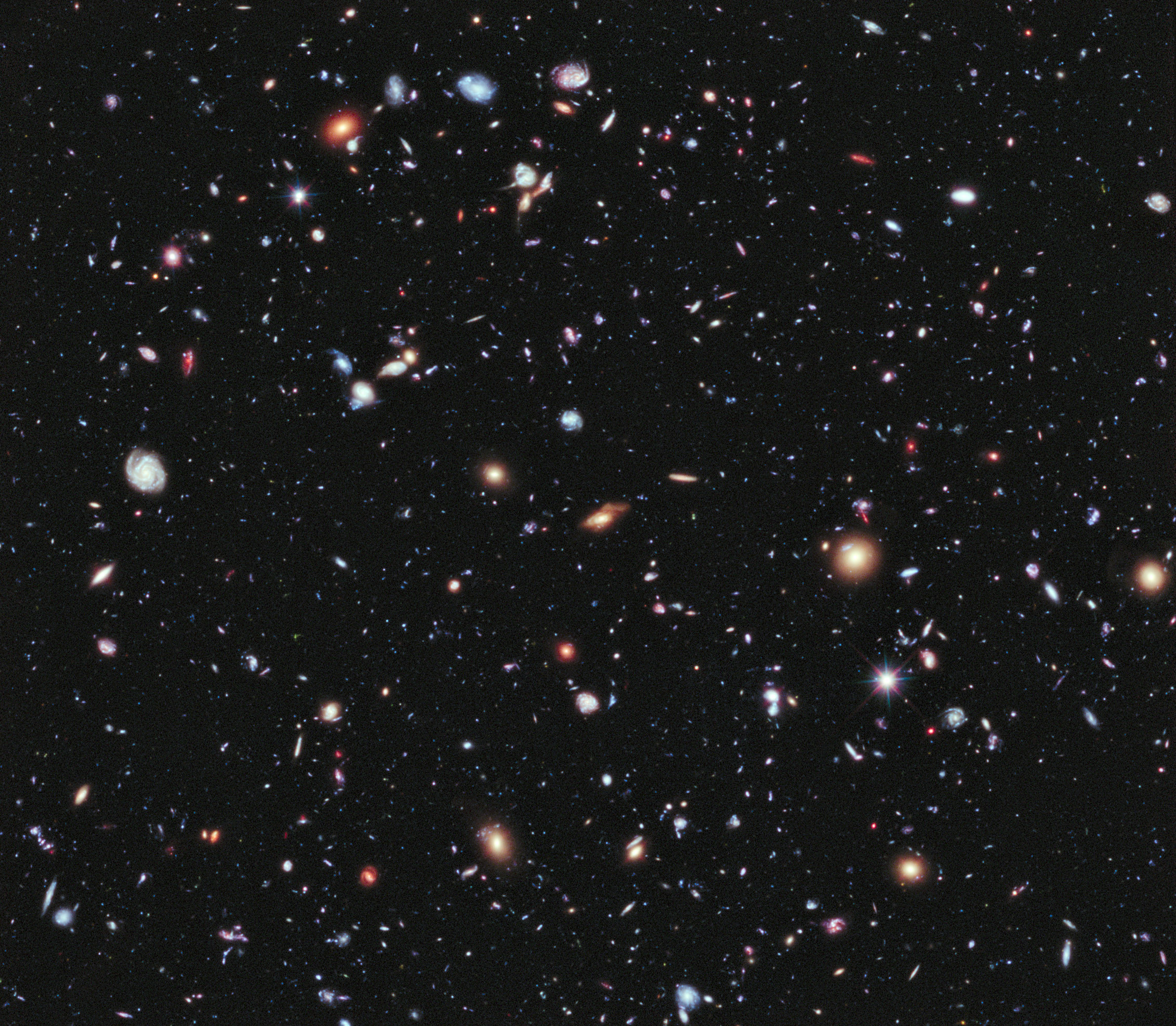
The Hubble Space Telescope (HST) has produced one of its most extraordinary views of the Universe to date.
Called the eXtreme Deep Field, the picture captures a mass of galaxies stretching back almost to the time when the first stars began to shine.
But this was no simple point and snap – some of the objects in this image are too distant and too faint for that.
Rather, this view required Hubble to stare at a tiny patch of sky for more than 500 hours to detect all the light.
“It’s a really spectacular image,” said Dr Michele Trenti, a science team member from the University of Cambridge, UK.
Then while the BBC News item had that stunning picture, over on the NASA website there was the following image together with more information.
Called the eXtreme Deep Field, or XDF, the photo was assembled by combining 10 years of NASA Hubble Space Telescope photographs taken of a patch of sky at the center of the original Hubble Ultra Deep Field. The XDF is a small fraction of the angular diameter of the full moon.
The Hubble Ultra Deep Field is an image of a small area of space in the constellation Fornax, created using Hubble Space Telescope data from 2003 and 2004. By collecting faint light over many hours of observation, it revealed thousands of galaxies, both nearby and very distant, making it the deepest image of the universe ever taken at that time.
The new full-color XDF image is even more sensitive, and contains about 5,500 galaxies even within its smaller field of view. The faintest galaxies are one ten-billionth the brightness of what the human eye can see.
Magnificent spiral galaxies similar in shape to our Milky Way and the neighboring Andromeda galaxy appear in this image, as do the large, fuzzy red galaxies where the formation of new stars has ceased. These red galaxies are the remnants of dramatic collisions between galaxies and are in their declining years. Peppered across the field are tiny, faint, more distant galaxies that were like the seedlings from which today’s magnificent galaxies grew. The history of galaxies — from soon after the first galaxies were born to the great galaxies of today, like our Milky Way — is laid out in this one remarkable image.
Hubble pointed at a tiny patch of southern sky in repeat visits (made over the past decade) for a total of 50 days, with a total exposure time of 2 million seconds. More than 2,000 images of the same field were taken with Hubble’s two premier cameras: the Advanced Camera for Surveys and the Wide Field Camera 3, which extends Hubble’s vision into near-infrared light.
“The XDF is the deepest image of the sky ever obtained and reveals the faintest and most distant galaxies ever seen. XDF allows us to explore further back in time than ever before”, said Garth Illingworth of the University of California at Santa Cruz, principal investigator of the Hubble Ultra Deep Field 2009 (HUDF09) program.
The universe is 13.7 billion years old, and the XDF reveals galaxies that span back 13.2 billion years in time. Most of the galaxies in the XDF are seen when they were young, small, and growing, often violently as they collided and merged together. The early universe was a time of dramatic birth for galaxies containing brilliant blue stars extraordinarily brighter than our sun. The light from those past events is just arriving at Earth now, and so the XDF is a “time tunnel into the distant past.” The youngest galaxy found in the XDF existed just 450 million years after the universe’s birth in the big bang.
Before Hubble was launched in 1990, astronomers could barely see normal galaxies to 7 billion light-years away, about halfway across the universe. Observations with telescopes on the ground were not able to establish how galaxies formed and evolved in the early universe.
Hubble gave astronomers their first view of the actual forms and shapes of galaxies when they were young. This provided compelling, direct visual evidence that the universe is truly changing as it ages. Like watching individual frames of a motion picture, the Hubble deep surveys reveal the emergence of structure in the infant universe and the subsequent dynamic stages of galaxy evolution.
The infrared vision of NASA’s planned James Webb Space Telescope will be aimed at the XDF. The Webb telescope will find even fainter galaxies that existed when the universe was just a few hundred million years old. Because of the expansion of the universe, light from the distant past is stretched into longer, infrared wavelengths. The Webb telescope’s infrared vision is ideally suited to push the XDF even deeper, into a time when the first stars and galaxies formed and filled the early “dark ages” of the universe with light.
The Hubble Space Telescope is a project of international cooperation between NASA and the European Space Agency. NASA’s Goddard Space Flight Center in Greenbelt, Md., manages the telescope. The Space Telescope Science Institute (STScI) in Baltimore, Md., conducts Hubble science operations. STScI is operated by the Association of Universities for Research in Astronomy, Inc., in Washington.
What a fabulous achievement. Just think that “The faintest galaxies are one ten-billionth the brightness of what the human eye can see.” and “The history of galaxies — from soon after the first galaxies were born to the great galaxies of today, like our Milky Way — is laid out in this one remarkable image.” Plus, “The youngest galaxy found in the XDF existed just 450 million years after the universe’s birth in the big bang.”
Do you know what crosses my mind looking at the picture? All those galaxies with, presumably, tens of thousands of planets and, surely, the near certainty that intelligent life must be teeming across those trillions of miles!
Let me close with this YouTube video brought to my attention thanks to Peter Sinclair of Climate Crocks.
We’ve all seen pictures of Earth from space, but have we really taken the time to appreciate what our planet looks like against the starscapes of the Milky Way galaxy? Here, we beckon viewers to see Earth in its cosmic context, which includes the stars, interstellar gases, the moon, the sun, and the solar winds. Be sure to watch in full HD, 1080p, and imagine you’re an astronaut aboard the International Space Station with a little time on your hands.



 Learning from Dogs