Tag: Herschel Space Observatory

Still musing about love.

Five days of writing about love and none the clearer!

So here I am penning Friday’s post about love.  You will recall that on Monday I wrote:

In last week’s telephone conversation MaryAnne spoke so easily about love that I promised her that I would dedicate a post on Learning from Dogs to her.

In fact, rather than one post, I’m setting myself the challenge of writing about love for the entire week, i.e. Monday to Friday.  I will readily admit that over and beyond today’s post, I don’t have more than the vaguest inkling of how the week will pan out.  You have been warned!

Ironically, up until yesterday things fell into place pretty easily.  But I must confess that today’s post has been a struggle. I read the love quotes over on the Brainy Quote website to find some inspiration.  None found.  Not that there weren’t many, many beautiful sayings but the incredible spread of quotations just magnified the difficulty of pinning down something to write about.

Then I did a web search for ‘love stories’.  Came across the story of The Lost Wallet.  It was moving but seemed too perfect a love story – try it yourself if you want.

Then back to the Brainy Quote website and once more meandered through the love quotes.  Saw this one.

For small creatures such as we the vastness is bearable only through love.Carl Sagan

That struck a chord.  A few hours earlier I had been sorting out my photographs and came across this one.
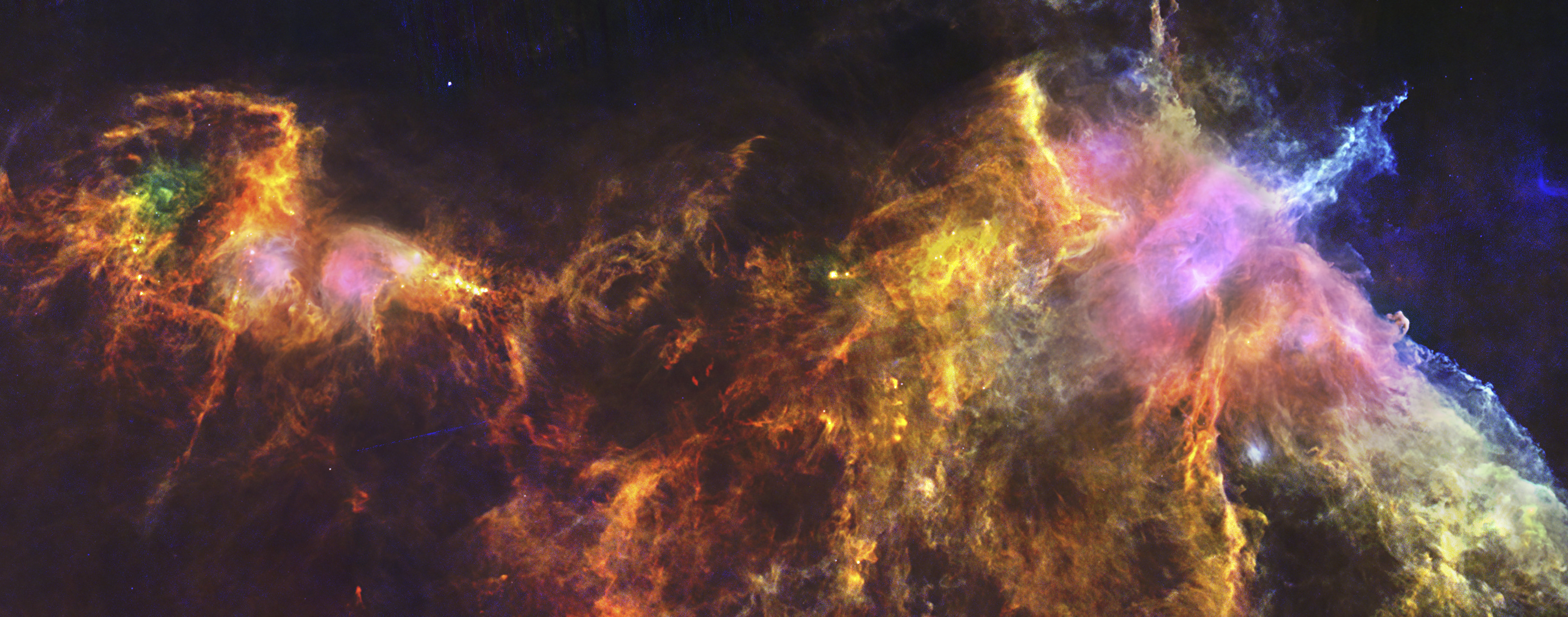
The Herschel Horsehead Nebula.

I had grabbed this image a month ago from the announcement on ESA’s website:

19 April 2013 New views of the Horsehead Nebula and its turbulent environment have been unveiled by ESA’s Herschel space observatory and the NASA/ESA Hubble space telescope.

The Horsehead Nebula lies in the constellation Orion, about 1300 light-years away, and is a popular target for amateur and professional astronomers alike. It sits just to the south of star Alnitak, the easternmost of Orion’s famous three-star belt, and is part of the vast Orion Molecular Cloud complex.

The new far-infrared Herschel view shows in spectacular detail the scene playing out around the Horsehead Nebula at the right-hand side of the image, where it seems to surf like a ‘white horse’ in the waves of turbulent star-forming clouds.

It appears to be riding towards another favourite stopping point for astrophotographers: NGC 2024, also known as the Flame Nebula. This star-forming region appears obscured by dark dust lanes in visible light images, but blazes in full glory in the far-infrared Herschel view.

The image is staggeringly beautiful yet a potent reminder that man, even the totality of our planet, is such an irrelevance in the scheme of things.  We are surrounded by beauty both within and without, yet the fragility of our existance is a ‘vastness’, both literally and psychologically.

Guess what!  Writing that last sentence brought to mind a photograph that I took Wednesday afternoon. As part of the Land Stewardship course Jean and I are taking, the class had gone to the Limpy Creek Botanical area in the Rogue River-Siskiyou National Forest not far from Grants Pass, Oregon.  Here’s that photograph.

P1130363

Reflect on the delicate beauty and vulnerability of that small wild flower. A perfect metaphor for the entire natural world.

So I am going to close this week’s perambulation through love with the thought that if we don’t love our planet with all the ardour and passion of a teenager’s first romance, all those other loves in our lives will ultimately become irrelevant.

Or as Carl Sagan put it:

Our mission is to awaken the broadest possible public to the wonders of nature as revealed by science.

Thank you, MaryAnne.

Beyond our beautiful planet.

Lifting one’s eyes to the far heavens.

Yesterday, I reposted 12 stunning photographs of the world we live on that had been published on Mother Nature Network on the 19th.

Coincidentally, I also saw something on the 19th that was just as breathtaking as those pictures of Planet Earth.  Here’s the picture that took my breath away.

HERSCHEL’S VIEW OF THE HORSEHEAD NEBULA

That image comes from the ESA Space in Images website, from which one learns:

  • Copyright: ESA/Herschel/PACS, SPIRE/N. Schneider, Ph. André, V. Könyves (CEA Saclay, France) for the “Gould Belt survey” Key Programme
  • Description: Stunning new view from ESA’s Herschel space observatory of the iconic Horsehead Nebula in the context of its surroundings. The image is a composite of the wavelengths of 70 microns (blue), 160 microns (green) and 250 microns (red), and covers 4.5×1.5 degrees. The image is oriented with northeast towards the left of the image and southwest towards the right.The Horsehead Nebula resides in the constellation Orion, about 1300 light-years away, and is part of the vast Orion Molecular Cloud complex. The Horsehead appears to rise above the surrounding gas and dust in the far right-hand side of this scene, and points towards the bright Flame Nebula. Intense radiation streaming away from newborn stars heats up the surrounding dust and gas, making it shine brightly to Herschel’s infrared-sensitive eyes (shown in pink and white in this image).To the left, the panoramic view also covers two other prominent sites where massive stars are forming, NGC 2068 and NGC 2071.

    Extensive networks of cool gas and dust weave throughout the scene in the form of red and yellow filaments, some of which may host newly forming low-mass stars.

Don’t know about you but I found that description a little dry, so to speak.

The BBC had a much friendlier version:

By Jonathan Amos, Science correspondent, BBC News.

Europe’s Herschel space telescope has imaged one of the most popular subjects in the sky – the Horsehead Nebula – and its environs.

The distinctively shaped molecular gas cloud is sited some 1,300 light-years from Earth in the Constellation Orion.

It is in a region of space undergoing active star formation – something Herschel has been most keen to study.

The Hubble space observatory has also returned to the Horsehead scene, to celebrate 23 years in orbit.

Together, these two great facilities give scientists a much broader insight into what is taking place in this familiar patch of the heavens.

“You need images at all scales and at all wavelengths in astronomy in order to understand the big picture and the small detail,” said Prof Matt Griffin, the principal investigator on Herschel’s SPIRE instrument.

“In this new Herschel view, the Horsehead looks like a little feature – a pimple. In reality, of course, it is a very large entity in its own right, but in this great sweep of a picture from Herschel you can see that the nebula is set within an even larger, molecular-cloud complex where there is a huge amount of material and a great range of conditions,” the Cardiff University, UK, researcher told BBC News.

To provide a sense of scale, the Horsehead Nebula, also known in the catalogues as “Barnard 33”, is about five light-years “tall”.

Hubble's new view of the Horsehead Nebula, a large cloud of hydrogen laced with dust.
Hubble’s new view of the Horsehead Nebula, a large cloud of hydrogen laced with dust.

Hubble sees the Horsehead in near-infrared light. Herschel, on the other hand, goes to much longer wavelengths. This allows it to see the glow coming directly from cold gas and dust – the material that will eventually collapse under gravity to form the next generation of stars.

Scientists are particularly keen to understand the mechanisms that drive the production of the biggest stars – objects much more massive than our own Sun that form relatively fast, burn bright but brief lives, and interact strongly with their environment, influencing the next round of star formation.

Anyway, that’s more than enough to copy directly from that BBC article.  Read the rest by going here.  All I will add is Jonathan’s last sentence, “A scholarly paper describing Herschel’s investigation of the Orion Molecular Cloud Complex has been published in the journal Astrophysical Journal Letters.

Oh, and ponder on how far away from Earth is that Constellation Orion.  Remember it was stated as 1,300 light-years.

Well, one light-year is just under 10 million, million kilometres (or about 6 million, million miles).  Apparently defined by the  IAU, or to give its the full name, the International Astronomical Union, a light-year is the distance that light travels in a vacuum in one Julian year.

So brace yourself!  1,300 light-years is just under 13,000,000,000,000,000 kilometres or in old money, 7,800,000,000,000,000 miles.

Rather puts pottering to the shops in Grants Pass into perspective!