Please indulge me with this purely personal reflection.
My Uncle Peter died in his sleep at 1.30am UK time on Monday, the 21st May, 2012. He was 91 and had been suffering from declining health for a while.
As my parting gift from across the seas, I just wanted to record the great inspiration that he was to both me and my son, Alex.
Peter was a great gliding fan (sailplane in American speak!). He must have started gliding not many years after the end of the war in 1945. Anyway, when I was a young lad, back in the mists of time, my Uncle Peter took me for a glider flight. That left a memory in me that lay dormant for many years until the late 1970s when a colleague, Roger Davis, introduced me to the Rattlesden Gliding Club and that started a 25-year interest in gliding and later power flying.
My son, Alex, also when he was a young boy was taken up for his first flight in a glider by Uncle Peter and later flew with me many times both in gliders and power aircraft. Today he is a Senior Captain with a British airline.
So, dear Uncle Peter, what an aviation inspiration you have been for two generations.
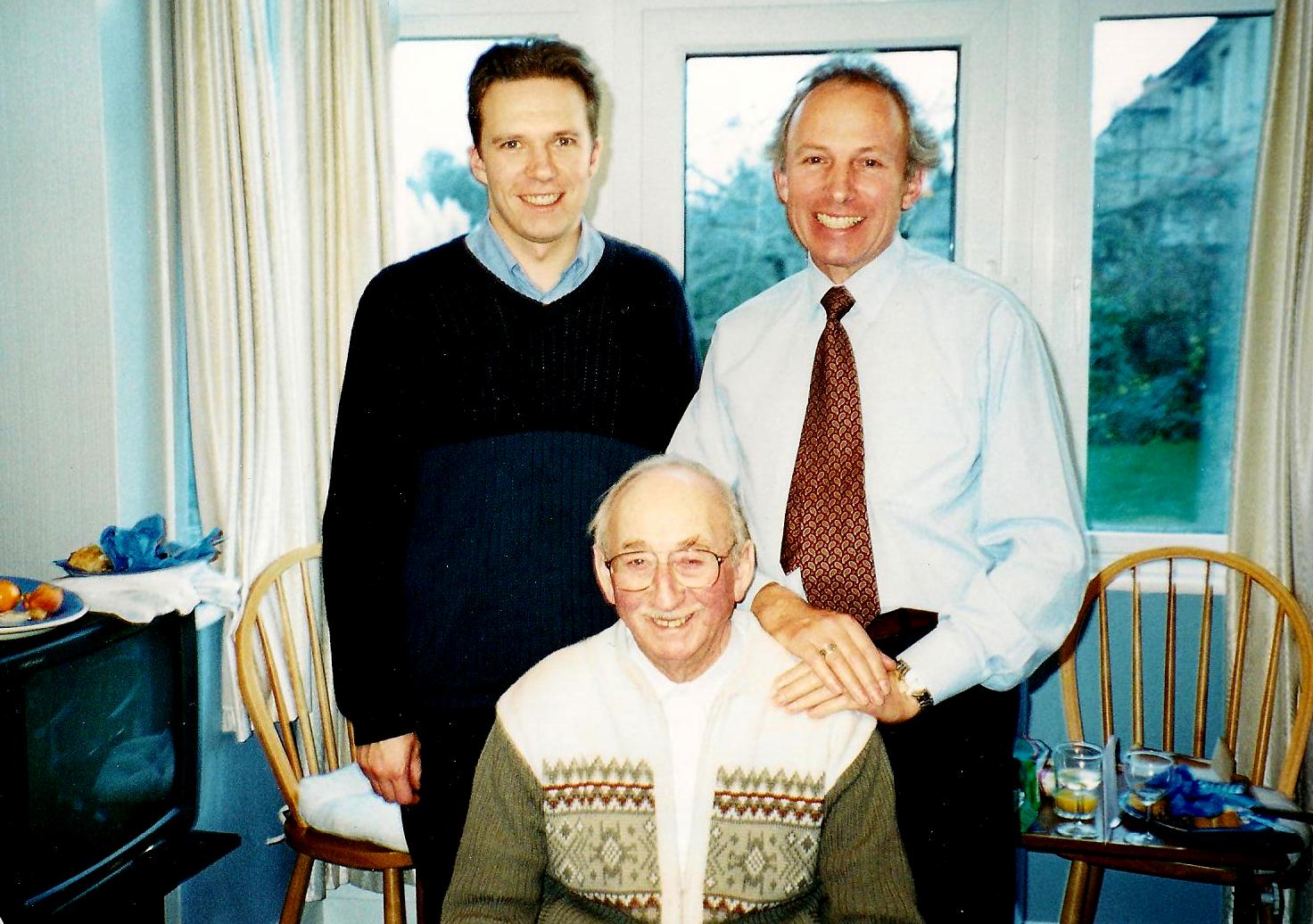
Uncle Peter and two generations of pilots.
As it happens, 1.30 am UK time on Monday the 21st was 5.30pm Arizonan time on Sunday the 20th. At that very moment, well 5.26pm to be precise, Jean and I were watching the solar eclipse and I took the photograph below of what was the partial eclipse here in Payson.
Partial solar eclipse partly hidden by the pine trees.
A tribute to a wonderful family man with a great sense of humour.
On the 18th January, I re-published an article written by Satish Kumar that had recently appeared in Resurgence Magazine. It was called Money and morality and attracted 1,300 readings plus an above-average number of comments.
After the article, I wrote,
Satish Kumar is an extraordinary person as a dip into his biographical details here will underline. Please do read about Satish; you will be amazed by his background! It includes this fact,
During this time, he has been the guiding spirit behind a number of now internationally-respected ecological and educational ventures including Schumacher College in South Devon where he is still a Visiting Fellow.
Schumacher College was well-know to me, 2006 and before, as I lived in the small village of Harberton, just outside Totnes in South Devon, England and Schumacher College at Dartington was less than 5 miles away. The College description includes,
People from all over the world, of all ages and backgrounds, have been informed, inspired and encouraged to act, by our 20 years of transformative courses for sustainable living.
Then later, this,
It is precisely at this time of global upheaval that we want you to come to the College to share with us the ways in which you are moved to live and act differently.
and concluded that I would be presenting some videos of Satish Kumar in subsequent posts.
So today, I want to start with a video that despite its shortness is not short of wisdom. There will be more from Satish soon.
Money must be guided by morality. – A powerful essay courtesy of Resurgence Magazine
(Because the essay, by Satish Kumar, is so well-worth reading, let me postpone my background chit-chat until later!)
Here it is.
If we take care of people and Nature, then the economy will take care of itself.
Money was a clever and convenient invention; it was designed as a means of exchange and a measure of wealth. But somehow that has changed; what was once solely a means to an end has become the end itself, and what was a measure of wealth has become wealth itself.
Take for example agriculture, the purpose of which was to produce nutritious food whilst ensuring that the land remained in good heart for all future generations and for the good health of biotic communities. Agriculture was a way of life that gave farmers their dignity, and in turn they cultivated the crops with tender loving care and considered their work intrinsically good.
Then came money, which changed everything: agriculture turned into agribusiness and the paramount purpose of it became the making of money. Food became a commodity and yet another means of making large profits. As a result British farmers – even those with 2,000 acres of land – cannot make a living, and farm labourers are paid £10 an hour whilst bankers are paid £1,000 an hour.
The example of agriculture turned to agribusiness is only one illustration of how our society has lost sight of right and wrong. We can cut down the rainforest to make money, we can pollute the rivers and over-fish the oceans for profit, we can destroy the local economy in search of cheaper goods, no matter how much CO2 is omitted in the process. The bottom line always comes first. We can hire and fire people at will for the sake of boosting the economy; people have become little more than the instruments of making money. GM crops, nuclear energy, cloning and animal experimentation – nothing is forbidden, just as long as it adds to GDP and increases the share value of corporations and companies.
Ethics, morals and human dignity are all secondary and subservient to the profit margin. Bankrupt bankers have to be bailed out even though we can all see that they and other business leaders are utterly incapable of solving the economic crisis. Politicians and policymakers have to obey their desires. No wonder then that our governments are completely incapable of creating conditions for the stability and wellbeing of people – because all social, political, educational and communal values exist solely to serve economic growth, which simply means growth in money supply, in GDP and in consumption.
As long as we are wedded to this financial paradigm and its money model, the strong will exploit the weak, and our social and environmental fabric (and morals) will continue to fall apart.
The current economic crisis gives us an opportunity to look deeper and examine the consequences of confusing the means with the ends. Money has a place, of course, but we must keep it in its place and not allow it to dominate our lives in such a manner that we lose all our bearings and become its slaves. Money was made to serve people, not the other way around. Unfortunately, we have allowed money to become the master and override all other moral, ethical and ecological values. There is more to life than an endless pursuit of money and profit.
Money is not wealth; real wealth is land, forest, rivers, animals and people. Wealth is created by the imagination, creativity and skill. Bankers and business leaders in search of ever-increasing profit are not the wealth creators; at best they are wealth counters and at worst wealth destroyers. So let’s honour the true wealth creators: skilled workers, architects and artists, craftsmen and women, teachers and doctors, builders and farmers; the economy is safe in their hands. Let us respect the generous Earth and wild Nature, the eternal source of wellbeing and prosperity. If we take care of people and Nature, then the economy will take care of itself.
Some people might say that this is too idealistic; but what have the realists done? They have made a complete mess of the world economy. Normally, we need idealism and realism in equal measure, but for the time being a little extra idealism will be helpful. We have had far too much realism.
Money must be guided by morality. And we are delighted to present this ideal in this issue of Resurgence, the first of a brand-new year.
Satish Kumar is Editor-in-Chief at Resurgence magazine.
with written permission from Resurgence magazine – at the heart of earth, art and spirit
published by The Resurgence Trust, Ford House, Hartland, Bideford, Devon EX39 6EE
oooOOOooo
OK, back to me!
I hope you enjoyed the essay, it certainly jumped off the page, as it were, for me hence my email to Emma Cocker, Picture Researcher & Assistant Editor at Resurgence Magazine which resulted in a very prompt approval for re-publishing on Learning from Dogs.
Satish Kumar
Satish Kumar is an extraordinary person as a dip into his biographical details here will underline. Please do read about Satish; you will be amazed by his background! It includes this fact,
During this time, he has been the guiding spirit behind a number of now internationally-respected ecological and educational ventures including Schumacher College in South Devon where he is still a Visiting Fellow.
Schumacher College was well-know to me, 2006 and before, as I lived in the small village of Harberton, just outside Totnes in South Devon, England and Schumacher College at Dartington was less than 5 miles away. The College description includes,
People from all over the world, of all ages and backgrounds, have been informed, inspired and encouraged to act, by our 20 years of transformative courses for sustainable living.
Then later, this,
It is precisely at this time of global upheaval that we want you to come to the College to share with us the ways in which you are moved to live and act differently.
No wonder that Bill McKibben of 350.org fame and often quoted on this Blog is quoted on the Schumacher website,
Schumacher is a very special place. As we try and figure out what on earth we’re going to do with this unraveling planet, it’s become a thinktank for hope, a battery for positive vision!
Bill McKibben, founder of 350.org
Finally, there are a number of videos presented by Satish that I propose to include in subsequent Posts on Learning from Dogs.
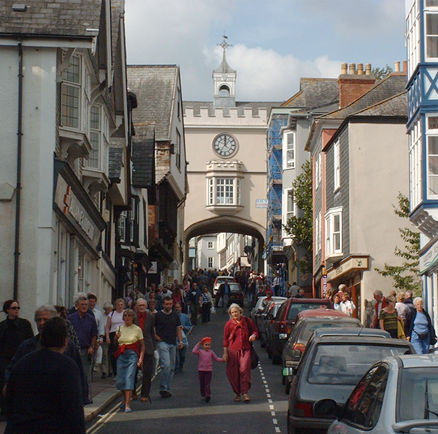
There’s no question that when one stays very still and closely watches a dog’s behaviour you see an amazing level of awareness. Even when they appear to be deeply asleep anything sensed by their ‘being’ is registered immediately. A small tale, by way of example. Many years ago when Pharaoh and I lived in the Devon village of Harberton, we frequently shopped in the town of Totnes, just 3 miles away. Many times, I would be walking up the High Street with Pharaoh nicely to heel being passed by many people walking the opposite way on the same pavement.
Totnes High Street
Every once in a while, during the fraction of time that it took for someone to pass us by, Pharaoh would utter a low, throatal growl without even slowing his pace. I always presumed that something, way beyond my level of consciousness, had disturbed Pharaoh during that instant of time.
Real awareness, or if you prefer, consciousness is not some touchy/feely concept but a true understanding about just what the heck is going on.
So do watch the following video of Peter Russell discussing Rediscovering Ourselves; it’s very relevant.
Then have a read of a couple of items on Peter’s website. The first is about runaway climate change, and here’s an extract,
Runaway Climate Change
The most dangerous aspect of global warming.
Global Warming is bad enough. Over the last hundred years, average global temperatures have increased by 0.75°C, one third of that rise occurring in the last twenty years. The 2007 report by The Intergovernmental Panel of Climate Change (IPCC) forecast that, by 2090, temperatures will have risen between 2 and 6 degrees.
Even a two degree rise in temperature would be disastrous. Changes in climate will lead to more intense storms, longer periods of drought, crop failures in many developing countries, the destruction of nearly all the coral reefs, the melting of much of the polar ice, the flooding of many low-lying urban areas, the possible collapse of the Amazonian rain forest, and the extinction of 20-30% of the planet’s species. The IPCC projects that this could happen by 2050.
If the temperature were to rise by six degrees, the prognosis is extremely bleak. At this temperature, the entire planet will be ice-free. Sea levels will rise by 70 meters. Many species of tiny plankton will cease to exist, and the problem would echo up the food chain, bringing the extinction of many fish, sea mammals, and the largest whales. Much of the land will now be desert. Hurricanes of unimaginable ferocity will bring widespread ecological devastation. If, as is possible, the ozone layer were destroyed, the burning ultraviolet light could make life on land impossible. Evolution would have been set back a billion years. It would be a planetary catastrophe.
Read the rest of that essay here. Now on to the next extract, from here,
The Under-rated Approach to Carbon Reduction
As critical as it is to reduce future carbon emissions, it is equally critical, perhaps even more critical, to get much of the CO2 that as already been released—and which is responsible for the current warming—out of the atmosphere and back into the ground where it belongs.
This approach, known as carbon capture and sequestration, has until now been largely ignored, and for several reasons. The atmosphere is so huge, it would seem to be an impossible task. There are possible technologies, but they are not nearly so well-developed as alternative energy sources. Many are still only ideas on paper. Where technologies of carbon capture have been developed they are mostly for capturing CO2 from smokestacks. Valuable as this may be, it is still dealing with the problem of future carbon emissions. What we need are technologies that will remove from the atmosphere the carbon that we already emitted, and then sequestrate it (put it away) in a stable form.
It is to this end that Sir Richard Branson announced his $25 million prize (Virgin Earth Challenge) for technologies that could capture a billion tons of carbon a year from the atmosphere (about one tenth of what we now release each year). Nor is it just Richard Branson who believes we must make this an equally important approach to the problem. His team includes Al Gore, James Lovelock, Sir Crispin Tickell (former UK ambassador to the UN), and James Hansen, the head climate scientist at NASA).
Again, the full article, a ‘must-read, in my opinion, is here.
It is really about awareness! Dogs have so much to teach us!


 Learning from Dogs