Tag: Global warming

Plus ça change

Plus ça change, plus c’est la même chose (“the more it changes, the more it’s the same thing”).

I’m at my PC thinking about tomorrow’s post.  It’s past 4pm and my creative juices are elsewhere!  So out of curiosity I wondered what I had published a year ago, in early February 2012.  To my amazement what was published was as fresh and relevant as if it had been published today.  So that’s what I am doing.  Republishing it along with the sequels on Tuesday and Wednesday.

oooOOOooo

Climate, truth and integrity, part one.

It ought to be straightforward, but the reality is different!

Those of you, dear readers, that have been following these ramblings and musings over the last 30 months, now amounting to more than 1,200 Posts [now 1,582, Ed.] , will hopefully have sensed that Learning from Dogs is much more than a blogsite about dogs!  It is, as I say here, about truth, integrity, honesty and trust using dogs as a powerful metaphor for these essential qualities of a civilised society.

But perhaps there is no topic more challenging for people to determine the truth than the topic of man’s impact on the earth’s climate.  I’m sure that millions intuitively sense that we are over-consuming ourselves to oblivion.  That is where I come from.  I am not a scientist, just a humble writer, and rely on quality sources of information and instinct to form my conclusions in this area.  I am also deeply suspicious of the largely out-of-sight relationships between large corporations, big money and politics!

I have no doubt that there are other millions of people who do believe that mankind is changing our planet’s climate.

So when I saw this article in the Wall Street Journal, I was dumbstruck.  Here’s the headline and opening paragraph,

No Need to Panic About Global Warming

There’s no compelling scientific argument for drastic action to ‘decarbonize’ the world’s economy.

Editor’s Note: The following has been signed by the 16 scientists listed at the end of the article:

A candidate for public office in any contemporary democracy may have to consider what, if anything, to do about “global warming.” Candidates should understand that the oft-repeated claim that nearly all scientists demand that something dramatic be done to stop global warming is not true. In fact, a large and growing number of distinguished scientists and engineers do not agree that drastic actions on global warming are needed.

The long article closes with this paragraph just ahead of the ‘signatures’ of the scientists.

Every candidate should support rational measures to protect and improve our environment, but it makes no sense at all to back expensive programs that divert resources from real needs and are based on alarming but untenable claims of “incontrovertible” evidence.

Then in short order, up came this from the Daily Mail online,

The supposed ‘consensus’ on man-made global warming is facing an inconvenient challenge after the release of new temperature data showing the planet has not warmed for the past 15 years.

The figures suggest that we could even be heading for a mini ice age to rival the 70-year temperature drop that saw frost fairs held on the Thames in the 17th Century.

Based on readings from more than 30,000 measuring stations, the data was issued last week without fanfare by the Met Office and the University of East Anglia Climatic Research Unit. It confirms that the rising trend in world temperatures ended in 1997.

I subscribe both to Climate Sight and Lack of Environment, although wish I spent more time thoroughly reading these fabulous sources of information.  However, I did spot an article on Climate Sight that came out on the 31st January with the heading of How much is most?  It opened thus,

A growing body of research is showing that humans are likely causing more than 100% of global warming: without our influences on the climate, the planet would actually be cooling slightly.

In 2007, the Intergovernmental Panel on Climate Change published its fourth assessment report, internationally regarded as the most credible summary of climate science to date. It concluded that “most of the observed increase in global average temperatures since the mid-20th century is very likely due to the observed increase in anthropogenic greenhouse gas concentrations”.

A clear question remains: How much is “most”? 51%? 75%? 99%? At the time that the IPCC report was written, the answer was unclear. However, a new frontier of climate research has emerged since, and scientists are working hard to quantify the answer to this question.

The timing was impeccable, so far as I was concerned.  I posted a comment, “While in every way that I can think of, I support the premise of mankind affecting global climate, I would love to hear from someone who could reconcile the Post above with these recent items:” and then included the links to the WSJ and Daily Mail items.

Little did I realise what a response I would get.  Just wonderful!  I will offer some of them to you in this piece, but please do read all the comments offered on that Climate Sight post.

First up was Dana Nuccitelli.  Dana is an environmental scientist at a private environmental consulting firm in the Sacramento, California area. He has a Bachelor’s Degree in astrophysics from the University of California at Berkeley, and a Master’s Degree in physics from the University of California at Davis.  (Taken from here.)  This is what he wrote,

How to reconcile the two? The folks who wrote those two articles you linked are misinformed and/or misinformers. I covered the first here  (and) SkS will shortly have a post on the second as well, but I covered the solar cycle issue recently here.

Dana’s article in Skeptical Science, that first link, included this:

Nearly half of the list (at least 7 of 16) have received fossil fuel industry funding, and the list also includes an economist, a physician, a chemist, an aerospace engineer, and an astronaut/politician.  These are apparently the best and brightest the climate denialists can come up with these days?

  • Claude Allegre, former director of the Institute for the Study of the Earth, University of Paris
  • J. Scott Armstrong, cofounder of the Journal of Forecasting and the International Journal of Forecasting;
  • Jan Breslow, head of the Laboratory of Biochemical Genetics and Metabolism, Rockefeller University;
  • Roger Cohen, fellow, American Physical Society;
  • Edward David, member, National Academy of Engineering and National Academy of Sciences;
  • William Happer, professor of physics, Princeton; 
  • Michael Kelly, professor of technology, University of Cambridge, U.K.;
  • William Kininmonth, former head of climate research at the Australian Bureau of Meteorology;
  • Richard Lindzen, professor of atmospheric sciences, MIT;
  • James McGrath, professor of chemistry, Virginia Technical University;
  • Rodney Nichols, former president and CEO of the New York Academy of Sciences;
  • Burt Rutan, aerospace engineer, designer of Voyager and SpaceShipOne;
  • Harrison H. Schmitt, Apollo 17 astronaut and former U.S. senator;
  • Nir Shaviv, professor of astrophysics, Hebrew University, Jerusalem;
  • Henk Tennekes, former director, Royal Dutch Meteorological Service;
  • Antonio Zichichi, president of the World Federation of Scientists, Geneva.

RED – No climate science publications, member of at least one climate denialist group – GWPF (advisory board), George C. Marshall Institute (board of directors or roundtable speakers), Australian Climate Science Coalition (advisory panel), Heartland Institute (board of directors), and/or ExxonMobil

BLUE – Published climate science research

Orange – both a member of a climate denialist group and has published climate science research

Black – no climate science publications or climate denialist group membership

Next was Gail Zawacki who writes a compelling Blog Dead Trees and Dying Forests.  She commented thus,

Paul, try climate progress, first link here and second link here.  I suggest you read those refutations very carefully.

The first link went to this,

Panic Attack: Murdoch’s Wall Street Journal Finds 16 Scientists to Push Pollutocrat Agenda With Long-Debunked Climate Lies

By Joe Romm on Jan 29, 2012 at 12:33 pm

A lot of folks have asked me to debunk the recent anti-truthful Wall Street Journal article with the counterfactual headline, “No Need to Panic About Global Warming.”  I’ll combine my debunking with the rapidly growing list of debunkings from scientists and others.  And I’ll update this as new debunkings come in.

That the WSJ would publish an amateurish collection of falsehoods and half truths is no surprise.   The entire global Murdoch enterprise is designed to advance the pollutocrat do-nothing agenda (see Scientist: “The Murdoch Media Empire Has Cost Humanity Perhaps One or Two Decades in Battle Against Climate Change”).  As National Academy of Sciences member Peter Gleick explains in his evisceration of the piece, “Remarkable Editorial Bias on Climate Science at the Wall Street Journal“:

But the most amazing and telling evidence of the bias of the Wall Street Journalin this field is the fact that 255 members of the United States National Academy of Sciences wrote a comparable (but scientifically accurate) essay on the realities of climate change and on the need for improved and serious public debate around the issue, offered it to the Wall Street Journal, and were turned down. The National Academy of Sciences is the nation’s pre-eminent independent scientific organizations. Its members are among the most respected in the world in their fields. Yet the Journal wouldn’t publish this letter, from more than 15 times as many top scientists. Instead they chose to publish an error-filled and misleading piece on climate because some so-called experts aligned with their bias signed it. This may be good politics for them, but it is bad science and it is bad for the nation.

Science magazine – perhaps the nation’s most important journal on scientific issues – published the letter from the NAS members after the Journal turned it down.

A tad more surprising is that 16 admittedly non-leading scientists would choose to soil their reputations by stringing together a collection of long-debunked falsehoods.  What is surprising is that these falsehoods are more easily debunked than the typical disinformer clap-trap because they are so out-of-date!

This is a long, detailed and powerful response to that WSJ article.  Do try and read it in full.

Gail’s second link went to this,

Human emissions of heat-trapping greenhouse gases have risen so rapidly that they now overwhelm any plausible decrease in solar activity.  Indeed, a paper from last June found that even if the Sun goes into “Hibernation” it won’t stop catastrophic global warming.

But that doesn’t stop serial disinformer David Rose of the UK’s Daily Mail from misleading the public — even after being slammed by top scientists in 2010 for falsely asserting “no global warming since 1995″ — see “Error-riddled articles and false statements destroy Daily Mail’s credibility.“  Rose has another willfully misleading piece, “Forget global warming – it’s Cycle 25 we need to worry about (and if NASA scientists are right the Thames will be freezing over again): Met Office releases new figures which show no warming in 15 years.”

OK, I think this is going to end up too long for one Post.

So let’s pause there and I will continue on Monday. [Tomorrow, Ed.]

Would love your comments, of course!

Change in action

There is real hope for us all!

Hopefully, you were able to watch the Amory Lovins talk in yesterday’s post?  If not, then do find time to watch how Professor Lovins sets out the powerful argument that the USA could soon, relatively speaking, be energy self-sufficient.

So on top of the Lovins presentation, I wanted to draw your attention to an item on Climate Crocks last October 5th.

One of the great stories untold in the American media is the ongoing revolution in one of the world’s most advanced economies – as Germany undertakes a bold and serious transition from powering a great engine of prosperity on fossil fuels, to plentiful and inexhaustible renewable energy.

Listening to Mitt Romney double and triple down on the bogus Fox/Fossil narrative about “clean coal” and failed renewables, it might be well to consider how one of our toughest manufacturing competitors is going all-in on the high stakes renewable energy revolution of the new century.

The article is a detailed analysis of how Germany is powering ahead, pardon the pun, in the provision of non carbon-based power, as this reference illustrates,

German use of coal to generate electricity has declined steadily from 1990 to 2011, according to readily available statistics on the German electricity system. The percentage of coal-fired electricity in German electricity generation has fallen from 56.7% in 1990 to 43.5% last year–a decrease of more than 10% despite a increase in total electricity generation during the same period of about 10%. At the same time the share of renewable energy in the electricity mix has increased from 3.6% to 19.9%, mostly due to the rapid development of wind energy and biomass.

Do go across and read the article.

Then thanks to a comment left on a recent post by Martin Lack another very positive story came to light (yet another pun – read on!),

Comment from Jules,

Here is one for you- http://www.solarroadways.com/intro.shtml – the idea is totally leftfield, but it fulfils certain issues such as distribution, decentralisation of power and offers a recharge network for electric cars and it has received a big chunk of government funding. It is so out there that I wonder if it could possibly be the answer but you never know.

Very quickly one finds that Solar Roadways are involved in something VERY interesting, namely,

Years ago, when the phrase “Global Warming” began gaining popularity, we started batting around the idea of replacing asphalt and concrete surfaces with solar panels that could be driven upon. We thought of the “black box” on airplanes: We didn’t know what material that black box was made of, but it seemed to be able to protect sensitive electronics from the worst of airline crashes.

Suppose we made a section of road out of this material and housed solar cells to collect energy, which could pay for the cost of the panel, thereby creating a road that would pay for itself over time. What if we added LEDs to “paint” the road lines from beneath, lighting up the road for safer night time driving? What if we added a heating element in the surface (like the defrosting wire in the rear window of our cars) to prevent snow/ice accumulation in northern climates? The ideas and possibilities just continued to roll in and the Solar Roadway project was born.

Now watch this!

and then watch this, as nearly 1.5 million others have!

The Solar Roadways project is working to pave roads with solar panels that you can drive on. Co-founder Scott Brusaw has made some major steps forward since our first visit back in 2007, so we visited him again for an exclusive update on the project, including the first ever video recorded of the Solar Roadways prototype! For more information visit http://www.solarroadways.com . This Solar Roadway project is highlighted as one of many planet-friendly solutions in the feature film by YERT – Your Environmental Road Trip. To learn more about YERT, visit http://yert.com .

Flattr this video here: https://flattr.com/thing/407726/YERT-video-about-Solar-Roadways-The-Prototype

And you can become a fan of YERT on Facebook here:http://www.facebook.com/home.php#!/pages/YERT-Your-Environmental-Road-Trip/12…

So nothing ever stays the same!

Modelling the future.

Can we trust the predictive output of computer modelling?

I would be the first to admit that this is not an area where I have anything more than general knowledge.  However, what prompted me to think about this topic was a chance conversation with someone here in Payson.  We were chatting over the phone and this person admitted to being less than fully convinced of the ’cause and effect’ of man’s influence on the global biosphere.

When I queried that, what was raised was the idea that all modelling algorithms used in climate change predictions must incorporate mathematical constants.  I continued to listen as it was explained that, by definition, all constants were, to some degree, approximations.  Take, for example, the obvious one of the constant π, that Wikipedia describes as: a mathematical constant that is the ratio of a circle’s circumference to its diameter. Pi, of course, would have to be rounded if it was to be used in any equation.  Even taking it to thirty decimal places, as in 3.14159 26535 89793 23846 26433 83279, would mean rounding it to 3.14159 26535 89793 23846 26433 83280 (50288 being the 30th to 35th decimal places).

OK, so I must admit that I was leaning to the viewpoint that this person had a valid perspective.  I then asked Martin Lack, he of Lack of Environment and a scientifically trained person, for his thoughts.  The rest of this post is based on the information that Martin promptly sent me.

One of the links that Martin sent was to this post on the Skeptical Science blogsite.  That post sets out the common skeptics view, namely:

Models are unreliable
“[Models] are full of fudge factors that are fitted to the existing climate, so the models more or less agree with the observed data. But there is no reason to believe that the same fudge factors would give the right behaviour in a world with different chemistry, for example in a world with increased CO2 in the atmosphere.”  (Freeman Dyson)

The author of the Skeptical Science posting responds,

Climate models are mathematical representations of the interactions between the atmosphere, oceans, land surface, ice – and the sun. This is clearly a very complex task, so models are built to estimate trends rather than events. For example, a climate model can tell you it will be cold in winter, but it can’t tell you what the temperature will be on a specific day – that’s weather forecasting. Climate trends are weather, averaged out over time – usually 30 years. Trends are important because they eliminate – or “smooth out” – single events that may be extreme, but quite rare.

Climate models have to be tested to find out if they work. We can’t wait for 30 years to see if a model is any good or not; models are tested against the past, against what we know happened. If a model can correctly predict trends from a starting point somewhere in the past, we could expect it to predict with reasonable certainty what might happen in the future.

So all models are first tested in a process called Hindcasting. The models used to predict future global warming can accurately map past climate changes. If they get the past right, there is no reason to think their predictions would be wrong. Testing models against the existing instrumental record suggested CO2 must cause global warming, because the models could not simulate what had already happened unless the extra CO2 was added to the model. All other known forcings are adequate in explaining temperature variations prior to the rise in temperature over the last thirty years, while none of them are capable of explaining the rise in the past thirty years.  CO2 does explain that rise, and explains it completely without any need for additional, as yet unknown forcings.

I strongly recommend you read the full article here.  But I will republish this graph that, for me at least, is a ‘slam dunk’ in favour for modelling accuracy.

Sea level change. Tide gauge data are indicated in red and satellite data in blue. The grey band shows the projections of the IPCC Third Assessment report (Copenhagen Diagnosis 2009).

Not only does this show that the data is within the range of projections of the modelled output, more seriously the data is right at the top end of the model’s predictions.  The article closes with this statement:

Climate models have already predicted many of the phenomena for which we now have empirical evidence. Climate models form a reliable guide to potential climate change.

There is a more detailed version of the above article available here.  Do read that if you want to dig further down into this important topic.  All I will do is to republish this,

There are two major questions in climate modeling – can they accurately reproduce the past (hindcasting) and can they successfully predict the future? To answer the first question, here is a summary of the IPCC model results of surface temperature from the 1800’s – both with and without man-made forcings. All the models are unable to predict recent warming without taking rising CO2 levels into account. Noone has created a general circulation model that can explain climate’s behaviour over the past century without CO2 warming. [my emphasis, Ed.]

Finally, back to Lack of Environment.  On the 6th February, 2012, Martin wrote an essay Climate science in a nut fragment.  Here’s how that essay closed:

Footnote:
If I were to attempt to go even further and summarise, in one single paragraph, why everyone on Earth should be concerned about ongoing anthropogenic climate disruption, it would read something like this:

Concern over anthropogenic climate disruption (ACD) is not based on computer modelling; it is based on the study of palaeoclimatology. Computer modelling is based on physics we have understood for over 100 years and is used to predict what will happen to the atmosphere for a range of projections for CO2 reductions. As such, the range of predictions is due to uncertainty in those projections; and not uncertainties in climate science. Furthermore, when one goes back 20 years and chooses to look at the projection scenario that most-closely reflects what has since happened to emissions, one finds that the modelled prediction matches reality very closely indeed.

In his email, Martin included these bullet points.

  • Concern over anthropogenic climate disruption (ACD) is not based on computer modelling.
  • It is based on our understanding of atmospheric physics (and how the Earth regulates its temperature).
  • Computer modelling is based on this physics (which we have understood for over 100 years).
  • Models have been used to predict temperature and sea level rise for a range of projections for CO2 emissions. 
  • The wide range of predictions was due to uncertainty in those emissions projections not uncertainties in climate science. 
  • This can be demonstrated by looking at predictions made over 20 years ago in light of what actually happened to emissions.
  • The model predictions for both temperature and sea level rise are very accurate (if not slightly under-estimating what has happened).

Sort of makes the point in spades!  The sooner all human beings understand the truth of what’s happening to our planet, the sooner we can amend our behaviours.  I’m going to pick up the theme of behaviours in tomorrow’s post on Learning from Dogs.

Finally, take a look at this graph and reflect!  This will be the topic that I write about on Thursday.

And now to do something.

The cumulative effect of millions of decisions brings about change!

Yesterday’s Post was about personal change.  It came on the back of a short series that was triggered by the Bill McKibben essay in Rolling Stone magazine that I republished on 31st July.  If you haven’t read it, do yourself a favour and read it soon.

The essay highlighted the challenge of how we change our ways, that is at a personal level, which is why I decided to devote a complete Post to the subject of change.  There was no doubt that the McKibben essay opened our eyes to the need for change, if they weren’t open already.  So being clear about the need for change and how, initially, it can make us feel less sure of ourselves, where do we go from here?  As John Fisher explains, within the change process, there is the stage where things start to happen.  This is what he writes about that stage,

Moving forward

In this stage we are starting to exert more control, make more things happen in a positive sense and are getting our sense of self back. We know who we are again and are starting to feel comfortable that we are acting in line with our convictions, beliefs, etc. and making the right choices. In this phase we are, again, experimenting within our environment more actively and effectively.

Keep this stage in mind as you journey along your individual path towards reducing your impact on the planet.  It really does act as a beacon for you, as a candle in the darkness.

OK, there’s an old saying in business ‘if you can’t measure it you can’t manage it!‘  So let’s start off by calculating the CO2 we are presently responsible for.

There are a number of CO2 calculators available on the Web but this one from The Resurgence Trust website seems as good as any.  Easy to use and it provides a starting point from which to plan your attack!  Make a promise to calculate your present CO2 output, soon!

Then to the plan of action!  A web search on reducing CO2 produces a huge number of results and I recommend that you undertake your own trawl to find the information that ‘rocks your boat’.  But on the Brave New Climate website there’s a summary that caught my eye, especially how it was introduced:

Top 10 ways to reduce your CO2 emissions footprint

Posted on 29 August 2008 by Barry Brook

Solving climate change is a huge international challenge. Only a concerted global effort, involving the governments of all nations, will be enough to avert dangerous consequences. But that said, the individual actions of everyday people are still crucial. Large and complex issues, like climate change, are usually best tackled by breaking down the problem into manageable bits.

For carbon emissions, this means reducing the COcontribution of each and every one of the six and a half billion people on the planet. But what can you, as an individual person or family, do that will most make a difference to the big picture? Here are my top ten action items, which are both simple to achieve and have a real effect. They are ranked by how much impact they make to ‘kicking the COhabit’.

Then follows ten solid recommendations:

  1. Make climate-conscious political decisions.
  2. Eat less red meat.
  3. Purchase “green electricity“.
  4. Make your home and household energy efficient.
  5. Buy energy and water efficient appliances.
  6. Walk, cycle or take public transport.
  7. Recycle, re-use and avoid useless purchases.
  8. Telecommute and teleconference.
  9. Buy local produce.
  10. Offset what you can’t save.

Each of these recommendations is supported by great web links and plenty of advice.  So don’t just skip through those 10 options, go here and commit to doing something!

And when you are ready to involve others beyond your family, 350.org has a great selection of resources for potential organizers.

We can make a difference!

More on the ‘Act’ stuff!

The business of acting to make a difference.

The future depends on what we do in the present. – Mahatma Gandhi

Yesterday, I republished a long essay from Bill McKibben under my title of Stop, read, reflect and Act!    Bill’s essay was called Global Warming’s Terrifying New Math and terrifying the numbers are!

If you didn’t read it yesterday, I encourage you to do so as soon as you can.  Why?  Because the process of change cannot start until we truly want to change; a total emotional commitment.  And the formation of those emotions, that realisation, requires a new understanding of the world around us, who we are and who we want to be.  An outcome that is all part of being better informed, which is why the McKibben essay is so profoundly important.

Tomorrow, I want to explore that process of personal change.

But before then, let me go back and repeat some words in Bill’s essay that really jumped off the page and hit me between the eyes.

Writing of Germany, Bill said, “… on one sunny Saturday in late May, that northern-latitude nation generated nearly half its power from solar panels within its borders. That’s a small miracle – and it demonstrates that we have the technology to solve our problems. But we lack the will.

We lack the will!!

Then in the next paragraph, Bill went on to write,

This record of failure means we know a lot about what strategies don’t work. Green groups, for instance, have spent a lot of time trying to change individual lifestyles: the iconic twisty light bulb has been installed by the millions, but so have a new generation of energy-sucking flatscreen TVs. Most of us are fundamentally ambivalent about going green: We like cheap flights to warm places, and we’re certainly not going to give them up if everyone else is still taking them. Since all of us are in some way the beneficiaries of cheap fossil fuel, tackling climate change has been like trying to build a movement against yourself – it’s as if the gay-rights movement had to be constructed entirely from evangelical preachers, or the abolition movement from slaveholders.

This is what hit me between the eyes, “the iconic twisty light bulb has been installed by the millions, but so have a new generation of energy-sucking flatscreen TVs.”  That describes me to perfection.  OK, we have installed solar panels as well but I admit to a significant degree of ambivalence! ” tackling climate change has been like trying to build a movement against yourself

Let me remind you of Bill’s next paragraph,

People perceive – correctly – that their individual actions will not make a decisive difference in the atmospheric concentration of CO2; by 2010, a poll found that “while recycling is widespread in America and 73 percent of those polled are paying bills online in order to save paper,” only four percent had reduced their utility use and only three percent had purchased hybrid cars. Given a hundred years, you could conceivably change lifestyles enough to matter – but time is precisely what we lack.

So it comes down to change; change in a timely manner, to boot!

Let’s hold that until tomorrow and I will leave you with this: Put your future in good hands – your own.

Stop, read, reflect and Act!

The latest from Bill McKibben has to be read and shared.

Introduction

We live in a world where there’s a great fondness for shortness, whether it’s headlines, soundbites, Twitter length ‘conversations’, text messages, and the rest.  However, I’m introducing an essay from Bill McKibben that is long.  When I use the word long I mean both literally, the essay is a shade under 6,200 words, and subjectively, the essay is long, very long, on meaning.

It was published in the August 2nd, 2012 issue of Rolling Stone.  As Allyse of the 350.org team wrote in a widely distributed email,

Here at 350.org, we do a lot of our internal communication via online chat, and our written shorthand for “YES!” and “totally awesome!” and “you rock!” is “++”. Which is why I say to you: ++ Social Media Team, ++. You all rock.

Bill McKibben’s article in Rolling Stone—which we asked you to spread around the internet last week—has been shared on Facebook almost 100K times and seen by hundreds of thousands of people. Great work. If you haven’t read it yet, please do.

This article really lays out the intellectual framework for much of our work in the weeks, months, and years ahead. We want to keep pushing these ideas out there, especially this one: our objection to the fossil fuel industry is structural—these businesses are in fact planning to wreck the planet!

So we took a quote from Bill’s article and made it into a graphic that’s already been shared almost 2,500 times on Facebook. Will you help us push it past 5,000? Click here to share.

As you know if you’ve read the article, this is really an all-hands-on-deck moment for humanity. Thanks for doing your part—in ways both large and small.

Onward,

Allyse

Will you put aside some time, settle down in a comfortable chair, and read the article?  Please do!

It crossed my mind to split it over a couple of days but I decided against that.  But I have inserted a ‘click to reveal more’ about 1,100 words into the article – please do read on when you reach that point.  And just as important, do comment!

Oh, want to see that image on Facebook that has been shared so widely?  Here it is:

A’int that the truth!

Finally, feel free to share this as far and wide as you want.  Thank you.

oooOOOooo

(Apart from the first image from Edel Rodriguez, all the other photographs have been inserted by me and are not in the original Rolling Stone production – I decided to insert them to make reading the article more visually attractive on a screen.)

Global Warming’s Terrifying New Math

Three simple numbers that add up to global catastrophe – and that make clear who the real enemy is

Illustration by Edel Rodriguez

By Bill McKibben
July 19, 2012 9:35 AM ET

If the pictures of those towering wildfires in Colorado haven’t convinced you, or the size of your AC bill this summer, here are some hard numbers about climate change: June broke or tied 3,215 high-temperature records across the United States. That followed the warmest May on record for the Northern Hemisphere – the 327th consecutive month in which the temperature of the entire globe exceeded the 20th-century average, the odds of which occurring by simple chance were 3.7 x 10-99, a number considerably larger than the number of stars in the universe.

Meteorologists reported that this spring was the warmest ever recorded for our nation – in fact, it crushed the old record by so much that it represented the “largest temperature departure from average of any season on record.” The same week, Saudi authorities reported that it had rained in Mecca despite a temperature of 109 degrees, the hottest downpour in the planet’s history.

Not that our leaders seemed to notice. Last month the world’s nations, meeting in Rio for the 20th-anniversary reprise of a massive 1992 environmental summit, accomplished nothing. Unlike George H.W. Bush, who flew in for the first conclave, Barack Obama didn’t even attend. It was “a ghost of the glad, confident meeting 20 years ago,” the British journalist George Monbiot wrote; no one paid it much attention, footsteps echoing through the halls “once thronged by multitudes.” Since I wrote one of the first books for a general audience about global warming way back in 1989, and since I’ve spent the intervening decades working ineffectively to slow that warming, I can say with some confidence that we’re losing the fight, badly and quickly – losing it because, most of all, we remain in denial about the peril that human civilization is in.

When we think about global warming at all, the arguments tend to be ideological, theological and economic. But to grasp the seriousness of our predicament, you just need to do a little math. For the past year, an easy and powerful bit of arithmetical analysis first published by financial analysts in the U.K. has been making the rounds of environmental conferences and journals, but it hasn’t yet broken through to the larger public. This analysis upends most of the conventional political thinking about climate change. And it allows us to understand our precarious – our almost-but-not-quite-finally hopeless – position with three simple numbers.

Continue reading “Stop, read, reflect and Act!”

Climate change is not a right vs left issue.

A revealing article in The Atlantic by Professor Adler.

Yesterday, I published a Post called Denialists standing up for insanity.  Then within hours of writing that, up popped in my email ‘in-box’ the latest ‘What’s New’ from the Yale Forum on Climate Change and the Media.  One article that jumped off the page at me was this one,

How A Conservative Sees, Wants to Address, Climate Change

June 6, 2012

Law professor Jonathan Adler, no flaming liberal, accepts much of the science and outlines conservative property rights principles for addressing climate change challenges.

What is surprising about these quotations?

  • “… there is reason to believe many of the effects [of climate change] will be quite negative.
  • “Excesses” of climate campaigners and “bad behavior” by some scientists “do not, and should not, discredit the underlying science.”
  • Despite some “substantial uncertainty … this is not sufficient justification for ignoring global warming or pretending that climate change is not a serious problem.”
  • “… effects will be most severe in those nations that are both least able to adapt and least responsible for” the greenhouse problem.
  • “Even non-catastrophic warming should be a serious concern.”

What’s actually surprising about these points is not so much the messages, but the messenger.

Then a couple of paragraphs later, the Yale Forum article links to The Atlantic piece as in, “Adler expresses his views on the seriousness of climate change in “A Conservative’s Approach to Combating Climate Change.”

Let me just give you a taste of that Atlantic piece.

It opens thus,

A Conservative’s Approach to Combating Climate Change

Guest post by Jonathan H. Adler, a professor at the Case Western Reserve University School of Law and regular contributor to the Volokh Conspiracy

No environmental issue is more polarizing than global climate change.  Many on the left fear increases in atmospheric concentrations of greenhouse gases threaten an environmental apocalypse while many on the right believe anthropogenic global warming is much ado about nothing and, at worst, a hoax.  Both sides pretend as if the climate policy debate is, first and foremost, about science, rather than policy. This is not so. There is substantial uncertainty about the scope, scale, and consequences of anthropogenic warming, and will be for some time, but this is not sufficient justification for ignoring global warming or pretending that climate change is not a serious problem.

The fifth and sixth paragraphs present a powerful ‘constitutional’ perspective,

Accepting, for the sake of argument, that the skeptics’ assessment of the science is correct, global warming will produce effects that should be of concern.  Among other things, even a modest increase in global temperature can be expected to produce some degree of sea-level rise, with consequent negative effects on low-lying regions.  Michaels and Balling, for instance, have posited a “best guess” that sea levels will rise 5 to 11 inches over the next century.  Such an increase in sea levels is likely manageable in wealthy, developed nations, such as the United States.  Poorer nations in the developing world, however, will not be so able to adapt to such changes.  This is of particular concern because these effects will be most severe in those nations that are both least able to adapt and least responsible for contributing to the concentration of greenhouse gases in the atmosphere.

It is a well established principle in the Anglo-American legal tradition that one does not have the right to use one’s own property in a manner that causes harm to one’s neighbor.  There are common law cases gong back 400 years establishing this principle and international law has long embraced a similar norm.  As I argued at length in this paper, if we accept this principle, even non-catastrophic warming should be a serious concern, as even non-catastrophic warming will produce the sorts of consequences that have long been recognized as property rights violations, such as the flooding of the land of others.

Professor Adler closes the article, as follows,

Fourth and finally, it is important to recognize that some degree of warming is already hard-wired into the system.  This means that some degree of adaptation will be necessary.  Yet as above, recognizing the reality of global warming need not justify increased federal control over the private economy.  There are many market-oriented steps that can, and should, be taken to increase the country’s ability to adapt to climate change including, as I’ve argued here and here, increased reliance upon water markets, particularly in the western United States where the effects of climate change on water supplies are likely to be most severe.

I recognize that a relatively brief post like this is unlikely to convince many people who have set positions on climate change.  I can already anticipate a comment thread filled with charges and counter-charges over the science.  But I hope this post has helped illustrate that the embrace of limited government principles need not entail the denial of environmental claims and that a concern for environmental protection need not lead to an ever increasing mound of prescriptive regulation.  And for those who wish to explore these arguments in further detail, there’s lots more in the links I’ve provided throughout this post.

The links provided by Professor Adler, as he refers to above, are well-worth pursuing, so for that reason alone, I do recommend reading the whole Atlantic piece in full.

The shaming of free speech

Free speech isn’t always free!

Recently over at the Blog Climate Sight, Kate wrote a Post about the antics of the group known as the  Heartland Institute, a Chicago-based PR group that denies the existence of human-caused climate change. Kate has given me permission to reproduce her post in full.

Stalin believed in gravity. Do you?

May 9, 2012 by climatesight

Here’s a classy way to slam people you disagree with: compare them to terrorists, dictators, and mass murderers.

Such was the focus of a recent billboard campaign by the Chicago-based Heartland Institute, a PR group that denies the existence of human-caused climate change. The only billboard that was actually displayed featured Ted Kaczynski (the Unabomber) and read, “I still believe in global warming. Do you?”

The message is clear: if a monster believes something, citizens of good moral standing should believe exactly the opposite. The Internet was quick to ridicule this philosophy, with parodies such as the following:

Similar billboards featuring Charles Manson and Fidel Castro were planned, but never publicly displayed. Heartland also considered putting Osama bin Laden on a future billboard. On their website, they attempted to justify this campaign:

The people who still believe in man-made global warming are mostly on the radical fringe of society. This is why the most prominent advocates of global warming aren’t scientists. They are murderers, tyrants, and madmen.

Given that a majority of Americans accept global warming, people did not take kindly to this campaign. Public outcry and negative media coverage led Heartland to cancel the project after 24 hours. However, their statementshowed little remorse:

We do not apologize for running the ad, and we will continue to experiment with ways to communicate the ‘realist’ message on the climate.

Even though the campaign has been cancelled, the Heartland Institute continues to suffer financial repercussions. Dozens of corporate donors, including State Farm Insurance and drinks firm Diego (which owns Guiness and Smirnoff) have ended their support as a direct result of this campaign. Earlier in the year, Heartland lost financial backing from General Motors after internal documents exposed some of the group’s projects, particularly the development of an alternative curriculum to teach K-12 students that global warming is fake.

Will they recover from this failed campaign? Given Heartland’s reliance on donations, their prospects look poor. It seems that the Heartland Institute, previously one of the most influential mouthpieces for climate change denial, is going out with a bang.

My prayer is that the aforementioned institute goes out, not with a bang, but with the sound of whimpering!  Because the right of free speech is abused and shamed by such disgraceful actions.  Well done, Kate.

Reply to a skeptic

“Unless someone like you cares a whole awful lot, Nothing is going to get better. It’s not.”

I came across this wonderful quotation on a blogsite called Wibble!  It was a comment to a post with the compelling title of It is vitally important not to make connections and explains that the quote was made by Dr. Seuss in the film The Lorax.

For me that quotation sums up how I would like to reply to not only my dear friend, Dan Gomez, who is a denialist of anthropogenic climate change, as last Monday’s Post illustrated, but also to skeptics everywhere else.

I should also add the important qualifier that I am neither a scientist nor have any expert skills in the relevant areas.  But, then again, neither does Dan.  He and I are both citizens of Planet Earth with a passion for the truth.

So where to go from here?  There is no question that the Earth’s climate is complex and endeavouring to understand ’cause and effect’ relies heavily on mathematical models.  But many complex aspects of our world are treated similarly, therefore so what!  Dan and I share with millions of others a lack of scientific competence, ergo we have to be rely on the scientific views expressed by those who do have the scientific competencies.

Would one challenge the competence of Scientific American magazine, that in an article on March 18, 2007, (five years ago!) opened thus,

Paris–The signs of global climate change are clear: melting glaciers, earlier blooms and rising temperatures. In fact, 11 of the past 12 years rank among the hottest ever recorded.

and continued later with this, [my emboldening]

For example, after objections by Saudi Arabia and China, the report dropped a sentence stating that the impact of human activity on the earth’s heat budget exceeds that of the sun by fivefold. “The difference is really a factor of 10,” says lead author Piers Forster of the University of Leeds in England: compared with its historical output, the sun currently contributes an extra 0.12 watt of energy for each square meter of the earth’s surface, whereas man-made sources trap an additional 1.6 watts per square meter.

Or what ‘influence’ might be at play when the British newspaper The Guardian reported earlier this year that,

Wall Street Journal rapped over climate change stance

, US environment correspondent

The Wall Street Journal has received a dressing down from a large group of leading scientists for promoting retrograde and out-of-date views on climate change.  In an opinion piece run by the Journal on Wednesday, nearly 40 scientists, including acknowledged climate change experts, took on the paper for publishing an article disputing the evidence on global warming.

The offending article, No Need to Panic About Global Warming, which appeared last week, argued that climate change was a cunning ploy deployed by governments to raise taxes and by non-profit organisations to solicit donations to save the planet.

It was signed by 16 scientists who don’t subscribe to the conventional wisdom that climate change is happening and is largely man-made – but as Wednesday’s letter points out, many of those who signed don’t actually work in climate science.

Later in that article Suzanne writes, referring to the 40 scientists, [again, my emboldening]

The letter goes on to note that some 97% of researchers who actively publish on climate science agree that climate change is real and caused by humans. It concludes: “It would be an act of recklessness for any political leader to disregard the weight of evidence and ignore the enormous risks that climate change clearly poses.”

There’s much, much more evidence that shows that the science is clear – mankind is risking the future viability of this planet for the species homo sapiens and countless other species!

One of the important points made by Dan in that Post last Monday was about the book, written by Senator James Inhofe, The Greatest Hoax.  Dan wrote, “This is all about money and power, not weather.

There are a number of independent websites across the world where one can quickly research the credentials and background by name of any person.  Try Skeptical Science as an example.  A quick enquiry using Senator Inhofe’s name came up with this: Quotes by James Inhofe – Climate Myth/What the Science Says.  Read It!  And read this on the website Think Progress.  There are other websites where one can do that type of research.

In an email just a day ago, Dan wrote, “My message/warning remains the same: “Follow the Money”.  When the “End-of-the-World” is the message, what politician can resist?”  If only it was that easy.

OK, I’m going to start rounding this all off by first asking you to watch this 4-minute video that I came across thanks to Pedantry’s blogsite Wibble.

A link between climate change and Joplin tornadoes? Never!

Next I’m going to repeat something that I have previously mentioned on Learning from Dogs.  There’s a saying in the aviation industry, “If there’s any doubt, there’s no doubt!”  That saying underpins the culture that has turned commercial air transport into one of the safest means of travel in history.

Let’s ponder that idea of doubt.

There is no question that there is a great deal of doubt.  Back in 2010 Gallup Poll reported that “42% of adults worldwide who see global warming as a threat to themselves and their families in 2010 hasn’t budged in the last few years“.

Would you get into a commercial airliner to fly from ‘a’ to ‘b’ if 42% of the passengers saw the flight as a threat to themselves?  No, of course not!

So one certainly wouldn’t fly then if 62% thought it was risky!  From here,

The newest study from the National Survey of American Public Opinion on Climate Change, which is a biannual survey taken since fall 2008 and organized by the Brookings Institute, shows that 62 percent of Americans now believe that man-made climate change is occurring, and 26 percent do not. The others are unsure.

So back to the theme that started this Post.  For the sake of all of us on this planet, for all our children and grandchildren and beyond, we need to start caring deeply about the future, changing our life-styles in as many ways as we can and demanding that our politicians and leaders are similarly committed to the future.

Not because the future is anything like certain – but to reduce the risks of a global catastrophy.  I have a grandson who will be one-year-old on March 21st.  I want to be certain that he has a viable life ahead of him for many, many years.  That means caring ‘a whole awful lot‘, letting hope motivate me to change, and recognising that change is already taking place, as the following trailer so superbly demonstrates.

“Unless someone like you cares a whole awful lot, Nothing is going to get better. It’s not.”

A skeptic’s view

Dan Gomez offers up an alternative view.

Many of you read the post I called Please help! that came out exactly a week ago.  If you were one of those readers you will have read how Dan and I go back 33 years.  In many ways we see eye-to-eye but not over mankind’s influence over the climate of our Planet.  To be clear, my own view is that we are very close, if not already past, the point of preventing a massive collapse of the biosphere.  Dan believes that we are living through possibly the biggest hoax in history.

Dan, however, has been willing to provide evidence that supports his view and has given me permission to reproduce some of his emails to me.  That’s generous of him – thanks Dan.

Let’s start with Dan’s reply to my offer to buy him the book Betrayal of Science and Reason by Paul & Anne Ehrlich.  This is what Dan sent to me,

PH – I guess I could write all day and provide numerous scientific papers and positioning that would repudiate a lot of the popular press on “Global Warming” or “Climate Change”, if that is more PC.  Read a little from the good Senator below and then I’ll buy you HIS book.

This is all about money and power, not weather. As the Senator points out, when he saw that the “Cap and Trade” bill was shot down, he stopped commenting. Then, more and more regulation from the UN and EPA Agency provoked this new book.

Once again, the science is at best moot and at worst fraudulent. Each of us must make up his own mind. Global climate cooling or heating will continue operating under geological time rules and, oh yeah, the Sun, Oceans and Regional Oscillations contribute a little.

As long as world governments don’t take public money or redistribute public money for their own “climate control” self-interests, I don’t really care. If there was no public money at stake, there would be no controversy.

People will continue to build houses below sea level in New Orleans. Another, bigger hurricane will flood them out again. Apparently, we can’t even stop this kind of nonsense through more legislation and then expensive emergency re-routing of public funds. This is part of the reason that the public sector is broke.

If private agencies wish to donate money to stop the rising seas or just support related studies, tant mieux. Just don’t add yet another set of agencies and regulations as another layer of big government. This only results in an ever higher tax structure and declining standards of living.

Book Description

Publication Date: February 28, 2012

Americans are over-regulated and over-taxed. When regulation escalates, the result is an increase in regulators. In other words, bigger government is required to enforce the greater degree of regulation. Bigger government means bigger budgets and higher taxes. “More” simply doesn’t mean “better.” A perfect example is the entire global warming, climate-change issue, which is an effort to dramatically and hugely increase regulation of each of our lives and business, and to raise our cost of living and taxes. In The Greatest Hoax, Senator James Inhofe will reveal the reasons behind those perpetuating the Hoax of global warming, who is benefitting from the general acceptance of the Hoax and why the premise statements are blatantly and categorically false.

In another couple of emails, Dan wrote,

There are two questions to answer: Whose science do you want to believe and who profits? My source of direction stems from a natural skepticism of big science when big money is involved. One of the definitions of science is that it is never completely understood and new discoveries as well as new methods of collecting data are ever changing. As we know, new evidence pops up everyday. So, to assume that “my science or your science” is irrefutable relevant to global warming, is not “good science”. Taking billions of global dollars out of private enterprise as well as higher public sector tax in order to “change the world- maybe” is irresponsible and dangerous.

Oh yeah, and I forgot, the world’s broke. Ask a Greek plumber or, for that matter, a Greek apparatchik, where global warming fits into his budget decisions……?

Then Dan wrote in another email,

 Emotionalism aside, I can’t argue the science issues except by contributing relevant articles by other scientists with opposing views. There are many.  I can comment on the political power and self-interest motivations of many proponents and that’s always fun……

Finally, Dan sent me the full copy of a recent article published by Roy Spencer, Ph. D. called Ten Years after The Warming.  He introduced it thus,

Before spending trillions that the world does not have, let’s see if we can get the conversation a little more firmed up…..  We need to really find out how sensitive the atmosphere, lithosphere and hydrosphere really are –  without assumptions.  Pretty hard thing to do even with advanced mainframes, GIGO…..

and then offered the article,

Ten Years After the Warming

February 26th, 2012 by Roy W. Spencer, Ph. D.

The version of global warming theory being pushed by the IPCC is that anthropogenic emissions of greenhouse gases are causing a radiative energy imbalance of the climate system, leading to warming.

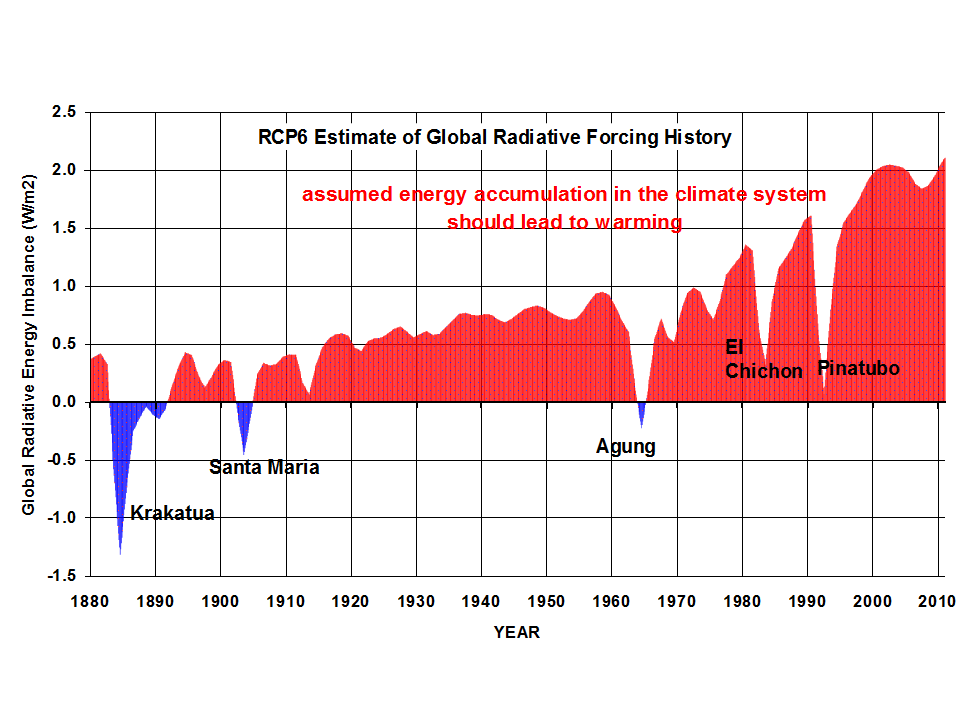
The radiative forcing history being used in the latest IPCC climate models looks something like the following, with red areas representing times when the climate system’s “stove is turned up”, that is, with heat accumulating in the system.

(Actually, the correct analogy would be that the stove setting remains the same, but the lid partially covering the pot is covering it a little more over time…but that’s too hard to explain.)

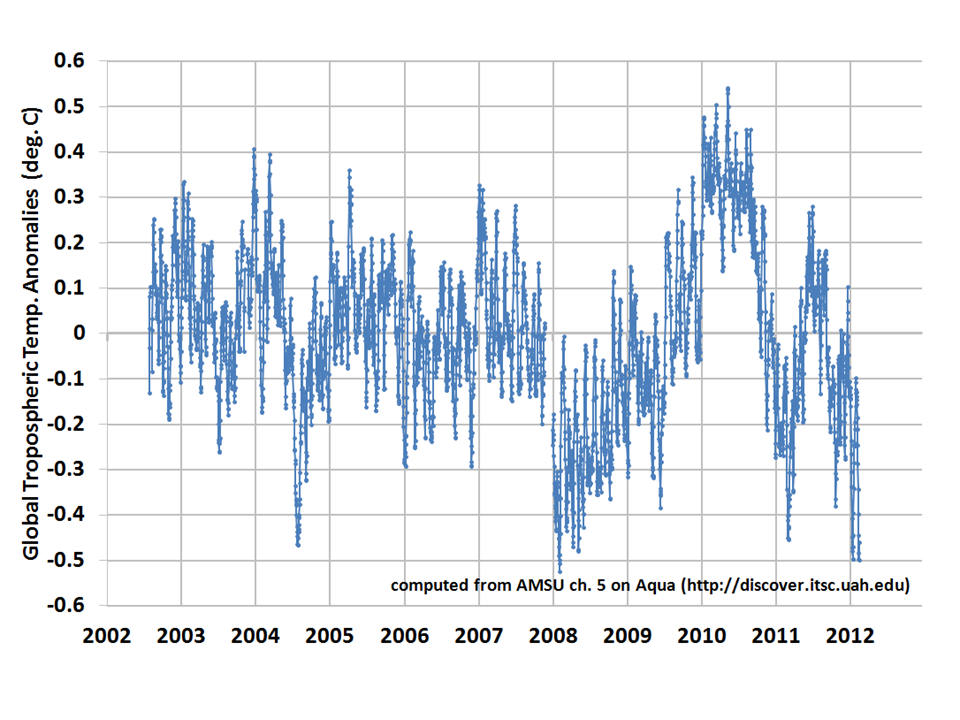
As can be seen, in the last 10 years the estimated forcing has been the strongest. Yet, most if not all temperature datasets show little or no global-average warming recently, either in the atmosphere, at the surface, or in the upper 700 meters of the ocean. For example, here are the tropospheric temperatures up though a few days ago:

So what is happening? You cannot simply say a lack of warming in 10 years is not that unusual, and that there have been previous 10-year periods without warming, too. No, we are supposedly in uncharted territory with a maximum in radiative forcing of the climate system. One cannot compare on an equal basis the last 10 years with any previous decades without warming.

There are 5 possibilities for the recent cessation of warming which are most discussed:

1) cooling from anthropogenic aerosols has been cancelling out warming from more greenhouse gases

2) natural cooling from internal climate fluctuations or the sun is cancelling out the GHG warming

3) increased ocean mixing is causing the extra energy to be distributed into the deep ocean

4) the temperature ’sensitivity’ of the climate system is not as large as the IPCC assumes.

5) there is something fundamentally wrong with the GHG warming theoryitself

Of course, some combination of the above 5 explanations is also possible.

The 1st possibility (aerosol cooling is cancelling out GHG forcing) is one of the more popular explanations with the climate modelers, and especially with NASA’s James Hansen. The uncertain strength (and even sign) of aerosol forcing allows the climate modelers to use aerosols as a tuning knob (aka fudge factor) in making their models produce warming more-or-less consistent with past observations. Using an assumed large aerosol cooling to cancel out the GHG warming allows the modelers to retain high climate sensitivity, and thus the fear of strong future warming if those aerosols ever dissipate.

The 2nd possibility (natural cooling) is a much less desirable explanation for the IPCC crowd because it opens the door to Mother Nature having as much or more influence on the climate system than do humans. We can’t have that, you know. Then you would have to consider the possibility that most of the warming in the last 50 years was natural, too. Goodbye, AGW funding.

The 3rd possibility (increased ocean mixing) is one of the more legitimate possibilities, at least theoretically. It’s popular with NCAR’s Kevin Trenberth. But one would need more observational evidence this is happening before embracing the idea. Unfortunately, how vertical mixing in the ocean naturally varies over time is poorly understood; the different IPCC models have widely varying strengths of mixing, and so ocean mixing is a huge wild card in the global warming debate, as is aerosol cooling. I believe much of past climate change on time scales of decades to many centuries might be due to such variations in ocean mixing, along with their likely influence on global cloud cover changing the amount of solar input into the climate system.

The 4th possibility (the climate system is relatively insensitive to forcing) is the top contender in the opinion of myself, Dick Lindzen, and a few other climate researchers who work in this field.

The 5th possibility (increasing GHGs don’t really cause warming) is total anathema to the IPCC. Without GHG warming, the whole AGW movement collapses. This kind of scientific finding would normally be Nobel Prize territory…except that the Nobel Prize has become more of a socio-political award in recent years, with only politically correct recipients. The self-flagellating elites don’t like the idea humans might not be destroying the Earth.

The longer we go without significant warming, the more obvious it will become that there is something seriously wrong with current AGW theory. I don’t think there is a certain number of years – 5, 10, 20, etc. – which will disprove the science of AGW….unless the climate system cools for the next 10 years. Eek! But I personally doubt that will happen.

As long as strong warming does not resume, the heat-hiding-in-the-deep-ocean explanation will provide refuge for many years to come, and will be difficult to convincingly rule out as an explanation since it takes so long for the deep ocean to warm by even a tiny amount.

Instead, there probably will be a tipping point (sooner than later) in popular perception when the public and Congress decide the jig is up, and they are no longer interested in hearing how we ‘might’ be headed for Armageddon.

The public already knows how awful scientists are at forecasting the future…especially a future of doom, which curiously seems to be the only future scientists know how to predict.

Now the challenge in this Post is not to make it so long that it becomes tiresome on the eyes, irrespective of the content.

So I’m going to leave it at this point and, perhaps, next time include some of Dan’s other points and comments in the light of how readers respond to this Post.