Tag: environment

Fracking Hell!

Is it me or are we all totally mad?  Only if we don’t take action!

I’ve quoted this expression before so forgive me for using it again.  That’s the old Devon expression, “All the world’s a little queer, ‘cept thee and me, and I ha’ me doubts about thee!”  It really does seem as if most of us are ‘a little queer!’

Yesterday, I expressed the tip of much frustration, nay incredulity, in a rant about why society showed such complacency towards the impending crisis of our civilisation.  As I wrote,

Why isn’t there such a huge outpouring of anger at the complacency of the world’s leaders?  How far does the collapse of the conditions, both social and physical, as in biosphere, have to go before we get real, urgent change?

Well today’s Post is taking a selection of recent items that have been published to show why I feel as I do.  I make no apologies for this being a longish Post but that doesn’t make it anything other than incredibly important; personal opinion, of course!

Let’s start with our love affair with carbon-based fuels, in this case natural gas (that’s methane you know).  Over on Lack of Environment Martin Lack recently published a piece on Fracking.  Here’s an extract,

Burning fossil fuels just because they are there is insane
For a long time, I have told anyone that would listen that we should leave unconventional hydrocarbons in the ground because of the extremely high probability that James Hansen is right; if we burn them all the runaway greenhouse effect is a “dead certainty” (i.e. on page 236 of Storms of My Grandchildren). However, thanks to the persistence of my many friends in the blogosphere, I have now also woken up to the reality that unconventional fossil fuel extraction – and hydraulic fracturing (known as fracking) in particular – is having significant immediate adverse environmental impacts. Pendantry has described this as humanity “fouling its own nest”; but I think my own description of it as “defecating in our own pig pen” conveys a more appropriate image.

In the USA, fracking has recently been prohibited in the State of Vermont and it must be hoped that other States will now do the same. The Vermont legislature took this action as a result of reports confirming the link between fracking and minor earthquakes; and because of high profile campaigns mounted by those communities already being adversely impacted by fracking. However, the latter should not be confused with NIMBYism. This is because opposition to fracking is a response to real environmental problems afflicting real people as a result of real stupidity on an industrial scale.
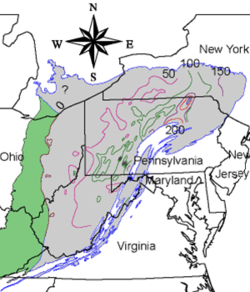
The Marcellus Shale formation

Martin also included a 17-minute feature from Link TV on the use, and dangers, of extracting natural gas from the Marcellus Shale in the US North-East.  It’s a sobering reminder of how we are playing with fire with the planet, both literally and metaphorically.  This is the video:

My next reference is an article published in the latest issue of Nature.  Only a summary is available freely online, but here it is anyway,

Approaching a state shift in Earth’s biosphere

Localized ecological systems are known to shift abruptly and irreversibly from one state to another when they are forced across critical thresholds. Here we review evidence that the global ecosystem as a whole can react in the same way and is approaching a planetary-scale critical transition as a result of human influence. The plausibility of a planetary-scale ‘tipping point’ highlights the need to improve biological forecasting by detecting early warning signs of critical transitions on global as well as local scales, and by detecting feedbacks that promote such transitions. It is also necessary to address root causes of how humans are forcing biological changes.

The overall theme of this issue of Nature is shown in their leading story, again taking the liberty of republishing an extract.  First how the article opens,

Return to Rio: Second chance for the planet

Twenty years ago, when the world’s leaders pledged to protect Earth’s climate and biodiversity at the Rio Earth Summit, they knew it would not be easy. But few could have guessed how much worse the situation would get. In 1992, the atmosphere held fewer than 360 parts per million (p.p.m.) of carbon dioxide; the concentration is now nearing 400 p.p.m. and surging upwards. At the same time, species are disappearing at an accelerating rate.

On the eve of the second Rio Earth Summit, Nature explores the causes and consequence of those changes, as well as the efforts that are being made to avert the worst outcomes. Our assessment shows how little progress nations have made towards honouring the commitments they made in 1992.

Then how that article closes,

Anthony Barnosky and his colleagues argue that the global ecosystem could eventually pass a tipping point and shift into a new state, the likes of which are hard for science to predict. But there are ways to avoid that fate, say Paul Ehrlich and his colleagues (page 68), who suggest techniques to make societies more sustainable and to head off many of the world’s chronic environmental problems.

Earth and its inhabitants have a second chance in Rio. They may not get many more.

There’s more and more of this but, yes, I know, one can only take so much.  So let me head for the close with a message of what you and I, and all of us, can do.

The United Nations Environment Programme recently released a video showing how inadequate have been our leaders.  Watch it first and then I’ll offer a solution.

The fifth edition of the Global Environmental Outlook (GEO-5), launched on the eve of the Rio+20 Summit, assessed 90 of the most-important environmental goals and objectives and found that significant progress had only been made in four.

More on the report findings here.

So join with me as I focus my rant from yesterday into something more valuable – asking you to take action – in whatever way you can!

Go here and sign the petition from 350.org.

Add your name to this:

To the G20 and World Leaders:

As concerned global citizens, we urge you to honour your previous commitments to end taxpayer handouts to the fossil fuel industry. To save our planet we need a game-changer now — we call on you to first lead by example, and then make ending all polluter payments the top global priority for the Rio Earth Summit.

So do it now – Go here and sign the petition from 350.org.

Then when you have signed that plea to world leaders to stop the subsidies to fossil fuels, pass this link to everyone you can – www.350.org/rio

And get close to 350.org and stay in touch.

Let’s do this; it’s so much better than ranting!

That little old word ‘truth’.

Truth: the true or actual state of a matter.

Well nothing complicated about the definition, is there!  If only society was equally motivated by getting to the truth of climate change.  Yes, I know I’m being naive!

Why my mini-rant?

I’m well in to James Hansen’s book Storms of my Grandchildren and it’s confirming my fears about the issues that are facing mankind now!  But more of that later.

What triggered me putting ‘pen to paper’ was a recent report from the Yale forum on climate change and the media.  Here’s how it opened,

Scientific Consensus Stronger than Scientists Thought?

Bruce Lieberman   May 2, 2012

More than two decades after the Intergovernmental Panel on Climate Change (IPCC) began publishing the latest scientific consensus on the globe’s changing climate, widespread doubts persist in the U.S. over whether there really is widespread agreement among scientists. It’s the primary argument of those who deny basic scientific foundations of warming.

But new and innovative survey results suggest the consensus among scientists might actually be stronger than the scientists themselves had thought.

The battles to define and debunk scientific consensus over climate change science have been fought for years. In 2004, University of California San Diego science historian Naomi Oreskes wrote about a broad consensus she found after studying 928 scientific papers published between 1993 and 2003.

But what I found deeply fascinating was that later on Bruce Lieberman, the report’s author, lists in detail the actual levels of agreement compared to the perceived levels.  To make it easier to take in, I have amended the telling differences to italic.

In sum, the newly released poll results identified surprisingly common points of agreement among climate scientists; and yet for each point, those scientists underestimated the amount of agreement among their colleagues. The results:

  • Human activity has been the primary cause of increases in global average air and ocean temperatures in the last 250 years. (About 90 percent of respondents agreed with this characterization, but those respondents estimated that less than 80 percent of their scientist colleagues held that view.)
  • If governmental policies do not change, the CO2 concentration in the atmosphere will exceed 550 parts per million between 2050 and 2059. (More than 30 percent agreed, but those respondents estimated that just over 20 percent of their peers held that view.)
  • If and when atmospheric CO2 concentrations reach 550 ppm, the increase in global average surface temperature relative to the year 2000 will be 2-3 degrees Celsius, or 3.2-4.8 F. (More than 40 percent agreed, but those respondents estimated that less than 30 percent held that view.)
  • If governmental policies do not change, in the year 2050, the increase in global average surface temperature relative to the year 2000 will be 1.5-2 degrees Celsius, or 2.4-3.2 F). (More than 35 percent agreed, but those respondents estimated that just over 30 percent held that view.)
  • The likelihood that global average sea level will rise more during this century than the highest level given in the 2007 assessment of the IPCC (0.59 meters, 23.2 inches) is more than 90 percent. (More than 30 percent agreed, but those respondents estimated that less than 20 percent held that view.)
  • Since 1851, the U.S. has experienced an average of six major hurricane landfalls (> 111 mph) per decade. The total number of major hurricane landfalls in the U.S. from 2011-2020 will be seven to eight. (Nearly 60 percent agreed, but those respondents estimated that just over 30 percent held that view.)
  • The total number of major hurricane landfalls in the U.S. from 2041 to 2050 will be seven to eight. (About 35 percent agreed, but those respondents estimated that less than 30 percent held that view.)
  • Given increasing levels of human activity, the concentration of CO2 in the atmosphere can be kept below 550 ppm with current technology — but only with changes in government policy. (Nearly 70 percent agreed, but those respondents estimated that just over 50 percent held that view.)

Now back to Hansen’s book.  Here’s what Hansen writes starting on p.144,

Getting to the truth!

Sea level rise is one of the two climate impacts that I believe should be at the top of the list that defines what is “dangerous,” on any time scale that humanity can imagine.  Ice sheets take thousands of years to build up from snowfall.  Reasonable “adaptation” to a large sea level rise is nearly impossible, because once ice sheets begin to rapidly disintegrate, sea level would be continually changing for centuries.  Coastal cities would become impractical to maintain.

The other climate change impact at the top of my “dangerous” list is extermination of species.  Human activities already have increased the rate of species extinctions far above the natural level.  Extinctions are occurring as humans take over more and more of the habitat of animal and plant species.  We deforest large regions, replace biologically diverse grasslands and forests with monoculture crops, and introduce foreign, invasive animal and plant species that sometimes wipe out the native ones.

Hansen points out that about a billion people live at elevations less than 25 metres (81 feet).

I included a short video of James Hansen in a Learning from Dogs Post just a few days ago.  You’ll find it here – go and watch it – and think about the truth!

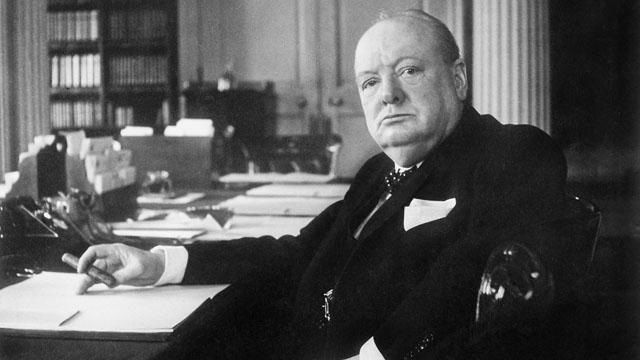
Photo: Winston Churchill, photographed by Cecil Beaton, at 10 Downing Street, London, in 1940.

Men stumble over the truth from time to time, but most pick themselves up and hurry off as if nothing happened.– Winston Churchill

Reading Planet Earth, part Two

The second of an unmissable series of four 1-hour videos from National Geographic.

The background and introduction to the first episode was published yesterday.  So I won’t natter on today saying more or less the same thing.

But I will add this thought.

The videos are tough viewing but compelling because they show the complexity and inter-relatedness of all forms of life on our Planet.  It shows that the debate about climate change/global warming/call it what you will is not a simplistic do you or do you not believe mankind is at the root of the changes.  No it’s a much more complex question about the threat to our whole biosphere, as Patrice Ayme so eloquently spelt out on March 2nd.  These videos make that crystal clear.

Here’s the second episode,

National Geographic – Strange Days on Planet Earth – Part 2 of 4 – One Degree Factor

Interlude

Only so much ‘heavy’ stuff that one can take at a time!

Yesterday, I wrote a piece about my dear friend Dan’s skeptic view of man-cause climate change.  Last Friday, I published a guest post from Patrice Ayme under the title of The collapse of the biosphere.  In the last 24 hours I also wrote a long comment to Martin Lack’s latest post, No cause for alarm? – You cannot be serious!  So, don’t know about you, dear reader, but it felt appropriate for today’s Post to be full of fluffy stuff.

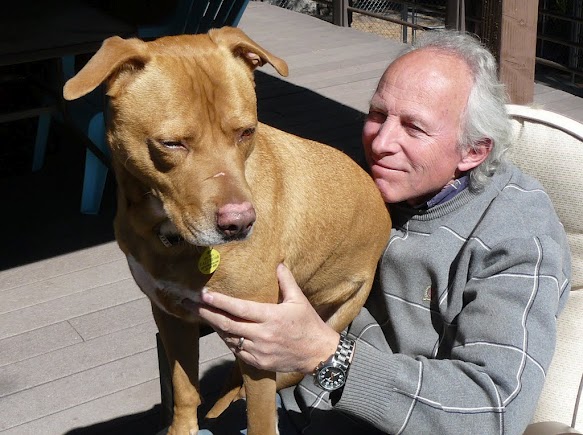
First an update on our latest member of our family, Kaysee (although we prefer the spelling Casey!).  Can’t believe that it was only a week ago since we got Casey from the local Humane Society but that’s what it was, Casey joined us on the 28th February.  Here are two photographs of Casey taken last Saturday, four days ago!

H'mm, let me try his lap!
No, this is definately the better one!

So I think one can say that Casey has settled in very well!

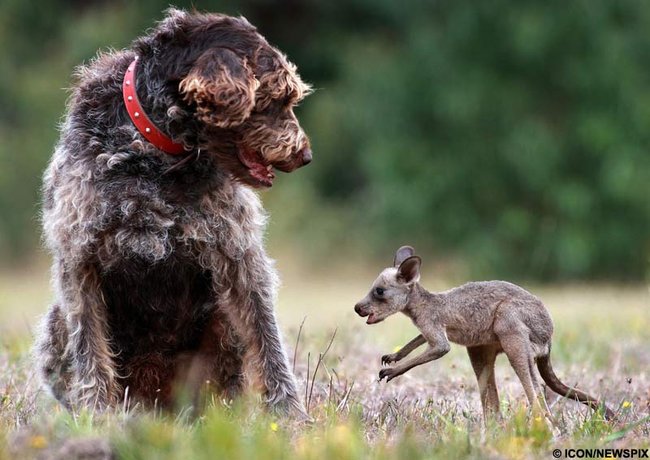
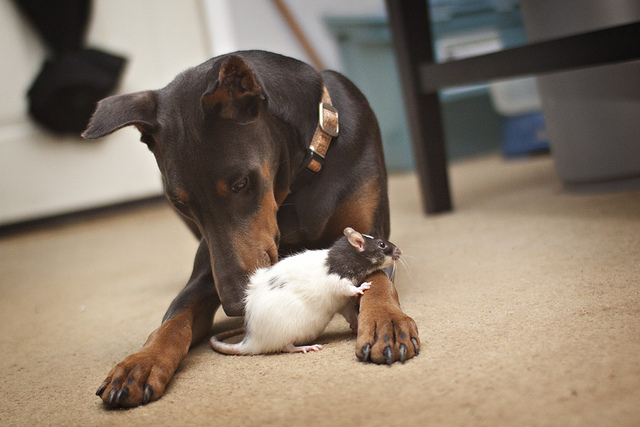
Next, Cynthia, the wife of Dan Gomez, emailed me a set of wonderful photographs that had come to her from sister-in-law Suzann.  Here’s a small selection for you to drool over.

Hallo! You're cute!
Love it when the phone is left on 'vibrate'!
Hey Mum, can I have fur as soft as this?
Sorry guys, I can't open the door for you!
Ah, that's perfect! Maybe a tad lower!

Meanwhile tomorrow it’s back to the grind!

Please help!

A plea to those who understand climate science so much better than I do!

Background to this Post.

Among my friends, two go way back.  One of them, Dan Gomez, a lively, ebullient Californian, was indirectly responsible for me and Jean meeting in Mexico back on December 17th, 2007.  I first met Dan at a dealers’ conference in Boston way back in the early days of Commodore Computers.  That was the Spring of 1979 and I had flown to Boston as the owner of the 8th Commodore Computer dealership to be appointed in the UK, based in Colchester, Essex.  Later, I became the global distributor of an English word processing program known as Wordcraft, written by Pete Dowson in the UK, and appointed Dan as my US West Coast Wordcraft distributor.  It gave me a wonderful reason to come out to Southern California several times a year; on business, of course!

Dan and I therefore go back 33 years!  Dan’s sister Suzann has a house down in San Carlos, Mexico.  Suzann invited me out to Mexico for Christmas 2007 which is where I first met Jean and, bingo, Jean and I then fell in love with each other!  How life flows!  (Two years ago yesterday, Jean and I moved into our house in Payson with our, then, 13 dogs and 6 cats!)

Paul & Dan Jan. 15th 2008

OK, to the Post!

Dan has been a climate change skeptic, as in caused by man, for many years.  Regular readers of Learning from Dogs will know I see things very differently.  But Dan and I agree fundamentally on getting to the truth.  This Blog proudly claims to seek “The underlying theme of Learning from Dogs is about truth, integrity, honesty and trust in every way.”

So when the other day Dan sent me a number of links supporting his view that “My point remains that climate change is an enormous, complex process that no computer model is going to predict and no human activity modify significantly. Big money is now at stake here and as the article shows, even trusted scientists will produce fraudulent information to further their goals as well as fill politician’s coffers.” I found my faith in my own views slighted dented.  Dan is a smart guy, a good thinker and not beholden to any firm or organisation with a vested interest in denying anthropogenic global warming.

Here are some of the items that Dan referred to,

From Newsbusters,

IPCC Scientist Admits Fake Data Used To Pressure World Leaders

A scientist responsible for a key 2007 United Nations Intergovernmental Panel on Climate Change report warning Himalayan glaciers would be completely melted by 2035 has admitted that the claim was made to put political pressure on world leaders.

Such was revealed by the British Daily Mail Sunday in an article destined to further reduce the credibility of the world’s so-called leading authority on manmade global warming.

As NewsBusters reported Saturday, the IPCC acknowledged earlier this week that its claim concerning these glaciers was based on junk science.

Read it in full here.

Then there was this,

Oregon Chapter American Meteorological Society

Anthropogenic (Human Caused) Global Warming – Is This The Greatest Scientific Myth of our Generation?”
January 25th, 2012, Portland, Oregon

First Speaker – Gordon Fulks, PhD Physics, University of Chicago

[Extract]

Dr. Fulks said: “My thesis tonight is simple: virtually ALL of what climate alarmists put forth as science is not. Some is half correct, some is incorrect, and too much is just plain nonsense or worse.”

This led him into what he called “one of the central problems with Anthropogenic Global Warming,” “the integrity of the data.” He discussed a variety of temperature data from land surface data that shows various manipulations and biases to the best global data from NASA satellites to the excellent ice core temperature proxies going back 450,000 years.

Second Speaker – Chuck Wiese, Meteorologist – Oregon State University

[Extract]

Mr. Wiese finished his presentation with the following conclusions:

1. There is nothing in the REAL atmospheric record that supports the recent temperature rise of the last century to carbon dioxide induced anthropogenic warming.

2. The tropospheric water vapor optical depth is remarkably stable but has declined recently over the last 70 years of record as carbon dioxide rose substantially in the atmosphere during the same period. This is a consistent outcome as expected by the first principle founding physics and inconsistent with atmospheric climate models.

3. Without water vapor acting as a positive feedback ( growth pattern ) to increasing carbon dioxide concentrations, the projected radiative forcing on the earth’s surface is but a grossly exaggerated calculation of what the earth’s temperature will actually do in response to carbon dioxide.

4. The earth’s “greenhouse effect” is NOT controlled by atmospheric carbon dioxide. It is modulated and governed by atmospheric water vapor and clouds, where the warming modulation is controlled by the amount of vapor and optical depth. Clouds with the hydrological cycle act to trim out water vapor into a hydrostatic, convective equilibrium. The stable atmospheric optical depth likes the earth mean temperature of 59 deg F without further solar or planetary modulation.

5. The Anthropogenic warming hypothesis by atmospheric CO2 is falsified by the real record and radiation physics.

Third Speaker – George Taylor, former Oregon State Climatologist

[Extract]

His presentation finished with his conclusions:

1. Human activities DO affect climate, in a variety of ways. Greenhouse gases are just one parameter.

2. Natural variations affect climate. I believe that they have been more significant influences on climate because they do a much better job of explaining observed variations.

3. Effects of future changes in CO2 are likely to be modest and manageable.

4. Many aspects of climate remain poorly understood.

The full transcripts and supporting materials may be seen here.

Then, in stark contrast, this week’s edition of The Economist has a leader about the problem of overfishing. “Of all the sea’s many problems, overfishing should be the most fixable. ”  What jumped off the page at me was how that leader article started,

ACIDIFICATION, warming, the destruction of coral reefs: the biggest problems facing the sea are as vast, deep and seemingly intractable as the oceans themselves. So long as the world fails to cut its emissions of greenhouse gases, cause of the global warming behind these troubles, they will grow.

So a newspaper of the standing of The Economist is clear, “So long as the world fails to cut its emissions of greenhouse gases, cause of the global warming behind these troubles

So if, dear reader, you can offer good supporting evidence as to why the Oregon Chapter of the American Meteorological Society seems to contradict what so many now believe, that mankind is changing the Earth’s climate, please comment or, better still, consider writing a guest post.

Thank you!

Money and morality

Money must be guided by morality. – A powerful essay courtesy of Resurgence Magazine

(Because the essay, by Satish Kumar, is so well-worth reading, let me postpone my background chit-chat until later!)

Here it is.

If we take care of people and Nature, then the economy will take care of itself.

Money was a clever and convenient invention; it was designed as a means of exchange and a measure of wealth. But somehow that has changed; what was once solely a means to an end has become the end itself, and what was a measure of wealth has become wealth itself.

Take for example agriculture, the purpose of which was to produce nutritious food whilst ensuring that the land remained in good heart for all future generations and for the good health of biotic communities. Agriculture was a way of life that gave farmers their dignity, and in turn they cultivated the crops with tender loving care and considered their work intrinsically good.

Then came money, which changed everything: agriculture turned into agribusiness and the paramount purpose of it became the making of money. Food became a commodity and yet another means of making large profits. As a result British farmers – even those with 2,000 acres of land – cannot make a living, and farm labourers are paid £10 an hour whilst bankers are paid £1,000 an hour.

The example of agriculture turned to agribusiness is only one illustration of how our society has lost sight of right and wrong. We can cut down the rainforest to make money, we can pollute the rivers and over-fish the oceans for profit, we can destroy the local economy in search of cheaper goods, no matter how much CO2 is omitted in the process. The bottom line always comes first. We can hire and fire people at will for the sake of boosting the economy; people have become little more than the instruments of making money. GM crops, nuclear energy, cloning and animal experimentation – nothing is forbidden, just as long as it adds to GDP and increases the share value of corporations and companies.

Ethics, morals and human dignity are all secondary and subservient to the profit margin. Bankrupt bankers have to be bailed out even though we can all see that they and other business leaders are utterly incapable of solving the economic crisis. Politicians and policymakers have to obey their desires. No wonder then that our governments are completely incapable of creating conditions for the stability and wellbeing of people – because all social, political, educational and communal values exist solely to serve economic growth, which simply means growth in money supply, in GDP and in consumption.

As long as we are wedded to this financial paradigm and its money model, the strong will exploit the weak, and our social and environmental fabric (and morals) will continue to fall apart.

The current economic crisis gives us an opportunity to look deeper and examine the consequences of confusing the means with the ends. Money has a place, of course, but we must keep it in its place and not allow it to dominate our lives in such a manner that we lose all our bearings and become its slaves. Money was made to serve people, not the other way around. Unfortunately, we have allowed money to become the master and override all other moral, ethical and ecological values. There is more to life than an endless pursuit of money and profit.

Money is not wealth; real wealth is land, forest, rivers, animals and people. Wealth is created by the imagination, creativity and skill. Bankers and business leaders in search of ever-increasing profit are not the wealth creators; at best they are wealth counters and at worst wealth destroyers. So let’s honour the true wealth creators: skilled workers, architects and artists, craftsmen and women, teachers and doctors, builders and farmers; the economy is safe in their hands. Let us respect the generous Earth and wild Nature, the eternal source of wellbeing and prosperity. If we take care of people and Nature, then the economy will take care of itself.

Some people might say that this is too idealistic; but what have the realists done? They have made a complete mess of the world economy. Normally, we need idealism and realism in equal measure, but for the time being a little extra idealism will be helpful. We have had far too much realism.

Money must be guided by morality. And we are delighted to present this ideal in this issue of Resurgence, the first of a brand-new year.

Satish Kumar is Editor-in-Chief at Resurgence magazine.

with written permission from Resurgence magazine – at the heart of earth, art and spirit
published by The Resurgence Trust, Ford House, Hartland, Bideford, Devon EX39 6EE

oooOOOooo

OK, back to me!

I hope you enjoyed the essay, it certainly jumped off the page, as it were, for me hence my email to Emma Cocker, Picture Researcher & Assistant Editor at Resurgence Magazine which resulted in a very prompt approval for re-publishing on Learning from Dogs.

Satish Kumar

Satish Kumar is an extraordinary person as a dip into his biographical details here will underline.  Please do read about Satish; you will be amazed by his background!  It includes this fact,

During this time, he has been the guiding spirit behind a number of now internationally-respected ecological and educational ventures including Schumacher College in South Devon where he is still a Visiting Fellow.

Schumacher College was well-know to me, 2006 and before, as I lived in the small village of Harberton, just outside Totnes in South Devon, England and Schumacher College at Dartington was less than 5 miles away.  The College description includes,

People from all over the world, of all ages and backgrounds, have been informed, inspired and encouraged to act, by our 20 years of transformative courses for sustainable living.

Then later, this,

It is precisely at this time of global upheaval that we want you to come to the College to share with us the ways in which you are moved to live and act differently.

No wonder that Bill McKibben of 350.org fame and often quoted on this Blog is quoted on the Schumacher website,

Schumacher is a very special place. As we try and figure out what on earth we’re going to do with this unraveling planet, it’s become a thinktank for hope, a battery for positive vision!

Bill McKibben, founder of 350.org

Finally, there are a number of videos presented by Satish that I propose to include in subsequent Posts on Learning from Dogs.

Voices from the Beeline Café

The second guest post from John H.

John’s first guest contribution, Clarity of Thought, was published on the 20th September and attracted a collection of very thoughtful comments.  To give you a sense of that first contribution, it started thus,

The Passion of Enlightenment

Enlightenment includes deep grief and a passion to leave life a bit better than we found it. Enlightenment has little practical value in a growing and constantly consuming cultural demographic. Consumers tend to spiritually disconnect when faced by a need for change or when morality becomes inconvenient.

To set the scene for these musings from John, Highway 87 that runs South-North through Payson, where John lives, is called the Beeline Highway and there is, indeed, a Beeline Cafe in town.

Over to John now.

Voices from the Beeline Café

Americans are the best entertained and the least informed people on earth.

Combined commercial and investment banks have become a global casino.

No one can afford to run for political office without corporate approval.

—ooOOoo—

Political campaigns are celebrity theaters devoid of content or reality.

Climate change is a planetary constant exacerbated by human activities.

A twenty-four hour media drumbeat of fear encourages human divisiveness.

—ooOOoo—

Education, history and science are marginalized.

Facts are systematically denied.

People are confused.

—ooOOoo—

Global totalitarianism is immensely profitable.

Corporations do not care about democracy or humanity.

Economically stressed voters are disenfranchised by corporate government.

—ooOOoo—

The rule of law has lost equity and become the tool of oppressors.

Firefighters, policemen, nurses and clergy have become political pawns.

Corporate supported criminals control a majority of the nations of the world.

—ooOOoo—

We have lost the rudder of human morality.

Material well-being is considered the greastest good.

War is a highly profitable form of corporate enterprise.

—ooOOoo—

The flag and cross are employed to demonize opposition to corporate authority.

Politics worth supporting begin and end with service to God and nature.

God grant us each the grace to make a transformative difference.

—ooOOoo—

an old lamplighter

Can modernisation be “ecological”?

Three guest posts from Martin Lack of Lack of Environment, today the concluding Part Three

Hope you have been following the previous two parts of this essay from Martin.  Part One can be read here; Part Two here.

————————-

Can modernisation be “ecological”? – Part 3

This is the third and final part of my mini-critique of the school of environmental thought known as Ecological Modernisation.
——————-
Newsflash: Today [Sept. 27th.] is Earth Overshoot Day for 2011. This was a genuine coincidence (i.e. I did not know this when I decided to do this 3-part story). See paragraph 2 below…
——————-

Where are we now?
In his seminal 1968 article on ‘The Tragedy of the Commons’, Garrett Hardin had observed that it was not possible to achieve Jeremy Bentham’s hedonistic goal of “the greatest good for the greatest number” because, at the level of the individual, to do so would require food and/or energy to be used for subsistence purposes only (Hardin 1968: 1243). In 1977, William Ophuls agreed that the optimum population is not the maximum possible, which appears to imply that, if necessary, artificial limits to growth should be imposed. Furthermore, he explicitly stated that, “…this optimum level… may be as little as fifty percent of the theoretical maximum…” (Ophuls 1977: 28).

Mathis Wackernagel et al have recently provided “…evidence that human activities have exceeded the biosphere’s capacity since the 1980s. This overshoot can be expressed as the extent to which human area demand exceeds nature’s supply. Whereas humanity’s load corresponded to 70% of the biosphere’s capacity in 1961; this percentage grew to 120% by 1999.” However, the authors also pointed out that, if… “12% of the bioproductive area was set aside to protect other species; the demand line crosses the supply line in the early 1970s rather than the 1980s” (Wackernagel et al 2002: 9268-9)(emphasis mine).

In laboratory-controlled studies, the size of a population of, say, fruit flies can be shown to depend on the scarcity or abundance of food; and the presence or absence of predators. However, in 2005, Meadows et al pointed out that a growing population “…will slow and stop in a smooth accommodation with its limits… only if it receives accurate, prompt signals telling it where it is with respect to its limits, and only if it responds to those signals quickly and accurately” (Meadows et al 2005: 157).

This pursuit of the resulting “S-curve” is sometimes referred to as the demographic transition of an increasingly affluent society through three stages: (1) high birth and death rates; (2) high birth rate but low death rate; and (3) low birth and death rates. However, in a section entitled ‘Why Technology and Markets Alone Can’t Avoid Overshoot’, Meadowset al also pointed out that if we put off dealing with limits to growth we are more likely to come up against several of them simultaneously (ibid: 223).

Even though no-one seems to want to talk about population control today, neither Hardin nor Malthus was the first to raise this contentious subject because, as Philip Kreager has pointed out, this dubious honour goes to Aristotle’s treatise on Politics within which, “…population is a recurring topic, extensively discussed and integral to the overall argument…” (Kreager 2008: 599). Furthermore, according to Theodore Lianos, although Aristotle was thinking at the scale of a city rather than a country, the great philosopher recognised that there was an optimum population size, which depended on the land area controlled by the city (for food production purposes), which could be determined by, “the land-population ratio that produces enough material goods so that the citizens can live a wise and generous life, comfortable but not wasteful nor luxurious” (Lianos 2010: 3).

Conclusions
It has been demonstrated that dematerialisation alone cannot deal with the problem of resource depletion unless the increase in unit efficiency is greater than the increase in scale of production (i.e. something that cannot be sustainable indefinitely).

Furthermore, whereas it may be possible to partially decouple environmental degradation from economic growth, pursuit of this as a sole objective is a dangerous strategy. This is because to do so is to remain ambivalent about the existence and significance of limits to growth; indeed it is to deny that growth itself may be the problem.

In the final analysis, the only thing that will be sustainable is progression towards the steady-state economy proposed by Daly and others; combined with qualitative development instead of quantitative growth. Therefore, the only form of modernisation that could be ecological is one that places the intrinsic value of vital resources such as clean air and clean water – and the inherent value of a beautiful landscape – well above the instrumental value of money or precious metals.
——————-
References:
Hardin, G. (1968), ‘The Tragedy of the Commons’, Science, 168, pp.1243-8.
Kreager, P. (2008), ‘Aristotle and open population thinking’, Population and Development Review 14(34), pp.599-629.
Lianos, T. (2010), ‘Aristotle’s Macroeconomic Model of the City-State’.
Meadows D, et al (2005), Limits to Growth: the 30-Year Update, London: Earthscan.
Ophuls, W. (1977), Ecology and the Politics of Scarcity, San Francisco: Freeman and Co..
Wackernagel, M. et al (2002), ‘Tracking the ecological overshoot of the human economy’,Proc. of the National Academy of Sciences [USA], 99(14), pp.9266-9271.

Transitions, pt Two

Reflections on these present times, concluding part.

I closed yesterday with, So maybe there’s a blindness with humans, and then set out the characteristics of that blindness.  One of those characteristics being,

Our obsession with how things are now prevents us from reflecting on those signs that indicate changes are under way, even when the likely conclusions are unmistakeable.  The ecological and climatic changes being the most obvious example of this strange blindness that mankind possesses.

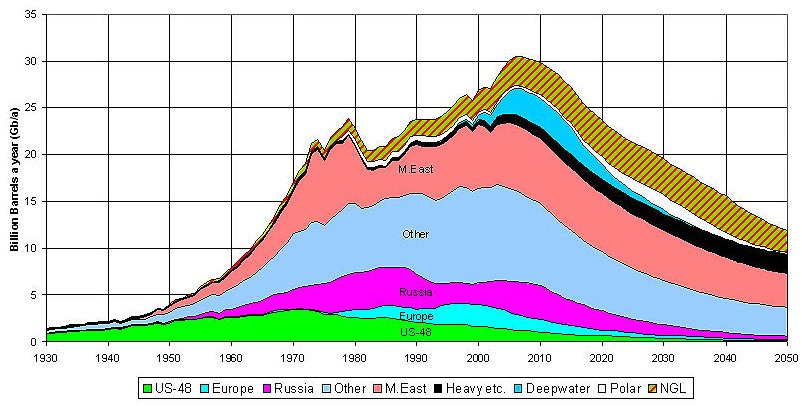
Let’s move this on a little.  The arguments from a wide range of scientists are overwhelmingly in favour of the proposition that mankind is using vastly more resources from the planet than the planet can provide.  Take oil.  This graph show past and projected oil production for the whole Earth out to 2050, less than 40 years away.

Here’s an extract from that website which I encourage you to read in full,

The part before 2007 is historical fact. The part that comes afterward is an ASPO extrapolation.

This graph is worth careful attention as a lot of world history is written into it. Note the steep rise in oil production after World War II. Note that 1971 was the peak in oil production in the United States lower 48. There is a sliver of white labled Arctic oil. That is mostly Alaskan Prudhoe Bay oil, which peaked in 1990. Prudhoe Bay was almost big enough to counteract the lower 48 peak of 1971. The sliver is very narrow now. The OPEC oil embargo of 1973 is very visible. The oil produced by non-OPEC countries stayed nearly constant while OPEC production nearly halved. The embargo caused the world economy to slow. But the high cost of energy spurred the development of energy efficient automobiles and refrigerators and a lot of other things. Note the effect of the collapse of the Russian economy in 1990 on Russian oil production. Note the rapid increase in oil production when the world economy boomed near the end of the twentieth century. Oil was $12 a barrel at that time. Note that European (North Sea) oil peaked in 2000. Note especially what would have happened if the 1973 embargo had not occurred. It is possible that the world would now be on the steep part of the right side of the Hubbert curve.

Take population growth. Here’s a graph that shows that going through seven billion, which is due shortly, is likely to be way short of the eventual peak.  Likely peak might be in the range of  eight to ten billion!  Just take a look at that graph,

Take global warming.  Here’s a graph from NASA, from which I quote,

The five warmest years since the late 1880s, according to NASA scientists, are in descending order 2005, 1998, 2002, 2003 and 2006. (reported in the year 2007!)

No apologies for bashing you around the head with these graphs and figures – most people have a good sense about these aspects of our life on this planet.  But, in a very real sense, that’s the point.

The point that despite powerful and obvious evidence, mankind has great difficulty accepting obvious trends and understanding that whatever ‘today’ feels like, ‘tomorrow’ is almost certainly not going to be more of the same.

At the risk of hammering this point to death, here are two pictures and some text to show how quickly ‘today’ changes and becomes ‘tomorrow’.

Scientist left speechless as vast glacier turns to water

by Helen Turner, Western Mail

THESE images show the astonishing rate of break-up of an enormous glacier in north Greenland – from ice to water in just two years.

The before and after photographs, which left a Welsh scientist who led the 24-month project “speechless”, reveal the worrying effects of climate change in an area previously thought too cold to be much affected.

The Petermann glacier pictured August, 5th, 2009
Petermann glacier, pictured from same position, July 24th, 2011

Dr Alun Hubbard, a reader at Aberystwyth University’s Centre for Glaciology, returned from the Petermann Glacier in north-west Greenland a month ago, but did not see the stark images documenting the changes until this week.

He said: “Although I knew what to expect in terms of ice loss from satellite imagery, I was still completely unprepared for the gob-smacking scale of the break-up, which rendered me speechless.  It was just incredible to see. This glacier is huge, 20km across, 1,000m high.”

“It’s like looking into the Grand Canyon full of ice and coming back two years later to find it’s full of water.”

“It’s quite hard to get your head around the scale of the change.  To be able to see that, everything changed in such a short period of time, I was speechless.”

Do read the full article on the Wales Online website here.

Stay with me a little longer, if you will.

Yves Smith in her wonderfully broad and addictive Blog, Naked Capitalism, had the first part of a powerful interview with Satyajit Das published on the 7th.  Here are a couple of extracts,

 It’s amazing how much money you can make just shuffling paper backwards and forwards. Malcolm Gladwell wrote a piece praising John Paulson who made a killing from the subprime disaster as an entrepreneur. But what did he make? What did he leave behind? Paul Volcker, the former chairman of the Federal Reserve, argued: “I wish someone would give me one shred of neutral evidence that financial innovation has led to economic growth — one shred of evidence. US financial services increased its share of value added from 2% to 6.5% but is that a reflection of your financial innovation, or just a reflection of what you’re paid?”

Just let that quote from Paul Volcker stay with you for a while.  Satyajit goes on to say,

Management and directors of financial institutions cannot really understand what is going on – it’s simply not practical. They cannot be across all the products. For example, Robert Rubin, the former head of Goldman Sachs and Treasury Secretary under President Clinton, encouraged increased risk taking at CitiGroup. He was guided by a consultant’s report and famously stated that risk was the only underpriced asset. He encouraged investment in AAA securities assuming that they were ‘money good’. He seemed not to be aware of the liquidity puts that Citi had written which meant that toxic off-balance sheet assets would come back to the mother ship in the case of a crisis. Now, if he didn’t understand, others would find it near impossible. And I’m talking about executive management.

Non executives are even further removed. Upon joining the Salomon Brothers Board, Henry Kaufman, the original Dr. Doom found that most non-executive directors had little experience or understanding of banking. They relied on board reports that were, “neither comprehensive … nor detailed enough … about the diversity and complexity of our operations.” Non-executive directors were reliant “on the veracity and competency of senior managers, who in turn … are beholden to the veracity of middle managers, who are themselves motivated to take risks through a variety of profit compensation formulas.”

Kaufman later joined the board of Lehman Brothers. Nine out of ten members of the Lehman board were retired, four were 75 years or more in age, only two had banking experience, but in a different era. The octogenarian Kaufman sat on the Lehman Risk Committee with a Broadway producer, a former Navy admiral, a former CEO of a Spanish-language TV station and the former chairman of IBM. The Committee only had two meetings in 2006 and 2007. AIG’s board included several heavyweight diplomats and admirals; even though Richard Breeden, former head of the SEC told a reporter, “AIG, as far as I know, didn’t own any aircraft carriers and didn’t have a seat in the United Nations.”

In other words, there is no shortage of information from all corners of the world to show, with very little doubt, that the last few decades have seen unprecedented mistakes by national governments, mistakes in corporate governance, a lack of understanding of economic fundamentals, poor financial and social management, and on and on and on.

But practically all of us, and I mean all of us, didn’t see it at the time, didn’t see where it was heading and only now, when it is full in our faces, do we get it and see it for what it has really been, a long period of over two decades where the ‘me‘ has been more important than the ‘us‘.

That me versus us even being promoted, if that’s the right word, by a British Prime Minister twenty-five years ago.  That quote from Margaret Thatcher back in 1987,  “And, you know, there is no such thing as society. There are individual men and women, and there are families.” (Margaret Thatcher, talking to Women’s Own magazine, October 31 1987)

Let me draw this all together, yesterday’s part and this concluding part.

There is significant evidence, real hard evidence, that the patterns of mankind’s behaviours of the last few decades cannot continue.  Simply because mankind will go over the edge of self-extinction.  Darwin’s evidence and all that!  We have to accept that humans will see the bleedin’ obvious before it is too late.  We have to keep the faith that our species homo sapiens is capable of huge and rapid change when that tipping point is reached, so eloquently written by Paul Gilding in his book, The Great Disruption, reviewed by me here.  We have to embrace the fact that just because the world and his wife appears to be living in total denial, the seedlings of change, powerful change, are already sprouting, everywhere, all over the world.

So let’s welcome those changes. Let’s nurture those seedlings, encourage them to grow and engulf our society with a new richness, a new fertile landscape.

Let’s embrace the power of now, the beauty of making today much better and letting go of tomorrow.

For today, I am in charge of my life,

Today, I choose my thoughts,

Today, I choose my attitudes,

Today, I choose my actions and behaviours.

With these, I create my life and my destiny.

It’s very difficult to make predictions, especially when they involve the future!

Sanity out of insanity

Dogs are such a great metaphor!

There’s no question that when one stays very still and closely watches a dog’s behaviour you see an amazing level of awareness.  Even when they appear to be deeply asleep anything sensed by their ‘being’ is registered immediately.  A small tale, by way of example.  Many years ago when Pharaoh and I lived in the Devon village of Harberton, we  frequently shopped in the town of Totnes, just 3 miles away.  Many times, I would be walking up the High Street with Pharaoh nicely to heel being passed by many people walking the opposite way on the same pavement.

Totnes High Street

Every once in a while, during the fraction of time that it took for someone to pass us by, Pharaoh would utter a low, throatal growl without even slowing his pace.  I always presumed that something, way beyond my level of consciousness, had disturbed Pharaoh during that instant of time.

Real awareness, or if you prefer, consciousness is not some touchy/feely concept but a true understanding about just what the heck is going on.

So do watch the following video of Peter Russell discussing Rediscovering Ourselves; it’s very relevant.

Then have a read of a couple of items on Peter’s website.  The first is about runaway climate change, and here’s an extract,

Runaway Climate Change

The most dangerous aspect of global warming.

Global Warming is bad enough. Over the last hundred years, average global temperatures have increased by 0.75°C, one third of that rise occurring in the last twenty years. The 2007 report by The Intergovernmental Panel of Climate Change (IPCC) forecast that, by 2090, temperatures will have risen between 2 and 6 degrees.

Even a two degree rise in temperature would be disastrous. Changes in climate will lead to more intense storms, longer periods of drought, crop failures in many developing countries, the destruction of nearly all the coral reefs, the melting of much of the polar ice, the flooding of many low-lying urban areas, the possible collapse of the Amazonian rain forest, and the extinction of 20-30% of the planet’s species. The IPCC projects that this could happen by 2050.

If the temperature were to rise by six degrees, the prognosis is extremely bleak. At this temperature, the entire planet will be ice-free. Sea levels will rise by 70 meters. Many species of tiny plankton will cease to exist, and the problem would echo up the food chain, bringing the extinction of many fish, sea mammals, and the largest whales. Much of the land will now be desert. Hurricanes of unimaginable ferocity will bring widespread ecological devastation. If, as is possible, the ozone layer were destroyed, the burning ultraviolet light could make life on land impossible. Evolution would have been set back a billion years. It would be a planetary catastrophe.

Read the rest of that essay here.  Now on to the next extract, from here,

The Under-rated Approach to Carbon Reduction

As critical as it is to reduce future carbon emissions, it is equally critical, perhaps even more critical, to get much of the CO2 that as already been released—and which is responsible for the current warming—out of the atmosphere and back into the ground where it belongs.

This approach, known as carbon capture and sequestration, has until now been largely ignored, and for several reasons. The atmosphere is so huge, it would seem to be an impossible task. There are possible technologies, but they are not nearly so well-developed as alternative energy sources. Many are still only ideas on paper. Where technologies of carbon capture have been developed they are mostly for capturing CO2 from smokestacks. Valuable as this may be, it is still dealing with the problem of future carbon emissions. What we need are technologies that will remove from the atmosphere the carbon that we already emitted, and then sequestrate it (put it away) in a stable form.

It is to this end that Sir Richard Branson announced his $25 million prize (Virgin Earth Challenge) for technologies that could capture a billion tons of carbon a year from the atmosphere (about one tenth of what we now release each year). Nor is it just Richard Branson who believes we must make this an equally important approach to the problem. His team includes Al Gore, James Lovelock, Sir Crispin Tickell (former UK ambassador to the UN), and James Hansen, the head climate scientist at NASA).

Again, the full article, a ‘must-read, in my opinion, is here.

It is really about awareness!  Dogs have so much to teach us!