As they say in the old country, it’s an ill wind that doesn’t blow anyone any good!
So often when I stare at the screen wondering just what on earth to write about, along comes something to fire me up.
In this case, it was a small clutch of disconnected items that seemed to have a common thread for me.
The first was reading the links in this morning’s Naked Capitalism summary and seeing this:
The REAL Fukushima Danger
Posted on September 14, 2013 by WashingtonsBlog
The Real Problem …
The fact that the Fukushima reactors have been leaking huge amounts of radioactive water ever since the 2011 earthquake is certainly newsworthy. As are the facts that:
- Scientists have no idea where the cores of the nuclear reactors are
- Radiation could hit Korea, China and the West Coast of North Americafairly hard
But the real problem is that the idiots who caused this mess are probably about to cause a much biggerproblem.
Specifically, the greatest short-term threat to humanity is from the fuel pools at Fukushima.
If one of the pools collapsed or caught fire, it could have severe adverse impacts not only on Japan … but the rest of the world, including the United States. Indeed, a Senator called it a national security concern for the U.S.:
The radiation caused by the failure of the spent fuel pools in the event of another earthquake could reach the West Coast within days. That absolutely makes the safe containment and protection of this spent fuel a security issue for the United States.
Nuclear expert Arnie Gundersen and physician Helen Caldicott have both said that people should evacuate the Northern Hemisphere if one of the Fukushima fuel pools collapses. Gundersen said:
Move south of the equator if that ever happened, I think that’s probably the lesson there.
Former U.N. adviser Akio Matsumura calls removing the radioactive materials from the Fukushima fuel pools “an issue of human survival”.
So the stakes in decommissioning the fuel pools are high, indeed.
But in 2 months, Tepco – the knuckleheads who caused the accident – are going to start doing this very difficult operation on their own.
The New York Times reports:
Thousands of workers and a small fleet of cranes are preparing for one of the latest efforts to avoid a deepening environmental disaster that has China and other neighbors increasingly worried: removing spent fuel rods from the damaged No. 4 reactor building and storing them in a safer place.
The Telegraph notes:
Tom Snitch, a senior professor at the University of Maryland and with more than 30 years’ experience in nuclear issues, said “[Japan officials] need to address the real problems, the spent fuel rods in Unit 4 and the leaking pressure vessels,” he said. “There has been too much work done wiping down walls and duct work in the reactors for any other reason then to do something…. This is a critical global issue and Japan must step up.”
Apologies, that’s more than sufficient to ruin your day! If you really want to read to the end, the item is here.
However, the next item carries a much more positive thread. It was an essay that was highlighted on Linked-In back in June.
The Number One Job Skill in 2020
What’s the crucial career strength that employers everywhere are seeking — even though hardly anyone is talking about it? A great way to find out is by studying this list of fast-growing occupations, as compiled by the U.S. Bureau of Labor Statistics.
Sports coaches and fitness trainers. Massage therapists, registered nurses and physical therapists. School psychologists, music tutors, preschool teachers and speech-language pathologists. Personal financial planners, chauffeurs and private detectives. These are among the fields expected to employ at least 20% more people in the U.S. by 2020.
Did you notice the common thread? Every one of these jobs is all about empathy.
In our fast-paced digital world, there’s lots of hand-wringing about the ways that automation and computer technology are taking away the kinds of jobs that kept our parents and grandparents employed. Walk through a modern factory, and you’ll be stunned by how few humans are needed to tend the machines. Similarly, travel agents, video editors and many other white-collar employees have been pushed to the sidelines by the digital revolution’s faster and cheaper methods.
But there’s no substitute for the magic of a face-to-face interaction with someone else who cares. Even the most ingenious machine-based attempts to mimic human conversation (hello, Siri) can’t match the emotional richness of a real conversation with a real person.
Coincidentally, that thought about the ‘magic of a face-to-face interaction’ really echoed in me. Why? Because, I was ruminating on the wonderful world of human interaction this world of blogging delivers. It seems to combine all the benefits of meeting real people with a global consciousness of those same real people spread way beyond our own local domains.
Hence the reason why I offer the next seemingly unrelated item. The recent post from Sue Dreamwallker that I am republishing in full.
A Big Thank You to you ALL.
This is just a short post to say a Big thank you to all of my readers and to those who visit regular and comment upon my posts. You Bring with you such light and encouragement, and I often at a loss to say how much your kind support means.
I logged onto my Blog today and discover that my readership has swelled to 400 followers and so I just want to say a Big thank you for all of my oldest friends who have been with me since my beginnings of Windows Live Spaces days when I started in 2007, My first real post after transferring was called Finding Answers here on WordPress. And I remember well spending the best part of a Day getting to know and personalise my header and Blog back then as everything was alien that day was in Oct 2010. A move I am so pleased to have made, as I just love the W.P. Community of friends we have gathered here and whom I have got to know and love.
And I just want to say a big thank you to all of my newest arrivals who have clicked the follow button.. I hope to get around to discovering your blogs as soon as time allows.And to say thank you to my email subscribers also.. And Welcome, I hope you enjoy my thoughts and if not please don’t be shy to air your opinions for that’s how we grow and learn by sharing knowledge and understanding.
Today I just want to post what I have been up to in recent days besides the ‘Day-job’ in picture format.. So if you click the photos, you should be able to read more in the caption headings.. [Photos available on Sue’s blogsite.]
Take care all of you and I have a busy week a head in my Day Job, so I will catch you when I can…
Love and Blessings
~Sue~
Still the resonances continued. For Rebecca Solnit published yesterday an incredibly powerful essay over on TomDispatch. It was called Victories Come in All Sizes. As always, Tom writes a wonderful introduction. Let me skip to Rebecca’s opening paragraphs.
Joy Arises, Rules Fall Apart
Thoughts for the Second Anniversary of Occupy Wall Street
By Rebecca SolnitI would have liked to know what the drummer hoped and what she expected. We’ll never know why she decided to take a drum to the central markets of Paris on October 5, 1789, and why, that day, the tinder was so ready to catch fire and a drumbeat was one of the sparks.
To the beat of that drum, the working women of the marketplace marched all the way to the Palace of Versailles, a dozen miles away, occupied the seat of French royal power, forced the king back to Paris, and got the French Revolution rolling. Far more than with the storming of the Bastille almost three months earlier, it was then that the revolution was really launched — though both were mysterious moments when citizens felt impelled to act and acted together, becoming in the process that mystical body, civil society, the colossus who writes history with her feet and crumples governments with her bare hands.
She strode out of the 1985 earthquake in Mexico City during which parts of the central city collapsed, and so did the credibility and power of the Institutional Revolutionary Party, the PRI that had ruled Mexico for 70 years. She woke up almost three years ago in North Africa, in what was called the Arab Spring, and became a succession of revolutions and revolts still unfolding across the region.
Such transformative moments have happened in many times and many places — sometimes as celebratory revolution, sometimes as terrible calamity, sometimes as both, and they are sometimes reenacted as festivals and carnivals. In these moments, the old order is shattered, governments and elites tremble, and in that rupture civil society is born — or reborn.
It really is an essay that you need to read in full.
However, this further extract covering the closing paragraphs explains why it resonated so strongly with me in terms of the rising consciousness of all the millions of ordinary people just trying to leave the world in a better place:
Part of what gave Occupy its particular beauty was the way the movement defined “we” as the 99%. That (and that contagious meme the 1%) entered our language, offering a way of imagining the world so much more inclusive than just about anything that had preceded it. And what an inclusive movement it was: the usual young white suspects, from really privileged to really desperate, but also a range of participants from World War II to Iraq War veterans to former Black Panthers, from libertarians to liberals to anarchist insurrectionists, from the tenured to the homeless to hip-hop moguls and rock stars.
And there was so much brutality, too, from the young women pepper-sprayed at an early Occupy demonstration and the students infamously pepper-sprayed while sitting peacefully on the campus of the University of California, Davis, to the poet laureate Robert Hass clubbed in the ribs at the Berkeley encampment, 84-year-old Dorli Rainey assaulted by police at Occupy Seattle, and the Iraq War veteran Scott Olsen whose skull was fractured by a projectile fired by the Oakland police. And then, of course, there was the massive police presence and violent way that in a number of cities the movement’s occupiers were finally ejected from their places of “occupation.”
Such overwhelming institutional violence couldn’t have made clearer the degree to which the 1% considered Occupy a genuine threat. At the G-20 economic summit in 2011, the Russian Prime Minister, Dmitry Medvedev, said, “The reward system of shareholders and managers of financial institution[s] should be changed step by step. Otherwise the ‘Occupy Wall Street’ slogan will become fashionable in all developed countries.” That was the voice of fear, because the realized dreams of the 99% are guaranteed to be the 1%’s nightmares.
We’ll never know what that drummer girl in Paris was thinking, but thanks to Schneider’s meticulous and elegant book, we know what one witness-participant was thinking all through the first year of Occupy, and what it was like to be warmed for a few months by that beautiful conflagration that spread across the world, to be part of that huge body that wasn’t exactly civil society, but something akin to it, perhaps in conception even larger than it, as Occupy encampments and general assemblies spread from Auckland to Hong Kong, from Oakland to London in the fall of 2011. Some of them lasted well into 2012, and others spawned things that are still with us: coalitions and alliances and senses of possibility and frameworks for understanding what’s wrong and what could be right. It was a sea-change moment, a watershed movement, a dream realized imperfectly (because only unrealized dreams are perfect), a groundswell that remains ground on which to build.
On the second anniversary of that day in lower Manhattan when people first sat down in outrage and then stayed in dedication and solidarity and hope, remember them, remember how unpredictably the world changes, remember those doing heroic work that you might hear little or nothing about but who are all around you, remember to hope, remember to build. Remember that you are 99% likely to be one of them and take up the burden that is also an invitation to change the world and occupy your dreams.
Rebecca Solnit, author most recently of The Faraway Nearby spent time at Occupy San Francisco, Occupy Oakland, and Occupy Wall Street in 2011 and wrote about Occupy often for TomDispatch in 2011-2012. This essay is adapted from her introduction to Nathan Schneider’s new book, Thank You, Anarchy (University of California Press).
Copyright 2013 Rebecca Solnit
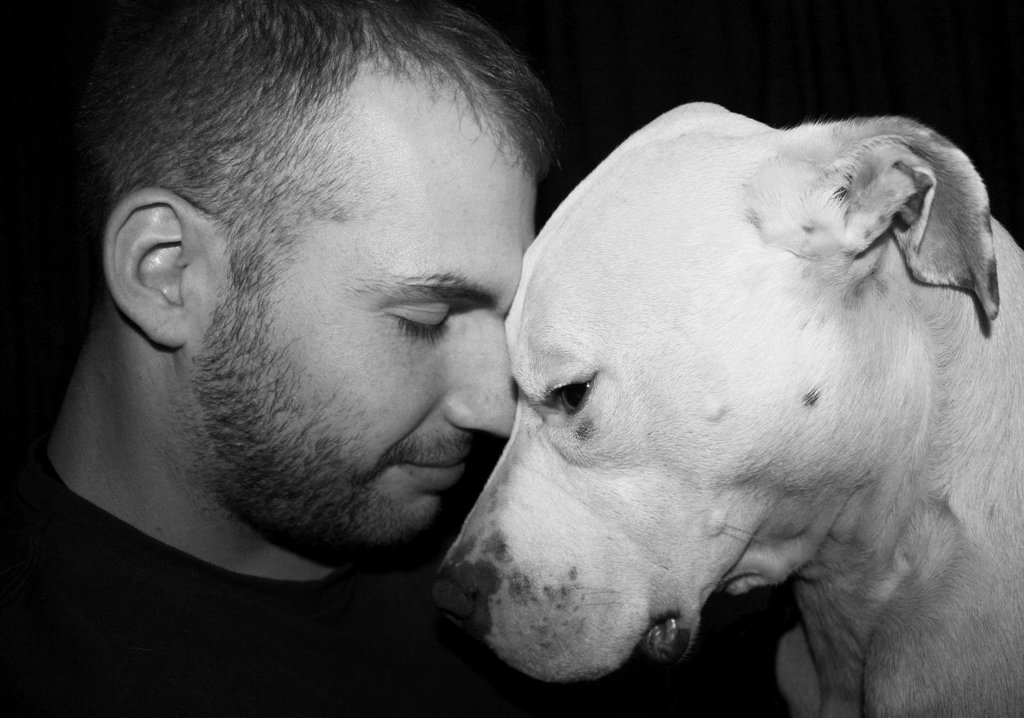
The final element was from an email yesterday in from Chris Snuggs. Chris has previously written guest posts on Learning from Dogs, the last one being In Defence of Politics back on July 8th. In that email was the following photograph.

Let me draw out the thread that I saw in all these items.
That is that the 1% that Rebecca Solnit wrote about are incredibly powerful people, with access to more power, money and control than one can even imagine. But what that 1% cannot control is the growing consciousness, the growing mindfulness and awareness of millions of people across this planet that something as simple and pure and beautiful as unconditional love will conquer all.
The most fundamental lesson that we can learn from dogs!

 Learning from Dogs