Tag: Education

Final message in a bottle

The concluding part of what we might care to leave for the next generation

Mankind over the next few years is facing the start of an interval of economic chaos and social stress between the end of the fossil fuel age and whatever follows.  That interval could well last a lifetime or more.  Some might argue that the economic challenges that have been the mark of 2011 are, indeed, the first signs of this economic chaos.

How well we cope, adapt and survive is not going to be down to those of my age (born 1944) but to the bright youngsters who have been born in the 21st century.

That was the motivation behind publishing, on December 1st, the speech given by Steve Jobs, the 2005 Stanford Commencement Speech, and on December 6th, the famous and fabulous speech given by Sir Ken Robinson at the 2005 TED Talks conference.

The third and concluding message is a subsequent speech given by Sir Ken, this time in May 2010.  It isn’t as stirring as his speech in 2005 but still a wonderful focus on what is our, as in homo sapiens, only chance of surviving – the innovation and creativity of the next  generations.

In this poignant, funny follow-up to his fabled 2006 talk, Sir Ken Robinson makes the case for a radical shift from standardized schools to personalized learning — creating conditions where kids’ natural talents can flourish.

Another Brick in the Wall

Another ‘take’ on Pink Floyd’s 1979 Release

I happened to be listening to the radio the other day and this Pink Floyd song was played again, as it regularly is. It haunts the mind with its dark, brooding and atmospheric rhythm, which is quite ironic for something supposedly against “thought control”.

It never struck me so clearly before, but I realized this time how very stupid it is and how much I really dislike the message it has given to generations of kids. Let’s have a closer look.

We don’t need no education: Oh yes you do, matey! It is in fact the ONLY THING that will SAVE you from “thought control”. The irony of this is breathtaking. What are you going to do WITHOUT education then? Without it you certainly WILL become just “another brick in the wall”, no ability to exercise any kind of judgement, no decent job = no money = no power of decision ….

As a teacher myself, I am frequently faced with spoilt, fairly mindless, ill brought-up, uninterested children who can’t concentrate for more than two minutes because their minds have been rotted by too much television and video-and computer games, plus of course the prevailing ethos in society of: “The world owes us a living.” and “We have a right to cars, houses, holidays and all the rest without having to work our socks off for them as our parents did.”

And of course, one needs to define “WE”. I suppose in fact you mean “YOU” , since who gave you the right to speak for everyone else? In my experience 95% of kids want to learn (i.e. develop their brains to avoid this dreaded ‘thought control’), whereas the remaining 5% of utter morons utterly muck up the class. Given the nature of your ranting I would place “you” in fact among the 5% of selfish morons.

So, the first line is idiotic. Does it get any better?

We don’t need no thought control: No, you don’t, but you don’t get it from teachers; they are overwhelmingly there to FREE your mind. If they tell you to “Shut up” then it is usually in the best interests of A) you yourself  B) everyone else in the classroom. If you are looking for the best purveyors of “thought control”, why not have a go at politicians, advertisers and the like? Or indeed sections of the the media? (or even your own song – another great irony)

You are not FREE in a classroom to “do your own thing” (another prevailing ethos), since that is not possible in a largish group trying to concentrate on something. Your idiotic chatter and behaviour is extremely anti-social and of course humungously selfish.

No dark sarcasm in the classroom: Teachers are frequently driven to distraction trying to help eager kids learn while a minority of mindless, anti-social morons creates havoc. Teachers may indeed resort to occasional sarcasm in the face of this onslaught of idiocy, but they are overwhelmingly reacting to the tsunami of negativism that sweeps over the class from the utter morons.

Teacher, leave them kids alone: Actually Sonny Jim, it is not the teacher’s JOB to “leave them kids alone”. His duty is to HELP THEM, to DEVELOP THEIR MINDS. “Leaving them alone” is the LAST thing he should do.

Astonishingly enough (and it may not have occurred to you – but then you are of course a moron, so what do you expect) the teacher even tries to HELP the morons who make his life hell. That is his DUTY. That is why he BECAME A TEACHER instead of flogging houses or mortgages and making lots more money.

All in all it’s just another brick in the wall: The bricks in the wall are the mindless, uneducated plebs who live unfulfilled lives, and their lives are NOT unfulfilled because they are not Wayne Rooney or don’t have loads of money but because they have no education, like you presumably.

If you don’t eat yer meat, you can’t have any pudding: Too bloody right. Growing children need protein; you don’t in general get that from pudding, but from meat. But then you don’t know that, do you, because you are an uneducated moron.

Don’t you think the teacher has better things to do than constantly moan at kids to eat a balanced diet? But instead of  slumping in an easy chair in the staffroom at lunchtime he gives up his time and more importantly nervous energy (since he gets a lot of negative crap from you) to HELP you A) get more protein B) avoid getting fat and C) learn something about nutrition so that when (God help us, or more pertinently ‘them’) you yourself have kids you might have some chance of bringing them up in a healthy way.

You may not be aware that an insanely-ludicrous percentage of British kids are clinically OBESE. Yes, VERY FAT (though these days it is probably not at all PC to use the word “fat”.) This means their lives will be much more uncomfortable, they will be very unattractive, will be subject to more illness than the healthy and will no doubt die younger.

So, the teacher who sacrifices his own nerves to try to get kids to eat properly is a HERO.

Sorry, your song is utter rubbish from start to end. Worse than that, it is pernicious and also insulting to teachers, whose overwhelming intention and indeed effect is to improve the present and future lives of their pupils.

The song may indeed refer to a personal experience of bad teachers (no section of society is without its black sheep) but the trouble is that it comes over as a blanket generalisation of negativism against teachers, and it is time someone stood up for them.

By Chris Snuggs

That oil spill

Visualisation of data

I can’t recall how but I came across a web site that focuses on ‘translating’ data into pictures.  As they say, a picture is worth a thousand words.  The web site is called Information is Beautiful.

Anyhow, they have attempted to graphically portray the scale of the BP oil spill. (A thumbnail is below but please click on the link, or here, to see this as it was meant to be shown.)

Ouch!

But this image is an update of an earlier one here that is really powerful.  Because it attempts to put the scale of the oil spill into context with global oil consumption.

If the Purdue University estimate of the oil spill is correct at 48,500 barrels a day (a barrel is approximately the equivalent of two car tankfuls of gas/petrol) and the spill is contained in 90 days then the total oil spilled will be:

90 x 48,500 = 4,365,000 barrels

That is an enormous quantity.

But have a guess as to how much that would represent in terms of hourly global oil consumption?

Any idea?

Well global oil consumption is 3,500,000 barrels an hour.

So 90 days at 48,500 barrels a day represents just 1 hour 15 minutes worth of global consumption!

If there was ever an argument for the world to wean itself off oil then this would appear to be it.

What has happened so far is tragic – tragic beyond measure.  But if it turns out to be a ‘tipping point’ for nations to reconsider how we find and use energy then, perhaps, it will have been a horrible lesson that we all had to take.

And if the USA puts all it’s collective back into leading the world out of our addiction to oil then the damage and hardship will not have been in vain.

By Paul Handover

Happiness

That pre-frontal cortex is at it again.

Prof Gilbert

There’s a fascinating video on the http://www.TED.com website given by Prof Dan Gilbert.  Prof Dan is Professor of Psychology at Havard and there’s a good resume on WikiPedia.

Here’s how John Brockman describes Dan Gilbert.

Dan Gilbert doesn’t have an instruction manual that tells you how to be happy in four easy steps and one hard one. Nor is he the kind of thinker who needs Freud, Marx, and Modernism to explain the human condition.

Gilbert, the Director of Harvard’s Hedonic Psychology Laboratory, is a scientist who explores what philosophy, psychology, neuroscience, and behavioral economics have to teach us about how, and how well the human brain can imagine its own future, and about how, and how well it can predict which of those futures it will most enjoy.

There can’t be a human that hasn’t pondered on what makes them happy. Gilbert sets out some fascinating and possibly counter-intuitive ideas. Here’s the video

By Paul Handover

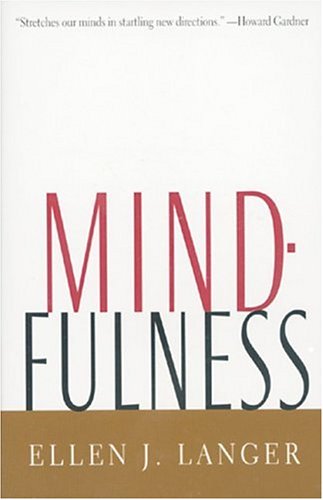
Mindfulness – a book review

In the laboratory of the hermits, no one noticed that the monkeys could talk.

Mindfulness

When a book ends with the above line, you know it’s going to be interesting.

When the inside front page carries a short review from Prof Alan Dershowitz of Havard Law School that reads, “One simply can’t finish this book and see the world in the same way”, you know the book is important.

Yes to both.

On Page 2, Ellen writes,

Unlike the exotic “altered states of conciousness” that we read so much about, mindfulness and mindlessness are so common that few of us appreciate their importance or make use of their power to change our lives.

This is a book for so many different aspects of life.  From fields like aviation where mindlessness can, literally, kill to mindful new perspectives for people looking to explore new horizons for the soul.

Langer demonstrates a rare capacity both to see what is extraordinary about human events and to envision even more enlivening human possibilities. – Lee Ross, Stanford University.

By Paul Handover

Elliot’s Schooling

So where does this all end up?

Well, I am finally back from an eventful break from writing at Learning From Dogs that has entailed my graduation from Wake Forest University, some final preparations for the University of Georgia School of Law and my move to Athens, and the unfortunate passing of my grandfather, Paul Norman Engstrom.

Therefore, it has been quite some time since I wrote my original post — which at that point was posted by Professor Jarrell with me as a guest author — in which I laid out my goals pertaining to a discussion of the United States’ education system.  Since then I have discussed the positives of our system, the negatives of our system, and pointed out the view of Sir Ken Robinson, who believes that creativity should be given the same status as literacy in education systems.

We are often surprised after researching a topic to find our conclusions to be in opposition with our previous line of thought.  However, sometimes it can be equally as surprising to do a great deal of research and then wind up back where you started, simply with a larger factual foundation behind.  This has been the case for me throughout this entire discussion of the United States’ education system.  Despite the attempt I have made to challenge my own viewpoint and think critically about my own biases, I continue to see the costs of the United States’ education system as far greater than its benefits.

Brick and mortar school building

As I have stated before, there is a great difference between formal education and learning.  Or, to be more precise, perhaps I should say that formal education is merely one part, and perhaps not even that large a part, of what “learning” entails.  I would suggest that the problem is not so much that the United States’ education system is damaging merely because of its existence, but rather that the greatest damage comes from society expecting far too much from this system.  School is no replacement for the learning that entails integration into a complex and competitive global society that necessitates human interaction, critical thinking skills, and creativity.  Sure, one can force youths into cinder block rooms and force them to learn multiplication tables and historical dates.  And, to an extent, I think this is necessary in a mass society as we have today.  However, this formula of forcing youths to learn facts and then having these facts regurgitated has been entrusted with far too much of what we today consider “learning,” and if we are ever to have a positive shift in our society from one of idea-accepters to idea-creators, this must change.

Learning the multiplication tables

Perhaps high school could integrate into their programs a larger degree of extracurricular internships that count for course credit — I am sure that this is an experiment that could be undertaken by a few school districts quite easily, and then expanded if it proves successful.  Perhaps also school curriculum could be altered to include more classes on philosophy and economics, which I see as foundational for a solid understanding of our world.  However, this alteration of core curriculum would be a much more difficult task to accomplish, and would require some serious time and thought.

by Elliot Engstrom

Question for Elliot About Public Education

Hello Elliot!

I’d love to engage in a discussion with you — and interested others — about the appropriate role of government in education.

The Federalist Papers made it clear, to me at least, that our founding fathers believed that the government, our federal government in particular, should have nothing to do with educating the populace.

The government providing public education? How did THAT happen?

I realize it sounds a bit radical now, but I believe that any discussion of what is right and wrong about public education today must begin with a healthy debate about whether the federal government should be involved in public education at all.

Your thoughts?  Thanks!

by Sherry Jarrell

Elliot’s schooling – Sir Ken’s view

Sir Ken Robinson’s view

I plan to have my final post on education finished very soon.  However, with my last week of finals and papers at the undergraduate level (which is finally over!) constantly hoarding my time, I have not yet quite been able to truly decide on which side I plan to end up.

My instinct tells me that the costs of the US schooling system far outweigh its benefits, but I feel I must be sure that this is truly a case that can be supported with logic and not simply my own biases coming through.

However, while I continue to ponder, I thought that readers might find this video interesting.  It’s a different take on the nature of institutionalized schooling than is often seen.  It’s on the longer side — approximately 20 minutes long — but I definitely think it is worth a watch for anyone pursuing a clear and well thought-out perspective on education, and it’s actually quite humorous and entertaining.

The video is of a presentation by Sir Ken Robinson, an internationally recognized leader in the development of innovation and human resources.  His thesis statement is as follows:

My contention is that creativity is as important in education as literacy, and we should treat it with the same status.

I hope the Learning From Dogs community enjoys this video.  Upon my return from celebrating my college graduation in Charleston, I plan to present my final finding on whether the costs or the benefits of schooling in the United States outweighs the other.

By Elliot Engstrom

Antonina Whaples — future fitness celebrity?

Showing dedication to health (and chain saws!)

Wake Forest University has an interesting program at our fitness center where students can be trained by certified personal trainers at an extremely discounted rate.  I have been doing this program for several months with a trainer named Antonina Whaples.  Aside from being a full time student at the university, “Nina,” as her friends call her, has just launched her career as a a figure competitor.  The whole process has exposed to me a side of the fitness world that I was not even really aware existed, but have found to be quite interesting.

Fitness world

Antonina recently competed in the National Physique Committee North Carolina State Championships, where she placed fifth — a very impressive feat for a first time competitor.  However, the real story is not just the competition itself, but also the work that went in to prepare for such an event.  Antonina’s diet, workouts, and lifestyle were all completely centered around this competition; it was dedication like I have rarely seen.  Antonina talked about this in an April 12 interview with the blog Promoting Real Women:

My trainers Jill Coleman (diet), and Kimberley Coronel (weight training) were essential to my process. The quality of my diet came out on stage and I trust Jill 100%. I never cheated on her plan and I was super pleased with my results. I know that this next show I will come in even leaner and fuller. I wouldn’t be where I am at all without the creative genius of Kim. She has built my body rep by rep and is my rock. I am proud to say that she is both my trainer and friend, and one of my greatest inspirations. One of the biggest things that mattered to me show day was making her proud!

Antonina (Don't try this at home! Ed.)

Before the show, Nina also did a photoshoot.  The pictures are really creative, and the fact that one of her majors is studio art really comes out.  My personal favorite is the photo featuring black leather boots and a chainsaw as the accessories of choice.

There’s a saying among Antonina’s friends that she is “intense.”  And if anyone has ever embodied the word “intense,” it certainly is Antonina Whaples.

Her blog, fitNasti, will be moving to a dot com domain name in the coming weeks, and I would not be surprised if after that her site continued to grow in popularity.

Keep an eye on Antonina Whaples — this girl is going places.

By Elliot Engstrom

Happy Birthday, Hubble!

The Hubble Space Telescope (HST) has been in space for 20 years!

This week, twenty years ago, the HST was launched into orbit.  There’s much online if you want to read about it both on WikiPedia and on the Hubble web site so this post is going to offer just two items.

A beautiful picture

Nucleus of Galaxy Centaurus A

And an interesting audio slideshow tribute from the BBC – click here, introduced thus:

Take a look at some of the sights it has seen in that time with Professor Alec Boksenberg from the Institute of Astronomy in Cambridge – who was on the European team that helped build Hubble.

By Paul Handover (in awe of what is beyond our skies)