Tag: Economic crisis

Aerial photography

Some chilling reminders of the reality of war!

Britain has a National Collection of Aerial Photography.  It is held within the offices of the Royal Commission on the Ancient and Historical Monuments of Scotland – perfectly logical!

A summary of the different collections is listed here, many of them wartime photographs that bring a multitude of emotions to the surface: incredible bravery of the pilots; photographic standards of 70 years ago, man’s inhumanity to man; and so on.

I pondered a bit about writing this Post because, well ….. well…, see what you make of it!

Author's Mum

Being born in England in the early part of November, 1944, World War 2 still resonates within me.

Early home in an industrial part of West London meant that my mother and father had a ring-side view of the German V1 and V2 rockets that were being visited on London at that time.

My mother, 90, still recounts her enormous sense of relief when VE Day was announced (May 8th, 1945) because she then thought that her son’s future life was more or less assured.

So back to these aerial photographs held in those collections.

Here’s a picture of the visitation of war on the beautiful French town of Caen.

Linger a while and look at the damage, mostly to private homes.  The photograph was taken just slightly more than a month before I was born.

So where’s this Post leading to….?

Read more of this Post

Mind over Matter: does it matter?

An example of how we really do own our lives.

We were invited to our friend’s 25th Wedding Anniversary on Saturday, 21st November.

English pub

It was in a local pub and they had invited many friends, some of whom we had not seen for many years.

One friend had started his own architect business, built it up over the last 10 years and, although he had lost a large amount of work because of the recession, things seemed to be picking up.

I mentioned that my work had dropped off dramatically since the summer. He said:

Well, Jon. You can make your own mind up what you do. You can either decide you’re going to go bankrupt or you can decide that you’re going to succeed –  in spite of everything.

For some reason, that short conversation had a huge impact on me and I realised that it really is mind over matter and once we make our mind up about something, good or bad, it tends to happen.

By Jon Lavin

Update on the “British Solution”

The Credit Crisis in Britain

Following yesterday’s Post on this Blog about Goldman Sachs, here’s Britain in action.

Ministers yesterday (17th November) launched a £50 billion ($84 billion) bailout of Britain’s crippled banks – and warned there could be worse to come. State-controlled lenders Royal Bank of Scotland and Lloyds Banking Group will receive fresh injections of taxpayers’ money totalling £39 billion ($65.5 billion).

RBS – which has now received the biggest state rescue anywhere in the world – was also handed £11 billion ($18.5 billion) in tax breaks to help keep it afloat.

Source: The Daily Mail

Thanks for the Greed. Are the directors responsible still in place? Are the Great and Good who removed controls and oversaw the decade of binge-spending and easy credit still in place?

Britain's Global Giant!

Oh, I remember now. The very same person in Britain who was Chancellor throughout the 90s and is now Prime Minister is – according to John Prescott (former Labour Deputy-Leader and the person whose office sign was changed at a cost of £700 ($1,200)  when his job name was rebadged weeks before he left it anyway)  – a “Global Giant” who saved the world.

Oh, and let’s not forget, this is the same person who said that: “Britain is better placed than other countries in Europe to weather the crisis …..etc blah, blah, blah …”

The reality (which is in fairly short supply among Global Giants) is different:

Within hours of the Chancellor’s announcement, the European Commission issued a stark warning about the frayed state of Britain’s national finances, warning of an ‘extraordinary deterioration’ because of the cost of City rescues.

It estimates public debt will double as a share of the economy between 2007 and 2011, reaching 88 per cent of gross domestic product – the biggest rise of any leading EU economy.

The latest £50billion bank bailout is roughly equivalent to the annual schools budget and far exceeds the annual defence budget of £35billion. The new moves bring the total of public money lavished on Britain’s financial rescue to £1.2trillion – almost £20,000 for every man, woman and child living in the country.

… and the £ has sunk drastically against the euro ….

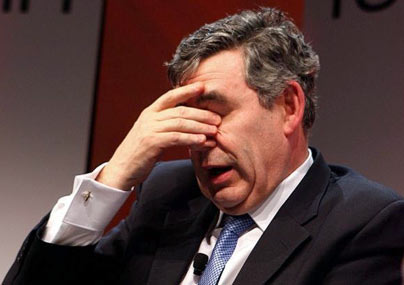
Still, let’s have a bit of positive spin …. the National Debt isn’t quite (yet) what is was just after WWII. A great achievement. Well done  Gordon Brown …. but you can do it …. just one more little push.

We could do with fewer spin-ridden “Global Giants” and more people with vision, courage and competence.

And rather than “saving the world” it might be nicer if Gordon Brown started with saving Britain.

By Chris Snuggs

Goldman Sachs – doing God’s work!

A fascinating and revealing interview in the Sunday Times.

This article in the British Sunday Times was published on November 8th and I’m sure many will have read it.  But for those that didn’t it really is worth settling down to a reasonably long read.  For you will learn that Goldman Sachs:

It’s the site of the best cash-making machine that global capitalism has ever produced, and, some say, a political force more powerful than governments. The people who work behind the brass-trim glass doors make more money than some countries do. They are the rainmakers’ rainmakers, the biggest swinging dicks in the financial jungle. Their assets total $1 trillion, their annual revenues run into the tens of billions, and their profits are in the billions, which they distribute liberally among themselves. Average pay this recessionary year for the 30,000 staff is expected to be a record $700,000. Top earners will get tens of millions, several hundred thousand times more than a cleaner at the firm. When they have finished getting “filthy rich by 40”, as the company saying goes, these alpha dogs don’t put their feet up. They parachute into some of the most senior political posts in the US and beyond, prompting accusations that they “rule the world”. Number 85 Broad Street is the home of Goldman Sachs.

The world’s most successful investment bank likes to hide behind the tidal wave of money that it generates and sends crashing over Manhattan, the City of London and most of the world’s other financial capitals. But now the dark knights of banking are being forced, blinking, into the cold light of day. The public, politicians and the press blame bankers’ reckless trading for the credit crunch and, as the most successful bank still standing, Goldman is their prime target. Here, politicians and commentators compete to denounce Goldman in ever more robust terms — “robber barons”, “economic vandals”, “vulture capitalists”. Vince Cable, the Lib Dem Treasury spokesman, contrasts the bank’s recent record results — profits of $3.2 billion in the last quarter alone — and its planned bumper bonus payments with what has happened to ordinary people’s jobs and incomes in 2009.

and later on in conversation with the Chairman and CEO, Lloyd Blankfein:

“Is it possible to have too much ambition? Is it possible to be too successful?” Blankfein shoots back. “I don’t want people in this firm to think that they have accomplished as much for themselves as they can and go on vacation. As the guardian of the interests of the shareholders and, by the way, for the purposes of society, I’d like them to continue to do what they are doing. I don’t want to put a cap on their ambition. It’s hard for me to argue for a cap on their compensation.”

So, it’s business as usual, then, regardless of whether it makes most people howl at the moon with rage? Goldman Sachs, this pillar of the free market, breeder of super-citizens, object of envy and awe will go on raking it in, getting richer than God? An impish grin spreads across Blankfein’s face. Call him a fat cat who mocks the public. Call him wicked. Call him what you will. He is, he says, just a banker “doing God’s work”

Indeed!

By Paul Handover

Remarkable people: Benjamin Zander

Music is his base

Very few people demonstrate and explain the benefits of responding positively to the world around us as effectively as Benjamin Zander.  The Boston Philharmonic Orchestra is “semi-professional”, which means that it is a volunteer orchestra who play to professional standards. He has conducted the orchestra for 30 years; and his standing as a professional cellist and conductor is without question.

Leadership is his forte

But his contribution as a musician is exceeded by his contribution as a speaker on leadership.

He combines speeches on leadership with his musical performances and has given keynote speeches at the World Economic Forum on at least four occasions.

In the book ,”The Art of Possibility”, which he co-authored with his partner Rosamund Stone Zander, they relate the following moving story.

A New Children’s Story

A little girl in second grade underwent chemotherapy for leukaemia.  When she returned to school, she wore a scarf to hide the fact that she lost all her hair. But some of the children pulled it off, and in their nervousness laughed and made fun of her.  The little girl was mortified and that afternoon begged her mother not to make her go back to school. Her mother tried to encourage her, saying. “The other children will get used to it, and anyway your hair will grow in again soon.”

The next morning, when their teacher walked in to class, all the children were sitting in their seats, some still tittering about the girl who had no hair, while she shrank into her chair.  “Good morning, children, “ the teacher said, smiling warmly in her familiar way of greeting them. She took off her coat and scarf. Her head was completely shaved.

After that, a rash of children begged their parents to let them cut their hair. And when a child came to class with short hair, newly bobbed, all the children laughed merrily – not out of fear – but out of the joy of the game. And everybody’s hair grew back at the same time.

Isn’t that wonderful?

Contrast that with the narrow thinking behind a recent incident at at school in the Australia when a child shaved her head to raise money for a charity in support of her father’s illness. She was barred from the school. The story is described here.

How daft is that? As others have asked, what would they have done if a pupil had lost her hair as a result of chemotherapy?

Sometimes you might wonder whether we live on the same planet!

Take time to watch …

If you are not familiar with Benjamin Zander’s presentation, then this is an uplifting experience. For example, this presentation (of more than an hour) was given at the World Economic Forum 2009 (and never mind the image quality, it is good enough!):

More on remarkable people …

By John Lewis

Lies, damn lies and Government statistics!

Do the last US 3rd Quarter GDP figures stand up to inspection?

The press recently celebrated the 3.5% annualized rise in the third quarter in reported U.S. Gross Domestic Product (GDP).  The figures were widely reported with, for example, CNNMoney, carrying the following headline and opening remarks:

Economy finally back in gear

Government says GDP grew 3.5% in third quarter, ending a year-long string of declines and coming in better than forecasts.

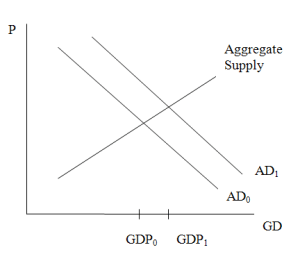
I urge caution in interpreting these figures at face value.  After all, the current GDP of the U.S. economy is simply the intersection of aggregate demand with aggregate supply.

As the figure below shows, GDP increases with increases in either the demand or supply curve, although increases in demand are accompanied by rising price levels while increases in supply push prices down and real incomes up.

graph

The quarterly figures make clear that the increase in demand was driven almost entirely by the expansion of government spending; the other three components of demand – consumption, business spending, and net exports, were either flat or falling.

Government spending is inherently short-term; it does not create wealth or enable sustainable growth.  In fact, neither consumption nor net exports create sustainable economic growth either.   Only business investment in new productive equipment (which includes business fixed investment, new residential housing and additions to inventory) has the potential to create sustainable growth in U.S. GDP, and then only when the investment leads to a permanent increase in the productivity of the business, namely a rightward (increased output per input) or downward (decreased cost) shift in the Aggregate Supply curve.

And there was little chance that the reported increase in GDP resulted from a long-term increase in the productive capacity or efficiency of the U.S. economy, as Business Investment was soundly negative in the 3rd quarter of 2009.

By Sherry Jarrell

[P.S. Karl Denninger at Market Ticker also raised big question marks about these figures. Ed.]

How far can you push people?

Debt stress in Middle Class America – how may this play out?

On Saturday, October 24th Yves Smith of Naked Capitalism ran a Post on her Blog about an anonymous couple who were over their heads in debt.  (Yves has given me written permission to reproduce the Post.) The story of this couple then generated a huge response of comments. Read the comments, each and every one of them.

Then ask yourself abraham-lincoln-picturewhere this is all heading?  These comments may, almost certainly are, just be the tip of the iceberg.  Seems a long way from Lincoln’s Gettysburg address in which he was reputed  to have used the words: “… government of the people, by the people, for the people, shall not perish from the earth.”

Some days I worry; worry a lot!

The extract from Yves Post about this couple is reproduced below but far better is to go and read the whole Post and all the comments.

UPDATE: Since writing this Post Yves has published a further Post on the topic again generating a huge volume of comments.  That was Sunday, November 1st.  Then bright and early on November 2nd James Kwak of Baseline Scenario weighs in with his version, Do smart, hard-working people deserve to make more money? 150 comments (at the time of writing) for that one.  Interestingly, as the days have gone on the mood of the commentators has become more reflective and thoughtful thus partly negating the theme behind this Post.

Read the Post from Naked Capitalism

Remarkable people update

Another quick look at Riverford Organics and a lesson for all.

Further to my post on Guy Watson of Riverford Organics, in the mini-series on remarkable people:

A couple of Saturdays ago (October 24), we had a great time out at Wash Farm, the home of Riverford Organics.

Our five year old son enjoys eating sweetcorn. Recently, having carried the weekly veg box from our doorstep to the sweetcornkitchen calling “Riverford coming through!”, he was then delighted to report: “there are three sweetcorns”, there having been two in previous weeks!

riverford 008On Saturday, he marched into a field of sweetcorn and, as if he had done it for years, went straight to a plant and, explaining what he was doing, tested the crop for size and ripeness and picked it by breaking it off like an expert. He then handed it to me and proceeded to pick many more of them. When I asked him how he knew what to do, all was revealed: “I saw it on the telly!”.

As luck would have it, I encountered Guy Watson at the event and it was great to shake his hand and offer a few words of congratulation on what he has done. Of course, he has no idea who I am!

Their customer service is great; and now they are embarking on more market research to understand better how their customers use their products! [See the relevant edition of their newsletter here!] [The subject of a Post on Market Research coming out soon. Ed.]

Although I am not an expert, I know enough to know that this is remarkable. To think about how customers are using the product, to measure it, to go into customers homes and find out what they are really doing with your products: this is at the pinnacle of good customer research!

No doubt there are others, but I have only ever heard of one other company who paid so much attention to customers in their homes. It was Intuit, the highly regarded US software vendor which, for decades, has consistently beaten Microsoft at providing accounting software. Their representatives would wait in a shop for a customer to buy their product and then request permission to travel with them to their home to record exactly what experience they had with installing and using it!

Final report from the day at Riverford: the event on Saturday was “Pumpkin Day”, its primary purpose being to buy (and have carved) your pumpkin for Hallowe’en. There was a competition to guess the weight of a (largish) pumpkin; I guessed by comparative lifting of the pumpkin and of said five-year-old son, and based my estimate on information from his mother about his most recent weight! Guess what? I have just heard that I won! So a case of (organic, of course) red wine is now expected to materialise alongside this weeks box of vegetables!

By John Lewis

P.S. The Riverford Blog is a good read

Sherry responds to John

A Post published today by John Lewis raises the question of why not consumer protection for financial ‘products.

Sherry’s reply.

A great question, John: why do we not have a threshold level of safety for financial products, as we do with cars and toys?

Well, for one, if a financial product “fails,” the consequence is purely financial – it is not injury or death.  A financial product simply represents a financial investment today in exchange for financial payoffs tomorrow.

The less certain those payoffs, the higher the minimum required return on that investment. If the returns were certified or regulated in some way, risk would be reduced, and the required return would also fall.  Limiting risk exposure throws out the baby with the bath water:  less risk means lower returns on the investment.  Look at the real returns to U.S. Treasury Bills – they are almost zero!

There is a role for regulation in financial products and that is for disclosure of relevant information.  When we invest in a financial product, we are putting our money at risk in exchange for future expected cash flows.  We forecast those cash flows on the basis of material information about the firm, its products or services, and its management and strategy.

Even here there is a fine line between the right to know and proprietary information that enables a firm to invest its own funds in the hope of generating a large return in exchange for taking risks.

The Securities and Exchange Commission’s requirement for a 20-day window between the time a bidder makes a tender offer for a target and the time the target shareholders must decide whether to accept the offer or not is an example of a regulation that crosses the line, in my view.

In a misguided attempt to protect shareholders from fly-by-night tender offers, the SEC has created an environment where multiple competing bids can arise, driving down the return to the original bidder and limiting the incentives for firms to productively redeploy assets through tender offers.

By Sherry Jarrell

Consumer ‘safety’ for financial products

Are we missing a lesson that has been applied for years?

I have resisted any temptation to comment on the economic situation on Learning from Dogs. The contributions from others are based on far more knowledge and understanding of the subject then I will ever have.

However, I feel obliged to ask humbly for some clarification about something that bothers me. Are we putting the cart before the horse? Are we ignoring the relationship between provider and consumer in finance?

The regulatory regime applied to the vast majority of products which are allowed to be sold to the public is such that toasterthere are probably more stringent safety standards for an electric toaster than for most, if not all, financial products!

Much of the talk of regulation and restraint, in the current climate, seems to relate to remuneration of people working for financial organisations. But, why does it matter what they receive? In other fields, success is rewarded and the shareholders, admittedly fairly indirectly, have some say on the policy in that area. Why should they not pay what they wish?

On the other hand (to coin an economic phrase!),  the minimum standards of the products are set by regulators.

In other fields, if a supplier cannot demonstrate, to the satisfaction of the regulators, that its product meets specified safety standards, then that product is not allowed to be offered.

It is very simple! I am not referring to contracts, customer service, compensation and so on; I am referring to a threshold level of safety below which the product is not allowed to be sold or operated. Think: “cars”, “aeroplanes”, “electrical appliances”, “children’s toys”, and … well anything else!

To be even clearer, this is not about “perfect safety” which is, of course, not available at any price. This is not about blame. This is not about guarantees. It IS about inspection, testing, certification, regulation … oh and policing!

Can anyone explain why this approach cannot be applied to financial products? (Sherry attempts to here.)

By John Lewis

p.s. as chance would have it the image of the toaster at the head of this Post was taken from an article talking about a recall of the Viking Toaster – point made rather well, don’t you think?