Tag: Economic crisis

The GPS and the AAAs

Welcome Per Kurowski Egerström

On the 22nd March, Learning from Dogs had the pleasure of a Post from our first Guest Author, Elliot Engstrom.  We are doubly delighted to have Per Kurowski join us as our second Guest Author.

Per Kurowski

Per is a prolific blogger.  He has had a full career including serving as an Executive Director of the World Bank from 2002 until 2004 for Costa Rica, El Salvador, Guatemala, Honduras, Mexico, Nicaragua, Spain and Venezuela.  More about Per’s life experiences can be found here.

Here is Per’s first Guest Post for Learning from Dogs.

——————-

The GPS and the AAAs

Not so long ago I asked my daughter to key in an address in the GPS and then even while I continuously heard a little voice inside me telling me I was heading in the wrong direction I ended up where I did not want to go.

Whither we are led?

Something similar caused the current financial crisis.

First the financial regulators in Basel decided that the only thing they would care about was the risk of individual financial defaults and not one iota about any other risks.

Second then, though they must have known these were humanly fallible they still empowered some few credit rating agencies to be their GPS on default risks.

Finally, by means of the minimum capital requirements for banks, they set up all the incentives possible to force them to heed what the GPS said and to ignore any internal warning voices.

Of course, almost like if planned on purpose, it all ended up in a crisis. In just a couple of years, over two trillion dollars followed some AAA signs over the precipice of badly awarded mortgages to the subprime sector. Today, we are still using the same financial risk GPS with the same keyed in instructions… and not a word about it in all recent Financial Regulatory Reform proposals

I hate the GPS type guidance of any system since I am convinced that any kid brought up with it will have no clue of what north, south, east or west means; just as the banker not knowing his client’s business or how to look into his client’s eyes or how to feel the firmness of his client’s handshake, can only end up stupidly following someone else’s opinion about his client on a stupid monitor.

I hate the GPS type guidance system because, on the margin, it is making our society more stupid as exemplified by how society, day by day, seems to be giving more importance to some opaque credit scores than to the school grades of their children. I wait in horror for some DNA health rating scores to appear and cause a total breakdown of civilization as we know it.

Yes, we are buried under massive loads of information and these systems are a tempting way of trying to make some sense out of it all, but, if we used them, at least we owe it to ourselves to concentrate all our efforts in developing our capacity to question and to respond adequately when our instincts tell us we’re heading in the wrong way.

Not all is lost though. I often order the GPS in my car to instruct me in different tongues so as to learn new languages, it gives a totally new meaning to “lost in translation”, and I eagerly await a GPS system that can describe the surroundings in more extensive terms than right or left, AAA or BBB-, since that way not only would I get more out of it but, more importantly, I would also be more inclined to talk-back.

By Per Kurowski

Let there be markets

Here’s a novel idea – make markets be markets!

I apologise for the rather trite sub-heading but it was a bit of attention grabbing to promote the results of a recent conference called Let Markets Be Markets.  It was published by the Roosevelt Institute and had one very impressive line of speakers.

One of the speakers was Simon Johnson of Baseline Scenario fame, a Blog that Learning from Dogs has followed since our inception.

Here’s 8 minutes of Simon pulling no punches.

If you want to read and watch other presentations, then Mike Konczal’s Blog Rortybomb is the place to go.

As this Blog has repeated from time to time, this present crisis is a long way from being over.

By Paul Handover

A useful reflection on the economic crisis.

Will this prove to be an accurate analysis of what happened?

Regular readers of Learning from Dogs will know that Yves Smith of Naked Capitalism is held in high regard by this author.  She was one of the authors mentioned in a recent Post titled Free Speech and then a little later on there was a Post from me specifically praising her.

Last Friday the US Business News Network, BNN, ran a piece which included Yves discussing her new book ECONNED.

Yves Smith - ECONNED

The reason for publishing this Post is that the video clip covering Yves contribution is a very clearly articulated account of how we got ourselves into this economic mess.  For those like this author who don’t really understand many of the sophisticated economic terms used widely elsewhere, this was a refreshing ‘tutorial’.

Do watch it – Yves is brought in around 3 min 45 secs.

By Paul Handover

In praise of Yves Smith

Helping thousands better understand this crisis

Yves’ Blog Naked Capitalism has been mentioned many times on Learning from Dogs.  Indeed, she was one of the Blog authors highlighted recently in this Post.

Yves Smith

I fail to understand how she finds the hours in the day to write in such detail – but those of us interested in getting under the skin of our present economic situation are all the better for it.  Here’s a great example that was published on the 23rd February.  I quote the opening paragraphs and then link to the rest of her post. From here on is her piece:

———————–

Martin Wolf, the Financial Times’ highly respected chief economics editor, weighs in with a pretty pessimistic piece tonight. This makes for a companion to Peter Boone and Simon Johnson’s Doomsday cycle post from yesterday.

Let us cut to the chase of Wolf’s argument:

Now, after the implosion, we witness the extraordinary rescue efforts. So what happens next? We can identify two alternatives: success and failure.

By “success”, I mean reignition of the credit engine in high-income deficit countries. So private sector spending surges anew, fiscal deficits shrink and the economy appears to being going back to normal, at last. By “failure” I mean that the deleveraging continues, private spending fails to pick up with any real vigour and fiscal deficits remain far bigger, for far longer, than almost anybody now dares to imagine. This would be post-bubble Japan on a far wider scale.

Yves here. Notice he associates success and failure with polar options. But how can you “reignite the credit engine” when the financial system is undercapitalized even before allowing for the need to take further writedowns? The IMF has found the converse in its study of 124 banking crises, that purging bad debt is a painful but necessary precursor to growth. So I fail to understand how Wolf envisages that “skip Go, collect $200″ of releveraging quickly comes about. And in fact, it turns out that Wolf’s “success” is a straw man:

[to read the rest click here, Ed]

By Paul Handover

Predicting lost decades for Britain

…. and most likely other ‘Western’ nations

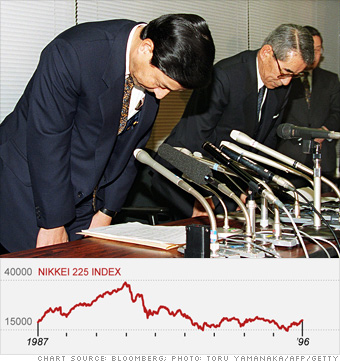
This Post is taken in its entirety from the website Contrary View. Contrary view number 73 has just been published, as follows.  Please see note after signature. [The Japanese Nikkei 225 index was 10352 at the time of writing this Post – 0800 MT, 23rd Feb.]

There is plenty of evidence from Japan about lost decades for investments. Japan has now lost two decades in equity and property investment, during which time only Government Bonds provided any sanctuary. All policy options failed, because none tackled the real problem, which is that there is already too much debt. What lessons can be drawn for Britain?

Lost decades

Shares here [in Britain] have certainly had a lost decade. On the Japanese evidence, they may well suffer another lost decade. Property has only hit minor bumps, so the Japanese experience suggests that property may suffer a long decline for two decades. In the UK, the Bank of England’s support for mortgages will be withdrawn over the next two years, which itself threatens prices. Why, though, the hysteria about Government debt?

It is questionable whether pundits appreciate the extent of the private sector debt problem, which explains why two groups of economists can offer totally contradictory remedies. In a world with no Gold standard and therefore no anchor to the monetary system, Government debt is relatively safe. The global economy is perched on a knife edge, with a permanent loss of output that must cause income loss and therefore restrict the capacity of households to service their debts. Seeing the commercial risks, banks are still restricting lending, which means there can be no sustained recovery.

There is a misconceived demographic argument being touted at present, which completely ignores the real driver of the post-1945 expansion, namely increased credit. That credit growth has simply gone too far and now brings its own problems. For those people who neither saw the credit crunch nor the long fall in interest rates and inflation coming, to now be credible in predicting a lost decade for bonds, is itself unbelievable.

By Paul Handover

Note: Until very recently, the author was a client of Kauders Portfolio Services, the publisher of the Contrary View website.  Please see the warning about these views posted on that site.

Managing in a mad world.

Even in the midst of great pain, we must think through our choices

The last week has been really mad.  I have been working in different companies and organisations and having to be part of redundancies, power struggles and people rebuilding their lives.

For example, I was in a company that had just let its second lot of people go in as many months. It’s gone past losing ‘dead wood’ and now people with valuable skills needed for recovery are going. I’ve noticed previously that good, employable people with key skills start to get concerned and will often take voluntary redundancy rather than hanging around to see how things pan out.

End of job!

It’s the shocking way that it’s done as well that’s unbelievable. No warning, just a phone call to attend a meeting, no hint as to what the meeting is about, then an envelope slid across the table and then a rapid escort off site. All done and dusted in 5 minutes.

Having been through this myself some years ago, it’s not something you forget in a hurry. Lots of feelings of rejection and feeling unvalued and unwanted are what I remember. Perhaps its part of being bought up in a job-for-life culture and then having that illusion shattered.

Working with people in this situation is literally quite shocking and traumatic because it clearly affects them and their lives and the lives of their families, and it affects me because the work we started comes to an abrupt end usually with little or no warning, and so does a source of income to be brutally honest. I don’t even have chance to say good-bye in many cases.

Every Thursday I become a trainee psychotherapist and work with people who mostly struggle to hold down any sort of job. The reasons for this are generally because of upbringings that are awful beyond description. The shock and trauma that is in the air when working with these people is amazing, and so scary for them that the idea of being present in the room with me and is virtually impossible.

So that brings us to managing in a world where lots of mad and non-integrous things happen. I believe that mindfulness can provide a key to these situations; being present for another does more than any instruction manual!

Being present means we make ourselves available at many levels to someone who is suffering. By avoiding the subtle invitation to join someone in their shock and trauma but by being there for them, to the best of our ability and listening to them at depth, we can provide an environment where real reflection can take place. Then options may be chosen which are not born of panic and reaction but come from reflection and response.

I believe that this approach gets us out of the ‘noise machine in our heads‘ (that is forever churning and worrying, in my case) that we have no control over, and creates space for more subtle things to come through the quiet and calm.

Most people I’ve met in my engineering work like to assume that they think their way out of tight situations but I’m not convinced that this process is actually effective. I have heard and practised many times the activity of ‘sleeping on something’ and then being able to decide on a course of action the following morning with relative ease. My psychotherapy clients can’t think their way out the awfulness because thinking about things has got them into a spiral

Albert Einstein

process which is highly addictive, predictable and virtually impossible to break without the intervention of a higher level of awareness. I think it was Einstein who said something like, “you can’t use the same intelligence that created a problem to solve it“!  In other words, a different approach or level must be used.

I believe that this different approach or level can be used to solve most problems we have. By bringing a different level of awareness to a challenge, whether it is redundancy or some other sort of deeper problem always gives different results and provides more options. It’s just that initially it needs to be facilitated, until we can do it under our own steam. I am heartened that even in the depths of a recession that there are still companies out there that support this approach and the work I do.

By Jon Lavin [This article from the BBC is worth reading in conjunction with Jon’s excellent Post. Jon may be contacted via learningfromdogs (at) gmail (dot) com]

Why the Fed Raised the Interest Rate

Contractionary Fed policy in a recession?

What does it mean when the Fed raises the interest rate? It helps to first understand how the Fed raises the rate, which may surprise some people.  The Fed does not “set” the interest rate as it might, for example, by declaration or edict or by fixing prices.  No, it targets a higher interest rate by contracting the money supply until that money supply intersects the market demand for money at a higher market-clearing rate of interest.

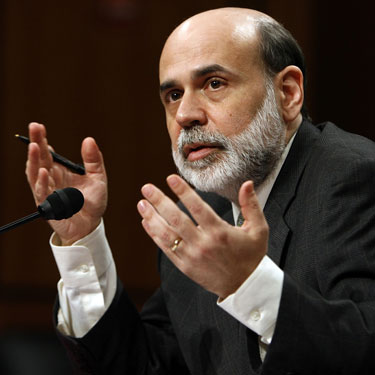
Ben Bernanke, recently reconfirmed Fed Chairman

How does the Fed reduce the money supply? Typically by conducting open market operations, which is the purchase or sale of government securities by the Fed.  To raise the money supply, it purchases new government securities, paying for them by creating — out of thin air — reserves for the commercial banking system. To reduce the money supply, it sells securities which shrinks the amount of deposits in circulation in the economy. In other words, it reduces the liquidity or amount of credit in the system.  This is equivalent to reducing aggregate demand for the goods and services in the economy. (Yes, you heard right — a reduction in the money supply decreases the aggregate demand for goods and services by businesses and consumers.)

Raising interest rates is a contractionary policy decision.  It is designed to “slow down” the economy, reducing output and employment, and raising the equilibrium prices of goods and services in the economy.  Why would the Fed choose to contract an already anemic economy?  To head off inflation, which has it own set of insidious costs and distortions that significantly hurt the economy.

The Fed has always had to tread a very fine line between increasing the money supply enough in the short run to pump up demand and minimize the depth and length of a recession, but not increasing the money supply so much that the increase in demand outstrips the ability of the economy to produce, which creates inflation in the longer run.   Excessive money growth is what causes inflation.  And over the last two years, the U.S. has witnessed a record-shattering increase in the money supply as policymakers struggled to deal with an unprecedented financial crisis.

I have been saying for months that this behemoth money supply would inevitably lead to significant inflation unless steps were taken to shrink it.  I believe the Fed has now begun to take those steps.

By Sherry Jarrell

Free speech!

Hats off to some intrepid commentators

We are going through unprecedented troubled times and the way ahead looks very uncertain.  The whole world could be participating in the ‘lost decade’ that Japan experienced previously.

But this article is not about doom and gloom!  It is about recognising the commitment to open and honest reporting being undertaken by (at least) these three  individuals.  Three commentators that this author follows in admiration and awe.

Learning from Dogs has nothing like the following of James Kwak, Yves Smith and Karl Denninger but the LfD authors do have an inkling of the work involved in writing not one but often several articles each day.  It is a huge commitment.

James Kwak

First James Kwak of Baseline Scenario.  Simon Johnson is, perhaps, the more well-known of this duo that comprise Baseline Scenario but it is James that puts in the leg-work.  Here’s a taste of a recent article from James:

Radio Stories

I spend a lot of time in the car driving to and from school, so I end up listening to a lot of podcasts (mainly This American Life, Radio Lab, Fresh Air, and Planet Money). I was catching up recently and wanted to point out a few highlights.
Last week on Fresh Air, Terry Gross interviewed Scott Patterson, author of The Quants, and Ed Thorp, mathematician,  inventor of blackjack card counting (or, at least, the first person to publish his methods), and, according to the book, also the inventor of the market-neutral hedge fund.

Large chunk snipped ……

I finally got around to listening to Planet Money’s interview with Russ Roberts from December. Russ Roberts and I are pretty sure to disagree on almost any actual policy question. But what I liked about his interview was that he basically admitted that policy questions cannot be settled by looking at the empirical studies. On whether the minimum wage increases or decreases employment for example, he says that he can poke holes in the studies whose conclusions he doesn’t agree with, but other people can poke holes in the studies he agrees with. In Roberts’s view, people’s policy positions are determined by their prior normative commitments.

I don’t completely agree. I don’t think that these questions, like the one about the minimum wage, are inherently unanswerable in the sense that the answer does not exist. But I agree that empirical studies are unlikely to get to the truth, particularly on a politically charged question, because there are so many ways to fudge an empirical study. As one of my professors said, there are a million ways you can screw up a study, and only one way to do it right. But I agree with the general sentiment. We are living in an age of numbers, where people think that statistics can answer any question. Statistics can answer any question, but they can answer it in multiple ways depending on who is sitting at the keyboard.

By James Kwak

Read about Yves Smith & Karl Denninger

More Trouble Ahead?

This is clear! Clear as mud!

Help!! Is there a financial Wizard out there somewhere? I need your input! My bank, the Société Générale, is advising

Société Générale

its customers that “a global economic collapse” is very possible within the next two years and that we should make “defensive preparations” for it.

Is this a sign of the bank losing its mind (and they did lose £5 billion a few years ago at the hands of a rogue trader) or do they know something that other pundits don’t?

Where is the Guru that can tell me where I should put my money now? Under the mattress? And in which form? Shirt buttons?

They say gold will skyrocket as the only thing buyable worth buying! And there’s me having just sold all mine at what I thought was the top of the market!!!! Oh Dear …..

By Chris Snuggs

Time for a Review

What’s more common in business could/ought to apply to us.

I was very pleased to call by and have a chat with a very good friend and his wife recently because they are facing financial difficulties.

Slightly unusual in that he is a qualified Doctor and has a share in the practice and his wife is a music teacher. Why should they have problems?

They bought their house three years ago and, like so many others, took out a large mortgage.  Probably not the best deal available at the time but it allowed them to secure the house they wanted. Since they purchased the property, house prices have fallen so they have fallen straight into negative equity!

The house needed some work and they also carried out a loft conversion. To make this possible they arranged another loan, not at a very good rate, but at least they are working on the property, and the bits they have done look great.

Working hours and the need to keep up to date with patient notes and write appraisals means that there is almost no time for relaxation; to fall into bed at night is a welcome relief! But what of the financial situation?

To keep the show on the road there has been no time to review the arrangement of ‘bricks’ on which the financial blocks are built.  Now they facing a large tax bill, so another large loan is being proposed, just to keep the tax man quiet and keep the show on the road.

How many of us find ourselves in a similar situation? Yet industry has a business practice that can help us. Analyse, diagnose, correct – sort of based on the mantra that ‘You can’t manage what you can’t measure‘.

  • Review our situation and diagnose the problems.
  • Look at our options.
  • Decide what to do.
  • Action our decision
  • And lastly REVIEW progress.

How often are we likely to review our situation like this at home or even make basic changes.  Well perhaps we need to review more often than we think. Make it a regular weekly practice.

Look at being tax efficient, and in the case I am describing this was the major problem, so the cycle of worry is now being broken, and a new firm financial arrangement of blocks being put in place rather than the little boxes, which were piled high, and about to fall down.

Yes it takes time. No we don’t want to face it, but hey its like banging your head against a wall.

It is great when it stops.

Try it!

Bob Derham