Tag: Economic crisis

I am scared!

Guest author, Per Kurowski, on a rather sobering topic!

I do not know what worse, the arrogance of the regulators thinking they can squeeze out the risk in banking by imposing different and completely arbitrary capital requirements based on the opinions of some few human fallible credit rating agencies, or their childish innocence not knowing this creates systemic risks of gigantic proportions.

What I do know is that an amazing number of intelligent people have fallen for this absurd and extremely dangerous regulatory paradigm. Honestly… I am truly scared!

How could I not be with regulators who can authorize banks to leverage up 62.5 to 1 on public debts like Greece’s while at the same time placing a 12.5 to 1 ceiling on the lending to the small businesses and entrepreneurs whom we depend so much on for our jobs.

Better hope they don't need funding!

All those financial and regulatory experts who kept mum when they should have spoken out on the financial crisis about to happen are now, quite effectively, circling their wagons in order to promote the myth that no one knew. False many did! In order to benefit from the lessons we must learn, they should not be allowed to succeed.

On October 19, 2004, as an Executive Director of the World Bank (2002-2004) I presented a written formal statement at the Board and that included the following:

We [I] believe that much of the world’s financial markets are currently being dangerously overstretched through an exaggerated reliance on intrinsically weak financial models that are based on very short series of statistical evidence and very doubtful volatility assumptions.

And I was no investment banker, nor a regulator, nor an investor, and so to me it is clear that all of them, had they done their job right, should have known… and that this crisis should have been nipped in the bud much earlier, as

Per Kurowski

the real explosion in truly bad mortgages took off in 2004, when the SEC in April delegated the setting of the capital requirements for the investment banks to the Basel Committee, and the G10 in June approved Basel II.

In order to understand it all don’t follow the money… follow the AAAs.  In case you missed “The Financial Crisis explained to dummies, non-experts and financial regulators” you can read it here.

By Per Kurowski

PS. I have put up a document that resumes most of what I said before and during my term as an Executive Director.

“Wild” Swing in the Dow Jones?

Market Swings are Normal…nay…Desirable!

Roller coaster?

Just to try to help put stock market swings into perspective, consider this:

  • the 347.8 point fall in the Dow Jones Industrial Average last week, from 10868.12 at the start of the trading day on Thursday, May 6, 2010 to 10520.32 at the close of trading, can be COMPLETELY explained by an increase in the perceived cost of capital from 12% to 12.23%.
  • do the math.  Using the constant dividend growth model, a very simplified model of the market value of equity, or Market Value = Current Dividend/(cost of equity capital – dividend growth rate), and assuming a long-term average cost of U.S. equity capital of 12% and average growth rate of 5%, we find that the opening level of 10868.12 = 760.77/(.12 -.05), and the closing level of 10520.32= 760.77/(.1223 -.05).
  • I think it is entirely possible that the chaos in Greece and surrounding nations, and the interconnections between worldwide supplies of liquidity and financial capital, that an increase in the perceived risk and uncertainty of the returns to equity from 12% per year to 12.23% per year makes perfect sense.
  • The market’s are working.  Market participants, from the individual investor using on-line trading at 2:00 in the morning from their living room to the most sophisticated computerized large-scale institutional trader, understands that a borrower’s ability to pay back its investors depends on the real productivity and growth of private industry, whether the borrower is a company or a country.

by Sherry Jarrell

The Fourteenth Banker

What interesting times we live in.

Came across a relatively new Blog with the title The Fourteenth Banker.  Caught my eye because of the similarity to the book written by Simon Johnson and James Kwak of Baseline Scenario fame.  Here’s an extract from the ‘About’ piece of this new Blog.

In response to the comments of folks in the Congress and oversight regimes, I have created this blog as a home for bankers who need to speak out and do not have a central clearinghouse or a safe place to do so.     Big banks now treat their employees like property, bought and owned.     Typically employees must subject themselves to all sorts of potential sanctions, forfeitures of compensation, clawbacks and even lawsuits if they speak in ways we often have thought were protected speech.   I am not talking about revealing confidential customer or proprietary information, I am talking about simply commenting on a company, management philosophy, making general observations or raising concerns.     It makes one appreciate unions even if not historically supportive of unions.   At least management and labor can have a debate.    Not so in today’s large banks.    Gag orders are written in the most intimidating way, included in Codes of Ethics, attached to incentive plans, posted on the company home pages.     We should ask ourselves, what is the big secret?

Do support the Blog by calling by.  Here’s a taste of what they are writing about:

Lying at Leyman

What is a million between friends?

Read this piece from Bloomberg Businessweek How Much Did Lehman CEO Dick Fuld Really Make?

This can only be called what it is. Delusion. Delusion about self, society, morality, values and anything else you can name. These are symptoms of a grave illness which is too common among those in power. In fact, the illness may be the requisite to power.

By Paul Handover

How big bankers became outlaws

[This is another Guest Post from Patrice Ayme which appeared on his Blog on the 28th April.  It has been slightly modified by me. Ed]


Celebrating Goldman Sachs, while acknowledging that it is far from being all their fault.

Point One: We are living in a state of law. Supposedly.

Point Two: That State is democracy, the rule of the demos, the people. It is not the rule of the bankers. Supposedly.

Point Three: Political leaders have recently given PRIVATE unelected individuals, the bankers, the means and the right to create money, the money everybody uses, through debt, ex nihilo, starting from PUBLIC funds  (Called, somewhat misleadingly, the fractional reserve banking system.)

Point Three contradicts the union of Point One and Point Two. Power is supposed to be exerted by the people, but money is power. Big bankers create money at will, with the complicity of the political leadership. So they create power at will.

Thus, the present system incites (big) MONEY CREATING BANKERS TO BECOME GANGSTERS, and then OUTLAWS.

It is as simple as that!

Thus one needs to get rid of the private fractional reserve PUBLICLY funded money creating system.  The situation has been rendered worse in the last decade by the blossoming of synthetic derivatives which are out-of-this-world bets which could not possibly be paid back.

Synthetic derivatives of derivatives transformed a 300 billion dollars loss in real mortgages into a potential exposure of 24,000 billion dollars, thanks to the leverage of the derivatives squared.

Then political leaders, accomplices with the bankers, offered to pay the 24,000 billion dollars, on behalf of taxpayers, leaving the economy in tatters.

Not all is lost: Goldman Sachs got its entire 2008 profit, 13 billion dollars, from taxpayers, through AIG, thanks to US politicians, and the USA loves a winner. Love and dove, there are still many a feather to pluck.

By Patrice Ayme

P.S. Synthetic derivatives are, mathematically and philosophically, a generalization of the license of the privately managed, publicly funded, fractional reserve system, thus proving further, if need be, how erroneous the latter can be.

P.P.S. The fractional reserve system ought to be kept, to provide the capital needed, simply it ought not to be anymore the province of a small private oligarchy gaming it.

Today’s Funny

The art of saying something and meaning something totally different.

I must confess to being a bit fed up with Greece.

In Anglo-Saxon language their attitude used to be called “taking the piss“.  Today’s “funny” (or if preferred take your pick from: tragic, surreal, ludicrous, ridiculous,bizarre, insane or indeed all of these at once) is something the Greek Prime Minister said. Admittedly he said it in February and I’ve only just picked up on it.

Here’s an extract from what was said:

‘We are a country which cannot alone deal with the speculation. So this has become a European problem, because if we do have a major problem, this could create a contagion for other countries too who are not to blame.’

Brilliant and I especially love the use of the word “speculation”.

This makes it seem as if it isn’t Greece’s fault at all; it’s all down to those nasty fat people in suits and sunglasses, the evil international financial mafia seeking to destabilize his country.

Then there is the “if” word. Now normally this is associated with a condition, but anyone who even in February thought that there was any conditionality involved in Greece’s meltdown must have been looney, or perhaps the Head of the International Monetary Fund (IMF) who said this on March 8th:

Greece will be able to deal with its own financial problems without needing a bailout, the head of the International Monetary Fund said today.

IMF managing director Dominique Strauss-Kahn said that Greece’s debt mountain is unlikely to spread to other eurozone countries with high levels of public debt.

And Mr Strauss-Kahn dismissed market speculation of potential default by other heavily indebted eurozone countries such as Portugal, Spain or Ireland as scare-mongering.

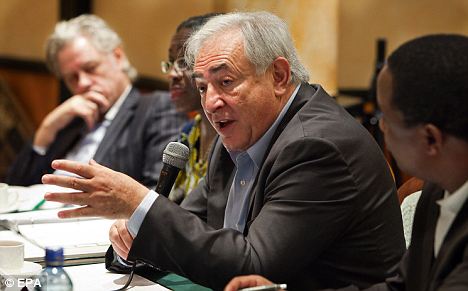
IMF Director Dominique Strauss-Kahn answers questions on a panel with Bob Geldof in Nairobi yesterday. Mr Strauss-Kahn has said he believes Greece will not need an IMF bailout .

Yes, this is the same DSK who is paid a vast salary and expenses and could be the next President of the EU.Of course he could have been lying to try to restore “confidence”. However, lying is lying, for whatever reason. Or he could have just been humungously wrong.

That’s the trouble with our leaders and financial experts these days; you never know whether they’re lying or just stupid; it’s usually one or the other and sometimes of course both.

And Papandreou’s quote continues: ” a contagion for other countries“. Indeed, Mr P. And what do we do with a “contagion” in the body? We destroy it and get rid of it …. and finally we have “other countries too who are not to blame“.

AHA! At last! Proof that my old Mum in the UK on her measly pension is not to blame. Thanks Mr P. At last some recognition fo the truth. Let’s have a bit more of that ….

As for the merits of Greece’s plea for funds, you only have to read this devastating article to feel your flabber gasting to breaking point.

No wonder the Germans are increasingly threatening to dump Greece, and so they should. Not the German government (all governments seem currently to lack the guts to do anything really necessary or serious).

No, this time it’s an economics professor threatening to take the EU to court if they allow this blatantly EU-illegal bailout, and public opinion is increasingly on his side.

It is a horrendous mess, but the only solution is for Greece to leave the euro. Bailing them out is a black hole. Does anyone in their right mind think the Greeks can really change their traditional practices and suddenly become honest, thrifty and hard-working?

Well, the answer is probably  “Yes”, but then cloud-cuckoo land is becoming seriously over-populated.

Which reminds me, I must get back to the British General Election Campaign ……

By Chris Snuggs

Well done, Bill Moyers!

A giant of US television retires from the screen

One of the fascinating aspects of my new American life is seeing how loud the volume of dissent is from the American

Bill Moyers

people about the shenanigans on Wall Street and the Too Big To Fail banks.  There is an intensity and passion that I can’t see happening on the other side of the Pond.  Maybe this is the cultural legacy of a people that just a short time ago, relatively speaking, were opening up this giant country seeking a better way of life than the ‘old countries’.

This intensity and passion is why, in the end, I believe that the solution to the huge crisis that still awaits us will start from this side of the Atlantic.  But it will get a whole lot worse before it gets better, such is the complexity and depth of the fraud that is being visited on decent, ordinary folks in this and many other fine countries.

Bill Moyers of the Bill Moyers Journal on PBS is retiring.  He’s approaching 76 and that’s a grand age to be dealing with the workload and stress of a weekly television presentation.  His last Journal was broadcast on the 23rd April, a week ago today airing two really important topics.  My only regret is that I haven’t been here sufficiently long to view many more of his Journals.

William K Black

In that last broadcast on the 23rd, Bill had two key interviews.  In this Post, I want to bring to your attention his first report, which was an interview with William K Black, now an academic but, just as importantly, a former bank regulator.  William Black really understands what is going on in banking.

The interview is both fascinating and captivating because, well to me anyway, it explains in terms that us laymen can understand, exactly what is going on and why it is so terribly important that legislation and regulations are brought into force to stop this fraud ever happening again.

This interview has not yet made it’s way onto YouTube so I can only post the link to the Bill Moyers website.

But, please, if you care about what is happening to us in whatever country you live in, click on this link and watch the interview.

And if you want to watch the earlier interview that Bill Moyers had with William Black then here it is.

By Paul Handover

Today’s Understatement of the Year

The EU Bailout!

German Chancellor Angela Merkel

German Chancellor Angela Merkel has questioned whether Greece should have been allowed into the eurozone in the first place.

She said the decision “may not have been scrutinised closely enough”.

Indeed, Angela. Indeed it may not, especially as Goldman Sachs organised some “credit swaps” (now illegal) that helped Greece disguise the size of its deficit.

Perhaps something is lost in translation, but why the “may”? Why can’t people bring themselves to call a spade a spade? The “may” is totally misplaced, isn’t it? So why say it?

See also this recent piece on the BBC.

By Chris Snuggs

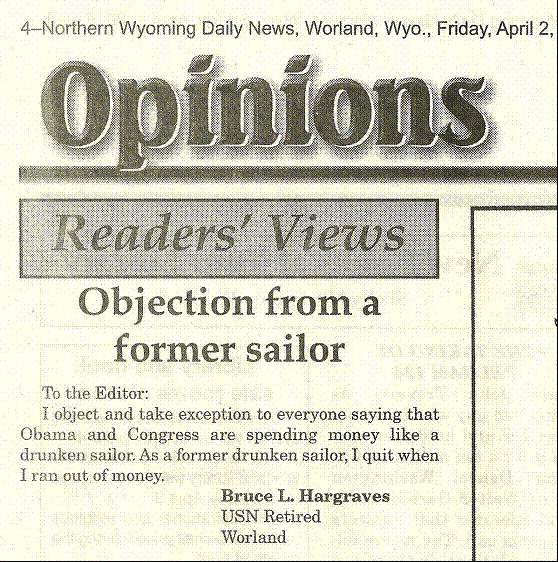
Drunken sailors

With thanks to one of our very regular followers, Gordon, for passing this on.

Well said, that sailor!

By Paul Handover

The beginning of the end for the Eurozone?

A fateful day for the eurozone

…. is how Gavin Hewitt recently headed up a post on his BBC Europe blog.  The headline caught my eye and then when I read the full article it seemed as yet another piece of western civilisation was sliding into chaos.  Maybe it’s my age!

Gavin Hewitt

Gavin Hewitt is the BBC’s Europe Editor and as you can see from his bio, Gavin is a very experienced reporter.  Here’s how this Eurozone article starts:

Friday [April 23rd, Ed] will be remembered as the day the euro needed rescuing. Sure it is Greece that has asked to be bailed out but it was still a day that the architects of the single currency had never envisaged. For when it came to it, there were no plans to save a euro member in trouble.

You see what I mean about grabbing one’s attention!

In fact the article is so powerful that I am going to run the risk of incurring the wrath of the BBC’s legal department by republishing it in full.

Here it is:

Read the rest of this article

US incomes

This isn’t just about America, it’s affecting us all!

Yesterday, Learning from Dogs published in full a Stratfor report about China.  The thrust of the report was:

U.S.-Chinese relations have become tenser in recent months, with the United States threatening to impose tariffs unless China agrees to revalue its currency and, ideally, allow it to become convertible like the yen or euro. China now follows Japan and Germany as one of the three major economies after the United States. Unlike the other two, it controls its currency’s value, allowing it to decrease the price of its exports and giving it an advantage not only over other exporters to the United States but also over domestic American manufacturers. The same is true in other regions that receive Chinese exports, such as Europe.

What Washington considered tolerable in a small developing economy is intolerable in one of the top five economies. The demand that Beijing raise the value of the yuan, however, poses dramatic challenges for the Chinese, as the ability to control their currency helps drive their exports. The issue is why China insists on controlling its currency, something embedded in the nature of the Chinese economy. A collision with the United States now seems inevitable. It is therefore important to understand the forces driving China, and it is time for STRATFOR to review its analysis of China.

(My italics)

So the state of US incomes is crucial, not only to Chinese exports to America but for global trade in general.

Karl Denninger

We have often congratulated Karl Denninger of Market Ticker for his commitment in analysing and reporting on the American economic scene and a recent piece on US Incomes was typical of his excellent reporting.  I am taking the liberty of publishing his Post in full because, frankly, this information is of importance to us all, wherever we live.

Where Did The Income Go?

It appears that the Federal Tit Pump is running out of power…

Personal income increased $1.2 billion, or less than 0.1 percent, and disposable personal income (DPI) increased $1.6 billion, or less than 0.1 percent, in February, according to the Bureau of Economic Analysis.  Personal consumption expenditures (PCE) increased $34.7 billion, or 0.3 percent.

Oh boy, now the $1.3 trillion in additional deficit spending is no longer contributing to personal income!  That’s not so positive – indeed, it’s not positive at all.

Private wage and salary disbursements increased $2.0 billion in February, compared with an increase of $16.6 billion in January.  Goods-producing industries’ payrolls decreased $3.5 billion, in contrast to an increase of $5.2 billion; manufacturing payrolls decreased $1.4 billion, in contrast to an increase of $5.0 billion.  Services-producing industries’ payrolls increased $5.5 billion, compared with an increase of $11.4 billion.

Goods down…. uh, where’s our so-called economic recovery?

Proprietors’ income decreased $6.1 billion in February, the same decrease as in January. Farm proprietors’ income decreased $7.1 billion, the same decrease as in January.  Nonfarm proprietors’ income increased $1.0 billion, the same increase as in January.

Very little change in proprietor’s income ex farming, but farmer income is down significantly.

Rental income of persons increased $2.2 billion in February, compared with an increase of $1.9 billion in January.  Personal income receipts on assets (personal interest income plus personal dividend income) decreased $16.5 billion, the same decrease as in January.

Rents up a bit, but dividends are down huge, continuing a trend.  This is not positive at all, and implies that assets are being sold to continue lifestyle choices.  This leads to a question that has begun to gnaw at me: Have we begun to cross into where boomers start pulling funds out of asset classes to live on?

Personal current transfer receipts increased $16.6 billion in February, compared with an increase of $29.8 billion in January.  The January change reflected the Making Work Pay Credit provision of the American Recovery and Reinvestment Act of 2009, which boosted January receipts by $19.8 billion. The Act provides for a refundable tax credit of up to $400 for working individuals and up to $800 for married taxpayers.  When an individual’s tax credit exceeds the taxes owed, the refundable tax credit payment is classified as “other” government social benefits to persons.

Government to the rescue!  $45 billion worth in the last two months, to be specific.  That’s a direct $270 billion in handouts, or 2% of GDP – and that’s only the direct handouts!  So subtract that off GDP and….. (oh, and don’t forget the rest of the $1.3 trillion too.)

Nothing to see here folks, as in “no evidence of sustainability in the recovery.”  We have a government that continues to “prime the pump” but there’s no water at the bottom of the well to generate self-sustaining economic growth.

By Paul Handover