A republication of a powerful essay from Martin Lack.
Martin and I haven’t seen eye-to-eye on everything, as each of us would readily admit. But there’s no taking away the power contained in many of Martin’s essays over on his Blog Lack of Environment. Unlike me, Martin has strong academic credentials that he uses well to support his position.
Martin recently published a strong Post called It doesn’t have to be like this and has kindly given written permission for it to be republished on Learning from Dogs.
Tomorrow, I plan to expand on the fruit crop disaster that Martin refers to below. So here is the essay,
—————

It doesn’t have to be like this
In 1974, the former World Bank economist Herman E Daly published an article on ‘The Economics of the Steady State’, beginning with a quote from the famous scientist Sir Arthur Eddington: “But if your theory is found to be against the Second Law of Thermodynamics, I can give you no hope; there is nothing for it but to collapse in deepest humiliation.” Daly is also on record as having quoted Aleksandr Solzhenitsyn (from Letter to the Soviet Leaders [i.e. published in 1974]), who said: “Society must cease to look upon ‘progress’ as something desirable. Eternal ‘progress’ is a nonsensical myth. What must be implemented is a not a steadily expanding economy but a zero growth economy; a stable economy.”
The essential point of Thomas Malthus’ (1798) ‘Essay on the Principle of Population’ was that populations increase faster than the supply of food can be made available to meet their needs. With this in mind, in 1972, Meadows et al predicted that the biophysical limits to growth would be exceeded at some point within 100 years: “If the present growth trends in world population, industrialization, pollution, food production, and resource depletion continue unchanged, the limits to growth on this planet will be reached sometime within the next one hundred years. The most probable result will be a rather sudden and uncontrollable decline in both population and industrial capacity.”
Recent strange weather in the USA – specifically a very warm March followed by unseasonal frosts in May – has all but wiped out all kinds of fruit crops. This may not have been the industrial collapse envisaged by Meadows et al (that is yet to come), but it is evidence of the way in which anthropogenic climate disruption (ACD) – or what some would have us be more precise and call human induced rapid global overheating (HIRGO) – threatens our ability to feed ourselves.
In 1992, the Meadows et al team summarised their revised conclusions as follows:
— 1. Human use of many essential resources and generation of many pollutants have already surpassed rates that are physically sustainable. Without significant reductions in material and energy flows, there will be in the coming decades an uncontrolled decline in per capita food output, energy use and industrial production.
— 2. This decline is not inevitable. To avoid it two changes are necessary. The first is a comprehensive revision of policies and practices that perpetuate growth in material consumption and in population. A second is a rapid, drastic increase in the efficiency with which materials are used.
— 3. A sustainable society is still technically and economically possible. It could be much more desirable than a society that tries to solve its problems by constant expansion. The transition to a sustainable society requires a careful balance between long-term and short term goals, and an emphasis on sufficiency, equity, and quality of life rather than on quantity of output. It requires more than productivity and more than technology; it also requires maturity, compassion, and wisdom.
In general, Meadows et al have been consistently ignored. In 1993, frustrated by the absence of discussion on population growth in international politics, Garrett Hardin pointed out that: “Two centuries of intermittent wrestling with population problems have produced useful insights about the reality and nature of limits… Four centuries of sedation by the delusion of limitlessness have left humanity floundering in a wilderness of rhetoric… From this it must be inferred that someday political conservatism will once again be defined as contented living within limits. The limitless world view will have to be abandoned.”
In this context, the words growth and development should not be confused. As Daly has pointed out:
“the Earth may be developing but it is not growing.”!
In their 30-year update of Limits to Growth, in a section entitled ‘Why Technology and Markets Alone Can’t Avoid Overshoot’, the Meadows et al team pointed out that if we put off dealing with limits to growth we are more likely to come up against several of them simultaneously. With regard to the computer modelling undertaken, they observed that in most cases the simulations ran out of the ‘ability to cope’ when too much industrial output has to be diverted to solving problems; and concluded: “Growth, and especially exponential growth, is so insidious because it shortens the time for effective action. It loads stress on a system faster and faster, until coping mechanisms that have been adequate with slower rates of change finally begin to fail.”
Just because Meadows et al have not yet been proven right does not mean that they were wrong.
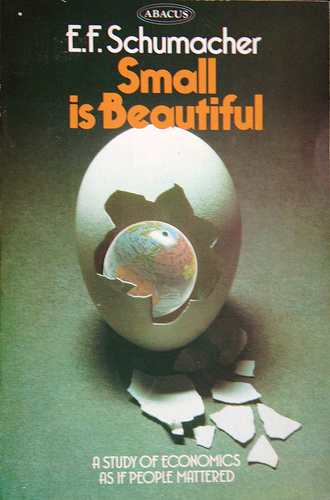
In Small is Beautiful (1973), E. F. Schumacher wrote: “The illusion of [mankind’s] unlimited powers, nourished by astonishing scientific and technological achievements, has produced the concurrent illusion of having solved the problem of production… based on the failure to distinguish between income and capital where this distinction matters most… A businessman would not consider a firm to have solved its problems of production and to have achieved viability if he saw that it was rapidly consuming its capital…”
What he meant was:
There is something fundamentally wrong in treating the Earth as if it were a business in liquidation. ― (Herman E. Daly)

 Learning from Dogs