Tag: Dogs on the Inside

Rebooting an inmate’s life

This is no conundrum: a direct contrast to yesterday.

The benefits of having a dog or two (or nine) are boundless and have been documented for thousands of years. Indeed, a quick web search revealed that Alexander Pope, the 18th-century English poet, is the attributed author of the quote, “Histories are more full of examples of the fidelity of dogs than of friends.”

Nevertheless, it was still a joy to come across the documentary film Dogs On The Inside.

Filmed in a Massachusetts prison, DOGS ON THE INSIDE follows the birth of a relationship between abandoned rescue dogs and prison inmates as they work together toward a second chance at a better life. Giving a voice to a forgotten dog and a forgotten man, the film is a life-affirming testament to the power of second chances.

The film was released in February 2014, and here is the trailer.

http://www.youtube.com/watch?v=S7ZjxPqL_EQ

In general, it seems to have gathered good reviews with this one from Amazon being typical of what I have seen.

I had tears in my eyes during several segments of this film. Such a lovely connection between the rescue workers and the dogs. Then, the inmates and the dogs. And, finally, the photos of their forever homes and families. Bravo to all at Don’t Throw Us Away. People like you, who work to save and rehab these animals, are amazing.

You are also recommended to read the review that is on the Ecorazzi website. Here’s a flavour of that review:

Two parties neglected and forgotten become the powerful emotional center of an uplifting new documentary, Dogs on the Inside.

We’re taken to Massachusetts, where there exists a unique, mutually-beneficial rehabilitation program that finds rescue dogs paired with prison inmates.

This documentary, from directors Brean Cunningham and Douglas Seirup, follows a handful of inmates at a correctional facility involved in Don’t Throw Us Away, a program that partners them with neglected dogs. For the animal, benefits include exercise, attention, and care while shelters remain crowded. For the prisoners, they have a chance to form connections and work towards parole.

It’s fascinating throughout watching both sides – scared dogs and (emotionally) guarded inmates – warm to one another, seemingly leaving their past behind.

That’s at the heart of this illuminating, heartwarming film: second chances. Early on, it’s easy to see the parallels between these two groups – with the comparisons handled tactfully throughout a film that never strays from its simple, honest goal. Dogs never preaches or calls for political or social change; it more so asks the viewer to be willing to forgive and welcome in those which have been cast aside. When an inmate says, ‘they come from a bad life, they haven’t seen love in while,’ he isn’t necessarily talking just about the dog.

Let me close with this heart-stirring photograph that was included in the above review.

Candido2-1

So much to learn from our precious, gorgeous dogs!
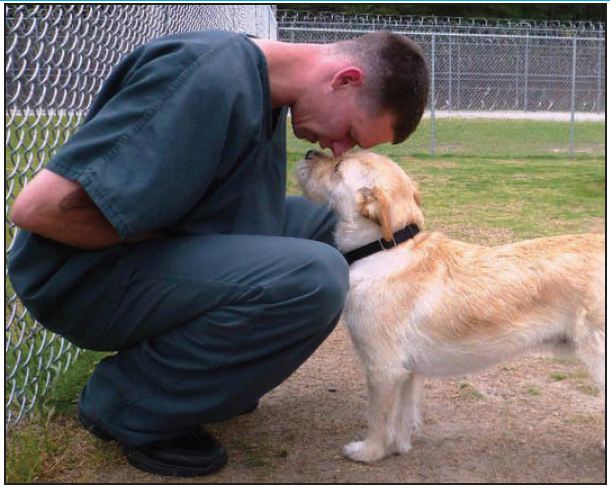
Dogs and the inside of our souls!

The role of dogs in helping young offenders.

In these times of terrible inequality, if there is one thing that has the power to crush a young person’s chances in life it is a criminal record, even a minor one. This is well-known in the UK. For a number of years I was a mentor with what was then called the Prince’s Youth Business Trust (PYBT) and now is just simply called The Prince’s Trust.

What was discovered, courtesy of the PYBT, was that if one taught disadvantaged youngsters the principles of forming and running your own business there were two positive outcomes. The first was that the young person performed much better at job interviews, and increased his or her odds of getting a job offer, and some young persons decided to start their own business; some very successfully so.

Thus with that background it was natural that an article in the US edition of The Economist caught my eye. It was called Pups and perps.

Pups and perps

What has four legs, a wet nose and helps young thugs grow up?

Dec 6th 2014 | LOS ANGELES | From the print edition

WHEN Jordan entered juvenile detention shortly after his 17th birthday, following a conviction for assault and robbery, all he could think about was getting out. The rowdy teenager from Anaheim, California, struggled to control his temper. But when he began working with Lulu, a poodle mix, he got a new leash on life. “I was too busy taking care of the dog to get into fights,” he says.

Jordan was taking part in “Pups and Wards”, a programme that pairs shelter dogs with young inmates. The perps train the pups and, with luck, learn something about personal responsibility. Other programmes allow prisoners to train dogs to be adopted by people with disabilities, such as traumatised veterans. Such training often requires full-time care—but prisoners have plenty of time on their hands.

The Economist article later on reports:

“All the research about the human-animal bond has buoyed these programmes,” says Gennifer Furst, a professor of criminal justice. “We have discovered that prisoners often identify with rescue dogs—they have both experienced trauma—and they are eager to become their protectors.” Crystal Wood, an officer at a maximum-security prison in Lancaster, California, says that several inmates on her yard—who are in prison for life—wept after interacting with dogs. “Many of these guys haven’t seen an animal in decades. It’s been striking to see how much working with a dog has reduced their anxiety levels.”

It was easy to find more information on Professor Gennifer Furst from the William Paterson University website:

Gennifer Furst received her B.A. in psychology (with a sociology minor) from Connecticut College and her M.A. in psychology (with a concentration in evaluation methodology) from Claremont Graduate University. She received her doctorate in criminal justice (with a concentration in corrections) from CUNY Graduate Center.

Dr. Furst is the Department of Sociology’s Criminal Justice Director. Dr. Furst’s research interests focus on issues of incarceration. She published the first national survey of prison-based animal programs in the US. A book based on that work was recently published. Additionally, she is interested in race and the administration of criminal justice, the death penalty, the use of animals in the criminal justice system, and the relationship between drugs and crime.

Read the rest of the good Professor’s background here.

Imagine my pleasure in finding that there is a film Dogs on the Inside and that YouTube carries an official trailer.

http://www.youtube.com/watch?v=S7ZjxPqL_EQ

As the film website states: “Everyone deserves a second chance.

So if you are motivated to get involved then don’t hesitate to return to the film’s website and read the Get Involved page.

The power of love.
The power of love.