Tag: Dogs Never Lie About Love

Prof. Pat Shipman

Pat Shipman showing how animals were intimately involved in the development of early humans.

Yesterday’s fascinating post was predominately taken up by a long and deeply interesting essay by Prof. Pat Shipman, The Woof at the Door.

Today, I want to report further on Pat Shipman primarily by looking at her book The Animal Connection.
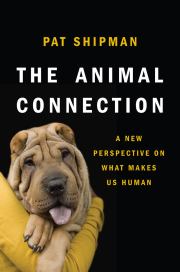
What makes us human?

Let me do no more than quote from page 259,

Domesticating animals provided a new sort of benefit.  They were living tools first and meat sources later, only when their useful lives were over or circumstances required.  The crucial importance of animal domestication in modern life shows that our relationship with animals selected for a set of communication skills and abilities to observe, draw conclusions and make connections among different observations that had been increasingly important since at least 2.6 million years ago.  The relationship between such skills and modern behaviors that characterize humanity is clear.

Prof. Shipman also confirms that the first domestication was of the dog at 32,000 years ago and goes on to say,

Other types of domestic animals provide enhanced protection for people, dwellings, stored crops, and other livestock.  Dogs and cats are the obvious examples, but herders have recently started touting llamas as guardians for flocks of sheep.

The domesticated carnivores also provide important assistance in hunting.  Dogs are better trackers than humans; they are faster runners, take larger prey, and will hunt with humans.  Cats hunt solitarily and are far superior to humans at catching rodents that can decimate crops or carry disease.  Dogs hunt with you; cats hunt for you; but both offer an advantage. (p.254)

As I said, it’s a fascinating book and one that is already reshaping my knowledge about the early evolution of man.  And in terms of reshaping knowledge about early man, do go across to Pat Shipman’s Blog, The Animal Connection.

You can read a full review with links to a number of book sellers here.  Let me close by using this praise for the book by Jeffrey Moussaieff Masson.  (Masson’s book Dogs Never Lie About Love is just a few feet from me as I write this, a deeply moving book for all dog lovers.)

This is what Jeffrey Masson wrote about The Animal Connection,

Pat Shipman has written one of the most important books on the human-animal connection ever.  One might even say it is the single most important book, possibly the only one, to look at our deep connection to animals over the entire evolutionary history of our species.
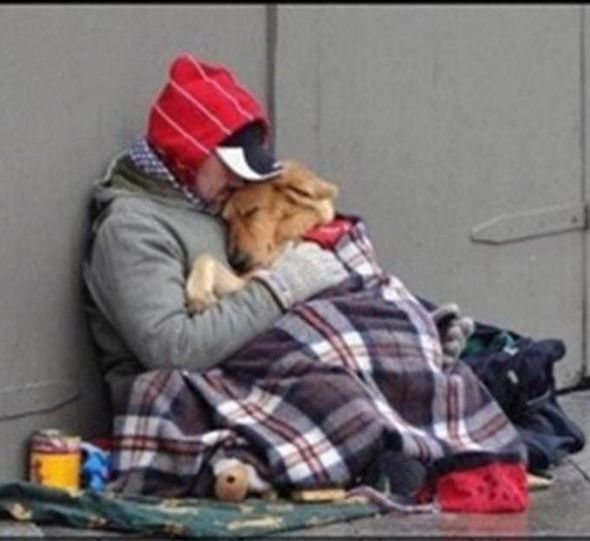
The oldest bond in the world!

Change out of hope.

Making a difference is the only way forward!

Don’t worry, this is not going to be some chest-banging Post!  I leave those for Monday to Friday. 😉  No, I just wanted to offer a couple of examples of the power of goodness and how making a positive difference is no more than wanting it.  As Perfect Stranger commented last Tuesday, “A single candle may light a thousand others and they in turn many thousands more” – Buddha

The first example is about how a group of upstanding citizens rescue a school of dolphins that became stuck on a beach in Brazil.

The second example comes from closer to home.  Ginger I. is a Board Member of the Humane Society of Central Arizona and is based at Payson.  Jean has been a volunteer at the Society’s Thrift Store for some time and has got to know Ginger well.

Ginger recently emailed me this; it has already done the rounds of the WWW, and quite rightly so.  It reminds me of the book Dogs Never Lie About Love, written by Jeffrey Masson, from which comes the following,

This ambiguity, which includes a certain ambivalence as well, has been memorialized in our speech, in our sayings, and in our tributes to and about dogs. Sir John Davies, in his epigram In Cineam (written in 1594), observed:

Thou sayest thou art as weary as a dog,
As angry, sick, and hungry as a dog,
As dull and melancholy as a dog,
As lazy, sleepy, idle as a dog.
But why dost thou compare thee to a dog?
In that for which all men despise a dog,
I will compare thee better to a dog.
Thou art as fair and comely as a dog,
Thou art as true and honest as a dog,
Thou art as kind and liberal as a dog,
Thou art as wise and valiant as a dog.

Ever since Madame Roland said in the eighteenth century “Plus je vois les hommes, plus j’admire les chiens” (The more I see of men, the more I admire dogs), generally what has been written about dogs tends to be positive. Sometimes it is even wonderful, as in William James’s statement “Marvelous as may be the power of my dog to understand my moods, deathless as is his affection and fidelity, his mental state is as unsolved a mystery to me as it was to my remotest ancestor.” Or it may be delicious, like Ambrose Bierce’s definition in his Devil’s Dictionary, “Dog, n. A kind of additional or subsidiary Deity designed to catch the overflow and surplus of the world’s worship.” Samuel Coleridge, in Table-Talk (May 2, 1830), was one of the first to note that “the best friend a man has in the world may turn against him and become his enemy. His son or daughter … may prove ungrateful. Those who are nearest and dearest to him … may become traitors to their faith…. The one absolutely unselfish friend that man can have in this selfish world, the one that never deserts him, the one that never proves ungrateful or treacherous, is his dog.”

Just read that last sentence again from Samual Coleridge as you look at the photograph below, “The one absolutely unselfish friend that man can have in this selfish world, the one that never deserts him, the one that never proves ungrateful or treacherous, is his dog.