Dogs’ evolution shows why they ‘love’ gnawing on bones.
This is the second article on the BBC Nature website following yesterday’s item about why dogs enjoy a healthy breakfast.
oooOOOooo
Dogs’ evolution shows why they ‘love’ gnawing on bones
By Victoria Gill
Science reporter, BBC Nature, Ottawa, Canada
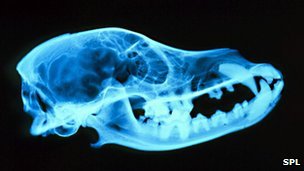
Social living drove dogs to evolve the “tools” for chewing bones, scientists say
Scientists say they have discovered why dogs love to eat meat and bones.
Ancient canines adopted pack-living about eight million years ago, to hunt larger prey, according to researchers.
The resulting evolution of their jaws gradually turned the ancestors of modern wolves, and ultimately our own pets, into “hypercarnivores”.
Dr Joao Munoz-Doran presented the findings at the First Joint Congress for Evolutionary Biology in Ottawa, Canada.
He and his colleagues from the National University of Colombia have created a canine “family tree”, piecing together the relationships between each of the more than 300 dog species.
“We compared species that have very different diets,” Dr Munoz-Doran explained to BBC Nature. “So we classified them as carnivores, hypercarnivores [animals that eat more than 70% meat] and omnivores [animals that eat meat and vegetation].”
The ancestors of modern wolves belong to this hypercarnivorous group.
The team’s analysis showed that the skull features that now distinguish a wolf – strong jaw muscles and enlarged canine teeth – first started to develop when their ancestors first began hunting in groups.
“We found a common evolutionary history for these traits,” Dr Munoz-Doran explained. “Eight million years ago was when [less forested, more] open habitats were spreading through Asia, Europe and North America. And when there are open habitats, the big prey group together. So there will be more eyes watching for a predator.”
The only way that dogs roaming the open plains could snatch very large prey from a herd was to work together.
“And after many generations of this grouping behaviour, there are new selective pressures on their [skull shape],” said the researcher.
This pressure meant that animals with larger teeth and stronger jaws were more likely to succeed in hunting, and to survive to pass on their large-toothed, strong-jawed genes to the next generation.
Animals with stronger jaws and larger canine teeth would have been more successful hunters
“They developed strength in their muscles – especially the muscles that close their mouth,” said Dr Munoz-Doran. “And bones that are more resistant to bending, so they could support the mechanical strains of biting the prey. “Over time, they became adapted to be ‘hypercarnivorous’.”
The researcher pointed out that domestic dogs had “very good evolutionary reasons to enjoy chewing a bone”.
“They have the tools to do that,” he told BBC Nature, “and they want to use their tools.”
oooOOOooo
Finally, to the side of that BBC Nature webpage were a few canine facts, as follows:
Common canines: Foxes, wolves, jackals, coyotes and dingoes are all members of this well-known group
Familiar faces: Wild canids are found on every continent except Antarctica
Communication is key: Previous studies of dog evolution have revealed that calls were essential for forming social groups and hunting larger prey
Pets’ past: All domestic dogs are descendants of the grey wolf
And don’t close without going here and listening to Steve Backshall howling with a wolf pack – (it’s a video as well – unmissable).
The grandeur of the ancient relationship between dog and man.
A couple of weeks ago, I came across a fascinating article that had been published in American Scientist magazine (online version) written by Professor Pat Shipman. The article provided the background and evidence to support the proposition that dogs may have been man’s best friend for thousands of years longer than we realized.
Very quickly I came across Pat Shipman’s website and learnt that this is one clever lady. As her About page explains,
CAREER SUMMARY
Prof. Shipman
I am internationally known as a paleoanthropologist and conducted research for many years in Africa on human evolution and the animal communities in which humans evolved.
I have conducted research on material from sites in France, Spain, the United States, Java, Ethiopia, Kenya, Tanzania, and South Africa. I have written more than 50 scholarly articles, appearing in journals such as Nature, Science, Journal of Archaeological Science, Paleobiology, Journal of Human Evolution, and Current Anthropology.
I have written more than 100 articles in popular science magazines or newspapers, including The Guardian, The New York Times, The Times Literary Supplement, American Scientist, Discover, and Natural History. Two of my books were featured on the cover of The New York Times Book Review: The Neadertals and Taking Wing. Taking Wing won the Phi Beta Kappa prize for science book of the year and was a runner-up for the LA Times Science Book prize.
My book on Homo erectus, Wisdom of the Bones, was co-authored by Alan Walker and won the Rhone-Poulenc Prize in science writing.
My books have been widely praised as compelling, accessible, and highly readable, with a strong narrative thread. Reviewers frequently comment upon the meticulous research that underpins my books, a feature I consider to be my trademark.
My most recent popular science book, The Ape in the Tree, written with Alan Walker, was called by The Vancouver Sun “part adventure story, part cutting-edge science.” In a Science magazine review, the book was praised as “a fine account of new ways to puzzle out the behaviors of fossilized animals from odd scraps of bone.” Another reviewer raved, “Wonderfully engaging and insightful, The Ape in the Tree, is sure to become a classic in the literature on human origins.” MacArthur fellow John Fleagle wrote in the Quarterly Review of Biology, “Science writing doesn’t get any better than this.” In 2009, this book was awarded the W.W. Howells Book Prize by the American Anthropological Association.
In Britain, my new biography of Mata Hari, Femme Fatale, was selected as The Book of the Week by BBC radio. Each day during the week, an actress gave dramatic readings from the book on the air for fifteen minutes.
With The Animal Connection, I return to paleoanthropology and consider the influence of our connection with animals on human evolution and the origin of modern human behavior.
See what I mean!
Anyway, as you can readily understand, as the author of a blog that writes about what we can learn from this ancient relationship between the dog and man, it struck me as wonderful if I might be permitted to republish in full that article. Prof. Shipman promptly gave me such permission.
So today, I am doing just that and tomorrow I want to write more about Pat Shipman’s latest book, The Animal Connection.
oooOOOooo
The Woof at the Door
Dogs may have been man’s best friend for thousands of years longer than we realized
It’s funny how much difference a single letter makes. A “woof” at the door is a very different thing from a wolf at the door. One is familiar, domestic, reassuring; the other is a frightening apparition of imminent danger. The distinction between our fond companions and the ferocious predator of northern climes goes back a long way.
Dogs are descended from wolves, probably the gray wolf. Some scientists argue that, because dogs and wolves can and do interbreed, they shouldn’t be considered to be separate species at all. They believe that domestic dogs are only a subspecies or variant of the gray wolf, Canis lupus, and ought to be called Canis lupus familiaris (the familiar or domestic wolf) instead of Canis familiaris (the familiar or domestic dog). Although the ability to interbreed and produce fertile offspring is a tried-and-true criterion for recognizing that two populations are really variants of a single species, the reality is more nuanced. We cannot know whether dog-wolf hybrids will thrive and survive, or die out, in the long run.
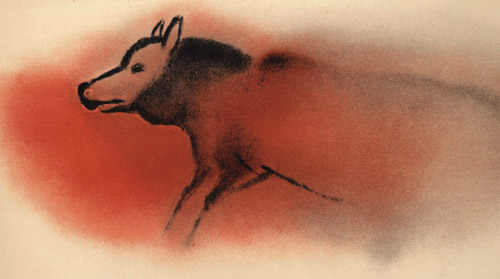
Prehistoric cave paintings rarely depict wolves or other carnivores. This watercolor tracing of a cave painting was made by the archaeologist Abbé Henri Breuil in the early 1900s from the Grotte de Font-de-Gaume in France. The 17,000-year-old cave paintings number about 250 and mostly show bison and mammoths—only one is thought to be a wolf. Canids may have been domesticated by this point; it is possible that portraying wolves and humans was taboo. Paul Bahn
Certainly we expect to be able to distinguish a dog from a wolf if we see one. Of course, domestic dogs are wildly variable in size and shape, thanks to several hundred years of selective breeding. Some have long, fluffy coats; others have tightly curled, nearly waterproof coats and webbed feet. Some are leggy and swift, whereas others are solid, stoutly built guard dogs. Some fit neatly into a pocketbook, but others barely fit into a compact car. As Robert K. Wayne of the University of California at Los Angeles declares, “Dogs show more diversity in appearance than any other mammal.”
What is it that tells us this animal is “dog” and that one is “wolf?”
Modern wolves and dogs can be distinguished reasonably easily by their appearance. The most telling feature of dogs is the snout, which is significantly shorter and wider than wolves’ snouts. Only a few dog breeds with extremely elongated, slender snouts, such as Irish wolfhounds, surpass wolves in “snoutiness.”
But a crucial part of the difference we perceive is in the animals’ manner and attitude towards humans. Domesticated dogs are just that: canids that live in the house or domicile of humans. They are genetically disposed to seek out human attention and approval and to accept human leadership. Wolves are not.
How did this important change come about? Probably in the distant past, humans took in a wolf cub, or even a whole litter of cubs, and provided shelter, food and protection. As the adopted cubs matured, some were aggressive, ferocious and difficult to handle; those probably ended up in the pot or were cast out. The ones that were more accepting of and more agreeable to humans were kept around longer and fed more. In time, humans might have co-opted the natural abilities of canids, using the dogs’ keen noses and swift running skills, for example, to assist in hunting game. If only the most desirable dogs were permitted to breed, the genes encoding for “better” dogs would continue to be concentrated until the new domesticated species (or subspecies) was formed.
Time to Tame
The creation of a domestic, useful, familiar canid by years of selectively breeding wild and terrifying wolves was almost certainly unplanned. The wolf at the beginning of the process of domestication was tamed—made individually docile—but the essential fact is that, over time, the offspring of those initial wolves were genetically inclined to be more tractable.
Domestication was one of the most brilliant accidents in the entire history of humankind. What’s more, we got it right the first time: Dogs were the original trial animal, and successful product, of such an accident—the happy outcome of years of unwitting experiments and dumb luck.
How long does domestication take? Nobody knows. In an experiment, Russian biologists kept a breeding colony of silver foxes and intentionally selected for breeding those with the least fear and the least aggression toward humans. After 10 generations, 18 percent of the foxes sought human contact and showed little fear. After 30 or so generations, a “domesticated fox” had been created.
The catch is that this experiment was deliberate and strictly controlled. The foxes could not breed with wild foxes and dilute the changing gene pool. Human contact was minimized so animals could not be tamed by their handlers. And because of the experiment’s scientific intent, no one could say, “Oh this one is so cute, let’s let it breed even if it is a little aggressive.” So in the case of dogs, without all these controls, the process could have taken much longer.
Another way of estimating the time at which domestic dogs originated is to consider their genetic differences from wolves. One prominent group of researchers, including Robert Wayne, along with Carles Vilà of the Uppsala University in Sweden and their collaborators, initially estimated in 1997 that dogs diverged from gray wolves 100,000 to 135,000 years ago. After more study, they revised their divergence date to between 40,000 and 100,000 years ago. Another group, led by Peter Savolainen of the Royal Institute of Technology in Sweden, favored the Chinese wolf, a subspecies of the gray wolf, as the probable ancestor and estimated in 2002 that it was domesticated between 15,000 and 40,000 years ago.
How do these genetic estimates stack up against the fossil record? Until 2009, the oldest known remains of domestic dogs were two adult skulls dated to between 13,000 and 17,000 years ago, from Eliseevichi, a region in Russia. Both had the relatively broad, short snout typical of dogs, and both were large, heavy animals, nearly the size of great Danes.
Then a team led by Mietje Germonpré of the Royal Belgian Institute of Natural Sciences reported a stunning new finding in the February 2009 issue of Journal of Archaeological Science: a nearly complete fossil dog skull dated to 31,680 + 250 years ago.
Another Look
Germonpré and her colleagues thought that researchers might have overlooked early prehistoric dogs in the fossil record of the Upper Paleolithic, so they analyzed skulls of large canids (wolves or dogs) from various European sites. The Upper Paleolithic time period spanned 40,000 to 10,000 years ago and is divided into sections based on the artifacts from those times. By convention, each span is named for a culture of people who made the artifacts, and the people, in turn, are usually named for the geographical location where the artifacts were found. The Epigravettian culture existed from 14,000 to 10,000 years ago; before that, the Magdalenian culture thrived from 18,000 to 10,000 years ago; and skipping back a few sections, the Aurignacian culture occurred from 32,000 to 26,000 years ago.
In order to identify the fossil skulls accurately, Germonpré’s team first analyzed a large reference sample of 48 wild, modern wolves and 53 dogs belonging to 11 different breeds. They also examined five skulls (including the ones found in Eliseevichi) that were firmly established as prehistoric domesticated dogs.
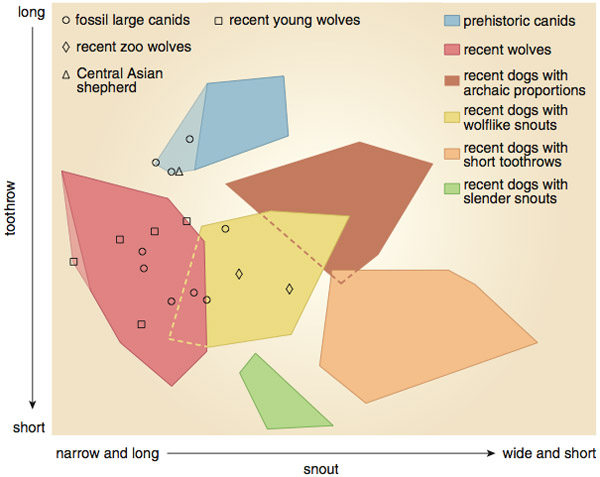
In order to establish the morphological differences between wolves and dogs, a group of researchers led by Mietje Germonpré statistically analyzed skulls from 48 modern, wild wolves and 53 modern dogs from 11 breeds, as well as five skulls that were previously established to be from prehistoric dogs. Recent wolves (pink) and prehistoric dogs (blue) clustered into their own groups, based on the length of their toothrows and the shape of their snouts. Modern dogs clustered into four groups, with some overlap in their areas. Recent dogs with archaic proportions included huskies (brown), recent dogs with wolflike snouts included German shepherds (yellow), recent dogs with short toothrows included great Danes (orange), and recent dogs with slender snouts included doberman pinscers (green). One modern dog, a Central Asian shepherd, clustered with the prehistoric dogs. The group then classified new skulls into the established groupings; examples that fell slightly outside of the ranges but that are statistically likely to be within the group are shown as lighter-shaded areas. Recent young wolves fell into the recent-wolf group, whereas wolves kept in captivity were classifed as recent dogs with wolflike snouts. Fossil canid skulls divided between the recent-wolf group and the prehistoric-dog group, with one falling in the group of recent dogs with wolflike snouts. Stephanie Freese, data courtesy of Mietje Germonpré.
The team used statistical analysis of cranial and dental measurements on the skulls to sort the reference sample into six natural clusters. One cluster contained modern wolves. Another consisted of recent dogs of archaic proportions (such as chow-chows and huskies); a single specimen of a Central Asian shepherd was closer to this group than any other but fell outside it. A third cluster included dogs, such as German shepherds and malinois, which have wolflike proportions. These three groups overlapped each other in their cranial proportions. A fourth group of modern dogs has short toothrows—the length of the jaw that contains teeth—and includes such breeds as great Danes, mastiffs and rottweilers. This group overlapped slightly with the archaic-proportioned dog group but not with the others.
The fifth and sixth clusters were completely separate from all others. One consisted of dogs with extremely long, slender snouts, such as Doberman pinschers. The final group, which had long toothrows and short, broad snouts, was made up of the prehistoric dogs. Statistically, the team’s ability to identify any individual specimen as belonging to the correct group was highly significant and accurate.
Using these clusters as reference categories, Germonpré and colleagues used a statistical technique (called discriminant function analysis ) to assign 17 unknown fossil canid skulls to the established categories. Not all of the “unknowns” were truly unknown, however. Five were immature modern wolves that might have had different proportions because of their age, two were wolves that had been kept in captivity, and one was the Central Asian shepherd that didn’t cluster into any of the groups. Additional unknowns were 11 fossil skulls from sites in Belgium, the Ukraine and Russia, although two of these fossil skulls proved to be too incomplete to classify.
The technique correctly classified all of the immature wolves as wolves, but the two zoo wolves were classified as recent dogs with wolflike snouts. Five of the fossil skulls also fell easily into the modern wolf group; although two of these specimens fell into the region of measurements that overlapped with the group of recent dogs with wolflike snouts, they had a higher statistical probability of being wolves. One fossil skull fit directly into the group of recent dogs with wolflike snouts, even though this specimen was clearly ancient.
The remaining three fossil skulls—one from Goyet Cave in Belgium and one each from Mezin and Mezhirich in the Ukraine—resembled each other closely. All three were classified as prehistoric dogs with probabilities of 99 percent, 73 percent and 57 percent, respectively, as was the (modern) Central Asian shepherd, with a 64 percent probability. In addition, the Mezin skull was odd enough in appearance (for a wolf) that another researcher has suggested it might have been a captive wolf. Germonpré and her team were delighted with these results.
The group also successfully extracted mitochondrial DNA (mtDNA) from seven ancient canid bones from Goyet Cave and Trou des Nutons in Belgium. Rather than damage precious skulls, they sampled only bones in which wolves and dogs differ little, so they presumed all of those they sampled for mtDNA were wolves. From each sample, they sequenced a segment of the mtDNA that is highly variable in living wolves and dogs. Each fossil had a unique mtDNA sequence, or haplotype , in this region, which could not be matched with any known sequences for modern wolves (of which there are about 160) or modern dogs (of which more than 1,000 exist) stored in GenBank, a database of all publicly available nucleotide sequences.
“I was not so surprised at the rich genetic diversity of the fossil wolves,” says Germonpré, because there have been other studies with similar findings. Foxes and wolves underwent a severe bottleneck in population size at the end of the last Ice Age, and many genetic lineages went extinct at this time.
“But we were surprised at the antiquity of the Goyet dog,” Germonpré adds. “We expected it would probably be Magdalenian,” perhaps 18,000 to 10,000 years old. This outcome would fit with their results for the Mezin and Mezhirich skulls, which were found with Epigravettian artifacts roughly 14,000 to 10,000 years old. When the age of this specimen from Goyet was directly dated using accelerated mass spectroscopy radiocarbon-dating techniques, the team found that it was not 18,000 years old, but almost twice as old as the next oldest dog, placing the Goyet dog in the Aurignacian period.
A Time of Change
The Goyet dog fossil shows that the domestication of the first animal was roughly contemporaneous with two fascinating developments in Europe.
Around this time, Europeans began producing objects that are recognizable as art. Some of the earliest known art objects from Europe include the remarkable cave paintings of Chauvet Cave in France, the oldest of which were made 32,900 ± 490 years ago. None of the hundreds of glorious Chauvet paintings show wolves. However, the cave preserves something even more haunting: the footprints of a human child about four-and-a-half feet tall, as well as many footprints of large canids and bears.
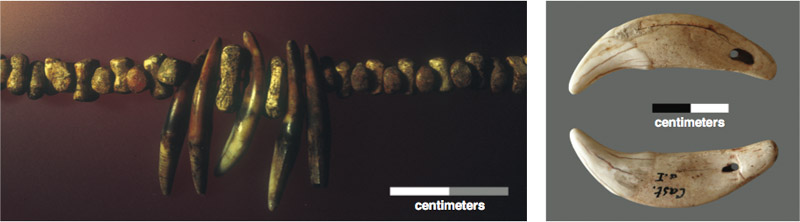
Around 33,000 years ago, humans began perforating teeth for use in decoration. Although canid teeth made up a very small percentage of the total fauna teeth available, they were used in a majority of the ornaments. Fangs from foxes and wolves appear to have been favorites. One example of a perforated wolf tooth (shown in two views at right) is from Abri Castanet in France and has been dated to 33,000 years ago. A strand of beads interspersed with fox teeth came from the Russian site of Sungir and has been dated to 24,000 years ago (left). There is no specific evidence that canid teeth were used in necklaces; the fox-teeth strand may have been a belt. Randall White
Michel-Alain Garcia of the Centre National de la Recherche Scientifique in Nanterre noticed in 1999 that one track of canid prints appears to accompany the child’s prints. These canid prints, unlike the others, have a shortened middle digit on the front paw: a characteristic of dogs. Garcia suggested that the child and dog might have explored the cave together. Charcoal from a torch the child carried is 26,000 years old.
The Upper Paleolithic cultures of Europe are famous for the flowering of all kinds of exquisite art: sculptures, carvings, paintings and engravings. Animals are common and readily recognizable subjects. Prehistoric art expert Paul Bahn notes that depictions of carnivores, including wolves or dogs, and of humans are rare. Bahn conjectures that portraying wolves and humans might have been taboo.
Anne Pike-Tay of Vassar College offers another perspective. She observes that the scarcity of artistic depictions of carnivores parallels their scarcity in the fossil faunas of the Upper Paleolithic. If domesticated dogs were helping humans hunt, she speculates that they might have been placed in a completely different symbolic category from other animals.
“What if dogs were put in the ‘human family’ category as an extension of the hunter, and like humans, warranted no (or very few) painted or engraved depictions?” she wonders.
The second development of the Aurignacian period is the appearance of objects of personal adornment: jewelry. Although beads and perforated objects occurred much earlier in Africa, the earliest such objects in Europe appeared about 40,000 years ago. At 33,000 years ago, early Aurignacian people began perforating animal teeth (and occasionally human teeth) to wear as pendants or other ornaments, such as belts.
Which teeth did they choose? Among their favorite sources are what have been identified as fangs of foxes and wolves. These identifications might better be termed “small or large canids,” because until now no one has considered the possibility that dogs might have been domesticated so long ago. Besides, identifying a single canid tooth specifically as dog or wolf would be difficult, if not impossible.
Randall White of New York University argues that Aurignacian and later people chose to wear objects that displayed their identity or membership in a certain group or clan. Like gang colors or a t-shirt that proclaims its wearer to be a fan of a particular band, ancient people wore things that made their allegiances clear.
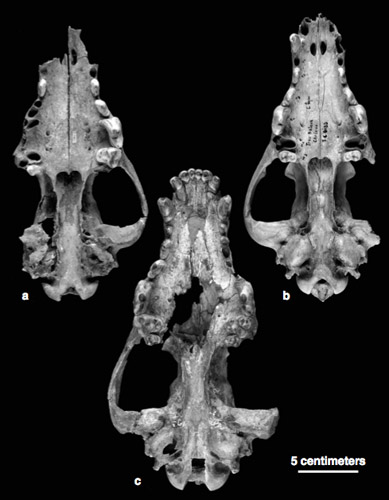
Fossils have helped to establish a far earlier timeframe for dog domestication. A paleolithic canid skull from Goyet in Belgium, about 31,000 years old, has traits characteristic of a dog rather than a wolf (a). When compared to wolves from a similar era, one from Trou Ballu (b) and one from Trou des Nutons (c) in France, the Goyet dog has a relatively wider snout and larger carnassial teeth, and it also has a wider braincase. Elsevier Ltd.
White observes that the teeth Aurignacian people chose to wear were obviously not a random sample of the animals in the fauna. For example, the fauna from the Grotte des Hyènes (Cave of Hyenas) at Brassempouy, France, is dominated by horses, aurochs (a type of cattle) and reindeer—mostly as food remains that often show cutmarks or charring—as well as hyenas, which probably lived in the cave when humans did not. Wolves are rare, making up less than 3 percent of the total fauna. Of approximately 1,600 animal teeth at Brassempouy, only about 2 percent were modified for use as ornaments. However, nearly two-thirds of the ornaments are teeth of wolves or foxes. The rest of the perforated teeth are from other rare species: bear, humans and red deer. None of the teeth of the most common species were used as ornaments at Brassempouy.
Did someone who wore a perforated canid tooth 33,000 years ago proclaim him- or herself to be one of the group that domesticated dogs?
Possibly. Domesticating dogs was a remarkable human achievement that doubtless provided a definite selective advantage to those who accomplished it successfully. They might well have had reason to brag about their accomplishment by wearing canid teeth.
Bibliography
Germonpré, M., et al. 2009. Fossil dogs and wolves from Paleolithic sites in Belgium, the Ukraine and Russia: Osteometry, ancient DNA and stable isotopes. Journal of Archaeological Science 36:473–490.
Morey, D. F. 1994. The early evolution of the domestic dog. American Scientist 82:336–347.
Ostrander, E. A. 2007. Genetics and the shape of dogs. American Scientist 95:406–413.
Savolainen, P., et al. 2002. Genetic evidence for an East Asian origin of domestic dogs. Science 298:1610–1613.
Trut, L. N. 1999. Early canid domestication: The farm-fox experiment. American Scientist 87:160–169.
Vilà, C., et al. 1997. Multiple and ancient origins of the domestic dog. Science 276:1687–1689.
He lay there, on the hard concrete, motionless, his eyes linked to mine. Linking our two very different species in a bond that defied rational description. A bond across not only two radically different creatures but across the tens of thousands of years since species dog embraced species homo sapiens, that is the hunter-gatherer version.
Such history of intimate co-operation shining out from those quiet, wise, brown eyes. Impossible not to sense the linking of souls as each gazed into the eyes of the other. The arm of the man reached behind, found the camera, and captured forever this magic.
The first picture comes from Merci O. from here in Payson.
Lost for words!
The next two are from the camera of ‘yours truly’.
Tough work being a puppy!
Cleo has settled in so beautifully and we can’t believe that these two weeks have gone so quickly.
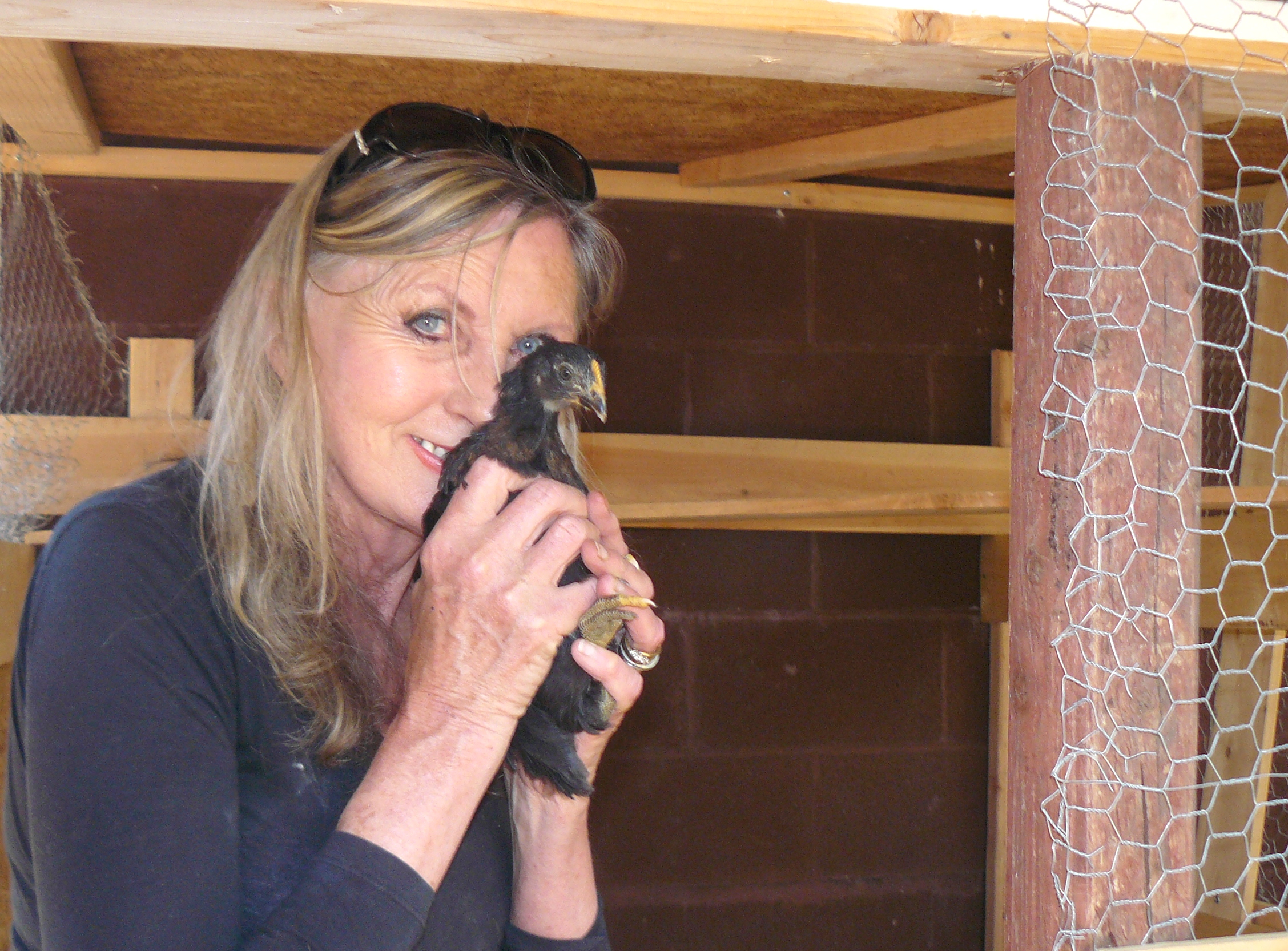
Finally, talking of settling in, our five young chicks have reached the stage where they could be housed outside in their new chicken house, the move taking place just five days ago.
Kaycee joins the fold taking us back up to ten dogs.
Many of you read and commented on the loss of Phoebe that I wrote about on the 17th February.
Phoebe used to be one of a group of three dogs that lived in our large basement room, the other two being Loopy and Ruby. Well, it wasn’t long after Phoebe’s death that we noticed Loopy was, how can I say it, just a bit off. She had previously suffered from Valley Fever that had affected her when we were living in Mexico, (useful website on Valley Fever is here) and Jean thought that the fever had returned. In order to keep a closer eye on Loopy, she came up from the basement and joined the three dogs that made up the ‘kitchen’ group. Those three dogs being Lilly, Paloma and Chester. It made sense any way as Phoebe was a great play friend for Ruby and it was clear that Ruby was both missing Phoebe and not finding Loopy as an effective substitute play friend.
Lilly, from the 'kitchen' group, checking Loopy out!
So on Tuesday, Jean and I, together with Ruby and little Sweeny, who also came from the local Humane Society, went back to the Society to find a companion for Ruby.
Jean had had her eye on a male dog, Kaycee, that had appeared in the list of available dogs that is featured each week in the local Payson Roundup newspaper. Indeed, here is the list of dogs for February that has Kaycee’s details, from which I reproduce below,
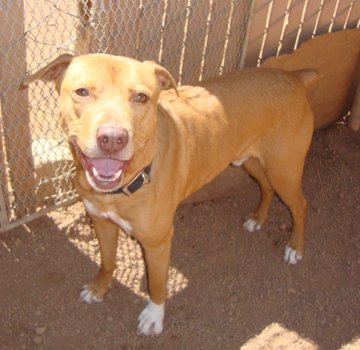
Kaycee
My name is Kaysee and I’m a 5-year-old Heeler/Pit mix. I have been with HSCAZ since 23rd March, 2011. I’m a flirty boy, who loves to have his butt scratched. I’m super smart too and I know all sorts of basic commands. Did I mention I like to play ball? My song choice is Brian Adams’ “Everything I Do,” because I will do it for you.
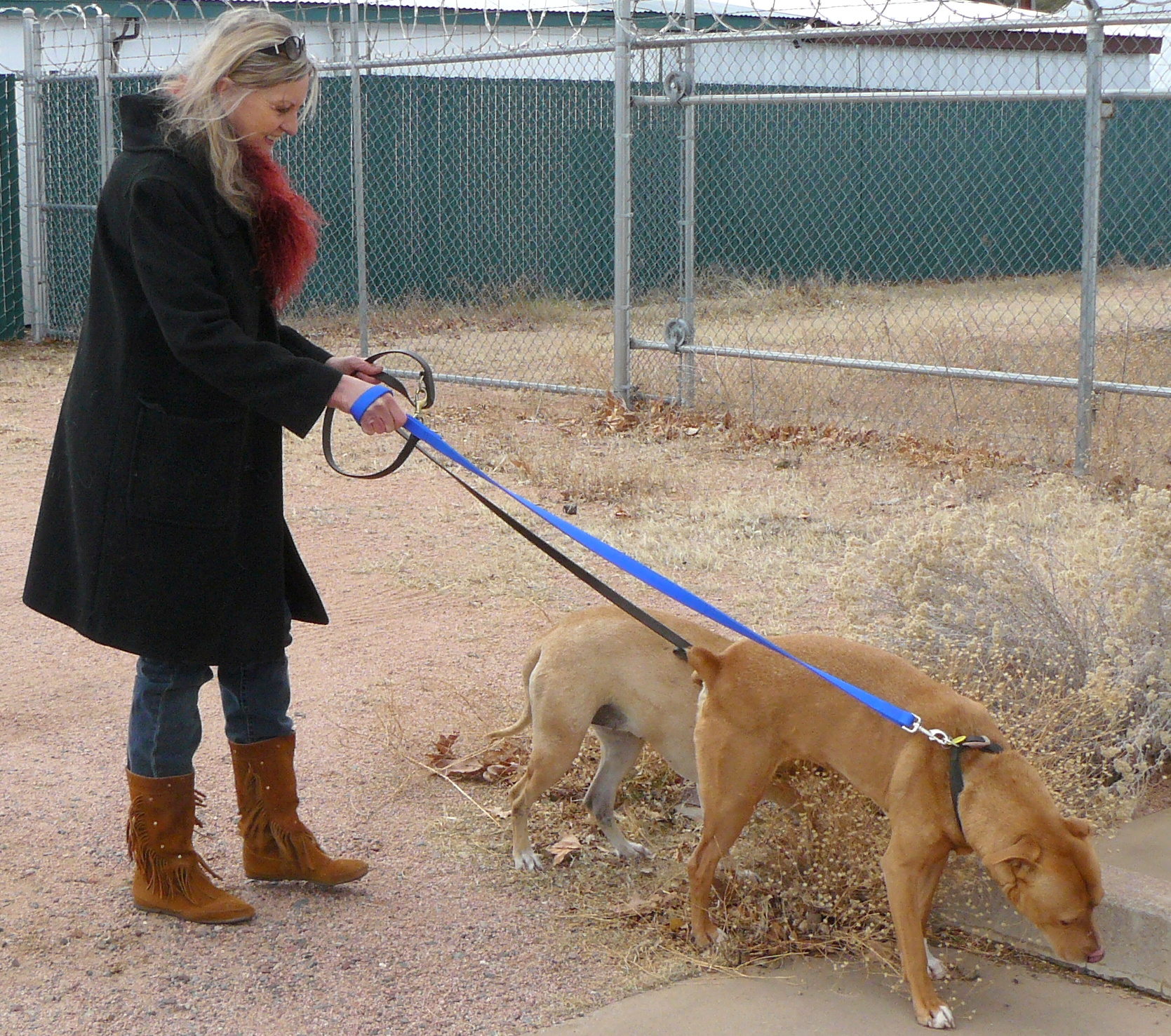
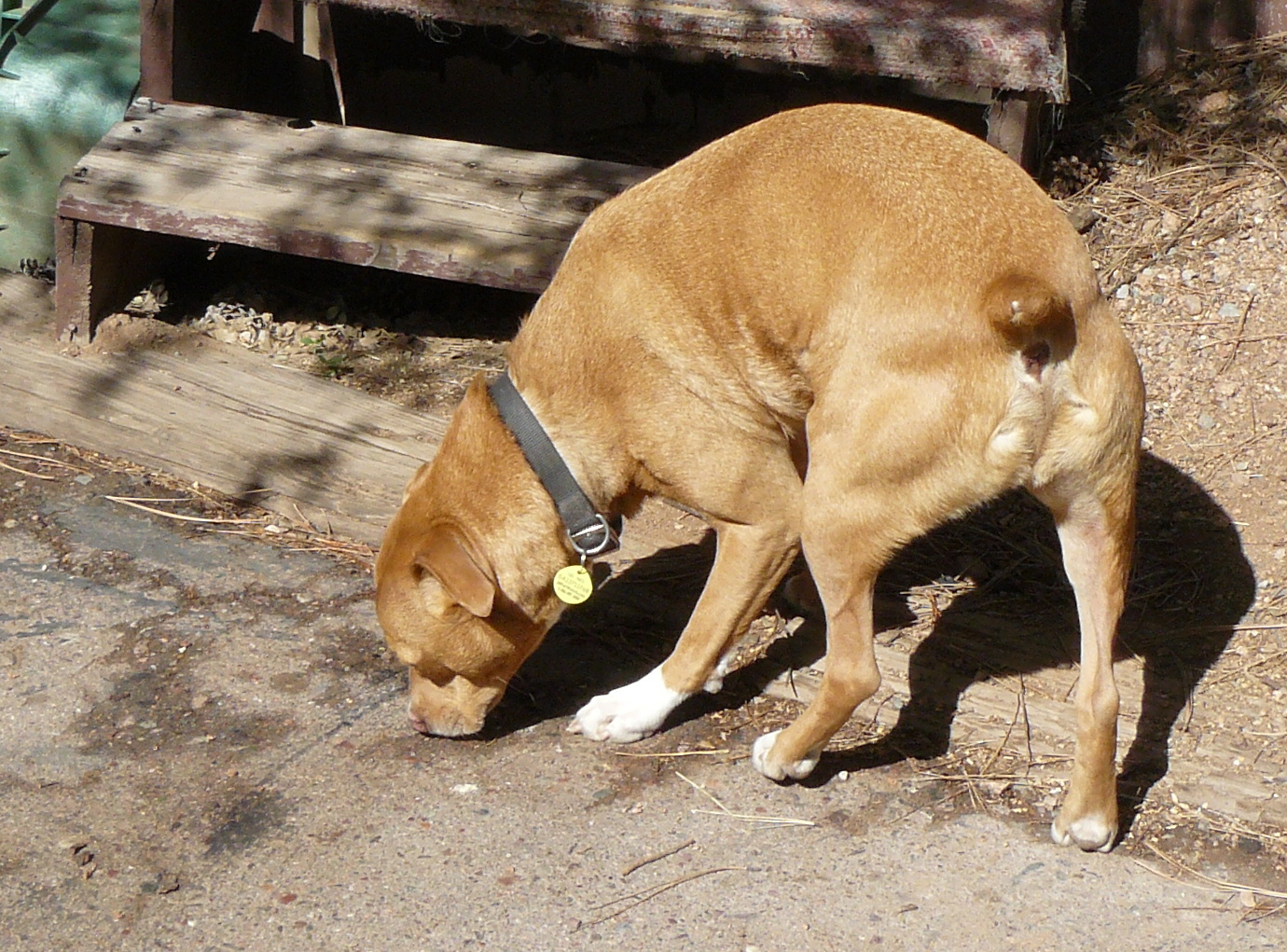
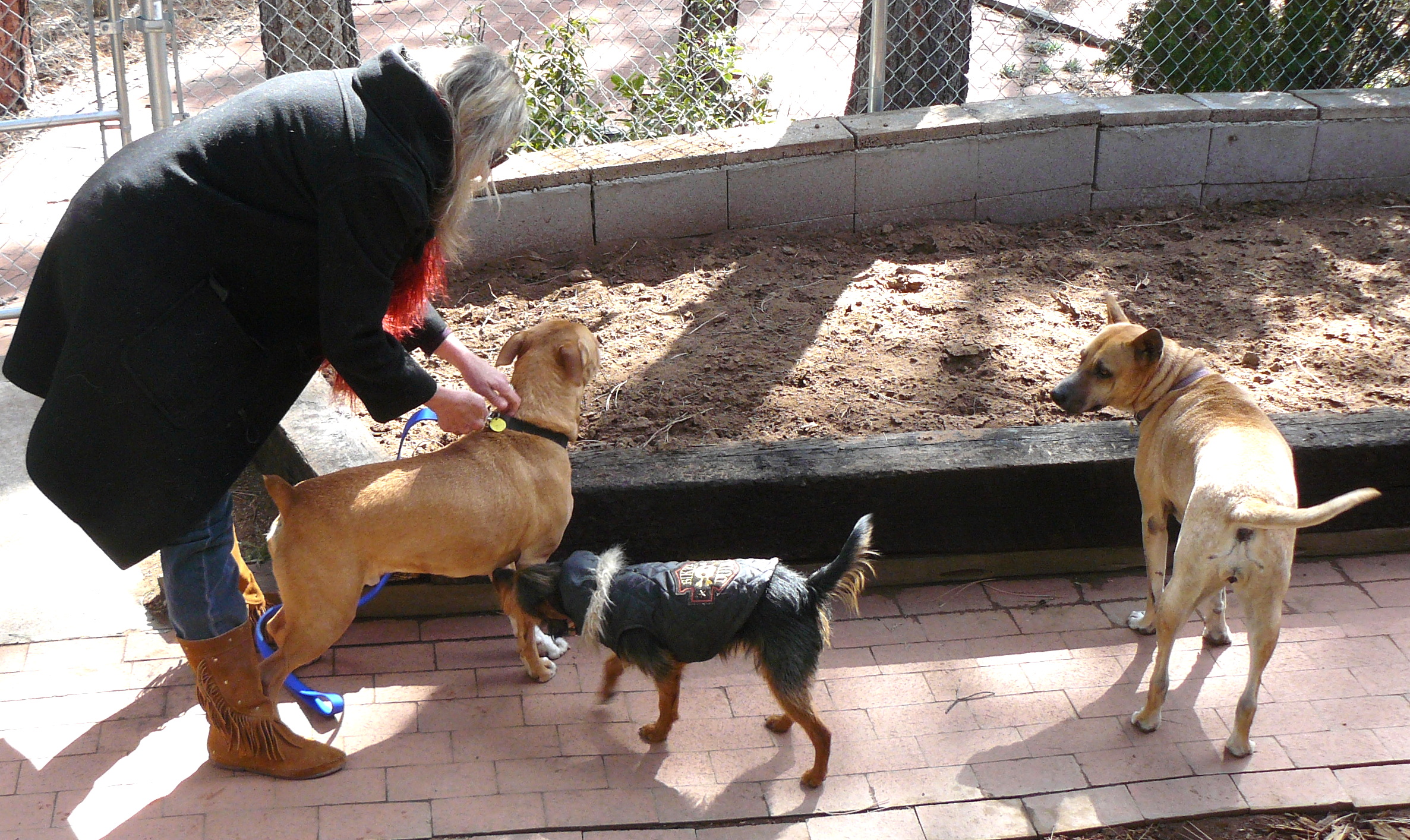
Anyway, Ruby and Kaycee took to each other without any issues and he came home with us later on the morning of the 28th. Now over 24 hours later, as I write this, it’s clear that he is a bright, loving dog with no obvious personality challenges and already Ruby is relishing his company; they slept curled up together last night. So that’s wonderful for all concerned.
What follows are some photographs of Kaycee’s arrival. To be honest, when Jean and I walked around the dogs at the Humane Society, it was very hard to fight back the tears – I wanted to take them all!
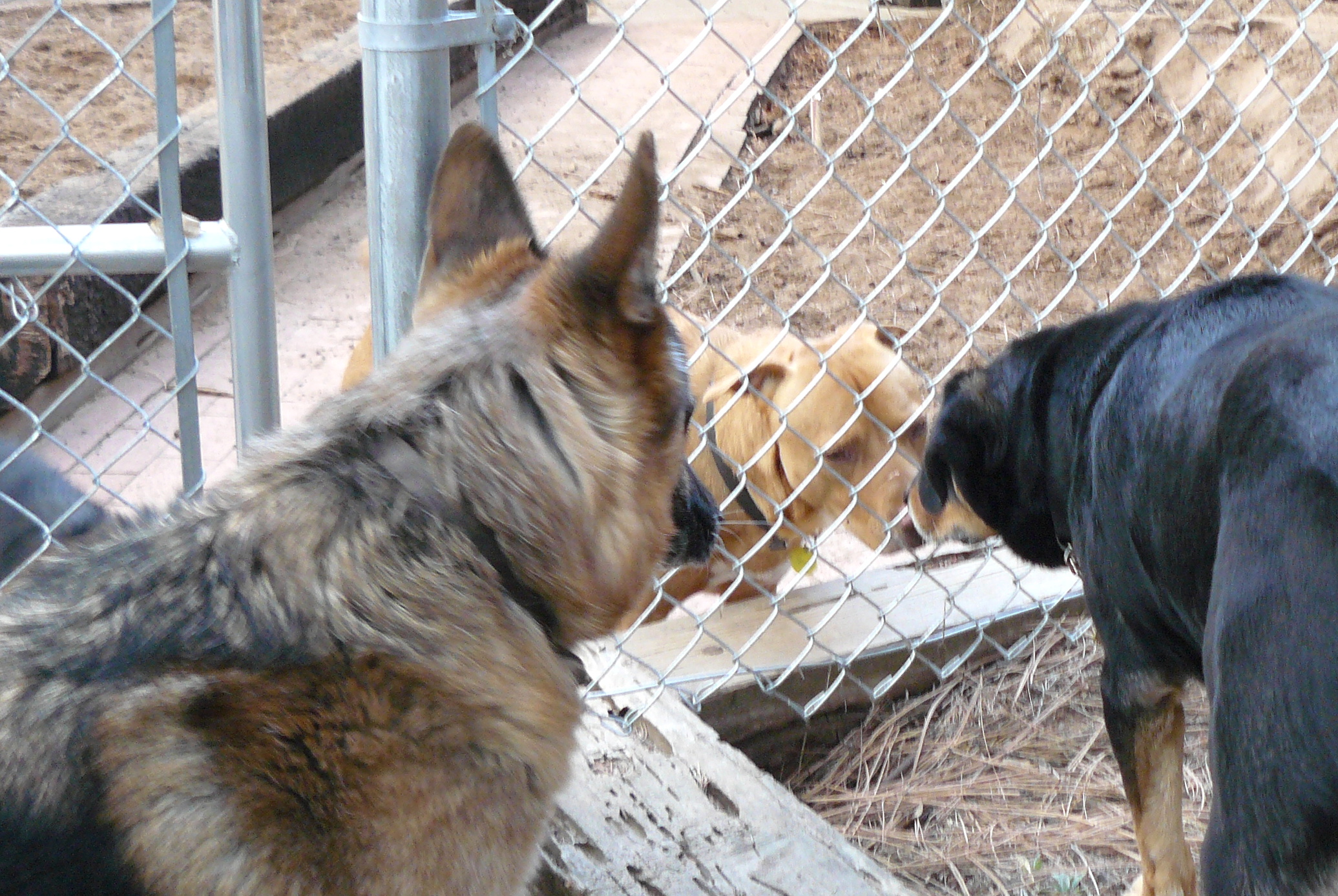
Ruby, partially hidden, and Kaycee outside the humane shelter.Checking out the new garden!Kaycee seconds away from freedom in his new home, Ruby and Sweeny looking on.Pharaoh and Hazel saying 'Hi' through the fence to Kaycee.
Last Summer, Jean and I signed up to a couple of evening courses at our local extension college, here in Payson. One of the courses was creative writing, something we have continued this year. That, plus encouragement from a number of writers (thank you all so much) who subscribe to Learning from Dogs, has pushed me to taking writing more seriously. Therefore, from time to time, I’m going to indulge myself by publishing a story on Learning from Dogs.
The following story is fictional in that the event did not take place, but the names of all concerned and the location are real!
Messages from the Night
by
Paul Handover
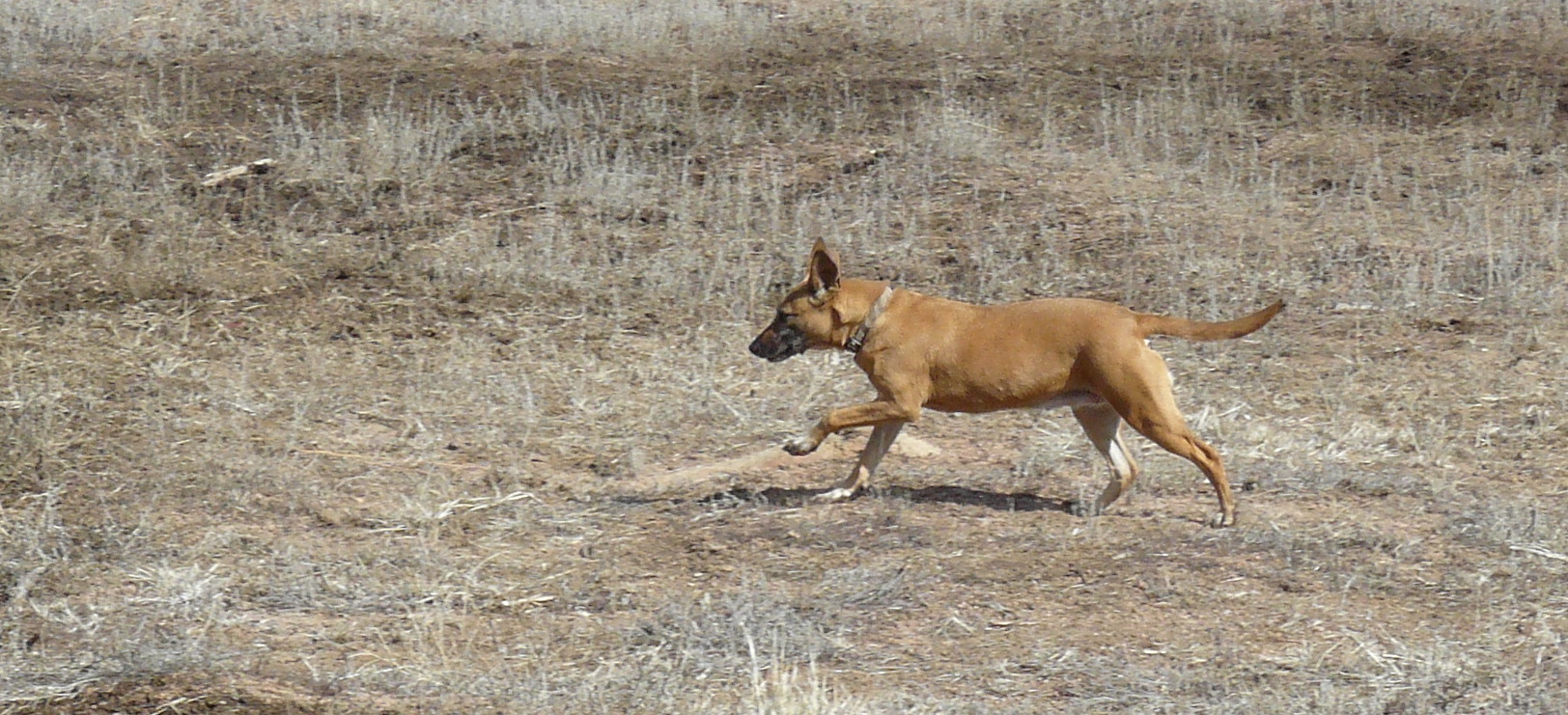
Dhalia heads for the hills!
“Jean, where’s Dhalia?”
“Don’t know. She was here moments ago.”
“Jeannie, You take the other dogs back to the car and I’ll go and scout around for her. Oh, and you better put Pharaoh on the leash otherwise you know he’ll follow me.”
“Paul, don’t worry, Dhalia’s always chasing scents; bet she beats us back to the car. Especially as it’s going to be dark soon.”
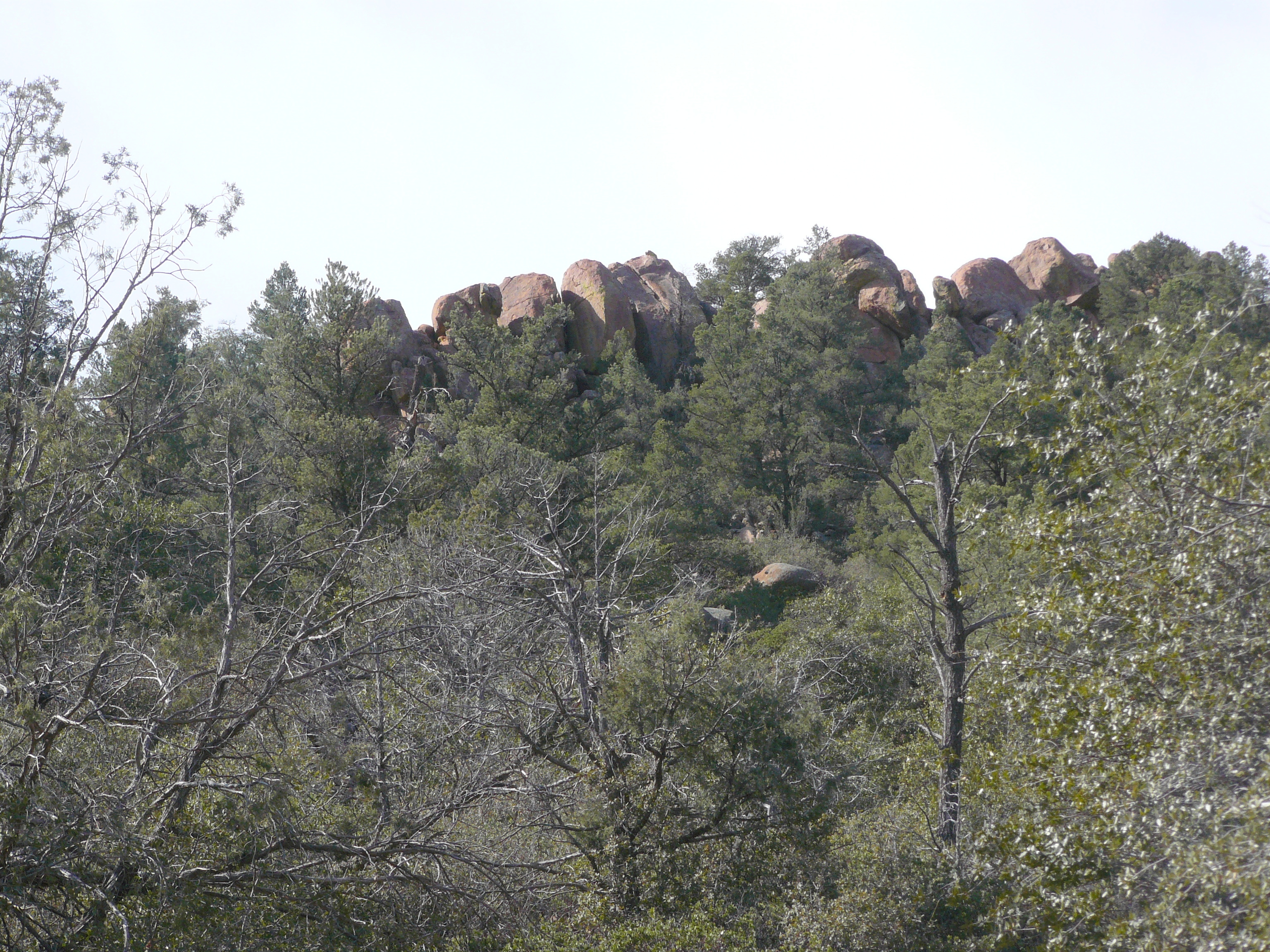
Nonetheless, Paul started back down the dusty, dirt road, the last rays of the sun pink on the high, tumbled cliffs of granite. This high rocky, forest plateau, known as the Granite Dells, just 3 miles from their home on the outskirts of Payson, made perfect dog-walking country and rarely did they miss an afternoon out here. However this afternoon, for reasons Paul was unclear about, they had left home much later than usual.
No sign of Dhalia ahead on the road so he struck off left, hoping she was somewhere up amongst the trees and the high boulders. Soon he reached the first crest, panting hard in the thin air. Behind him, across the breath-taking landscape, the setting sun had dipped beneath faraway mountain ridges; a magnificent sight. Suddenly, in the midst of that brief pause admiring the perfect evening, a sound echoed around the cliffs. The sound of a dog barking. Paul bet his life on that being Dhalia. Just as quickly the barking stopped.
Challenging walking country.
The barking started up again, barking that suggested Dhalia was hunting something. The sound came from an area of boulders way up above the pine trees on the other side of the small valley ahead of him. Perhaps, Dhalia had trapped herself. More likely, he reflected, swept up in the evening scents of the wilderness, Dhalia had temporarily reverted back to the wild, hunting dog she had been all those years ago. That feral Mexican street dog who in 2005 had tentatively turned away from scavenging in a pile of rubbish in a dirty Mexican town and shyly approached Jean. Jean had named her Dhalia.
He set off down to the valley floor and after 15 minutes of hard climbing had reached the high boulders the other side.
Paul whistled, then called “Dhalia! Dhalia! Come, there’s a good girl.” Thank God for such a sweet, obedient dog. He anticipated the sound of dog feet scampering through rough undergrowth. But no sound came.
He listened; no sounds, no more barking. Now where had she gone? Perhaps past these boulders down in the steep ravine beyond him, the one so densely forested with pine trees. With daylight practically gone he needed to find Dhalia very soon.
He plunged down the slope, through tree branches that whipped across his face, then fell heavily as his foot found empty space instead of the expected firm ground. Paul cursed, picked himself up and paused. That fall had a message; the madness of continuing this search in the near dark. This terrain made very rough going even in daylight. At night, the boulders and plunging ravines would guarantee a busted body, at best! Plus, he ruefully admitted, he didn’t have a clue about finding his way back to the road from wherever he was!
The unavoidable truth smacked him full in the face, he would be spending this night alone in the high, open forest. It had one hell of a very scary dimension.
He forced himself not to dwell on just how scary it all felt. He needed to stay busy, find some way of keeping warm; last night at home it had dropped to within a few degrees of freezing. Paul looked around, seeing a possible solution. He broke a small branch off a nearby mesquite tree and made a crude brush with which he swept up the fallen pine needles he saw everywhere about him. Soon he had a stack sufficient to cover him, or so he hoped. Thank God that when he and Jeannie had decided to give the four dogs this late afternoon walk, he had jeans and a long-sleeved shirt on, a pullover thrown over his shoulders. Didn’t make Dhalia’s antics any less frustrating but he probably wasn’t going to freeze to death!
The air temperature sank as if connected with the last rays of the sun. Paul’s confidence sank with the temperature.
He lay down, shuffled about, swept the pine needles across his body, tried to find a position that carried some illusion of comfort. No matter the position, he couldn’t silence his mind. No way to silence the screaming in his head, his deep, primeval fear of this dark forest about him, imagination already running away with visions of hostile night creatures, large and small, watching him, smelling him, biding their time. Perhaps he might sleep for a while?
A moment later the absurdity of that last thought hit him. Caused him to utter aloud, “You stupid sod. There’s no way you’re going to sleep through this!” His words echoed off unseen cliffs in the darkness reinforcing his sense of isolation.
He was very frightened. Why? Where in his psyche did that come from? He had spent many nights alone at sea without a problem, a thousand miles from shore. Then, of course, he knew his location, always had a radio link to the outside world. But being lost in this dark, lonely forest touched something very deep in him. Suddenly, he started shivering.
The slightest movement caused the needles to slip from him and the cold night air began to penetrate his body. He mused about how cold it might get and, by extension, thanked his lucky stars that the night was early October not, say, mid-December. So far, not too cold, but soon the fear rather than the temperature started to devour him. What stupid fool said, ‘Nothing to fear but fear itself!’ His plan to sleep under pine needles, fear or no fear, had failed; he couldn’t get warm. He had to move.
He looked around, saw a boulder a few yards away, like some giant, black shadow. No details, just this huge outline etched against the night. Paul carefully raised himself, felt the remaining needles fall away, and gingerly shuffled across to the dark rock. He half-expected something to bite his extended hand as he explored the surface, ran his hand down towards the unseen ground. Miracle of miracles, the granite gently emitted the warmth absorbed from the day’s sun. He slowly settled himself to the ground, eased his back against the rock-face and pulled his knees up to his chest. He felt so much less vulnerable than he had laying on the forest floor. Paul let out a long sigh, then burst into tears, huge heart-rending sobs coming from somewhere deep within him.
On the 26th January, I wrote a piece about some computer challenges that I was having called Oh, to be a dog! I included a number of gorgeous photographs of dogs that had been previously sent to me by Katie S. There was such a lovely response to those pictures that it seemed timely to offer some more.
Here they are.
"A life without a dog is a mistake"” (Carl Zuckmayer)When you leave a dog behind because he “grew old", your children will learn the lesson. Maybe they will do the same to you when you are an old man. Think about it….“Women and cats will do what please’s them, dogs and men should relax and get used to the idea” (Robert A. Heinlein)
"Love is when your dog licks your face, even if you leave it alone the whole day" Anita, 4 years old
"The dog knows, but does not know that he knows“ (Pierre Teilhard de Chardin)
A peek at a very interesting article in the February issue of National Geographic magazine.
Big thanks to Bob T. here in Payson for sending me a recent email that contained the one line, “There is a lengthy article entitled “Mix, Match, Morph” in the February issue of National Geographic. I strongly suspect you will find it of interest.” Understatement big time! The article is wonderful. It is also available online! 🙂
The premise behind the article is, as the opening words reveal,
Three breeds, Copyright National Geographic, photo by Robert Clark
How to Build a Dog
Scientists have found the secret recipe behind the spectacular
variety of dog shapes and sizes, and it could help unravel the
complexity of human genetic disease.
As is made clear early on in Evan Ratcliff’s text, the huge variety in the breeds of dogs is a very recent occurence,
For reasons both practical and whimsical, man’s best friend has been artificially evolved into the most diverse animal on the planet—a staggering achievement, given that most of the 350 to 400 dog breeds in existence have been around for only a couple hundred years.
And later Ratcliff writes,
The breeders gave no thought, of course, to the fact that while coaxing such weird new dogs into existence, they were also tinkering with the genes that determine canine anatomy in the first place. Scientists since have assumed that underneath the morphological diversity of dogs lay an equivalent amount of genetic diversity. A recent explosion in canine genomic research, however, has led to a surprising, and opposite, conclusion: The vast mosaic of dog shapes, colors, and sizes is decided largely by changes in a mere handful of gene regions.
What is critically being discovered is,
Already, more than a hundred dog diseases have been mapped to mutations in particular genes, many of them with human counterparts. Those diseases may have a whole array of mutations leading to a risk of disease in dogs, as they do in us.
It would be wrong, without permission to reproduce the article, to include more but you can quickly go here and read it yourself. Except I can’t resist closing with the last sentence from the article,
After all, he points out, there are millions of dog lovers out there willing and eager to help with the fieldwork.
Ain’t that the truth!
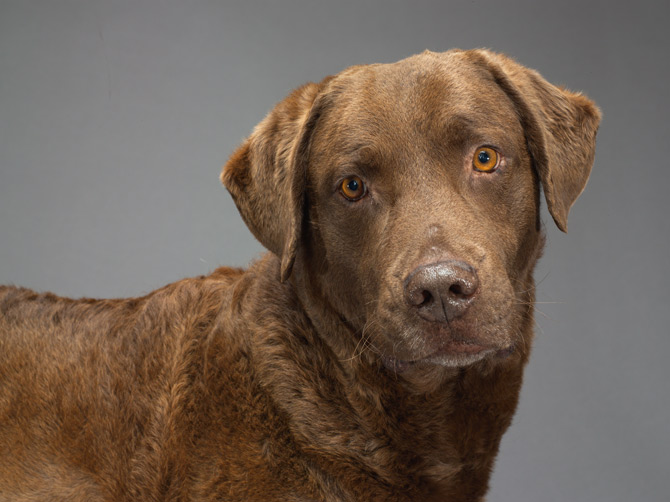
And don’t miss the fabulous photographs of dogs taken by Robert Clark which you can see here, another example of which is below. Robert Clark’s website is here.
Chesapeake Bay retriever, 48, Photograph by Robert Clark









 Learning from Dogs