Tag: Communities

The social strength of communities

A solid reminder of a key lesson from dogs.

I was researching for a chapter on Communities for my book and came across a wonderful essay by an Erik Kennedy. It was so brimful of common-sense that I wanted to share it with you.

The essay was entitled: On the Social Lives of Cavemen. Here’s how it opens:

essays

by erik d kennedy

On the Social Lives of Cavemen

Tribal Living in the Modern World

May 2011

Introduction: The Gustatory Lives of Cavemen

We may be the pinnacle of millions of years of evolution, but we’re throwing our birthright straight out the window of our comfortable suburban homes. In this essay, we’re going to discuss walking across our family-sized lawn, climbing over our questionably large picket fence, and retrieving that birthright.

Then a little later on, Mr Kennedy writes (my emphasis):

The Tribe

Human beings are no strangers to group living. Call it a family trait. Our closest animal relatives spend a good bulk of their time eating bugs off of their friends’ back. While I’m overjoyed we’re not social in that manner, I’m less pleased that we’re not social more to that degree. In study after study, having and spending time with close friends is consistently correlated with happiness and well-being. And yet, the last few decades in America have seen a remarkable decline in many things associated with being in a tight-knit social circle—things like family and household size, club participation, and number of close friends. Conversely, we’ve seen an increase in things associated with being alone—TV, commutes, and the internet, for example.

This trend is quite unhealthy. It’s no surprise that humans are social animals—but it may be surprising that we’re such social animals that merely joining a club halves your chance of death in the next year—or that living in a close-knit town of three-generation homes can almost singlehandedly keep you safe from heart disease.

Any of you that have a few dogs around you at home know what wonderful close-knit groups they make. Frequently highlighted here on Learning from Dogs.
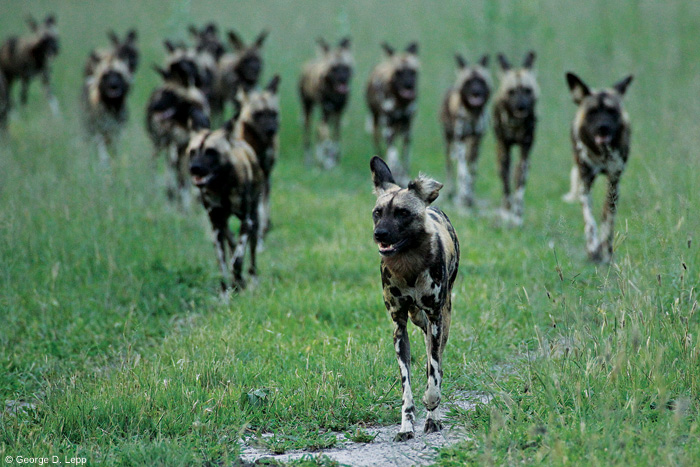
Group of wild dogs from a photograph taken by George Lepp.

Dogs offer many beautiful examples of the benefits of community. For the reason that their ancient genes, long before they became domesticated animals, still guide their behaviours. When dogs lived in the wild, their natural pack size was around fifty animals. There were just three dogs that had pack status; the alpha, beta and omega dogs. Or more usefully described as the Mentor, Minder and Nanny dogs. (As is still the case in wild dog pack families.)

As has been explained previously in this place, all three dogs of status, wild or domesticated, are born into their respective roles, with their ‘duties’ in their pack being instinctive. There was no such thing as competition for that role as all the other dogs in that natural pack grouping would be equal participants with no ambitions to be anything else.

One doesn’t need to reflect for very long before the obvious question arises: If fifty dogs is the optimum number for a pack of dogs, is there a limit to the number of people we can have in the human equivalent of a pack?

Well, says anthropologist Robin Dunbar, that number is about 150 persons. Robin Dunbar achieved fame by drawing a graph that plotted primates’ social group size as a function of their brain sizes. He inputted the average human brain size into his model, and up came the number 150. Beyond that number is past the upper bounds for both hunter-gatherer tribes and Palaeolithic farming villages. More than that, it appears that everything from startup employee counts to online social networks show this number as a fairly consistent maximum for creating and maintaining close social ties.

Once more, a great lesson from our dogs – wrap the strength of a community around you.
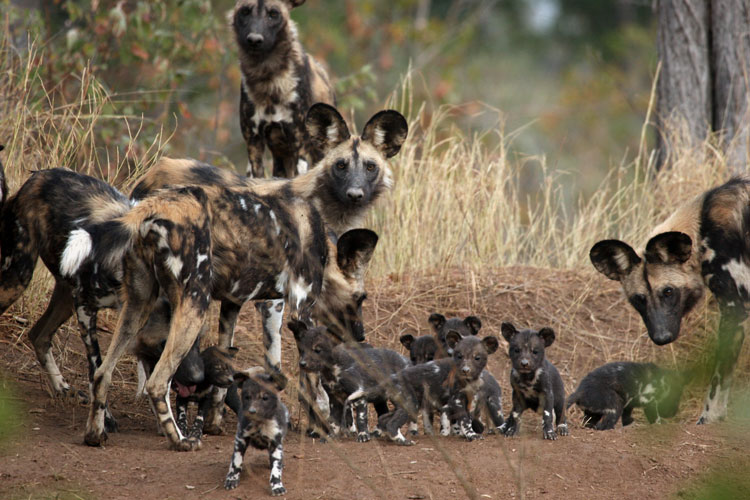
A return to community values.

The foundation of change.

Undoubtedly, those of you that watched the George Monbiot speech in yesterday’s post will have been struck by at least two key aspects.  The first being the utter absurdity in the way that we are being governed (UK and the USA) and the second that change can only come from people bonding at a local level.  For it is within local communities that groups of people share their ideas and develop a vision for change that they can stand behind in an open and demonstrable manner.

The history of mankind is inseparable from the history of living in communities.  It’s only in recent times that so many have chosen to live in cities and towns. Dogs, of course, offer a brilliant and wonderful example of the benefits of community life.

African wild dogs (Photo credit: Trent Binfold-Walsh)

(See more pictures at the African Wildlife Conservation Fund website.)

Back to George Monbiot. Here are some of Mr. Monbiot’s words towards the end of his speech. (My emphasis.)

As Lakoff has pointed out, these people are trying to do the right thing but they are completely failing to apply a frames analysis. A frame is a mental structure through which you understand an issue. Instead of framing the issue with our own values and describing and projecting our values – which is the only thing in the medium- to long-term that ever works – we are abandoning them and adopting instead the values of the people who are wrecking the environment. How could there be any long-term outcome other than more destruction?

There’s another way of looking at this, which says the same thing in different ways. All of us are somewhere along a spectrum between intrinsic values and extrinsic values. Extrinsic values are about reputation and image and money. They’re about driving down the street in your Ferrari and showing it to everyone. They are about requiring other people’s approbation for your own sense of well-being.

Intrinsic values are about being more comfortable with yourself and who you are. About being embedded in your family, your community, among your friends, and not needing to display to other people in order to demonstrate to yourself that you are worth something.

The desire for humans to belong to a community was highlighted in a recent article in Time Magazine under it’s Culture section (August 4th). The article was called Atheist “Churches” Gain Popularity—Even in the Bible Belt (again, my emphasis).

Jerry Dewitt (Left), A former Pentecostal minister, DeWitt now leads the secular Community Mission Chapel in Lake Charles, La. Mike Aus (Right), In September 2012, Aus began Houston Oasis, an atheist service that is considered a model for nonbelievers nationwide.

On a clear, Sunny July morning, as churchgoers all around Houston take to their pews, dozens of nonbelievers are finding seats inside a meeting room in a corporate conference center on the city’s west side to listen to a sermon about losing faith. But first there’s the weekly “community moment”–remarks on a chosen topic delivered by the group’s executive director, this time focused on how we’re hardwired to read sensationalized news–as well as announcements about an upcoming secular summer camp. In between, a musician sings softly of Albert Einstein.

The men speaking before the assembled gathering–executive director Mike Aus, who regularly leads the group, and Jerry DeWitt, a visitor who heads a similar gathering in Louisiana–are both deeply familiar with the idea of Sunday ritual.

Later in the article, Mike Aus (see picture above) goes on to say (once more, my emphasis):

There are a lot of people in the free-thought movement who say: Well, this is just mimicking church. But if we don’t offer regular human community and support for nonbelievers, it would be detrimental to the movement.

Whether we like it or not, change is being thrown at us by nature at an unprecedented scale; certainly unprecedented in the experience of homo sapiens. Our only hope is to turn away from the destructive agendas of our present governments all across the world and build change from the grassroots up.

It’s time to remember the value of communities.