Tag: Colony Collapse Disorder

Pity the bees; pity us.

A world without bees would be a world without us!

Note: I would like to remind good readers of Learning from Dogs as to what I wrote a week ago; namely:

My daughter, Maija, son-in-law, Marius, and grandson, Morten, aged two, are staying with us over the next couple of weeks, arriving tomorrow.

So being able to offer a daily fresh post on Learning from Dogs will be a challenge. As indeed, it should be: Family should always be the top priority.

However, rather than leaving you with blank pages, I shall be regurgitating some earlier posts, starting tomorrow.

Thus the room for creative writings from yours truly is restrained, if not impossible, until Maija and company leave on Friday morning.

oooo

Guard their future - and ours!
Guard their future – and ours!

For today I want to focus, primarily using materials from elsewhere, on the developing situation regarding our bees: they are in crisis.

This all came to my attention when Jean and I were able to watch a recent BBC Horizon Special: What’s Killing Our Bees?  As the BBC Horizon website explains:

Bill Turnbull investigates one of the biggest mysteries in the British countryside: what is killing our bees. It is a question that generates huge controversy. Changes in the weather, pesticides and even a deadly virus have all been blamed. It is a question that Bill is all too familiar with as a beekeeper himself. He meets the scientists who are fitting minute radar transponders on to bees to try to find answers.

Not sure how long this will remain available on YouTube but here is the first quarter of that BBC Horizon Special.

But the message put out by Bill Turnbull that this was solely a mystery for the British countryside was demolished in TIME Magazine for August 12th, which ran as their lead story:

g9510.20_Bee.indd
Bees making the headlines.

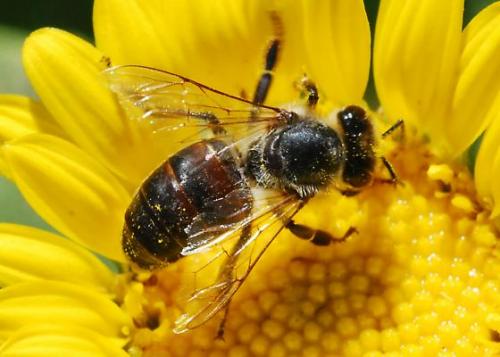
You can thank the Apis mellifera, better known as the Western honeybee, for 1 in every 3 mouthfuls you’ll eat today. Honeybees — which pollinate crops like apples, blueberries and cucumbers — are the “glue that holds our agricultural system together,” as the journalist Hannah Nordhaus put it in her 2011 book The Beekeeper’s Lament. But that glue is failing. Bee hives are dying off or disappearing thanks to a still-unsolved malady called colony collapse disorder (CCD), so much so that commercial beekeepers are being pushed out of the business.

So what’s killing the honeybees? Pesticides — including a new class called neonicotinoids — seem to be harming bees even at what should be safe levels. Biological threats like the Varroa mite are killing off colonies directly and spreading deadly diseases. As our farms become monocultures of commodity crops like wheat and corn — plants that provide little pollen for foraging bees — honeybees are literally starving to death. If we don’t do something, there may not be enough honeybees to meet the pollination demands for valuable crops. But more than that, in a world where up to 100,000 species go extinct each year, the vanishing honeybee could be the herald of a permanently diminished planet.

Forgive me, but just have to repeat that last sentence: “the vanishing honeybee could be the herald of a permanently diminished planet.

Then piling on the pressure was an article on Food Freedom News on the 11th August: 31 Percent of US Honey Bees Wiped Out This Year – Who Will Pollinate Our Crops?

By Michael Snyder
Blacklisted News

If bees keep dying off at this rate, we are going to be facing a horrific agricultural crisis very rapidly in the United States.  Last winter, 31 percent of all U.S. bee colonies were wiped out.  The year before that it was 21 percent.  These colony losses are being described as “catastrophic” by those in the industry, and nobody is quite sure how to fix the problem.  Some are blaming the bee deaths on pesticides, others are blaming parasites and others are blaming cell phones.  But no matter what is causing these deaths, if it doesn’t stop we will all soon notice the effects at the supermarket.  Bees pollinate about a hundred different crops in the United States, and if the bees disappear nobody is quite sure how we will be able to continue to grow many of those crops.  This emerging crisis does not get a lot of attention from the mainstream media, but if we continue to lose 30 percent of our bees every year it is going to have a cataclysmic effect on our food supply.

The frightening thing is that the bee deaths appear to be accelerating and they appear to be even worse in the UK and Canada…

This past winter was one of the worst on record for bees. In the U.S., beekeepers lost 31 percent of their colonies, compared to a loss of 21 percent the previous winter. In Canada, the Canadian Honey Council reports an annual loss of 35 percent of honey bee colonies in the last three years. In Britain, the Bee Farmers’ Association says its members lost roughly half their colonies over the winter.

“It has been absolutely catastrophic,” said Margaret Ginman, who is general secretary of the Bee Farmers’ Association. “This has been one of the worst years in living memory.”

Scientists have been scrambling to figure out what is causing this, and one study that was recently conducted by researchers at the University of Maryland and the U.S. Department of Agriculture may have some answers…

Please read the rest of the report here.

The United States Department of Agriculture (USDA) website is an obvious point of reference although a quick search by me failed to find confirmation of the importance of bee pollination for many crops, as was reported in the TIME Magazine article, namely:

Although many crops are only partially dependent on bee pollination, others, like the almond, cannot get by without it.  According to USDA, one-third of the food in our diet relies to some extent on bee pollination.

Almond: 100%

Apple: 90%

Asparagus: 90%

Avocado: 90%

I’m sure you get the message!

Tomorrow, I will present a recent essay from George Monbiot who offers his view of this major crisis.

We are what we eat!

So why do we insist of manipulating the genetics of food!

I read somewhere recently, and of course now can’t find the reference, that the genetic modification of our food represents as big a danger to the long-term survival  of man as does the damage to our biosphere.

So a recent item on the blog Food Freedom News jumped out at me.  This was an item that was introduced as, “The author of Seeds of Destruction (about Monsanto) has a new piece out on pesticides and mass animal deaths… very sobering.

Clicking on the ‘new piece’ link takes one to here, from which I quote the opening paragraphs,

Death of the Birds and the Bees Across America

By F. William Engdahl
Global Research

“A recent study showed that every human tested had the world’s best-selling pesticide, Roundup, detectable in their urine at concentrations between five and twenty times the level considered safe for drinking water.”

Birds and bees are something most of us take for granted as part of nature. The expression “teaching about the birds and the bees” to explain the process of human reproduction to young people is not an accidental expression. Bees and birds contribute to the essence of life on our planet. A study by the US Department of Agriculture estimated that “…perhaps one-third of our total diet is dependent, directly or indirectly, upon insect-pollinated plants.”

The honey bee, Apis mellifera, is the most important pollinator of agricultural crops. Honey bees pollinate over 70 out of 100 crops that in turn provide 90% of the world’s food. They pollinate most fruits and vegetables–including apples, oranges, strawberries, onions and carrots.  But while managed honey bee populations have increased over the last 50 years, bee colony populations have decreased significantly in many European and North American nations. Simultaneously, crops that are dependent on insects for pollination have increased. The phenomenon has received the curious designation of Colony Collapse Disorder (CCD), implying it could be caused by any number of factors. Serious recent scientific studies however point to a major cause: use of new highly toxic systemic pesticides in agriculture since about 2004.

That first paragraph alone made me sit up, “A recent study showed that every human tested had the world’s best-selling pesticide, Roundup, detectable in their urine at concentrations between five and twenty times the level considered safe for drinking water.”  What a strange race we are!

Wlliam F. Engdahl

Then it was easy to find out more information about the author of the book Seeds of Destruction, William F. Engdahl, including his website.  Mr. Engdahl is clearly no stranger to controversy as this YouTube video illustrates,

Back to that Food Freedom article.  Further on, there is evidence of the size of the problem in the UK,

Alarming UK results

A private UK research organization, Buglife and the Soil Association, undertook tests to try to determine cause of the bee death. They found that the decline was caused in part by a group of pesticides called neonicotinoids. Neonicotinoids are “systemic” chemicals that kill insects by getting into the cell of the plant. In Britain it’s widely used for crops like oilseed rape and for production of potted plants.

The neonicotinoids are found in the UK in products including Chinook, used on oilseed rape and Bayer UK 720, used in the production of potted plants which then ends up in gardens and homes around the country. The new study examined in detail the most comprehensive array of peer-reviewed research into possible long-term effects of neonicotinoid use. Their conclusion was that neonicotinoid pesticides damage the health and life cycle of bees over the long term by affecting the nervous system. The report noted, “Neonicotinoids may be a significant factor contributing to current bee declines and could also contribute to declines in other non-target invertebrate species.” The organization called for a total ban on pesticides containing any neonicotinoids.

The president of the UK Soil Association, Peter Melchett, told the press that pesticides were causing a continued decline in pollinating insects, risking a multimillion pound farming industry. “The UK is notorious for taking the most relaxed approach to pesticide safety in the EU; Buglife’s report shows that this puts at risk pollination services vital for UK agriculture,” he said.

Indeed in March 2012 Sir Robert Watson, Chief Scientist at the British Government’s Department of Environment announced that his government was reconsidering its allowance of neonicotinoid use in the UK. Watson told a British newspaper, “We will absolutely look at the University of Stirling work, the French work, and the American work that came out a couple of months ago. We must look at this in real detail to see whether or not the current British position is correct or is incorrect. I want this all reassessed, very, very carefully.”  To date no policy change has ensued however. Given the seriousness of the scientific studies and of the claims of danger, a prudent policy would have been to provisionally suspend further uise of neonicotinoids pending further research. No such luck.

And if the harm to bees wasn’t serious enough, try this extract,

Effect on Human Brain?

But most alarming of all is the evidence that exposure to neonicotinides has horrific possible effects on humans as well as on birds and bees.

Professor Henk Tennekes describes the effects:

“Today the major illnesses confronting children in the United States include a number of psychosocial and behavioral conditions. Neurodevelopmental disorders, including learning disabilities, dyslexia, mental retardation, attention deficit disorder, and autism – occurrence is more prevalent than previously thought, affecting 5 percent to 10 percent of the 4 million children born in the United States annually. Beyond childhood, incidence rates of chronic neurodegenerative diseases of adult life such as Parkinson’s disease and dementia have increased markedly. These trends raise the possibility that exposures in early life act as triggers of later illness, perhaps by reducing the numbers of cells in essential regions of the brain to below the level needed to maintain function in the face of advancing age. Prenatal and childhood exposures to pesticides have emerged as a significant risk factor explaining impacts on brain structure and health that can increase the risk of neurological disease later in life.”

There is also growing evidence suggesting persistent exposure to plants sprayed with neonicotinoids could be responsible for damage to the human brain, including the recent sharp rise in incidents of autism in children.

This really is an article that you should read in full, which also includes a full bibliography and notes section.  Plus you can leave your responses as a comment – go for it!

Apis mellifera – the honey bee (family Apidae)