Tag: climate change

Global climate confusion, part one

This is a long theme that is being broken down into two posts.  Hope you can stay with it because it seems to me to represent how difficult it can be, when the topic is complex with significant implications for society, to determine the truth of an issue.

To set my own position clear, I have for many years taken it more or less for granted that mankind, through the mechanisms of increased population, increased standards of living and increased use of carbon-based fuels must be having a deleterious effect on the planet’s atmosphere.

Indeed, there have been a number of articles on Learning from Dogs that support that position of mine.  However, my dear friend Dan Gomez sent me a piece that I published on the 16th. June under the heading of Always two sides.  Frankly, I was still a little sceptical.

Then on the 22nd June, I published an account about the increasing quietness of the sun which, at the end, included a quotation from Dr Frank Hill,  “It is unfortunate that the global warming/cooling studies have become so politically polarizing.” H’mm, I thought, what is it that Dr. Hill sees that causes him to write this way?

Then another good friend of Learning from Dogs, Patrice Ayme, reminded me that he had written a comprehensive article on his own Blog about the apparent enigma of the sun cooling while at the same time the ice caps were melting.  Ah ha, I thought, a thoughtful and erudite explanation that while it was complex we are still in a phase of climate change (i.e. warming) most likely caused by man.  Patrice gave me permission to reproduce his essay in full, which I so do below.

But then reading the comments sent in to Patrice’s original essay on the 31st May, 2009, I was set right back to the position of being very, very confused.  More about the confusion that exists tomorrow, but now here’s Patrice’s original essay.

SUN COOLING, ICE MELTING…

By Patrice Ayme

TWENTY FIVE  METERS SEA LEVEL RISE ALL TOO SOON FROM MELTING OF ANTARCTICA’S ICE BASINS?

How to enlighten the conversation with one picture worth 10,000 words. Watch the red line below, and how much it dips lately:

Synopsis: More than 98% of scientific papers considering the subject opine that recent human activities have warmed up the climate. But the percentage of the public who believe that is only around 55% … in the USA. This disbelief, far from being healthy, is related to the propaganda of big polluters, allowing the latter to avoid making the economy of the USA efficient (so they have less to do, avoid public inquiry, and make greater profits, while being beyond any suspicion).

One recent tactic of these sneaky types has been to talk about the sun and planets. The main argument they make is that the sun is acting up, thus allegedly causing the warming. Fair enough. Considering the sun is a must, indeed: there is plenty of evidence that the recent Little Ice Age was caused by a sort of Solar Winter. So let’s look at the sun: as the graph above shows, it is COOLING. The sun is cooling. The warming would have been much greater, had the sun not been so kind. Ooopss.

Other climate deniers made some noise about a recent cover article in Science that computed that the collapse of the WAIS (West Antarctica Ice Shield) would rise sea level by only 3.30 meters. But this article sort of cheats: reading its fine print shows that the rise would be rather be 3.80 meters, and it brazenly ignores all possible melting of part of the Antarctica Peninsula (contriving to do so by the not so subtle artifice that said peninsula is not  semantically part of the WAIS; however, the peninsula is more north and warmer, so, one ought to suspect, it would melt even more, as it has actually started to do!).

The authors in Science also ignore other mountainous regions of the WAIS itself, using, once again the artifice that being on land does not make them part of the WAIS, formally speaking,  since the WAIS is a shield, and nothing inclined is, although, of course, having deep blue sea all around the present mountainous areas of the WAIS would warm them up.

I then turn this argument around. Looking towards the east, and I ponder what could happen with East Antarctica. Answer: very serious trouble.

By the way, the expression “climate change” is misleading. The biosphere is attacked in all ways by the rise in Greenhouse Gases, and not just by direct warming. It is losing the battle quickly. Changes that have happened before in millions of years are now happening in decades, so biological species cannot adapt through migration, and, or, biological evolution.

Half of the CO2 recently produced has sunk into the ocean, where it reacted with water to make carbonic acid. So millions of species of the plancton, many making oxygen, are dissolving in an acid prepared by the average American household and its refusal to endure a stiff carbon tax. Moreover entire zones within the oceans have warmed so much that they lost enough oxygen to support life as we know it (most sea species are highly sensitive to tiny temperature variations). And as evolution presently knows it. These gigantic zones are now dead: life does not have time to evolve species adapted to this new environment. What is going on is a BIOSPHERICAL CATASTROPHE, as a result of stuffing life’s environment with 400 million years of carbon deposits.

——————–

SOLAR INPUT:

No climate change discussion can be considered complete without considering the sun. This is one point greenhouse deniers have been making. It is indeed extremely correct.

Greenhouse deniers have been loudly proclaiming, that because some planets (Mars, Pluto) are warming (perhaps), then the sun has got to be warming. This argument can be put to rest: Mars and Pluto’s climates are dominated by astronomical and peculiar factors (see notes).

And, unfortunately for greenhouse deniers, the sun output has been slowing down, as the graph below shows.
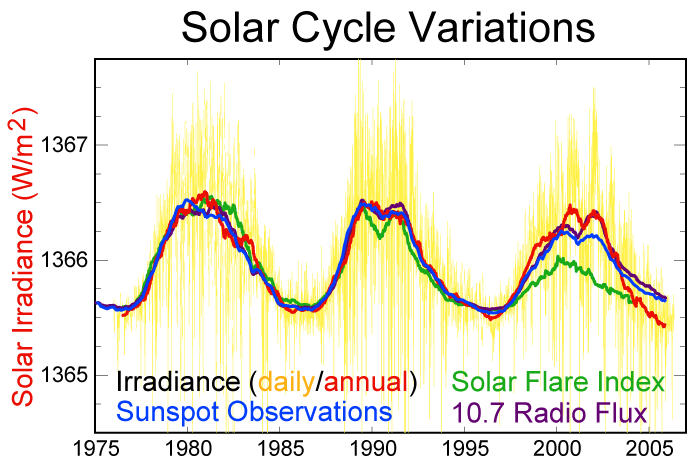
What does this mean? We should be cooling down, because the sun’s output has been going down as much as an astounding 6% in some frequencies. But, nevertheless, the lower troposphere has been warming up (while the stratosphere, robbed of heat by the greenhouse blanket BELOW it, has been cooling, a predicted effect of the greenhouse; this warming at low elevation accompanied by a cooling higher up shows that the observed changes of temperatures are due to a greenhouse, not just a global change in solar output).

Thus the warming of recent times is indeed caused by greenhouse warming, as humans augmented greenhouse gases by more than fifty percent in 150 years. Notice that in the graph above that we are reaching a local minimum of solar output, and that solar output should soon increase again in the next 11 years cycle.

Another tactic has been for some greenhouse deniers to turn into outright friends of the greenhouse, and claim that we were spared a new ice age from the human induced greenhouse. (That many people living in the Arctic will love the considerable heating the poles will experience is only natural though.)

Indeed, some scientists have speculated that herding augmented the production of methane during the Neolithic, thus preventing the cooling that would otherwise have happened. Methane is a very strong greenhouse gas. Basically Neolithic man killed the carnivores, and reduced the forests, so the herbivores would have plenty to munch on, and the herbivores became more numerous. As they did, the worldwide density of methane went up significantly, durably warming up the lower atmosphere.

Maybe. But that is not the point. The point is that we are doing GEOENGINEERING on our own planet, haphazardly, driven by short term profit and hubris. In particular what would happen if Mr. Sun would wake up, and produce as much output as it used to a few decades ago? Well, the gentle warming up would turn into outright swift heating.

(This being said, a lot of people living in high latitudes can only be pleased by polar heating: an entire world is opening up, and many of the big polluters know there are significant fossil fuel reserves around the poles, piled up there in warmer eons past…)

LUBRICATION, OR HOW TO LOSE AN ICE CAP:

A few years back, only the fringes of Greenland were melting in summer. The ice cap flowed majestically to the sea, at a sedate pace, through enormous flowing glaciers entering the sea. Greenland’s ice cap towers more than 3000 meters above sea level and the possibility of its melting sounded like bad science fiction.

In recent summers, though, up to half of Greenland has been melting, and “icequakes” have gone from about five a year in 1996 to around 30. In a typical icequake, a glacier the size of Manhattan, and 500 meters thick, slips by say ten meters in one minute (icequakes release their Richter 6 energy with lower frequency waves than the most destructive tectonic earthquakes, so one needs special seismographs to pick them up; although about half of the energy of the tsunami quake of 2004 was released that way, making the waves two-thirds as high as they would have been otherwise; hence that tsunami quake is viewed as 9.1 Richter, or 9.3 Richter, depending whether one counts the low frequency waves, or not…).

The reason for icequakes is undoubtedly lubrication by water gushing below the glaciers, having ended down there by what is called a moulin (a giant waterfall chute, up to twenty meters across and 3 kilometers deep). On the margins of Greenland, where the slope is strong, the glaciers avalanche down. Before 2000, glaciers on the West coast of Greenland had never done so. Now they do.

Interestingly, something a bit similar is found down south. Hundreds of lakes have been found under the main ice shield in Antarctica. They are most probably caused by geothermal heating, but they communicate with each other, and can propel (by appropriate swelling of their liquid mass) the ice shield above. That ice shield can be up to 4,000 meters thick. My point? One could imagine the same formation of moulins occurring down south (although there, right now temperatures, even in summer, oscillate between minus 50 Celsius and minus ten, so there are no dangers of lakes forming on the surface yet, as they now happen on the Greenland ice cap; such lakes can vanish into a newly formed moulin in minutes).

WHY GLACIATIONS COME AND GO, AND WHY IT’S GOING TO BE WARM FOR 50,000 YEARS:

One thing to know about Antarctica is that it was long covered with the same forests found nowadays in Patagonia. Trees and even dinosaurs (!) had adapted to the long nights. Glaciers were only found in the numerous high mountain ranges of the polar continent. In the last four million years, after 70 million years of steady cooling, perhaps because of the closing of the bridge between North and South America, and the rise of mighty mountain ranges, plus the opening of a circumpolar ocean which insulated Antarctica from the rest of the planet thermally, earth’s climate became much cooler. The apparition of glaciated poles was, most certainly, itself an accelerating cause of cooling. Sea level dropped 135 meters below the present level, as water ice gathered in colossal ice shields. Glaciations oscillated, between the poles and the temperate zones, as the parameters of earth’s orbit varied.

Joseph Alphonse Adhemar (1797 – 1862), a French mathematician, was the first to suggest that glaciations occurred from astronomical dispositions, in his 1842 book “Revolutions of the Sea”. Then the self educated Scottish scientist Croll, using Leverrier’s precise math (which had allowed him to discover Neptune) revealed the relationship between ice, albedo (that is the measure of how much sunlight is reflected back to space), and the eccentricity of earth’s orbit.

Croll suggested the basic idea of orbitally forced insolation variations influencing terrestrial temperatures. This comes from a geographical oddity, the fact that the continents of Earth are gathered up in the North. That allows support of enormous ice shields.

The sea does not allow support of huge iceshields, kilometers thick, as it is too warm (except in Antartica). Why the sea stays warm is another miracle, related to CO2 and volcanoes. Basically ice shields all over, as in “Snow Ball Earth”, lock up in the atmosphere CO2, bringing a strong greenhouse, which, in turn, melts the iceshields. A “Snow Ball Earth” related to the rise of complex life, is suspected to have occured a few times around 700 to 600 million years ago. So CO2, life, volcanoes, plate tectonic, active geology and temperature of the biosphere are tightly connected.

So, if not enough sun falls on those northern continents during summer, the ice from the preceding winter will not melt, and the continents will gather ice, and the ice will spread south, if it can.

This lack of sun exposure in summer will happen from celestial mechanics interacting with the inclination of the rotation axis of the earth. Croll’s work was widely discussed, but by the end of the 19th century, the theory was generally disbelieved. Much later, the Serbian Milutin Milankovitch further developed the theory that eventually triumphed in 1976, in modified form.

The bottom line is that the present astronomical calculations show that 65° North summer insolation should increase gradually over the next 25,000 years, and that no declines in 65° North summer insolation sufficient to cause an ice age are expected in the next 50,000 to 100,000 years.

Hence Earth should warm up for the next 50,000 years, an exceptionally long interglacial. [Berger A, Loutre MF (2002). “Climate: An exceptionally long interglacial ahead?”. Science 297: 1287–1288]

A DAMOCLES ICICLE, READY TO CRUSH US ALL: THE WEST ANTARCTIC ICE SHIELD (WAIS)

The West Antarctic Ice Shield (WAIS) looks all white and solid from space, with a few huge mountains ranges coming out. Those mountains are, in truth, massive islands coming out of a frozen mass of fresh water that stands in place of the ocean. The WAIS connects the Antarctic peninsula, which goes north towards Patagonia, to the main part of the polar continent. The WAIS is covered with ice, it is made of ice. The crucial point, though, is that most of the rock supporting the solid ice of the WAIS is below sea level. It is a giant ice cube resting on what ought to be the bottom of the ocean.

The sea is out there, lapping against the boundary of the WAIS, which rests so heavily on the continent, that it pushes it down. The rocky boundary has no ice pushing it down, except a bit on the side, so it is not as low. Thus the rock below the WAIS forms a bowl that would be under water, if it were not under ice. That bowl is glued on its margin by ice. The surface oceanic water is salty, and would be below freezing if it were not so salty, thus it glues efficiently the margin of the WAIS, since the WAIS is made of freshwater, and thus freezes solid below zero Celsius. This system sounds contrived, and it is indeed a rather unstable arrangement.

Water has the curious property that it is denser at 4 degree Celsius (8 degrees Fahrenheit above the freezing point of pure water). Hence the sub freezing salty ocean water is above relatively warmer ocean water. If at some point some warm water can come in contact with the boundary of the WAIS, it could suddenly melt the sweet water ice of the WAIS at the margin, and then flow below the WAIS, melting it from below, and organizing some sort of satanic Carnot thermal engine with a strong circulation squeaking below, and accelerating the whole thing (it maybe how and why the ice shelves dislocate so fast, by the way: sudden circulation forming a thermal engine underneath, I would suggest).

From previous studies, it was widely assumed that the WAIS would cause a sea level rise of 5 meters if it melted. But an article in Science, May 15, 2009, claiming more precise radar telemetry, revisits the threat: “Theory has suggested that the West Antarctic Ice Sheet may be INHERENTLY UNSTABLE. Recent observations lend weight to this hypothesis. We reassess the potential contribution to eustatic and regional sea level from a rapid collapse of the ice sheet and find that previous assessments have substantially overestimated its likely primary contribution. We obtain a value for the global, eustatic sea-level rise contribution of about 3.3 meters, with important regional variations.”

The important regional variations have mostly to do with the rise of the local shores in West Antarctica: as the ice goes away, the continent rebounds. The authors count ONLY regions of where the bedrock slope is opposite to the glacial flow, a pointless restriction, in my not so humble opinion. Counting all regions below sea level, as they should have, the same authors find a rise of 3.8 meters. The authors also ignore the melting in the colossal mountainous islands that would be left, some as large as medium size countries.

THE WEST ANTARCTIC ICE SHIELD (WAIS) IS ALL SET TO BREAK UP:

Temperatures have increased enormously in the polar regions (up to 5 degrees Celsius in some regions such as the Antarctica peninsula, although the overall planetary warming is only 0.75 C, less than one degree Celsius; some say only 0.4 degree Celsius!). This comes from the poles being the planet’s heat sinks: all the heat is sent there, as the greenhouse effect proceeds apace (another why little is being done about it, as temperate areas, where the deciders live, have barely warmed up).

This warming up at the poles has a very practical effect: the surface waters in Antarctica are in danger of reaching zero degree Celsius, the temperature at which fresh water ice melts. That means that the margin of the WAIS could come unglued, and warm ocean water could flow below it. In other words, we are within an easy warming reach of a WAIS catastrophe. Something like this happened to the ice shield over Hudson Bay, which dislocated very fast a few thousands years ago, as warm ocean water slipped below it. (I just suggested a mechanism for this otherwise unexplainable speedy break-up.)

COULD THE EAST ANTARCTIC ICE BASINS DISSOLVE TOO?

As if this looming WAIS disaster was not enough, there is another Damocles icicle hanging above the carbon banquet. A mechanism is revealed with a new actor, that I am perversely pleased to introduce, the East Antarctic Ice Shield, allowing a sea level rise of 35 meters in one generation. I am not saying that it will happen, but that there is a mechanism that could make it happen, and political leaders who claim to be cautious will now to have to consider this.

I looked at the pretty pictures in the same article in Science trying to minimize the danger posed by the WAIS, and looked again. And then looked again, and looked on the side, where East Antarctica, most of Antarctica, is found; disbelief setting in ominously all over.

Incredible. How interesting. There I saw a positively enormous area where the ice cap bottom is LOWER than 200 METERS BELOW SEA LEVEL. Yes, 200 meters below! Imagine the disaster when warm water is going to slip below that… There are actually two areas, next to each other, the Wilkes Subglacial Basin and the Aurora Basin, and they obviously communicate below sea level, and moreover front hundreds of kilometers of Antarctic ocean below 200 meters below sea level. They do this nicely by a pleasant 67 degrees of southern latitude, just under the Antarctic Polar Circle, about as close to the pole as Fairbanks, Iceland, and further than the Lofoten islands or the city of Murmansk, or Europe’s North Cape. (All those areas are free of ice, and Fairbanks is not under the influence of the Gulf Stream!)

The ambiance of that article in Science was reassuring in this typically reserved way scientists affect, in the hope of being taken seriously: “Collapse is considered to be a low-probability, high-impact event with, for example, a 5% probability of the WAIS contributing 10 mm per year within 200 years.” Of course, this is pseudo science, because “is considered to be” is not science. Science is about events that can be repeated at will. It’s not about getting consideration in a social setting.

Hence, if anything, I found the conclusions of that article scarier than ever. I want to see an article evoking not just the WAIS, but all the potential flash flood in EASTERN ANTARCTICA. Now, methinks it’s got to be of the order of twenty meters of sea level rise, just looking at it the maps. So thank you science, thank you lord, and let’s get ready for real nomadism, running for the hills! A bad emotion (the melting of the iceshields can only be a multimillennial event) reinforced by a little bit of the wrong knowledge (speciously minimizing arguments on a fraction of the problem, namely the WAIS) often spells disaster.

Conclusion: HELL NOW?

If the poles melt, there is no coming back. The Earth’s albedo will be irreversibly reduced, the dark polar oceans and polar forests will absorb light and heat, instead of throwing it back to space. The planet will switch to its HOT REGIME. To its hot regime it is very familiar with. But the present biosphere is not. We would be back in a flash to Jurassic Park. But without the dinosaurs in Alaska (as they used to be!)

We used to have about 280 ppm of CO2 equivalent greenhouse gases, 150 years ago. Now we are around 450 ppm, and increasing fast (3 ppm a year in CO2 rise alone, which is itself at 385 ppm). From long term geological records, we know that Antarctica covers itself with ice at 425 ppm. Even an American politician should be able to understand what this means; the southern polar icecap is now unstable.

At the most extreme, adding to the preceding tipping points the “clathrate gun” (massive eruptions of frozen methane stores, apparently greater than all the other fossil fuels combined), a hellish scenario seems possible where this would all happen WITHIN A CENTURY. Massive melting within much less than that is also possible: in 2007 frozen methane in the warmest Arctic ocean ever erupted a bit. In 2008, the ocean was a bit colder, and methane came out of the tundra instead. Before, for an entire decade, methane’s density had not augmented.

Methane, CH4 has 100 times the greenhouse capability of CO2; some fancy man-made gases have 10,000 times the greenhouse capability of CO2, hence the difference between 385 ppm of pure CO2, and the 450 ppm of warming by CO2 equivalent gases I evoked.

There is no doubt that at least 90% of mankind would die in the process (nuclear bombing of coal plants for ecological reasons may be an ironical twist, with a rare touch of ecological humor).

That of course, was the bad side of things. On the good side, carbon addicts will be able to burn coal like there is no tomorrow, for a few years more, thanks to the antics of Mr. Sun conveniently truly going to sleep, as CO2 build up. A self-fulfilling prophecy: there will be indeed no tomorrow, thanks to them.

Humankind, playing fast and loose with things it digs up from underground, where they have been buried for hundreds of millions of years, if not billions, burns those things in the atmosphere. The USA, apparently hoping to transmogrify itself through platitudes, is taking its sweet time to do nothing significant about climate change. Not only is the USA also culprit, indirectly, of a lot of Chinese emissions, but, as (still) the world number one industrial power, the USA, through competition of its products worldwide, has an unfair carbon advantage it is using to the hilt (most of the electricity of the USA comes from indigenous coal, cheap and plentiful).

Obama should have put a ten cents per gallon gas tax on his first day, but he found much safer to send more taxpayer money to Afghanistan, and his friends in high finance, so convenient, in truth, with financing him. At least, very short term, so it is: the sea has not reached the White House yet (when it does, it will be too late, as the greenhouse effect is highly non linear, as I described above).

Weirdly, and perniciously, Mr. Sun, which was supposed to be steady as a rock, has been cooperating with the polluters, in the last two decades. But we are at the bottom of the 11 year cycle, so this should be less of a factor for a while.

The Sun has slowed down for decades at least twice in the last millennium. This caused the Little Ice Age (which destroyed Viking Greenland). Should the Sun persists in cooling down in the coming decade, the catastrophe would be even greater than if it did not. Indeed, temperatures would not rise as much.  Thus polluters would be encouraged to stuff the atmosphere with even more CO2, perhaps even arguing that they are sparing us an ice age. However, the CO2 would keep on building up, and half of it dissolves in the ocean, where it reacts with water to make carbonic acid. Thus the oceans would die even faster.

Ultimately, when the Sun wakes up from its slumber, all the heat would return, and more. Moreover a lot of CO2 would come out of the oceans, thanks to the temperature rise.

A little knowledge is a dangerous thing, a lot of knowledge is necessary to those who want to be morally right. Planetary engineering, as we are presently doing, without knowing enough, is the most terrible thing. When the hand of fate comes upon us, not only will the planet get hellish, but many of the vengeful ones in flooded countries will make sure that there is hell to pay.

Patrice Ayme
***

Notes: 1) Mars and Pluto’s climates are dominated by the enormous wobble for the former, and the amazing eccentricity of the second. Sometimes, Pluto is so far from the sun, its atmosphere snows down, and freezes on the ground. As it approaches the sun a century later, or so, the atmosphere goes back up, and puts a greenhouse around the planet, warming it up (right now Pluto is going away from the sun, but there is inertia to its greenhouse, so it keeps on warming).

Mars’ axis of rotation can be so inclined on the ecliptic plane (it oscillates between 10 and 45 degrees!) that then the poles get sun full on, once a year, and melt, and the Martian atmosphere is then thick with CO2 and H2O, two powerful greenhouse gases, so the planet warms up a lot (conversely, when the planet stands upright on its orbital plane, light grazes the poles, and the atmosphere freezes around the ice caps, the greenhouse effect goes way down, and the planet freezes.

2) The glory of SUBOCEANIC ANTARCTICA:
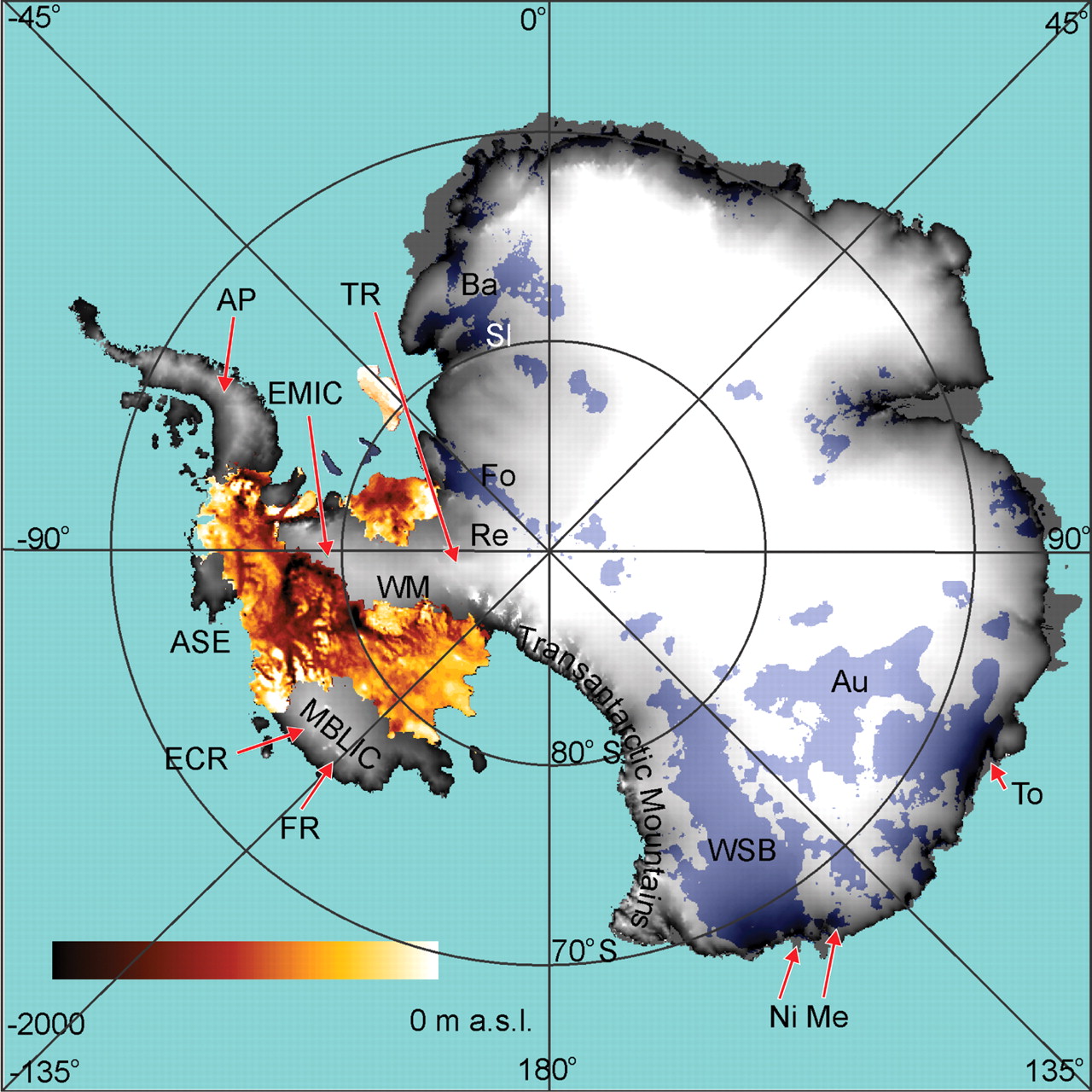
Fig. 1 Antarctic surface topography (gray shading) and bed topography (brown) defining the region of interest. For clarity, the ice shelves in West Antarctica are not shown. The brownish and yellow parts are the WAIS’ bed, and are all below sea level, and are why the WAIS will disintegrate.

Areas more than 200 meters BELOW SEA LEVEL in East Antarctica are indicated by blue shading. NOTICE THAT A LOT OF EAST ANTARCTICA, WHERE THE SUB SEA LEVEL BASINS ARE, HAVE THEIR MARGINS WELL NORTH OF 70 DEGREES (and actually just north of THE SOUTH POLAR CIRCLE).

AP, Antarctic Peninsula; EMIC, Ellsworth Mountain Ice Cap; ECR, Executive Committee Range; MBLIC, Marie Byrd Land Ice Cap; WM, Whitmoor Mountains; TR, Thiel Range; Ba, Bailey Glacier; SL, Slessor Ice Stream; Fo, Foundation Ice Stream; Re, Recovery Glacier; To, Totten Glacier; Au, AURORA BASIN; Me, Mertz Glacier; Ni, Ninnis Glacier; WSB, WILKES SUBGLACIAL BASIN; FR, Flood Range; a.s.l., above sea level.

(Illustrations from Bamber and al. Science May 15, 2009)

P/S 1: We are just coming out of a solar minimum so pronounced that cosmic rays, less deflected by the sun’s weakening magnetic field, have become a problem… Sunspots had nearly completely disappeared for the first half of 2009, before reappearing violently in July… There are mysterious strong correlations between sunspots and Earth’s temperature (mysterious, because, although very strong, they inverted in the 1970s;Vincent Courtillot, 2009).

P/S 2:  Thus, we have had a sort of solar winter in the last generation, and we seem to have reached its nadir right now, in the spring of 2009. (That would explain why the lowest icepack in the Arctic was in 2007, and the second lowest in 2008, with 2009 the third lowest ever recorded.)

Nothing says that the sun will not be even weaker in its next cycle. Maybe the greenhouse effect will save us!

Indeed… During the “Little Ice Age“, there was a considerable cooling, apparently originating from the sun’s reduced activity. After a slow start around 1300 CE which had, nevertheless, dramatic consequences in Europe (famines, and maybe a contribution to the massive war and plague that quickly followed; soon the Greenland Vikking colonies were decimated and had to be evacuated), the SOLAR cooling accelerated around 1600 CE. Galileo still saw some sun spots. But just a few. Soon they completely disappeared (the so called “Maunder minimum”). And they stayed disappeared for centuries. The glaciers in the Alps advanced dramatically, sometimes by several miles. In the late nineteenth century, sunspots reappeared, and the CO2 went up significantly, from industrialization (although warming itself extracts CO2 from sea and tundra). The result was an even faster retreat of the glaciers.

We cannot predict the sun (aside from its 11 year and 22 year, and an apparent 1,000 year cycles). We can only assume it will pick up, back up to what has been its normal activity over the last 5,000 years of civilized history. If it did, solar warming would combine with the greenhouse, and it is to be feared that the planet will switch SUDDENLY to the hot mode. It may be in a way even more violent than anything movies have imagined so far (because of the methane stores, and the dramatic changes their release would lead to: melting poles, CO2 bubbling out of the oceans). Good luck to us all…

Always two sides

I am indebted to my life-long friend, Dan Gomez, for this piece.

Background (Personal nostalgia warning!!!)

Dan and I go back too many years; I mean way too many!  He and I met in Spring 1979 when I was addressing a national conference of US Commodore PC dealers in Boston, USA.  I was there to promote a British Word Processing program called Wordcraft, written by Peter Dowson, that I had exclusive rights to.  I was also a Commodore PC dealer in Colchester, Essex, England; indeed I was the 8th dealer appointed in the UK.  The luck in finding Wordcraft is underlined by the fact that between 1970 and 1978 I was a salesman with IBM UK Office Products division and ended up as a word-processing specialist salesman for IBM.

Anyway, in my sales pitch to these US dealers, I used the word ‘fortnight’, a common term in England.  From somewhere out in the audience, this Californian voice shouted out, “Hey Handover, what’s a fortnight?”  Many readers will be aware that Americans don’t use that term.  That Californian voice was Dan!

From that cheeky start came a great relationship including Dan being my West Coast distributor for Wordcraft.  It was Dan’s sister, whom I have also known for countless years, who invited me to her Winter home in San Carlos, Mexico, to spend Christmas 2007 with her and her husband and which was the catalyst of me meeting Jean, who is now by most beautiful wife!

Dan, my Best Man, at the wedding of Jean and me, November 20th 2010

————————ooOOOoo————————

OK, to the theme of this article.

Shortly after the Newsweek ‘Weather Panic‘ article on the 10th, Dan sent me this email,

Paul – Saw your blog vis a vis Newsweek’s recent cover.

Don’t forget to publish the other side of this perennial story without all the sensationalism of selling newspapers and proselytizing to the unwashed masses or you could end up drinking your own cool-aid.  The science of weather cycles, sun activity, ocean currents, high-altitude jet streams, colliding warm/cool fronts have been at work long before any creature walked the earth, let alone man. The facts demonstrate this time and time again. Good science is skeptical science and needs to be viewed carefully by way of verifiable and constant testing of hypotheses.

The below article, although not at all sexy, has a different view, in general, as to the vagaries of weather extremes.  There are many like this and represent unbiased, and to some, unpopular scientific reasoning at work.

Just food for thought.

–DG

He then included this.

Recent Weather Extremes: Global Warming Fingerprint Not

by Chip Knappenberger
March 21, 2011

On occasion, I have the opportunity to assist Dr. Patrick J. Michaels (Senior Fellow in Environmental Studies at the Cato Institute) in reviewing the latest scientific research on climate change. When we happen upon findings in the peer-reviewed scientific literature that may not have received the media attention that they deserved, or have been misinterpreted in the popular press, Pat sometimes covers them over at the “Current Wisdom” section of the Cato@Liberty blog site.

His latest posting there highlights research findings that show that extreme weather events during last summer and the previous two winters can be fully explained by natural climate variability—and that “global warming” need not (and should not) be invoked.

This topic—whether or not weather extremes (or at least some portion of them) can be attributed to anthropogenic global warming (or, as Dr. Pielke Sr., prefers, anthropogenic climate change)—has been garnering a lot of attention as of late. It was a major reason for holding the House Subcommittee hearing last week, is a hot topic of discussion in the press, and is the subject of an in-progress major report from the Intergovernmental Panel on Climate Change (IPCC).

As such, I wanted to highlight some of the findings that Pat reported on. I encourage a visit to the full article “Overplaying the Human Contribution to Recent Weather Extremes” over at Cato@Liberty.

The Great Russian Heat Wave of 2010

A new paper by Randall Dole and colleagues from the Physical Sciences Division (PSD) of the Earth System Research Laboratory (ESRL) of the National Oceanic and Atmospheric Administration (NOAA) examined the events leading up to and causing the big heat wave in Russia last summer (which was also part of an atmospheric pattern that was connected to the floods in Pakistan). Here is what they found:

“Our analysis points to a primarily natural cause for the Russian heat wave. This event appears to be mainly due to internal atmospheric dynamical processes that produced and maintained an intense and long-lived blocking event. Results from prior studies suggest that it is likely that the intensity of the heat wave was further increased by regional land surface feedbacks. The absence of long-term trends in regional mean temperatures and variability together with the [climate] model results indicate that it is very unlikely that warming attributable to increasing greenhouse gas concentrations contributed substantially to the magnitude of this heat wave.”

As Pat commented, “Can’t be much clearer than that.”

Recent Winter Severity

From Pat’s article:

Another soon-to-be released paper to appear in Geophysical Research Lettersdescribes the results of using the seasonal weather prediction model from the European Center for Medium-Range Weather Forecasts (ECMWF) to help untangle the causes of the unusual atmospheric circulation patterns that gave rise to the harsh winter of 2009-2010 on both sides of the Atlantic. A team of ECMWF scientists led by Thomas Jung went back and did experiments changing initial conditions that were fed into the ECMWF model and then assessed how well the model simulated the known weather patterns of the winter of 2009-2010. The different set of initial conditions was selected so as to test all the pet theories behind the origins of the harsh winter. Jung et al. describe their investigations this way: “Here, the origin and predictability of the unusual winter of 2009/10 are explored through numerical experimentation with the ECMWF Monthly forecasting system. More specifically, the role of anomalies in sea surface temperature (SST) and sea ice, the tropical atmospheric circulation, the stratospheric polar vortex, solar insolation and near surface temperature (proxy for snow cover) are examined.”

In a nutshell, here is what Jung et al. found:

“The results of this study, therefore, increase the likelihood that both the development and persistence of negative NAO phase [an atmospheric circulation pattern that was largely behind the harsh winter conditions] resulted from internal atmospheric dynamical processes.”

Or, as Pat put it “Translation: Random variability.”

Pat also examined a third study by Roseanne D’Arrigo and colleagues who found an historical analog of the conditions responsible for the harsh winter of 2009-2010 way back in 1783-1784. The winter of 1783-1784 was a historically extreme one on both sides of the Atlantic and has long been associated with a large volcanic eruption that occurred in Iceland during the summer of 1783. Even Benjamin Franklin connected the winter conditions to the volcano. But D’Arrigo and colleagues now suggest a different mechanism. According to Pat:

But in their new study, Roseanne D’Arrigo and colleagues conclude that the harshness of that winter primarily was the result of anomalous atmospheric circulation patterns that closely resembled those observed during the winter of 2009-10, and that the previous summer’s volcanic eruption played a far less prominent role:

“Our results suggest that Franklin and others may have been mistaken in attributing winter conditions in 1783-4 mainly to Laki or another eruption, rather than unforced variability.

“Similarly, conditions during the 2009-10 winter likely resulted from natural [atmospheric] variability, not tied to greenhouse gas forcing… Evidence thus suggests that these winters were linked to the rare but natural occurrence of negative NAO and El Niño events.”

Bottom Line

The take home message of Pat’s post is worth repeating:

The point is that natural variability can and does produce extreme events on every time scale, from days (e.g., individual storms), weeks (e.g., the Russian heat wave), months (e.g., the winter of 2009-10), decades (e.g., the lack of global warming since 1998), centuries (e.g., the Little Ice Age), millennia (e.g., the cycle of major Ice Ages), and eons (e.g., snowball earth).

Folks would do well to keep this in mind next time global warming is being posited for the weather disaster du jour. Almost assuredly, it is all hype and little might.

Be sure to check out Pat’s full article which includes much more in depth coverage of these three soon-to-be-released scientific studies.

————————ooOOOoo————————

I need to mull over this when I am back home with more time.  In the meantime, comments from readers most welcomed.

Earth’s climate

Where’s it going?

Last Friday (10th) I wrote about a recent article that appeared in the Newsweek magazine of June 6th and mused about there seeming to be a growing awareness of the changing of the Planet Earth.

I just wanted to add a few other important elements (pardon the pun) of the current awareness.

First, at the time of writing this (June 2nd) the website that shows the monthly level of CO2 in the atmosphere was still showing the figure for April.  Here it is,

CO2 in the atmosphere

Go here and check out what it is for May 2011.  We all know that it won’t be below 393.18, which is already over 12% above the maximum safe level that scientists have determined.

UPDATE (June 7th): The figures for May are now on the website CO2 Now and they are 394.35 up, as predicted, from the figure of 393.18 for April, 2011.

Then go and watch this, from Bill McKibben,

Then go to the CO2 Now website and read, and ponder and think about what is becoming increasingly obvious to us all.

Finally, read a article that Bill McKibben has recently written that seems to have been widely published.  Here it is on the TomDispatch website.  It starts thus,

Three Strikes and You’re Hot
Time for Obama to Say No to the Fossil Fuel Wish List 

By Bill McKibben

In our globalized world, old-fashioned geography is not supposed to count for much: mountain ranges, deep-water ports, railroad grades — those seem so nineteenth century. The earth is flat, or so I remember somebody saying.

But those nostalgic for an earlier day, take heart. The Obama administration is making its biggest decisions yet on our energy future and those decisions are intimately tied to this continent’s geography. Remember those old maps from your high-school textbooks that showed each state and province’s prime economic activities? A sheaf of wheat for farm country? A little steel mill for manufacturing? These days in North America what you want to look for are the pickaxes that mean mining, and the derricks that stand for oil.

Yes, it all seems ‘doom and gloom’ around us at present but then consider that the only way we, as in mankind, can change to a truly sustainable relationship with this Planet is through better understanding and a global realisation that the time for change is now!  That is a very positive message!

“Weather panic” courtesy Newsweek

Is it me or does there seem to be a shift in overall awareness of our ‘new world’?

On the 30th May, I mentioned the concept of a new Anthropocene era for the second time, based on The Economist of the 28th May having it as a lead story.  (The first mention was on the 16th May.)

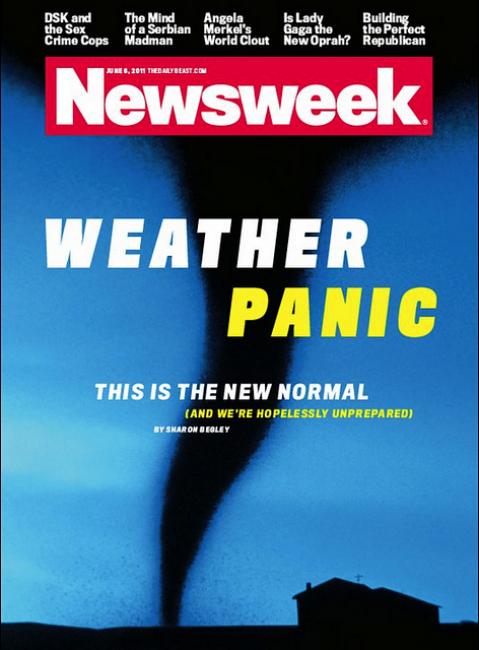
Then a couple of days later, friend John H. here in Payson, drops off his copy of Newsweek for June 6th.  Here’s the cover page.

Newsweek, June 6, 2011

This is how the article runs, written by Sharon Begley,

Are You Ready for More?

In a world of climate change, freak storms are the new normal. Why we’re unprepared for the harrowing future.

Joplin, Mo., was prepared. The tornado warning system gave residents 24 minutes’ notice that a twister was bearing down on them. Doctors and nurses at St. John’s Regional Medical Center, who had practiced tornado drills for years, moved fast, getting patients away from windows, closing blinds, and activating emergency generators. And yet more than 130 people died in Joplin, including four people at St. John’s, where the tornado sucked up the roof and left the building in ruins, like much of the shattered city.

Then just a couple of paragraphs later, this pretty blunt summary,

From these and other extreme-weather events, one lesson is sinking in with terrifying certainty. The stable climate of the last 12,000 years is gone. Which means you haven’t seen anything yet. And we are not prepared.

Just read that again very carefully, “The stable climate of the last 12,000 years is gone.”  Do take a few moments off and go here and read the full article.  The last paragraph of which reads,

So what lies behind America’s resistance to action? Economist Sachs points to the lobbying power of industries that resist acknowledgment of climate change’s impact. “The country is two decades behind in taking action because both parties are in thrall to Big Oil and Big Coal,” says Sachs. “The airwaves are filled with corporate-financed climate misinformation.” But the vanguard of action isn’t waiting any longer. This week, representatives from an estimated 100 cities are meeting in Bonn, Germany, for the 2nd World Congress on Cities and Adaptation to Climate Change. The theme is “Resilient Cities.” As Joplin, Mo., learned in the most tragic way possible, against some impacts of climate change, man’s puny efforts are futile. But time is getting short, and the stakes are high. Says Daniel Sarewitz, a professor of science and society at Arizona State University: “Not to adapt is to consign millions of people to death and disruption.”

It’s a powerful article that can be read in full on the Newsweek website.

So, perhaps one might say at last, the notion that mankind’s impact on the Planet is real and capable of affecting practically all of us living on this beautiful Planet is becoming a ‘mainstream’ accepted idea.

More musings about this next Tuesday, 14th.

More on Bill McKibben’s book, eaarth.

Some very telling points.

I first mentioned this book on the 13th May when I was about a third of the way in.  Because I thought there might be material useful to the course that has been running here in Payson, I did skip around the book looking for ‘attention-grabbing’ points.  It wasn’t difficult to find numerous extracts.

Try this on page 214 from the Chapter Afterword.

As it turns out, however, the BP spill was not the most dangerous thing that happened in the months after this book was first published.  In fact, in the spring and summer of 2101, the list of startling events in the natural world included:

  • Nineteen nations setting new all-time high temperature records, which in itself is a record.  Some of those records were for entire regions – [then some of the details]
  • Scientists reported that the earth had just come through the warmest six months, the warmest year, and the warmest decade for which we have records; it appears 2010 will be the warmest calendar year on record.
  • The most protracted and extreme heat wave in a thousand years of Russian history (it had never before topped 100 degrees in Moscow) led to a siege of peat fires that shrouded the capital in ghostly, deadly smoke.  [Then goes on to mention the effect of this heat on global grain prices.]
  • Since warm air holds more water vapour that cold air, scientists were not surprised to see steady increases in flooding.  Still, the spring and summer of 2010 were off the charts.  We saw “thousand-year storms” across the globe [goes into details]
  • Meanwhile, in the far north, the Petermann Glacier on Greenland calved an iceberg four times the size of Manhattan.
  • And the most ominous news of all might have come from the pages of the eminent scientific journal Nature, which published an enormous study of the productivity of the earth’s seas. [More details follow – not good news!]
That last point can be read in more detail from Nature‘s website.  It’s here.
The book closes thus (referring to how the BP oil spill was, ultimately, an accident),
But the greatest danger we face, climate change, is no accident.  It’s what happens when everything goes the way it’s supposed to go.  It’s not a function of bad technology, it’s a function of a bad business model: of the fact that Exxon Mobil and BP and Peabody Coal are allowed to use the atmosphere, free of charge, as an open sewer for the inevitable waste from their products.  They’ll fight to the end to defend that business model, for it produces greater profits that any industry has ever known.  We won’t match them dollar for dollar: To fight back, we need a different currency, our bodies and our spirit and our creativity.  That’s what a movement looks like; let’s hope we can rally one in time to make a difference.
Powerful stuff from a powerful book.
Fired up?  Then go and join:  350.org

A day off

Apologies to all but circumstances have conspired to steal any time today (Saturday) to put together a post for tomorrow (Sunday) or ‘today’ for you the reader, if you follow me!

But here’s a very interesting if scary website that I will return to in due course.

http://co2now.org/ which is introduced thus,

What the world needs to watch

Global warming is mainly the result of CO2 levels rising in the Earth’s atmosphere. Both atmospheric CO2 and climate change are accelerating. Climate scientists say we have years, not decades, to stabilize CO2 and other greenhouse gases. To help the world succeed, CO2Now.org makes it easy to see the most current CO2 level and what it means. So, use this site and keep an eye on CO2.  Invite others to do the same. Then we can do more to send CO2 in the right direction.

Once again that website is CO2Now. org.

eaarth, the book.

The latest edition of Bill McKibben’s book.

I’m about a third of the way through McKibben’s book eaarth.  To say that it is disturbing is an understatement.  I’ll tell you why.

eaarth

Most people when they think about it have, at the very least, feelings of guilt or denial in terms of what humans are doing to the planet’s environment that humans require for survival.  Many of us know in our hearts that it is probably not good news but maybe really thinking about it can be put off for a little longer!

It’s almost as though we know that those aches and pains are a sign of something potentially dangerous to our health but, hey ho, I’ll put off seeing the doctor for a little bit longer.

Then the day comes when one goes to the doctor and he confirms your worst fears; what you really knew deep in your heart.

Thus it is with the planet.  Most of us know that we have been treating the planet as an inexhaustible resource for the sole benefit of mankind and to hell with the future.  The you read a book such as eaarth from Bill McKibben and realise the extreme folly of denial, self-delusion, and the rest.  Here’s the preface of the book,

PREFACE

I’m writing these words on a gorgeous spring afternoon, perched on the bank of a brook high along the spine of the Green Mountains, a mile or so from my home in the Vermont mountain town of Ripton. The creek burbles along, the picture of a placid mountain stream, but a few feet away there’s a scene of real violence a deep gash through the woods where a flood last summer ripped away many cubic feet of tree and rock and soil and drove it downstream through the center of the village. Before the afternoon was out, the only paved road into town had been demolished by the rushing water, a string of bridges lay in ruins, and the governor was trying to reach the area by helicopter.

Twenty years ago, in 1989, I wrote the first book for a general audience about global warming, which in those days we called the “greenhouse effect.” That book, The End of Nature, was mainly a philosophical argument. It was too early to see the practical effects of climate change but not too early to feel them; in the most widely excerpted passage of the book, I described walking down a different river, near my then-home sixty miles away, in New York’s Adirondack Mountains. Merely knowing that we’d begun to alter the climate meant that the water fl owing in that creek had a different, lesser meaning. “Instead of a world where rain had an independent and mysterious existence, the rain had become a subset of human activity,” I wrote. “The rain bore a brand; it was a steer, not a deer.”

Now, that sadness has turned into a sharper-edged fear. Walking along this river today, you don’t need to imagine a damned thing the evidence of destruction is all too obvious. Much more quickly than we would have guessed in the late 1980s, global warming has dramatically altered, among many other things, hydrological cycles. One of the key facts of the twenty- first century turns out to be that warm air holds more water vapor than cold: in arid areas this means increased evaporation and hence drought. And once that water is in the atmosphere, it will come down, which in moist areas like Vermont means increased deluge and flood. Total rainfall across our continent is up 7 percent,1 and that huge change is accelerating. Worse, more and more of it comes in downpours.2 Not gentle rain but damaging gully washers: across the planet, flood damage is increasing by 5 percent a year.3 Data show dramatic increases 20 percent or more in the most extreme weather events across the eastern United States, the kind of storms that drop many inches of rain in a single day.4Vermont saw three flood emergencies in the 1960s, two in the 1970s, three in the 1980s and ten in the 1990s and ten so far in the first decade of the new century.

In our Vermont town, in the summer of 2008, we had what may have been the two largest rainstorms in our history about six weeks apart. The second and worse storm, on the morning of August 6, dropped at least six inches of rain in three hours up on the steep slopes of the mountains. Those forests are mostly intact, with only light logging to disturb them but that was far too much water for the woods to absorb. One of my neighbors, Amy Sheldon, is a river researcher, and she was walking through the mountains with me one recent day, imagining the floods on that August morning. “You would have seen streams changing violently like that,” she said, snapping her fingers. “A matter of minutes.” A year later the signs persisted: streambeds gouged down to bedrock, culverts obliterated, groves of trees laid to jackstraws.

Our town of barely more than five hundred people has been coping with the damage ever since. We passed a $400,000 bond to pay for our share of the damage to town roads and culverts. (The total cost was in the millions, most of it paid by the state and federal governments.) Now we’re paying more to line the creek with a seven-hundred-foot-long wall of huge boulders riprap, it’s called where it passes through the center of town, a scheme that may save a few houses for a few years, but which will speed up the water and cause even more erosion downstream. There’s a complicated equation for how wide a stream will be, given its grade and geology; Sheldon showed it to me as we reclined on rocks by the riverbank. It mathematically defines streams as we have known them, sets an upper limit to their size. You could use it to plan for the future, so you could know where to build and where to let well enough alone. But none of that planning works if it suddenly rains harder and faster than it has ever rained before, and that’s exactly what’s now happening. It’s raining harder and evaporating faster; seas are rising and ice is melting, melting far more quickly than we once expected. The first point of this book is simple: global warming is no longer a philosophical threat, no longer a future threat, no longer a threat at all. It’s our reality. We’ve changed the planet, changed it in large and fundamental ways. And these changes are far, far more evident in the toughest parts of the globe, where climate change is already wrecking thousands of lives daily. In July 2009, Oxfam released an epic report, “Suffering the Science,” which concluded that even if we now adapted “the smartest possible curbs” on carbon emissions, “the prospects are very bleak for hundreds of millions of people, most of them among the world’s poorest.”5

And so this book will be, by necessity, less philosophical than its predecessor. We need now to understand the world we’ve created, and consider urgently how to live in it. We can’t simply keep stacking boulders against the change that’s coming on every front; we’ll need to figure out what parts of our lives and our ideologies we must abandon so that we can protect the core of our societies and civilizations. There’s nothing airy or speculative about this conversation; it’s got to be uncomfortable, staccato, direct.

Which doesn’t mean that the change we must make or the world on the other side will be without its comforts or beauties. Reality always comes with beauty, sometimes more than fantasy, and the end of this book will suggest where those beauties lie. But hope has to be real. It can’t be a hope that the scientists will turn out to be wrong, or that President Barack Obama can somehow fix everything. Obama can help but precisely to the degree he’s willing to embrace reality, to understand that we live on the world we live on, not the one we might wish for. Maturity is not the opposite of hope; it’s what makes hope possible.

The need for that kind of maturity became painfully clear in the last days of 2009, as I was doing the final revisions for this book. Many people had invested great hope that the Copenhagen conference would mark a turning point in the climate change debate. If it did, it was a turning point for the worse, with the richest and most powerful countries making it abundantly clear that they weren’t going to take strong steps to address the crisis before us. They looked the poorest and most vulnerable nations straight in the eye, and then they looked away and concluded a face- saving accord with no targets or timetables. To see hope dashed is never pleasant. In the early morning hours after President Obama jetted back to Washington, a group of young protesters gathered at the metro station outside the conference hall in Copenhagen.It’s our future you decide, they chanted.

My only real fear is that the reality described in this book, and increasingly evident in the world around us, will be for some an excuse to give up. We need just the opposite increased engagement. Some of that engagement will be local: building the kind of communities and economies that can withstand what’s coming. And some of it must be global: we must step up the fight to keep climate change from getting even more powerfully out of control, and to try to protect those people most at risk, who are almost always those who have done the least to cause the problem. I’ve spent much of the last two de cades in that fight, most recently helping lead 350.org, a huge grassroots global effort to force dramatic action. It’s true that we’ve lost that fight, insofar as our goal was to preserve the world we were born into. That’s not the world we live on any longer, and there’s no use pretending otherwise.

But damage is always relative. So far we’ve increased global temperatures about a degree, and it’s caused the massive change chronicled in chapter 1. That’s not going to go away. But if we don’t stop pouring more carbon into the atmosphere, the temperature will simply keep rising, right past the point where any kind of adaptation will prove impossible. I have dedicated this book to my closest colleagues in this battle, my crew at 350.org, with the pledge that we’ll keep battling. We have no other choice.

Nature, big business and the future

Just maybe, economic activity and financial capital could align itself with the planetary demands!

A collection of items crossed my screen in the last few days that reinforced the interconnectedness of all life on Planet Earth.

First I saw an item on the BBC News website that demonstrated that climate change, global warming, or however one wants to describe man’s relationship with the planet, is not some crazy, fuzzy idea of a few liberal environmentalists.  This was a report of the significant drop in global wheat yields.

The report was entitled, Climate shifts ‘hit global wheat yields’ and was written by Mark Kinver, Science and environment reporter, BBC News.  Here’s a taste of what was written.

Shifts in the climate over the past three decades have been linked to a 5.5% decline in global wheat production, a study has suggested.

A team of US scientists assessed the impact of changes to rainfall and temperature on four major food crops: wheat, rice, corn and soybeans.

Climate trends in some countries were big enough to wipe out gains from other factors, such as technology, they said.

Professor David Lobell from Stanford University went on to say,

“In particular, you have to assume how non-linear the response will be and how different the crops of tomorrow will be from the crops of today,” he said.

He added that the study focused on historical data in order to strengthen confidence in the existing projections.

“I think it is very clear that climate is not the predominant driver of change over long periods of time in crop production.

“Across the board, you see crop yields going up over the past 30 years, but the question is how much is climate modified (and) what would have happened if the climate was not changing.

“In some countries, we see that climate has only affected things by a few percent. In other countries, we see that yields would have been rising twice as fast.

“On a global average, we see that wheat production would be about 5% higher if we had not seen the warming since 1980. We see about the same for maize or corn.

“Yet for rice and soybean, we actually find that production is about the same as if climate had not been trending.”

The report may be accessed here.

Sort of moving on, most people, when they stop and think about it, must realise that 6.9 billion people living (i.e. depending) on Planet Earth have to be causing changes.  The Inside Science News Service published a reminder from last December of a calculation that,

By Mary Caperton Morton, ISNS Contributor
Inside Science News Service

STRASBURG, Pa. — Next month, representatives from more than 190 nations will gather in Japan at the Nagoya Biodiversity Summit to develop a global strategy for staunching habitat and biodiversity loss around the world.

The statistics are sobering: Every 20 minutes a species goes extinct. At that rate — estimated to be a thousand times faster than pre-human impact background levels – in 300 years, half of all living species of mammals, birds, fish, reptiles and plants will be gone. [My italics]

This alarming decline has not gone unnoticed. In 1992, the United Nations Convention on Biological Diversity — or CBD — one of the most widely ratified treaties in the world, established lofty conservation goals to be met by 2010. But since then the decline in biodiversity has not slowed. Nearly 16,000 species are still listed as threatened, with more than 200 of them described as “possibly extinct.”

What we need, some might ask, is for big business to get behind and push!  Perhaps not so far fetched.

Last October, the British Guardian newspaper, published a very telling reminder that nothing ever in life stays the same.

The article was presented thus,

Biodiversity loss seen as greater financial risk than terrorism, says UN

Loss of ecosystems perceived by banks and insurance companies to be a greater economic risk than terrorism, finds UN report.

Written by Jonathan Watts in Nagoya.

A controlled burn of oil from the Deepwater Horizon well in the Gulf of Mexico. The report cites the Gulf of Mexico oil spill as an extreme example of the potential impact of inadequate environmental controls. Photograph: Ann Heisenfelt/EPA

The financial risks posed by the loss of species and ecosystems have risen sharply and are becoming a greater concern for businesses than international terrorism, according to a United Nations report released today.

From over-depletion of fish stocks and soil degradation caused by agricultural chemicals to water shortages and mining pollution, the paper – commissioned by the UN Environment Programme and partners – said the likelihood has climbed sharply that declines in biodiversity would have a “severe” $10bn (£6bn) to $50bn impact on business.

With the European Union and other regions increasingly holding companies liable for impacts on ecosystem services, it suggests banks, investors and insurance companies are starting to calculate the losses that could arise from diminishing supplies, tightened conservationcontrols and the reputational damage caused by involvement in an unsound project.

Achim Steiner, UN under-secretary general and Unep executive director, said: “The kinds of emerging concerns and rising perception of risks underlines a fundamental sea change in the way some financial institutions, alongside natural resource-dependent companies, are now starting to glimpse and to factor in the economic importance of biodiversity and ecosystems”.

The briefing paper cites the 55% crash of BP’s share price and the decline of its credit rating in the wake of the Gulf of Mexico oil spill as an extreme example of the potential impact of inadequate environmental controls.

Read the full article in the Guardian here.

The United Nations Environment Programme report may be found here.  The cover page says this,

“ As the global financial sector recovers and moves into the post financial crisis era,
there is one notion that crystallises before our eyes more acutely than ever: we need
to understand systemic risk in a much more holistic way. This CEO Briefing underscores
the critical natural capital that underpins our economic activity and financial capital.”
Richard Burrett, Partner in Earth Capital Partners
Co-Chair, UNEP Finance Initiative

Well put!

As I wrote at the very start, just maybe, economic activity and financial capital could align itself with the planetary demands!

Gondolas for New York?

Can we really make sense of the science of climate change?

Those that come to this Blog on a regular basis, and many thanks to you, by the way, will know that, overall, I take the stance that climate change, global warming, etc., etc. is real.  At the very least to me it is reasonably described by the saying that most pilots are familiar with, “If there’s any doubt, there’s no doubt.”  In other words, if something is worrying you don’t hesitate to get your ‘arse’ on the ground.

The planet’s climate systems are incredibly complex and like processes and systems much less complex than the earth’s atmosphere getting to real hard evidence is challenging.  Please accept that my personal position is unchanged; for me there are sufficient signs to suggest that climatic changes may be more likely, than less likely, to substantially harm humankind’s existence on Planet Earth within the next generation.

However, Dan Gomez, my very good Californian friend of 40-plus years, is much more sceptical.  I respect his intellect greatly and, therefore, respect his opinions.  Dan recently sent me a number of documents that raise valid questions.  Over time I want to share these with you and invite anyone who wishes to comment on Learning for Dogs to do so, or even better submit a guest post.

But before going to the first of Dan’s documents, let me share something that was reported by BBC News recently.  It’s this.

New York is a major loser and Reykjavik a winner from new forecasts of sea level rise in different regions.

The Intergovernmental Panel on Climate Change (IPCC) said in 2007 that sea levels would rise at least 28cm (1ft) by the year 2100.

But this is a global average; and now a Dutch team has made what appears to be the first attempt to model all the factors leading to regional variations.

Other researchers say the IPCC’s figure is likely to be a huge under-estimate.

Whatever the global figure turns out to be, there will be regional differences.

That IPCC report may be accessed here and the main website of the IPCC is here.  But even the BBC’s report shows that scientists are still learning more, as time goes on.

Ocean currents and differences in the temperature and salinity of seawater are among the factors that mean sea level currently varies by up a metre across the oceans – this does not include short-term changes due to tides or winds.

So if currents change with global warming, which is expected – and if regions such as the Arctic Ocean become less saline as ice sheets discharge their contents into the sea – the regional patterns of peaks and troughs will also change.

“Everybody will still have the impact, and in many places they will get the average rise,” said Roderik van der Wal from the University of Utrecht, one of the team presenting their regional projections at the European Geosciences Union (EGU) meeting in Vienna.

“But places like New York are going to have a larger contribution than the average – 20% more in this case – and Reykjavik will be better off.”

The news item also contains some fascinating evidence of the influence of gravity from the mass of the polar ice caps.  Read the full article here.

Gondola's for hire in a few year's time?

Now on to one of Dan’s documents.  It is from the website detailing the history of plant fossils of West Virginia.  The document refers to the climate of the carboniferous period.  Here’s how it starts.

West Virginia today is mostly an erosional plateau carved up into steep ridges and narrow valleys, but 300 million years ago, during the Carboniferous Period, it was part of a vast equatorial coastal swamp extending many hundreds of miles and barely rising above sea level. This steamy, tropical quagmire served as the nursery for Earth’s first primitive forests, comprised of giant lycopods, ferns, and seed ferns.

North America was located along Earth’s equator then, courtesy of the forces of continental drift. The hot and humid climate of the Middle Carboniferous Period was accompanied by an explosion of terrestrial plant life. However by the Late Carboniferous Period Earth’s climate had become increasingly cooler and drier. By the beginning of the Permian Period average global temperatures declined by about 10° C.

Interestingly, the last half of the Carboniferous Period witnessed periods of significant ice cap formation over polar landmasses– particularly in the southern hemisphere. Alternating cool and warm periods during the ensuing Carboniferous Ice Age coincided with cycles of glacier expansion and retreat. Coastlines fluctuated, caused by a combination of both local basin subsidence and worldwide sea level changes. In West Virginia a complex system of meandering river deltas supported vast coal swamps that left repeating stratigraphic levels of peat bogs that later became coal, separated by layers of fluvial rocks like sandstone and shale when the deltas were building, and marine rocks like black shales and limestones when rising seas drowned coastlands. Accumulations of several thousand feet of these sediments over millions of years caused heat and pressure which transformed the soft sediments into rock and the peat layers into the 100 or so coal seams which today comprise the Great Bituminous Coalfields of the Eastern U.S. and Western Europe.

One needs to read the full article to properly understand this period of history of the planet.  But it includes revealing diagrams like this one.

Global Temperature and Atmospheric CO2 over Geologic Time

Here’s how it concludes.

What will our climate be like in the future? That is the question scientists are asking and seeking answers to currently. The causes of “global warming” and climate change are today being popularly described in terms of human activities. However, climate change is something that happens constantly on its own. If humans are in fact altering Earth’s climate with our cars, electrical powerplants, and factories these changes must be larger than the natural climate variability in order to be measurable. So far the signal of a discernible human contribution to global climate change has not emerged from this natural variability or background noise.

Understanding Earth’s geologic and climate past is important for understanding why our present Earth is the way it is, and what Earth may look like in the future. The geologic information locked up in the rocks and coal seams of the Carboniferous Period are like a history book waiting to be opened. What we know so far, is merely an introduction. It falls on the next generation of geologists, climatologists, biologists, and curious others to continue the exploration and discovery of Earth’s dynamic history– a fascinating and surprising tale, written in stone.


Truth fears no questions.  ~Unknown

Head scratching stuff!

“All truths are easy to understand once they are discovered; the point is to discover them.”

Galileo

Thus said Galileo Galilei.

Why do I start this Post in this fashion?

Simple! Discovering the truth is always the challenge.

But before I go any further, I want to say thanks to my son who drew my attention to the video that is linked to in the next paragraph.  (As a professional pilot he clearly takes a more than casual interest in the weather).

Here’s a link to that video by Joe Bastadi about the big changes to the planet’s weather.  The video is summarised thus, “Temperature is a measure of kinetic energy, and the dirty little secret of the whole AGW debate is that total kinteic energy of the Earth over the longer term is not changing, but is cyclical.

Joe is a professionally trained forecaster (Penn State University) but also a controversial figure.  He is a member of the AccuWeather team.

Anyway, do watch that video – the link is here.  Bottom line is that global weather patterns and longer-term trends are hugely driven by the earth’s natural rhythms and the influence of mankind is minimal in comparison.

Please click the video link above because that is much more current than an earlier interview of Joe Bastardi on YouTube that follows.

OK?

Now go here – ClimateProgress.org.  It’s an important long article that concludes thus:

CONCLUSION:  Unrestricted emissions of greenhouse gases threaten multiple catastrophes, any one of which justifies action.  Together, they represent the gravest threat to humanity imaginable.  The fact that the overwhelming majority of the mainstream media ignored the overwhelming majority of these studies and devoted a large fraction of its climate ‘ink’ in the last 12 months to what was essentially a non-story is arguably the single greatest failing of the science media this year.

So, if you are like me and so many others in wanting to understand the truth about our planet’s climatic future – this Post is going to disappoint you!