Staying with the theme of rejuvenating our relationship with the natural world.
A recent post from TomDispatch republished in this place once again with the generous permission of Tom Engelhardt. It follows on so sweetly to yesterday’s post Returning to Nature.
oooOOOooo
Rewilding the West
Here’s a nifty trick that’s been on my mind lately. In case you hadn’t noticed, the weather news this season has been pretty grim. Tornados so large and destructive that they would have given Dorothy pause, 500-year European floods, massive rainstorms rolling across the land, record heat in California and Alaska, late snowfalls that boggle the imagination, wildfires that dwarf past ones in the American West. I could go on, but why bother since anyone who has been watching primetime TV news can’t but notice that staggering weather has been the lead or second story much of the time all spring and into the summer.
You’re probably wondering right now: But what’s the trick? I’m surprised you haven’t noticed yourself. All of this weather has a new, made-for-TV label. It’s now regularly called “extreme weather” or “severe weather.” And that’s anything but inaccurate. The weather has been both “severe” and “extreme” this spring. The trick is that, as a label, “extreme weather” has managed (with rare exceptions) to obviate the need even to mention that any of this could have the slightest thing to do with climate change, with our overheating, over-greenhouse-gassed planet. Think of it as a fabulous form of recognition and denial wrapped in the same package.
The TV news gets all the benefits of night-after-night, eyeball-gluing drama in which the weather goes nuts, houses are destroyed, and people weep (or are stoic) about ruined lives. It gets to bring in the tornado watchers and the weather people in their raincoats and waders. (Have you noticed that the TV news can’t report a flood without putting some reporter with a mic knee-deep in water?) It gets to focus nightly on those daunting weather maps with their blazing red danger zones, and offer warnings about what potential disaster tomorrow might have to offer, all the while remaining in official, blissful denial about what’s happening on this planet of ours. Somehow, it has managed to incorporate the possible effects of climate change into the nightly news as a major story, while excluding just about all serious discussion of it. Tell me that isn’t a doubly nifty trick!
Of course, if there’s nothing but “extreme weather” happening and that weather has no extreme context, no extreme meaning, then none of us have to worry our little heads about what’s to be done. Those trying to remedy the degradation of conditions on this planet can also be ignored, which is why we couldn’t be more pleased that TomDispatch regular Chip Ward introduces us to such a person today. Tom
Trek West for the Big Picture
Saving the Land One Footfall at a Time
By Chip WardMy home sits at the gateway to a national park in Utah, a source of envy among tourists who gather along Capitol Reef’s “scenic drive.” But after 40 years of living in one desert or another, I know firsthand that America’s iconic desert landscapes, places like Monument Valley and Arches National Park, are the exceptions, not the rule. The rule is that we dig up, dump on, dam, bomb, drill, over-graze, and otherwise abuse our deserts, most of them public lands owned by you, the taxpaying citizen. Generally, our management of the nation’s public lands is a disgrace and deserts are exhibit A.
But let’s skip the grim survey of how humans are overloading the carrying capacity of our original earthly Eden that usually opens a report like this. The intent of such a recitation of folly is to compel the reader’s attention by underlining the dire importance of the topic at hand. But I assume you understand by now that you woke up this morning on an overheated planet of slums threatened by ecological collapse.
So instead, let’s get right to the point: what do we do about it? How do we begin to heal the wounds?
The crises we face and that our children and grandchildren will endure long after we leave them invite a visionary response. On the other hand, the world is already awash in well-intentioned tinkerers. Yet dysfunction and destruction still reign. Maybe it’s time to leap to a new paradigm.
Enter John Davis and Trek West. At this very moment, Davis is walking, biking, paddling, and horseback riding 6,000 miles through a chain of mountain ranges that stretches like a spine across North America from the Sierra Madres of Mexico through the Rockies of the American West up into Canada. He started this winter in the Sonoran desert we share with our southern neighbor and has been heading northward for months. He will cross many of our most treasured national parks like Yellowstone and Grand Canyon, the ones that tourists love, but his trek is no sightseeing adventure.
Davis and his Trek West partners along the route are advocating for what they call “landscape connectivity” on a continental scale. Two years ago, Davis trekked from Key West to Quebec, 8,000 human-powered miles. Same theme: conserve and connect.
A Conservation Revolution
Gone are the days when conservation was all about bullets, hooks, and cameras. Fishermen and hunters are still an important constituency in the conservation community, but birdwatchers now outnumber them. Ecological criteria increasingly frame any debate about how to heal degraded habitat. What the nineteenth century naturalist and Sierra Club founder John Muir knew intuitively — that everything in the universe is “hitched to everything else” — has been confirmed beyond doubt by hard science.
Davis is one of the founders of a new school of thought called conservation biology. Its proponents argue that it is not faintly enough to preserve scenic rock and ice parks and isolated islands of wildlife. Wild creatures need room to roam so they can find the necessary water, food, and mates. In the long run, many of America’s wild creatures from salamanders to bears will survive only in Disney movies if we box out genetic diversity, block migration routes, destroy nesting grounds, and save only carefully preserved, isolated populations of a species. Connectivity is the keel of an emerging conservation ethic for helping to heal this country.
John Davis envisions an unbroken chain of wild lands spanning North America from Mexico to Canada. When completed, a necklace of “core” areas, including national parks, wildlife reserves, and protected wilderness areas will be linked together and buffered by national forests and private lands. Creatures now boxed into wild islands surrounded by a sea of development will have room to roam.
A connected landscape will be more resilient as climate change puts further stress on creatures and their habitats. Already species from birds to mammals are responding to warming temperatures by moving northward if they can, or to higher ground if they can’t migrate horizontally. The famed scientist and conservationist E.O. Wilson called the project to link together America’s wild lands the most important conservation initiative in the world today.
After trekking through the habitat of the last remaining jaguars on the continent, Davis ran into the new wall designed to keep illegal Mexican migrants out of the United States. It is, he pointed out, a far more effective barrier against wildlife migration than the human version of the same and so is lobotomizing the border ecosystem we share with Mexico. As for Davis, he easily climbed it in less than five minutes and was on his way.
Backpacks Meet Cowboy Hats
Although pushing 50, Davis has the trim, muscular build of a professional athlete — and he’ll need every toned muscle he has to complete his quest. The day before I met him in Escalante, Utah, he had been surprised by a lingering bout of spring weather and found himself pushing his bike through 10 miles of deep snow on top of Utah’s Aquarius Plateau. The next week, he planned to paddle through Desolation Canyon, one of the most spectacular river passages on the planet. But when I encountered him, he was taking a break and making a pitch for connectivity before a gathering of federal land managers, concerned local citizens, and ranchers who share the watershed of the Escalante River.
The Escalante River Watershed Partnership (ERWP) is the unwieldy name for a grassroots coalition whose aim is to restore the river’s degraded ecosystem. The rugged network of high desert canyons that drain into the remote Escalante River have been eroding for years thanks to overgrazing by cattle. They are also choked with tamarisk and Russian olive trees.
Tamarisks are an invasive species that suck up precious ground water, while filling in springs and seeps that are the only water sources for many bird and animal species. The tall, feathery plumes of the tamarisk have taken over hundreds of miles of riverbank in the West. “Tammies” also salt the surrounding soil when they shed their leaves, killing native plants that might otherwise compete. A beetle was imported from Eurasia to eat the tammies and was unbelievably successful. As a result, those thick hedges that still block riverbanks are now dead-dry and ready to ignite. If not cut back, they will burn or regrow. Russian olive trees also crowd stream banks and add needle-like thorns to the unpleasant mix.
The diverse stakeholders in the Escalante River Watershed Partnership may not share John Davis’s grand vision of an ecologically whole and “rewilded” continent, but they are intent on sewing together and rewilding their pieces of the torn fabric of American life. As any effective organizer knows, you start where there is common ground — or where there are common weeds.
Ranchers, rangers, biologists, hikers, and back-country guides are in many ways competing constituencies, but it turns out they all share the goal of clearing riparian (wet) canyons of those suffocating tammies. The scientists survey the ground and identify targets. Grants are written to bring in volunteers to do the fieldwork. Last week, a dozen Great Old Broads for Wilderness, mostly outspoken middle-aged women, spent a week clearing unwanted brush as a service project.
As biologists monitor progress and the group discusses issues that arise, inevitably the damage done by grazing cows comes up. It couldn’t be a more awkward topic. After all, ranchers are in the room. Cattle ranching in these desert landscapes is a marginal activity. Those ranchers depend on federal grants, tax breaks, and access to public land to make it work. But cows erode stream banks and silt the water, short-circuit forest succession by eating seedlings, and contaminate fresh water with their voluminous poop that also spreads cheatgrass and weeds.
The hope is that eventually the EWRP will become a platform for a public airing of difficult issues like where cattle should be allowed to graze on public land and how many and when.
A Roadkill Extravaganza
Those awaiting Davis’s Trek West presentation this particular day in this particular corner of Utah have already found a scale that seems to fit the desperate needs of our landscape, state, country, and planet. Most of us who believe in change are caught between the seeming futility of small-scale actions — like recycling our trash or using more energy-efficient light bulbs — and the impotence we experience when we push for large-scale change like climate legislation in Congress or international treaties to limit atmospheric greenhouse gases.
On the one hand, too little; on the other, too late. There does, however, turn out to be a middle scale between individual action and national or global campaigns that works well and makes sense: the community. That’s the place where people can best embrace their roles as citizens, face off, share, contend, cooperate, create, learn from, and empower one another.
Watershed partnerships harken back to an old ideal. John Wesley Powell, the one-armed general and Civil War hero who later explored the Colorado River and its tributaries, was the first person to grasp and publicize the aridity rather than fecundity of significant parts of the American West. He argued that practices and policies developed for wet Eastern lands were inappropriate for the drier West. He advocated for governance around watersheds where local stakeholders committed to living within the limits they knew firsthand could come together and plan. That’s what I’m observing this morning in Utah. In twenty-first-century terms, think of it as ecological citizenship.
Davis claims he is shy and a poor presenter, but it turns out that he is quietly charismatic. The case he makes for corridors is practical. His listeners know that he is trekking across a landscape that is not your grandfather’s Wild West. The wide-open spaces where the antelope once roamed are now fragmented by a zillion roads featuring SUVs with flattened animals on their bumpers. Davis says that, on his most recent journey, he’s already seen at least 1,000 crushed, dead creatures. It’s been a roadkill extravaganza.
So, what to do? He shows pictures of a landscaped underpass in nearby Kanab, Utah, constructed at a deer crossing where at least 100 deer a year were being hit by cars. Every year about 10% of the local herd was becoming roadkill along with foxes, turkeys, and the occasional bobcat. The underpass cost $2.6 million, which is hardly chump change in this neck of the woods, but each deer-car collision costs, on average, $6,600. Do the math, he tells them. Making the landscape permeable for animals seeking food, mates, and water keeps them healthy and pays for itself soon enough.
The Wolf at the Door
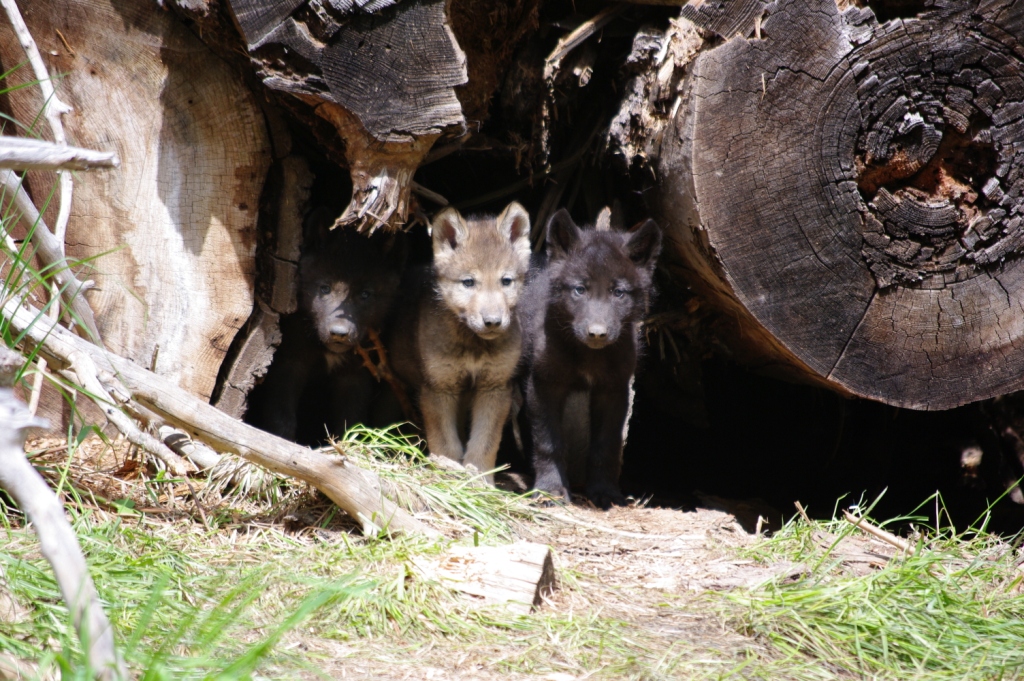
Ranchers and the Bureau of Land Management (BLM) rangers who serve them view John Davis skeptically. For one thing, he’s been frank about the need to reintroduce wolves across Western ecosystems, given the “keystone” role they play in shaping a healthy landscape. In case you’re not a Westerner, you should know that the subject of wolf reintroduction is a political third rail in much of our region. It’s an idea that would stun and appall our grandfathers, who killed wolves on their lands to leave more deer and elk for hunters and make meadows safe for cattle.
Ecologically, the reintroduction of wolves to Yellowstone National Park has been an unqualified success. Since wolves were returned to that landscape, elk are no longer bunching up and munching down in stream-fed valleys until they are silted, eroded, and devoid of other wildlife. The wolves thin the elk herds and move them, which, in turn, allows willows, aspens, beavers, birds, and a more biodiverse landscape to thrive. Their success in Yellowstone has confirmed the insights of conservation biologists, giving them credibility and authority. Cowboys fear that, having pushed aside elk, conservationists will go after their cows next.
Meanwhile, back at the ranch, elk hunters, cowboys, gun-nuts, and tea-hadi politicians have worked themselves into an anti-wolf frenzy. Western state legislators have introduced several bills designed to limit and control wolves even if they haven’t seen one in their area for 100 years. They want to trade the wolves’ endangered status under the law for licenses to hunt them. A few days after Davis met the watershed group, the Obama administration caved in to this eco-political hysteria and agreed to remove endangered species protections from wolves. This backlash against reintroduction has been painful for advocates like Davis.
A Greater Canyonlands National Monument Moment?
The decision to lift wolf protection is consistent with the Obama administration’s disappointing record on Western environmental issues. Nevertheless, conservation advocacy groups like the Southern Utah Wilderness Alliance and the Sierra Club are urging the president to take a cue from Bill Clinton’s example. Back in 1996, he created the Grand Staircase Escalante National Monument under the Antiquities Act that allows presidents to set aside natural and archaeological treasures. Now, the conservation groups want Obama to do something similar on an even grander scale and create a “Greater Canyonlands National Monument” from some of the healthiest wild lands in southern Utah.
A few days later, Davis addressed the need for such a monument at a forum in Moab, Utah. Our state has about nine million acres of quality wilderness land ready to be designated and protected as such. That’s a lot of core area for John Davis’s conservation vision, a lot of possibility for connectivity. But the public debate about wilderness designation has been stalemated for decades. Utah Republicans in particular resist more steps to formally protect wilderness areas even though the public overwhelmingly supports it.
They are wedded to traditional mining and grazing interests and like to portray themselves as victims of a bullying federal government that wants to jam national monuments and formally designated wilderness areas down their throats. But Clinton’s creation of the new monument has proven a boon for Escalante’s economy. In the 12 years since it came into being, the populations of surrounding Kane and Garfield counties have grown by 8%. Jobs rose in those years by 38% and per capita income by 30%. Adjoining counties whose economies are oriented towards gas and oil lagged far behind.
President Obama’s appointment of Sally Jewel, former CEO of REI, a chain of outdoor gear and clothing stores, may signal a shift away from ranching and mining as the dominant voices on the Western political stage. Jewel understands firsthand that recreation and tourism have become powerful economic engines here.
A presidential initiative alone will hardly begin to settle all the questions we face about how to make peace with the land that holds us in its embrace. But designating another monument here could be a catalyst for an ever-expanding idea of grassroots stewardship of America’s wild lands.
The Escalante watershed partnership was formed in the wake of Clinton’s catalytic act. At that time, the Clinton administration took another experimental step. It gave stewardship of Grand Staircase Escalante to the controversial Bureau of Land Management instead of the National Park Service. That was a first and undoubtedly a concession to Utah’s politicians who would rather deal with the traditionally compliant, pro-mining, pro-grazing BLM than the stricter National Park Service. Clinton gambled that the move might instill a missing environmental ethic in that bureau.
The results on that are not yet in, but there is no question about one thing: Clinton’s creation has been a catalyst for grassroots political activity. When monument status was a done deal, the river’s stakeholders decided the time had finally come to practice that awkward dance of mutuality among conservationists who want to save the land, ranchers who want to use it, and federal land managers charged with sorting out what exactly to do. John Davis is clearly on the side of conservation.
Making the Imaginary Real
The Trek West sponsors recognize that there may never be some grand national initiative to accomplish their vision, nothing like the Wilderness Act, the Clean Air Act, or the other signature environmental legislation of the 1960s and 1970s. If our troubled public lands are rescued, it’s likely to happen in a piecemeal fashion, as local and regional groups work to improve their own backyards. The folks who gather in Escalante don’t claim to have all the answers. They are not here to spread the truth and save the world. They belong to no ideology or movement. They’re just working on their piece of the puzzle, experimenting and learning as they go. Rivers being the arteries of the land, it makes sense to start there.
An existing constituency almost always trumps an imaginary one. You can make a case, for example, that a change in land use practices and policies would benefit more people, boost the local economy, and be healthier for wildlife, too, but those imaginary winners can’t compete with cattlemen who are real, well organized, and have been active in the political arena for many years. They have established close relationships with local politicians who depend on their support. Because they were there first, they wrote most of the rules and those favor their uses of public land.
The trick for conservationists who want change is to make that imaginary constituency real, to bring a new set of stakeholders together and find ways to empower them. That may not be the intention of those who gathered in Escalante for the watershed partnership, but it’s what is happening nonetheless — and John Davis is a catalyst.
According to the prevailing belief, growth should always be the bottom line. Trek West expresses an alternate vision that aims instead to translate ecological principles and criteria into actual designs on the ground. That’s not simply a matter of making better maps. Those of us who live within the iconic Western landscapes so treasured by all Americans understand that maps, charts, and spreadsheets do not adequately measure or describe this inspiring and awesome place where we live.
We experience the land sensually. Perhaps that is the ultimate message John Davis is delivering as he treks across the continent’s wild spine. He is making sense of the land one footfall at a time, listening to it, watching it, and feeling it as he goes. So, reconnect landscapes, yes, but also connect head and heart.
Davis’s quest is heroic, but his testimony is simple: when we learn from the land we lean towards wholeness.
Chip Ward, a former librarian and grassroots organizer, is the author of Canaries on the Rim and Hope’s Horizon as well as a TomDispatch regular. He wrote this essay while living between a mountain on fire and a desert that is blowing away.
Follow TomDispatch on Twitter and join us on Facebook or Tumblr. Check out the newest Dispatch book, Nick Turse’s The Changing Face of Empire: Special Ops, Drones, Proxy Fighters, Secret Bases, and Cyberwarfare.
Copyright 2013 Chip Ward
oooOOOooo
Simply going to finish off today’s post with the two pictures included recently in, I cry for the wolves.
oooo

 Learning from Dogs