Tag: Business

Feeling safe!

Safe, as in psychologically as well as physically, has its rewards.

Jon 05'
Jon Lavin

I had a very interesting session recently. I did some coaching work with a client company who managed a small team. The day was split into two – the morning with the client and the afternoon with the whole team.

What struck me about the day was the power of good leadership and the importance of leaders who are aware of how they come across and are capable of forming a relationship with their teams.

My client was struggling with her team because she was unaware how she was communicating, not only with her team but with other people in the organisation.

Unfortunately, becoming aware of how we are in a relationship with others brings us face to face with ourselves and requires a willingness to accept ourselves, warts and all, before trying to change anything.

After we all had lunch together and broke the ice a bit we focused on what was working (not what was not working), what was missing, what inspired and what was possible. By examining these areas and so creating a safe environment, everybody was able to reveal more of themselves and what they needed to have a satisfactory, safe working relationship with each other.

By Jon Lavin

Ticker Guy

Karl Denninger is a hero!

Karl Denninger - Mr Market Ticker

Several times a week, I drop into Karl Denninger’s blog The Market Ticker.  While frequently the articles are too technical for me, it’s still, nonetheless, possible to get the drift of Karl’s messages.

As his overall theme is strongly coincident with my own views on my pension investments, and which have served me proud over the last 10 years, especially the last 2 years, it’s natural that I like what Karl does.

But the point of this Post is to underline just how much time and effort Karl puts in to his work, all of which is free to the world at the click of a mouse.

Are there others who devote equal amounts of time to their Blogs and websites?  Yes, many!  And many of them are also heroes (and heroines!)

Of course, I have no doubt that The Market Ticker is part of Karl’s business strategy but, again, he could choose other ways to make his income without sharing, for free, so many valuable ideas.

Here are a couple of examples to underline my deep respect for this man. (Taken from Market Ticker on the 13th May.)

Read more of this Post

Is “IT” “in denial”?

Change: the only thing that’s constant!

Whither IT?

Wow, the big picture of the IT world seems to be crumbling with increasing rapidity! Many people are at risk of getting hurt if they continue to hold traditional attitudes.

The post “Why the New Normal Could Kill IT” captures it well.  Here’s how that article starts:

Plenty of seismic shifts have rocked and reshaped IT in the past. Some big rumblings’ epicenters had origins in an unstoppable technology shift; other fissures had nothing to do with PCs and servers. Consider the recent shocks: the Internet revolution and dotcom bust; Y2K and 9/11; the consumerization of IT; and the unstoppable broadband and mobile explosion.

However, the latest shock–the global financial meltdown–is like the recent 8.8 earthquake that shook Chile and knocked the earth off its axis. And for IT leaders today, it’s important to realize that the aftershocks are still coming.

Thomas Wailgum provides an insightful description of the challenges facing the important operational aspects of IT in many organizations. Many of the symptoms and some of the causes that he describes are undoubtedly true and have been adversely affecting the performance of many people for a long time!

But, who really cares?

I suggest that the people who really care are the people who are trying to serve the customers of the business. Consequently they will decide what they do and how they do it, including what services and products they use, including those that involve IT (almost all of them these days).

It seems to me interesting to describe this, as he has done, from the perspective of IT and IT people (of whom I am also, broadly, one!) .. but it is only interesting to IT people.

The people who require services are getting them from wherever they can and wherever they like and will continue, increasingly, to do so.

Many of the points that he makes are valid and accurate, including his list of  “recent shocks”. Two of those struck me as particularly poignant and relevant.

One is “the unstoppable broadband and mobile explosion”, which seems to be a strange way to describe it. My reading of this is that IT people would like to “stop” it; but why? The availability of communication services with increasing bandwidth and location-independence is enabling greater sharing of information and understanding; many people, especially those in the “third world”, are benefitting enormously from this. I hope that I have understood his meaning incorrectly because, surely, the task of people who understand IT is to help others to take full advantage of the opportunities, not to try to stop them!

The other is “the consumerization of IT”, which is one way of looking at it but, again, seems to carry a subtextual bias. I detect a sense that this is seen to be the use, in business applications, of lower quality facilities intended for individuals who do not know the implications. There is some truth in this, but this has been a trend for decades and, so far, the roof has not fallen in! I suggest that this is misunderstanding of the bigger picture and, in a sense, does not go far enough

This is not simply consumerization, this is the commoditization of IT. This happens in every industry as bespoke products become more generally available, the nature of the competition changes. What was custom becomes standard and the action moves up a layer!

Much of Thomas Wailgum’s account of the situation is accurate and, potentially, very useful; but, by viewing it from the perspective of the providers of IT services rather than that of the consumers of IT services, the nature of the solutions seems to be pointing in the wrong direction!

By John Lewis

Captain Thomas Murray – RIP

Regular readers of Learning from Dogs will know that we usually only post a single article on week-end days.  But yesterday I received news that a business friend of many years standing had lost his battle against ill-health and died peacefully in the afternoon.  His name was Tom Murray and it’s my wish to celebrate his life by reproducing in full the email that was sent to me. It’s serendipitous that the planned posts by John Lewis for this week-end are aviation related.

Capt. Tom Murray

On Thursday afternoon the world lost a respected, influential, and creative aviator, one of the “Great Ones”.

Captain Thomas Murray was a pilot, artist, inventor, musician, and father.

A noted jet pilot, he explored the far corners of the globe, mapping out the Canadian Arctic, flying thousands of hours in Africa, Europe, the Himalayas, and the Americas.

Whether flying Gulf streams, Falcon, Hawkers, Learjets or old DC3s, Tom was a pilot’s pilot, the friendly, knowledgeable kind of guy who knew his craft so thoroughly that airmen the world over would “just call Tom”, whenever they needed answers.

He thrilled everyone he met with exciting stories of his travels…

…such as the time he found himself lost while flying over what should have been a large African lake, only to realize the lake had dried up. The only hope of finding civilization was to dead-reckon his way in a straight line and hope he hit the tiny “dot of a town” that was his final destination.

…Or the time his oxygen system failed in the Himalayas at 20,000 feet forcing him to dive the airplane into an 8000-foot valley to find out he was the only conscious crewmember.

…Or the time the entire front panel of his Hawker 800 fell onto his lap during takeoff because someone had forgotten to screw it in.

An adventurer to the max, he was also an inventor and visionary.

Tom took an ordinary problem such as converting hard-to-read aircraft performance charts into easy-to-read tables, and then turned that process into a successful business.

Tom created one of the first electronic documents to find its way into a cockpit – tables of aircraft performance data that minimized the chance of pilot error due to miscalculation that he called “EPADS”.

Constantly working to organize the cockpit, provide higher levels of safety and better information to the pilots, he invented one of the world’s first electronic flight bags, and established the process of managing aircraft electronic checklists, a process that the FAA later modeled their ECL guidelines after.

He joked that the entire cockpit should have a mode that turned it into a simulator during flight to alleviate boredom amongst pilots and give them a chance to train in truly challenging simulations during long flights.

He invented games for children, played flute, and wrote a storybook.

An accomplished artist, he relaxed by attending artist workshops and amazing all with his skill and precision. Just last summer, Tom held his first art exhibition.

His greatest creation with wife Daisy was his son, Thomas Alexander Murray, who was born with the charismatic smile and sense of mischief that characterized Tom at his best.

Tom’s inventions were his “other child”.  He would latch onto a design problem like a pit bull.

He cherished the fact that he would uncompromisingly focus on a design and refuse to leave it go it until it was “perfect”, even to his own financial detriment when those around him insisted he was losing sight of the “big picture”.

To this effect, during his last year, he asked me to form a foundation in his name, to offer an annual award (which I’ll see if it’s possible to do)…

“To the individual who focuses on solving difficult problems; who is clearly addicted to finding the solution; who is unrelenting in the face of opposition – which may seem to be (or genuinely be) to their own personal detriment”

Perhaps he wanted an award, he knew he’d win!

Tom was well known for acting as “pilot in command” in his daily life, often forcing people to act “my way or the highway” and insisting that his way was the “right way”.

While this trait was annoying and frustrating to colleagues and friends, what was possibly more frustrating was the number of times one was forced to humble oneself when he was indeed “right”.

In the last year of his life, Tom worked relentlessly to teach others his design philosophy and prepare several of us to run the company he’d created, the vessel that would carry his vision and concern for the safety of his fellow pilots into the future.

Tom loved life and spent his days on a personal mission to make the world a better place, a more interesting place, a more ordered place, a more beautiful place, a more fun place to live…

Tom wasn’t always too clear with his emotions, and though he often maintained a “business” exterior, at heart he was the artist, and his appreciation and depth of love for his family, fellow pilots, and the people who worked for him and with him, his friends — was endless.

You always knew when he respected you, he’d give you a big pilot’s “Thumbs up!”

We will miss him dearly.

Today, we salute a great airman, Captain Thomas Murray.

On behalf of Tom, I know he would wish you a warm, “Thumbs up!”

Charles Guerin President
On-Board Data Systems (OBDS)

U.S. unemployment remains at 9.7%

Little reason for celebration

The official unemployment rate of the U.S. economy remains at 9.7%,  and the underemployment rate increased to 16.9%.  These numbers represent a real tragedy for many Americans.

While the White House tries to celebrate the creation of 162,000 new jobs last month, at least 48,000 of these new jobs are government jobs, specifically temporary census workers, who are doing unproductive work and are being paid with taxes collected from the rest of the private economy.

Unemployment

Employment also increased in temporary help services and healthcare, but continued to decline in financial activities and in information, which is interesting given the recent comments by President Obama that the government takeover of the student loan program tucked into the health care bill “took $68 billion from banks and financial institutions.”(Obama’s  April 1 remarks)  That’s a lot of jobs, Mr. President.

Seems like there is more concrete evidence that, rather than creating jobs, the President’s policies are costing the economy jobs.

by Sherry Jarrell

So what next in the global merry-go-round?

Well, it is a Chinese saying, “May you live in interesting times”!

A couple of weeks ago on Learning from Dogs, there was an article reminding readers that the web has been around for 20 years and Sir ‘Tim’ Berners-Lee is still hard at it in terms of Internet innovations. And to support this, today accompanying this Post is one on what the BBC is doing to commemorate the event.

The Internet has completely reformed the way that ordinary people get access to information.  Stratfor is a great example.

From their web site:

STRATFOR’s global team of intelligence professionals provides an audience of decision-makers and sophisticated news consumers in the U.S. and around the world with unique insights into political, economic, and military developments. The company uses human intelligence and other sources combined with powerful analysis based on geopolitics to produce penetrating explanations of world events. This independent, non-ideological content enables users not only to better understand international events, but also to reduce risks and identify opportunities in every region of the globe.

One can subscribe to a range of free reports and it came to pass that a Stratfor report on China came into my in-box.

Stratfor generously allow free distribution of this report and because the relationship between China and the USA has so many global implications, the report is published in full, as follows:

Read the Stratfor report

Celebrity Eclipse

Can this form of holidaying still remain popular?

The Celebrity Eclipse has recently left her construction dockyard at Papenburg, Germany bound for her home base.  This enormous  new ship attracted some news simply because the exercise of getting her from the dockyard to the open sea required some ‘shoe-horning’!  This YouTube video shows why (amateur filming but a great soundtrack!):

The Celebrity Solstice leaving the dockyard at Papenburg
The Celebrity Solstice leaving the dockyard (backwards!) at Papenburg

All would wish any ship that sets out to sea safe travel.  But one wonders whether this huge ship, that must require such huge sums of money just to stay afloat, and that must have been conceived and ordered when times were much rosier, will ever be a commercial success?

By Paul Handover

Attraction

The difference that makes the difference!

Nature's 'law' of attraction

As a follow-up to my last Post on Learning from Dogs “Managing in a mad world“, I got to thinking about the so called “Law of Attraction“.

I say that because I beginning to believe that this ‘Law’ is more about what we think about and focus our attention on than anything that has a tangible force of attraction.  But it is well known that the brain (to protect our sanity!) filters out on a huge scale so this ‘attraction’ may be our minds remaining receptive or, as it were, allowing us to ‘resonate’ with others sharing our ideas and emotions.

Again, I notice this common ground between my psychotherapy clients and my business clients. Successful people tend to focus on the positive and usually have a strong belief in themselves and their abilities, and unsuccessful people who have suffered any sort of difficulty for an extended time, tend to be preoccupied with focussing on the negative and tend to have a negative self-view.

Naturally, we become orientated around our belief systems. This, I believe is where good, consistent parenting comes in because many of our beliefs are taken on from our parents. Even if the parenting style has been ‘tough’ as long as there’s consistency, balance is maintained and there is a solid reference point for the youngster to come away from.

Management styles resemble parenting styles, and why shouldn’t they, as the higher qualities of facilitating structured learning in a safe environment is exactly what good management is all about. Delegating is about empowering and confidence building. Parenting styles that are loose or have little or no structure or that are overbearing and dictatorial tend to be damaging.

Of course, there are no hard and fast rules here, just tendencies but it’s interesting how these are played out everywhere, in every situation where we are in relationship with others. Even more interesting in a recession where companies are really struggling!

How fascinating to clock the number of companies struggling badly who have an autocratic management style, where staff are told what to do and there is little empowerment, and then compare them to ones where the opposite is true and people are free to interact, communicate, feel they’re reasonably empowered and work together in an environment of mutual trust.

The correlation in this part of the South West UK where I mainly work is significant. It’s as if  when we feel empowered and we’re working together with a group of like-minded people, all problems and challenges are solvable, because our self-belief is high and we visualise success. Also, adversity is seen as a challenge and one that can be mastered.

We certainly are living in interesting times!

By Jon Lavin

The Toyota Fiasco

Toyota – How not to do business!

Learning from Dogs was created by a few people who felt compelled to promote the values of “integrity”, which is often in short supply in the modern world, though perhaps it always has been to some extent in all civilisations. Is dishonesty an eternal part of Human Nature? We like to think not …..

Well, “Integrity” includes being honest, open and dedicated to the truth, even if this is personally inconvenient. It may seem a somewhat forlorn hope to promote something that for an important minority of people is and will probably remain an alien concept, these being people who put self above group. However, the recent Toyota fiasco reminds me that perhaps integrity’s time has indeed arrived, for this is THE INFORMATION AGE. It is NO LONGER easy to hide the truth, which tends to come out now with greater frequency due to a variety of factors including most importantly the Internet. But there are other reasons, too. To take Britain, for example, we now have the “Freedom of Information Act”, which – despite some limitations – has done wonders in allowing the free press (another essential ingredient of course, and sadly lacking in so many countries) to reveal wrong-doing, principally by appallingly-incompetent governments.

Toyota chief Akio Toyoda

As for Toyota, what has staggered me is that the company KNEW of these accelerator & brake problems several years ago. Indeed, people began having crashes as far back as 2006. Yet only recently has it done anything serious about putting things right.  One has to wonder what on earth possessed the Toyota bosses to think that they could get away with it, which on the face of it seems to be exactly what they were trying to do. Who was advising them? It seems to me to have been INEVITABLE that the truth about their cars’ problems  would come out, so even from a cynical and selfish point of view they should have recalled the defective cars at least two years ago. But quite APART from the wisdom of doing that in practical, business terms (the result of delay being to devastate the company’s image to a far greater extent than would otherwise have been the case) there was a MORAL aspect to the problem, too. By ALLOWING the problems to go unresolved they put people at risk. And not just ANY people, but their customers! As has been said before, but sadly with all too much frequency, “You couldn’t make this up.”

How could the world’s number one car manufacturer get it so utterly and totally wrong, both from a moral and practical point of view? I am wondering if Toyota can recover from this. Yes, I know they are big, but there are PLENTY OF CHOICES for people seeking to buy a vehicle. Who in their right mind is now going to buy a car from a company which A) made defective cars (and MILLIONS of them) and B) HID THE TRUTH while people were dying in crashes?

One reason may again be the Japanese obsession with “face”. It was probably difficult for the world’s number one company, which seemed capable of nothing but success, to admit publicly that it had got things badly wrong. The Chairman is now admitting this, but to be frank it reminds me of the old expression about getting blood out of a stone, or being dragged kicking and screaming to the confessional.  And from what I read today he seems to be blaming the troubles on the fact that “the company may have grown too quickly.” I could describe this utterance with an extremely rude word or two but as this is a family site I will refrain. Let’s just say that the company WASN’T HONEST.

I remember as a kid growing up in the shattered London of the1950s the lessons I got from teachers and parents. One of those which stuck in my mind was “Honesty is the best policy.” This has never been more true as it is now. For the Brave New World we dream of honesty is a sine qua non. We must be honest with ourselves, our friends, families, companies and the public. There is no other way to happiness. Will Toyota’s disaster be a lesson for other companies?  NOBODY can get it right all the time and there is no dishonour in the occasional failure, only in the lies involved in trying to cover it up. How many times has this been demonstrated? Had Nixon come clean at once about Watergate he might have survived, but the cover-up was worse than the deed.

On a practical note, I sincerely hope that the families of those killed or maimed in Toyota accidents will sting the company for every yen they can; that is no more than the company deserves.

By Chris Snuggs

[BBC News had an item on the 24th that makes interesting watching. Ed.]

Now this IS smart!

A very good idea from the Canadians

Read this quote:

“Time and again we see behaviour by people – we are talking highly educated, high income people – who are making less than ideal financial decisions for themselves and their families,” said one source. “Other countries that have developed a strategy have focused on education in high schools. This task force has come to the early conclusion that, while enhanced financial education is vital over the long term, it is insufficient.”

The first sentence is so important, to my mind, that it is worth repeating, “Time and again we see behaviour by people – we are talking highly educated, high income people – who are making less than ideal financial decisions for themselves and their families,

This comes from a piece published by the Canadian newspaper, The Globe and Mail, about a Canadian taskforce that is

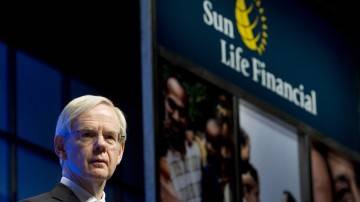
Group will be headed by Sun Life's Don Stewart

looking into ways of making Canadians “more savvy” about their personal finances.

The financial industry is very adept at producing complex financial products that are almost beyond the limits of the understanding of good common people.  We, the people, need to be much smarter and that’s why this initiative from the Canadians seems, on the surface, to be such an excellent idea.

By Paul Handover